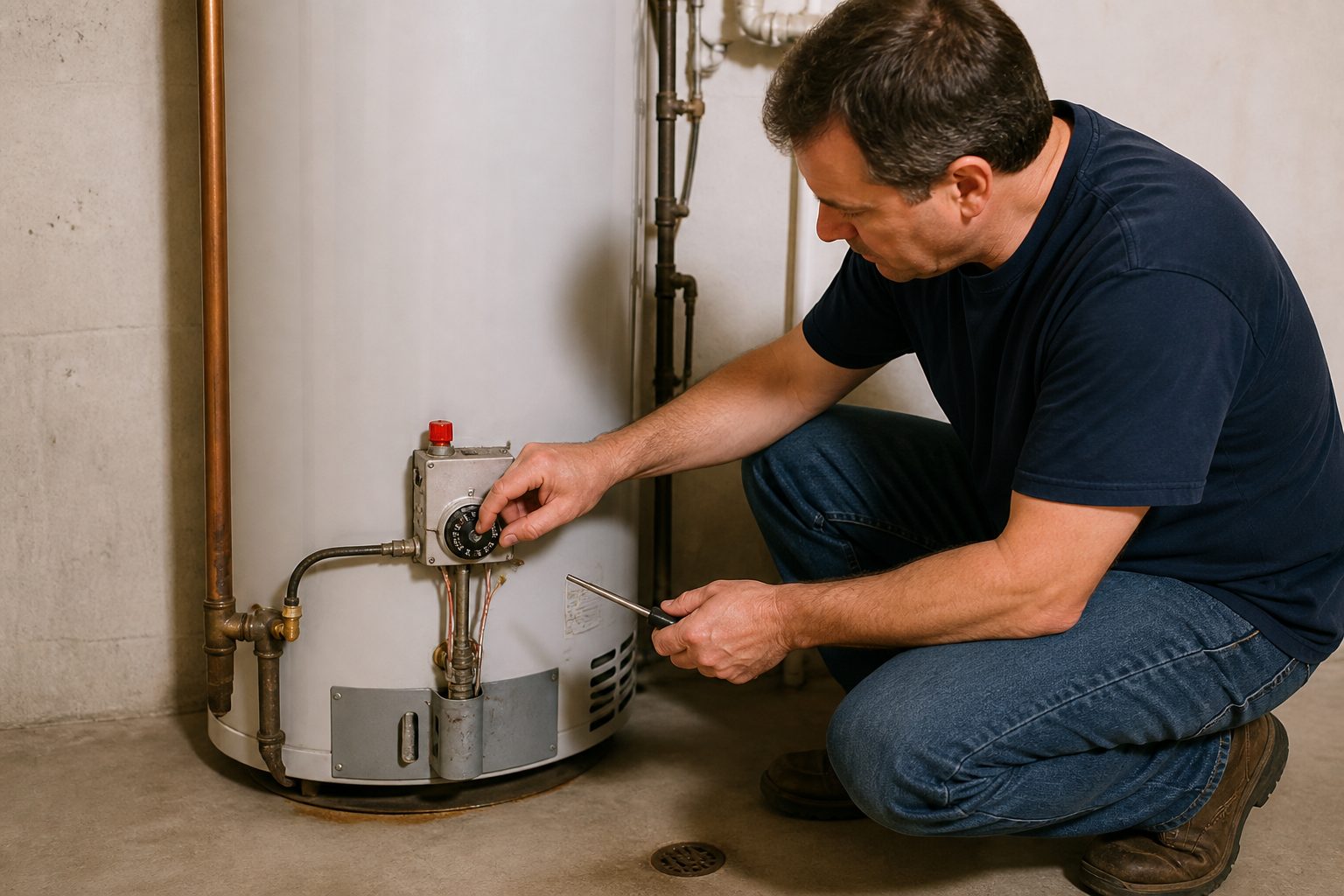
What is the right water heater temperature setting? 120 degrees Fahrenheit for most households, the figure both DOE and the Consumer Product Safety Commission recommend. Immune-compromised households are the documented exception.
Key Takeaways
- CPSC “urges all users to lower their water heaters to 120 degrees Fahrenheit,” and puts burn exposure at 140 degrees at six seconds (CPSC 5098).
- DOE rates the change at 4% to 22% annual savings, and says a 140 degree tank wastes $36 to $61 a year in standby losses (DOE, archived).
- CDC puts the Legionella growth band at 77 to 113 degrees and advises storing above 140 (CDC).
- Both hold at once if storage is separated from delivery: store hot, mix down at the tap.
- Plumbing code caps shower and tub delivery at 120 degrees via ASSE 1016 and 1070 devices.
- DOE names a suppressed immune system or chronic respiratory disease as the reason to keep 140 degrees.
- Our arithmetic: 140 to 120 degrees in a 65 degree space cuts standby driving force 27%.
What is the right water heater temperature setting?
120 degrees Fahrenheit. DOE’s Energy Saver project page says that although some manufacturers ship thermostats at 140 degrees, “most households usually only require them to be set at 120ºF, which also slows mineral buildup and corrosion in your water heater and pipes.”
CPSC reaches the same number from the injury side, saying 120 degrees “may be necessary for residential water heaters to reduce or eliminate the risk of most tap water scald injuries.” The case for 140 is bacterial.
Where it lands turns on a distinction homeowner advice skips: what the tank stores is not what the tub receives. A heater reaching no setting is a different fault, covered in our guide to no hot water.
How fast does water at 120, 130 and 140 degrees burn skin?
CPSC publishes exposure times to third-degree burns at four temperatures. The gap between 120 and 140 is not incremental: five minutes against six seconds, which is why CPSC treats it as a product safety matter.
| Water temperature | Exposure to a third-degree burn | Source |
|---|---|---|
| 150 degrees F | 2 seconds (most adults) | CPSC 5098 |
| 140 degrees F | 6 seconds | CPSC 5098 |
| 130 degrees F | 30 seconds | CPSC 5098 |
| 120 degrees F | 5 minutes | CPSC 5098 |
“The majority of injuries and deaths involving tap water scalds are to the elderly and children under the age of five,” it says. Both have thinner skin and slower reflexes, so six seconds is optimistic.
Safety point: five minutes is not a safe-forever number. CPSC states that “even if the temperature is 120 degrees, a five minute exposure could result in third-degree burns.” The lower setting buys reaction time, not immunity.
Does a 120 degree water heater temperature setting create a Legionella risk?
Slightly, and the agencies say so openly. CDC’s potable water guidance puts the favorable growth band for Legionella at 77 to 113 degrees Fahrenheit, with growth possible “as low as 68°F (20°C).” A 120 degree tank sits above that band but not far, and tank bottoms run cooler.
Its control advice is explicit: “Store hot water at temperatures above 140°F (60°C)” and “ensure hot water in circulation does not fall below 120°F (49°C).” The ENERGY STAR heat pump guide restates it: “Heating tanks to 140°F significantly reduces legionella risk.”
DOE concedes the mechanism: “while there is a very slight risk of promoting legionellae bacteria when hot water tanks are maintained at 120ºF, this level is still considered safe for the majority of the population.”
How do storage and delivered temperature get separated?
With a thermostatic mixing valve, which blends stored hot water with cold on the outlet side so the tank holds 140 while taps deliver 120. CDC recommends fitting them “as close as possible to fixtures,” which “will prevent scalding while permitting circulating hot water temperatures above 120°F.”
That resolves an argument usually miscast as one number. ENERGY STAR notes a mixing valve “allows the user to safely increase the tank water temperature setting above 125°F,” with a capacity dividend: 125 to 140 degrees “adds an equivalent amount of available hot water as increasing tank capacity by about 10 to 15 gallons.” That can beat a decision to replace.
| Position | Source | Temperature | Stated basis |
|---|---|---|---|
| Tank to 120 | DOE Energy Saver | 120 degrees F | Standby losses, scald, scale |
| Tank to 120 | CPSC | 120 degrees F | Tap water scald injuries |
| Store above 140 | CDC | Above 140 degrees F | Legionella control |
| Store 140, deliver 120 | CDC, ENERGY STAR | 140 stored, 120 at tap | Mixing valve near fixtures |
| Cap the fixture | Plumbing code | 120 degrees F maximum | ASSE 1016 and 1070 devices |
What does plumbing code limit at the shower and tub?
Delivered temperature there is capped at 120 degrees Fahrenheit, independent of the tank. IRC P2708.4, as adopted in state regulation, requires shower valves conforming to ASSE 1016/ASME A112.1016/CSA B125.16 or ASME A112.18.1/CSA B125.1, field adjusted so delivered water stays under 120.
Bathtubs get their own section. IRC P2713.3 limits bathtub supply “to a temperature of not greater than 120°F (49°C) by a water-temperature limiting device that conforms to ASSE 1070.” Adoption varies by jurisdiction.
So in a code-compliant bathroom, a 140 degree tank is already mixed down at the shower and tub. Kitchen and laundry taps usually fall outside those sections, where a hot tank arrives at full temperature.
How do you measure and change the water heater temperature setting?
Measure at the tap, not the dial. DOE’s Building America guide says to “turn on the hot water tap only and run the water for about 3 minutes,” then fill a mug and read it.
- Use the tap farthest from the heater, because that is what the plumbing run delivers.
- Test two hours after any hot water use, as CPSC advises, so the tank is not recovering.
- Mark the thermostat position before moving it, so the change is reversible.
- Adjust, wait two hours, measure again. DOE notes “several adjustments may be necessary.”
The adjustment differs by equipment. Gas dials are marked in letters rather than degrees, which is why the tap reading is the trustworthy one.
- Gas storage tank: turn the dial on the gas control valve at the tank base. No panels, no power to kill.
- Electric resistance tank: shut the breaker off first. CPSC notes most electric heaters “have two thermostats, both of which must be set to a common temperature,” behind upper and lower panels. Setting only the upper one is the common error.
- Heat pump water heater: set temperature on the digital panel or app. ENERGY STAR lists four modes, Economy, Heat Pump Only, Resistance Only and Vacation, Economy being the default on 208/240-volt models. Mode and setpoint are separate, as our explainer on how these units work sets out.
Electrical safety: the breaker goes off before either access panel comes off, because the thermostats sit beside live 240-volt terminals.
What does a lower water heater temperature setting actually save?
DOE rates the project at 4% to 22% of annual water heating cost. The mechanism is standby loss: “Set too high, or at 140ºF, your water heater can waste anywhere from $36 to $61 annually in standby heat losses.”
Our own arithmetic, labelled as ours: standby loss scales with the gap between tank and room. In a 65 degree space, a 140 degree tank runs a 75 degree gap and a 120 degree tank 55, a 26.7% cut.
Also ours: at the 18.34 cents per kilowatthour US average EIA reported for June 2026, $36 to $61 is roughly 196 to 333 kilowatthours a year. Dwarfed by DOE’s claim that consumption-side savings “may amount to more than $400.” Rates vary, as our tracking of June 2026 electricity prices shows.
One DOE caveat: a dishwasher without a booster heater “may require a water temperature within a range of 130ºF to 140ºF.” Fuel changes the arithmetic, as our breakdown of what heat costs by fuel shows.
Who should keep the tank at 140 degrees?
DOE names the exception: “If you have a suppressed immune system or chronic respiratory disease, you may consider keeping your hot water tank at 140ºF.” It warns in the same breath that this “significantly increases the risk of scalding,” and tells those households to fit “mixing valves or other temperature-regulating devices on any taps used for washing or bathing.”
Young children push the other way. CPSC’s advice to hand-test before bathing an infant exists because a 140 degree tank gives an unattended toddler six seconds. Where a home holds both, the mixing valve is not optional.
Equipment changes the calculus. Tankless units store nothing, as our comparison of tankless and tank systems sets out. Solar systems can overshoot in summer, which is why solar water heater installations carry a tempering valve as standard.
Verifying a number beats trusting a dial, the reflex behind the pre-heating-season walkthrough and the thermostat setpoints DOE publishes.
Stock turns over slowly, as our 2026 shipments coverage shows, so most tanks in service were set once and never rechecked.
How we researched this
Research date: September 2026. Eight primary sources were consulted and all eight are cited below. The DOE Energy Saver page was reached through an Internet Archive copy captured December 31, 2025, because the live URL returns 404.
Excluded: Reddit was not consulted at all. Scalding and Legionella are safety topics where anonymous anecdotes cannot support a number, so no threads were mined for questions, quotes or figures. Also excluded: contractor blogs and lead-generation sites, several of which publish burn-time tables with no attribution; manufacturer marketing claims; and vendor price surveys for mixing valves, because no federal series publishes that cost. The ICC code portal blocks automated access, so code text came from a state regulation adopting those IRC sections verbatim, with section numbers named for local verification. Two figures are our own arithmetic and labelled as such: the 26.7% driving force cut and the kilowatthour conversion.
Frequently asked questions
Is 120 or 140 degrees the correct water heater temperature setting?
120 for most households. DOE recommends it on standby loss and scale grounds, CPSC because 140 degree water burns in six seconds. CDC’s 140 degree storage advice is met by mixing down at the fixture.
How do I check my water heater temperature?
With a meat or candy thermometer. DOE’s Building America guide says to run the hot tap only for about three minutes, then fill a mug and read it. CPSC advises testing two hours after hot water use.
Why does my electric water heater have two thermostats?
One serves the upper heating element, one the lower. CPSC states both “must be set to a common temperature for proper operation.” Setting only the upper leaves the tank bottom at the old temperature.
What temperature does Legionella grow at?
CDC puts the most favorable band at 77 to 113 degrees Fahrenheit, with growth possible as low as 68. That is why its guidance calls for storing above 140 degrees and keeping circulation above 120.
Will 120 degrees be too cool for my dishwasher?
Probably not, but check. DOE notes a dishwasher without a booster heater “may require a water temperature within a range of 130ºF to 140ºF.” Most recent units heat their own water.
Does plumbing code cap the temperature at the tap?
At showers and tubs, yes. IRC P2708.4 limits shower valve output to 120 degrees using ASSE 1016 class devices, and P2713.3 limits bathtub supply using an ASSE 1070 device.
Sources
- DOE Energy Saver. “Do-It-Yourself Savings Project: Lower Water Heating Temperature.” https://web.archive.org/web/20260101023608id_/https://www.energy.gov/energysaver/do-it-yourself-savings-project-lower-water-heating-temperature (archived). Accessed September 2026.
- CPSC. “Avoiding Tap Water Scalds,” Publication 5098. https://www.cpsc.gov/s3fs-public/5098.pdf. Accessed September 2026.
- CDC. “Controlling Legionella in Potable Water Systems.” https://www.cdc.gov/control-legionella/php/toolkit/potable-water-systems-module.html. Accessed September 2026.
- DOE Building America Solution Center. “Check Water Heater Temperature.” https://basc.pnnl.gov/diy-guides/check-water-heater-temperature. Accessed September 2026.
- ENERGY STAR. “Heat Pump Water Heater Guide,” June 2024. https://www.energystar.gov/sites/default/files/2024-07/ENERGY%20STAR%20Heat%20Pump%20Water%20Heater%20Technical%20Guide%20508C.pdf. Accessed September 2026.
- Cornell LII. “S.C. Code Regs. 8-1243, IRC P2708.4 Shower control valves.” https://www.law.cornell.edu/regulations/south-carolina/R-8-1243. Accessed September 2026.
- Cornell LII. “S.C. Code Regs. 8-1244, IRC P2713.3 Bathtub valves.” https://www.law.cornell.edu/regulations/south-carolina/R-8-1244. Accessed September 2026.
- EIA. “Electric Power Monthly, Table 5.3.” https://www.eia.gov/electricity/monthly/epm_table_grapher.php?t=epmt_5_3. Accessed September 2026.
Leave a Reply