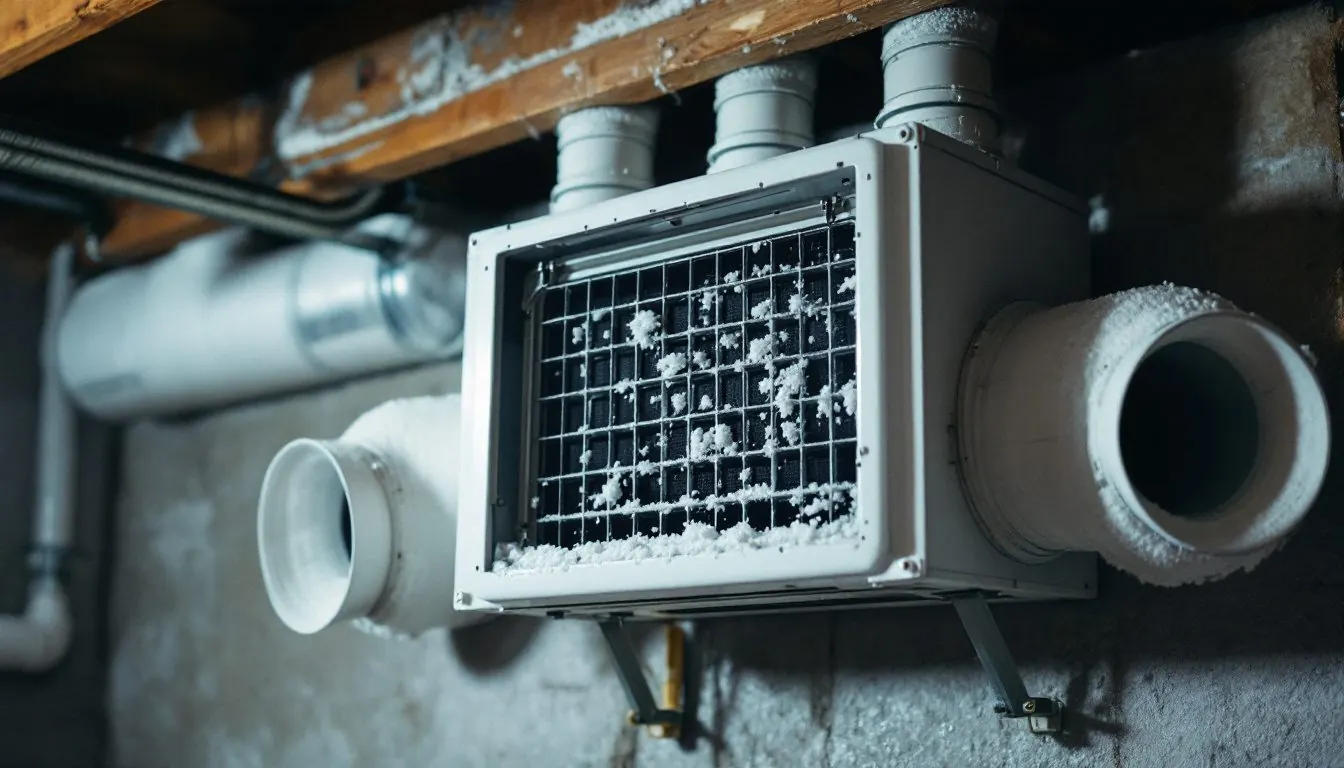
An HRV freezing up is normal in small doses: below about 23°F outdoors, moisture in the warm exhaust air freezes on the core, and the unit runs a timed defrost to melt it. Ice that keeps growing means the defrost is not keeping up; the maker manuals point to unbalanced airflow, blocked hoods or filters, or a failed damper or sensor.
At what outdoor temperature does an HRV core start to freeze?
Most makers set the line between 23°F and 27°F. Broan’s HRV160 owner’s manual says HRV cores frost below 23°F and its ERV140 sibling below 14°F (Broan, archived copy).
Natural Resources Canada’s HRV guide puts the typical trigger at -5°C, (23°F), because “the temperature of the outgoing air drops to the point at which moisture or frost can form on the surfaces of the heat-exchange core” (NRCan, archived copy). Lifebreath’s larger 455, 650, 700 and 1200 series start their defrost timer below 27°F (-3°C) (Lifebreath user guide).
The ice sits on the exhaust side, the air carrying the house’s moisture, so a home with high humidity in winter ices an HRV faster than a dry one at the same outdoor temperature.
How long should an HRV defrost cycle last, and how often?
Where manuals print a table, a defrost runs 4 to 10 minutes and repeats more often as it gets colder. Broan’s HRV150FLS defrosts for 7 minutes after every 50 minutes of running at 23°F, but after every 20 minutes at -17°F, with the cycle stretched to 10 minutes. The table converts each published cycle into the share of every hour spent defrosting.
| Unit and setting | Outdoor temp | Defrost / run between | Time in defrost |
|---|---|---|---|
| Broan HRV150FLS, normal | 23°F | 7 min / 50 min | 12%, about 7 min per hour |
| Broan HRV150FLS, normal | 5°F | 7 min / 25 min | 22%, about 13 min per hour |
| Broan HRV150FLS, normal | -17°F | 10 min / 20 min | 33%, 20 min per hour |
| Broan HRV150FLS, extended defrost | -17°F | 10 min / 15 min | 40%, 24 min per hour |
| Lifebreath 455 to 1200 FD/DD, factory | below 27°F | 4 min / 30 min | 12%, about 7 min per hour |
| Lifebreath FD/DD, DIP switch 8 ON | below 27°F | 4 min / 20 min | 17%, about 10 min per hour |
Compiled by The HVAC Brief from the Broan HRV150FLS/HRV190FLS installer manual (section 1.3) and the Lifebreath 455/650/700/1200 user guide (Defrost Time Adjustment). HVAC Brief calculation: defrost minutes divided by (defrost minutes plus run minutes).
A unit defrosting a third of the time at -17°F is working as designed. Broan says that during a cycle “the unit shifts to maximum speed and the dampers close,” so a sudden jump to high speed for a few minutes on a cold night is the defrost, not a fault.
Damper, fan or preheat: which defrost does your HRV use?
Check the model number. Lifebreath’s FD models use fan defrost, where “the fresh air supply is shut off while the exhaust fan continues to operate,” and DD models use a motorized damper that “opens the defrost port and at the same time closes off the supply air from outside,” so indoor air flows through the core. Both repeat until it is above 27°F outside.
Fan defrost briefly runs the house at negative pressure, which NRCan warns can pull combustion gases back from a furnace, water heater or fireplace; Lifebreath says never to install an HRV where its operation could backdraft vented combustion equipment, the same concern behind make up air in tight houses.
Electric preheat keeps fresh air flowing but costs power. Zehnder’s ComfoAir Q manual lists a “pre-heater for frost protection” and rates the ComfoAir Q350 at 1850W maximum including the pre-heater against 180W without it (those are European 230 V ratings; Zehnder).
Why is my HRV freezing up even though it has a defrost cycle?
Because defrost only works when both airstreams and the control are healthy.
| What you see | Likely cause | Check |
|---|---|---|
| Core iced on the exhaust side; filters dirty | Restricted airflow, which NRCan lists as a cause of imbalance | Wash or replace both filters; Lifebreath says four times a year |
| Core ices again after cleaning | More supply than exhaust air | Rebalance: NRCan says increase exhaust flow or decrease supply flow |
| Fresh air duct frozen, or very cold air at the supply grille | Damper iced, damper rod broken, or failed actuator or board | Broan HRV150FLS: 24 VAC at J12-1 and J12-2 |
| Broan HRV160 LED blinking green | Thermistor problem; unit “will defrost frequently” | Unit keeps running; Broan says contact the installer |
| Frost on the hood screen outside | Snow or frost on the bird screen | Clear hoods; NRCan suggests moving hoods higher if they clog often |
| Ice or water in the insulated duct to outside | Torn or unsealed vapor barrier jacket | Tape tears and seal joints (Lifebreath) |
| Water or ice in the bottom of the unit | Plugged drain pan or kinked, frozen drain line | Pour 2 to 3 litres of warm water into the pan (NRCan) |
Compiled by The HVAC Brief from the troubleshooting sections of the Broan HRV150FLS installer manual (item 10), the Broan HRV160 owner’s manual (item 6), the Lifebreath 195DCS user guide and NRCan’s HRV guide.
Imbalance built into the ductwork is the cause that filter cleaning cannot fix. NRCan’s guide says pulling more air in than is exhausted creates positive pressure, and with it “the HRV core can develop frost or freeze.” Its listed causes of imbalance: unequal ductwork on the two sides, a clogged filter, a blocked hood, or a bad damper or fan. Lifebreath’s troubleshooting table adds that “minimal frost build-up is expected on cores before unit initiates defrost.”
Is it the core, the outside hood or the drain line that is frozen?
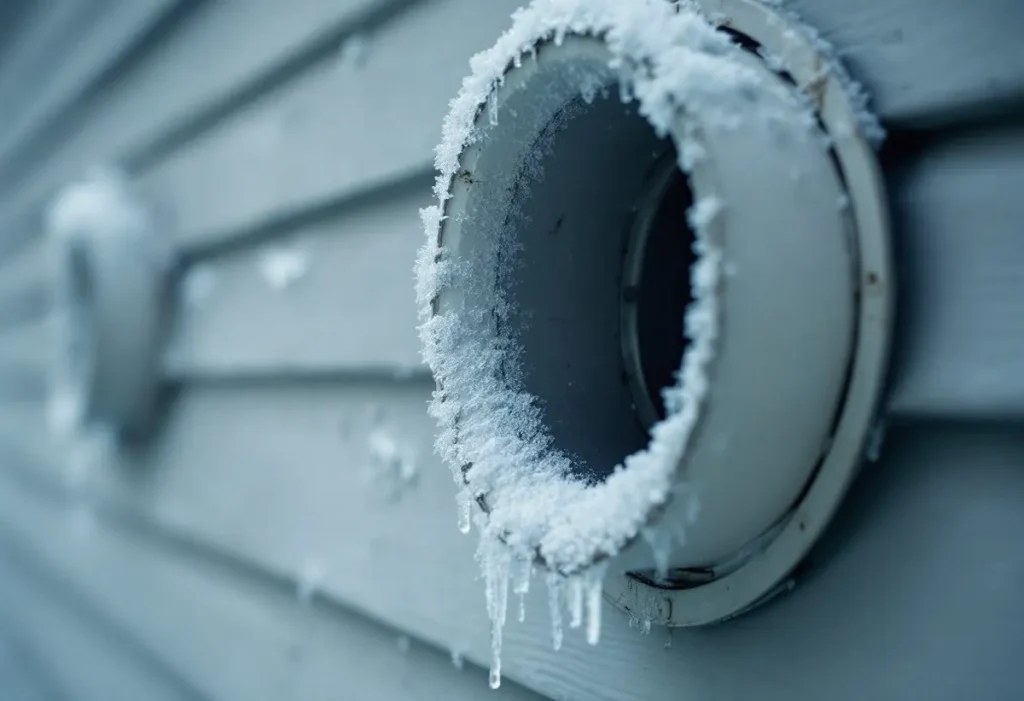
Open the access door: light frost that clears within one defrost cycle is normal. Then check both hoods; Lifebreath tells owners to make sure “snow is not blocking the hoods or that frost has not built up on the wire mesh (bird screen),” and a snow-buried hood is the same trap that catches a furnace vent blocked by snow.
Last, follow the drain tube, which Broan requires on every HRV150FLS and HRV190FLS. Building scientist Allison Bailes at Energy Vanguard notes that an HRV condensate line ending outdoors can freeze, and prefers an indoor drain to heat tape; it is the same failure behind a frozen furnace condensate line. Frost on the outside ducts is a vapor barrier problem, covered in the ductwork condensation guide.
How do you defrost an HRV that is already iced solid?
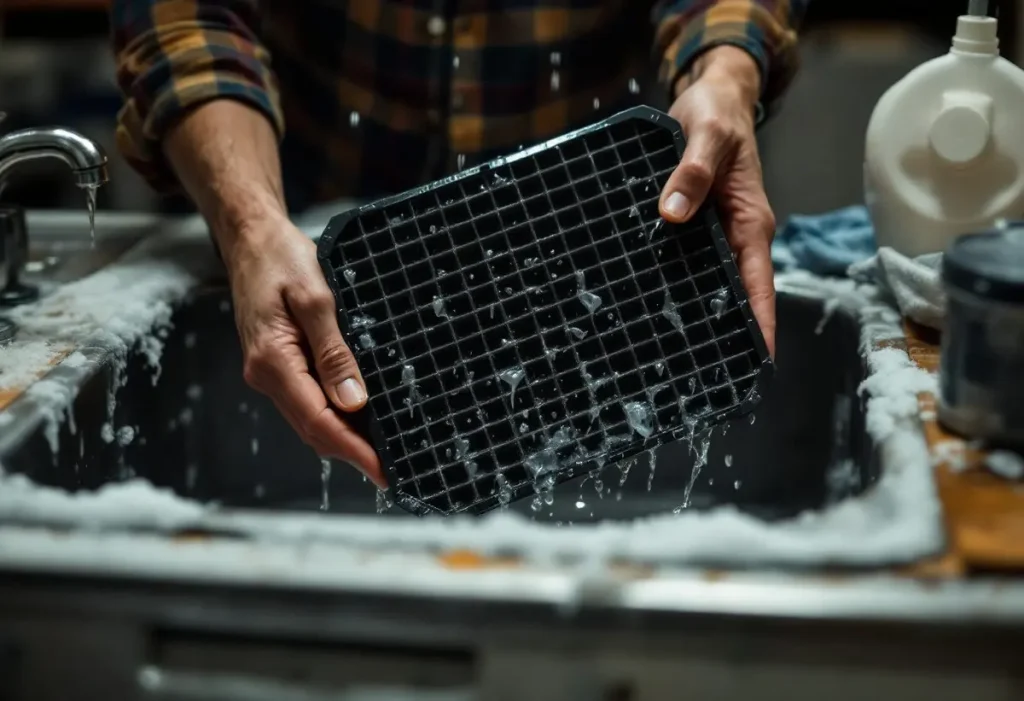
Let it melt; do not chip it. NRCan’s HRV troubleshooting table says to “open the door and let the ice melt” and notes that some cores slide out and can be thawed in a sink. Unplug it and wash the filters while the core thaws.
Broan notes that ice on the port damper can stop the defrost itself from working, so fix the cause before plugging back in. If the unit is mounted upside down in a place that sees -4°F for more than 5 days in a row, Broan says the HRV150FLS and HRV190FLS “must always be set in extended defrost,” set by holding the push button during the first 5 seconds of boot until the LED turns amber.
Do ERVs freeze up less than HRVs?
Usually yes, by several degrees, and the ERV vs HRV basics explain why. Broan’s own figures put the ERV140 frost point at 14°F against 23°F for the HRV160, because an ERV core moves some moisture back to the incoming air instead of leaving it all on the exhaust side. The trade-off is that an ERV keeps more moisture indoors, so it does less to dry out a house with window condensation. Energy Vanguard cites research by the Cold Climate Housing Research Center in Fairbanks, Alaska, where 14 houses with 8 ERV models ran through the 2013 to 2014 winter without a core freezing, and credits the units’ defrost cycles for that.
What does a technician measure when an HRV keeps icing up?
Airflow on both sides, the defrost sensor and the damper circuit. On Broan’s FLS units, balancing uses a magnehelic gauge on the exhaust and fresh air pressure taps, setting the fresh air damper until both flows match. Below 32°F, the manual says wait 10 minutes after plugging in so no defrost skews the reading.
If flows match and the core still ices, Broan’s manual moves to the damper: 24 VAC present at the connector but no movement means replacing the port assembly. NRCan wants the defrost tested and airflows measured every year, with results on the HRV’s maintenance label.
Frequently asked questions
Why is my HRV continuously running?
Continuous running is the design: NRCan’s HRV guide says an HRV should run on low speed continuously year-round, with low speed at 40 percent to 60 percent of the high-speed rate. Winter bursts of high speed come from the dehumidistat, which Lifebreath says forces high speed above its set point, or from a Broan defrost, which shifts to maximum speed.
Should I turn off HRV in winter?
No. NRCan recommends running an HRV year-round, and winter is when it removes the most moisture: Lifebreath says its dehumidifying effect works only when outdoor air is below 59°F. Shutting it off hides the cause of icing. NRCan’s fix is to thaw the core, clean the filters, check the defrost and have the airflows rebalanced.
Why is my Lifebreath HRV freezing up?
Lifebreath’s troubleshooting table lists two causes for an HRV or its ducts frosting up: unbalanced airflows and a defrost malfunction, fixed by a contractor rebalance. On its 455 to 1200 series, defrost starts below 27°F and runs 4 minutes in every 34; DIP switch 8 ON shortens the run between defrosts to 20 minutes.
Why is my HRV icing up on the outside hood?
The exhaust hood carries the house’s warm, moist air out, so frost collects on its bird screen. Lifebreath tells owners to keep that mesh clear of frost and both hoods clear of snow, because a clogged hood starves one airstream. NRCan suggests moving hoods higher up the wall if they clog regularly.
How we researched this
In November 2026 we read the defrost and troubleshooting sections of the Broan HRV150FLS/HRV190FLS installer manual, the Broan ERV140/HRV160 owner’s manual, the Lifebreath 455/650/700/1200 and 195DCS user guides, the Zehnder ComfoAir Q installer manual and Natural Resources Canada’s consumer guide to HRVs, and compared them with today’s top results. Defrost minutes come from maker tables; the time in defrost column is our arithmetic. Contractor blogs and forums were excluded as sources for figures; RenewAire’s frost white paper would not load and is not cited. Autocomplete phrases like “how to get hrv up” concern heart rate variability, not ventilators.
Sources
- Natural Resources Canada. “Heat Recovery Ventilators” (revised February 2012). https://web.archive.org/web/2024id_/https://natural-resources.canada.ca/sites/nrcan/files/energy/pdf/energystar/HRV_EN.pdf (archived copy). Accessed November 2026.
- Broan-NuTone. “Installer Manual HRV150FL, HRV190FL” (23129 rev. 05). https://web.archive.org/web/2025id_/https://www.broan-nutone.com/getmedia/9b86d960-d6d2-4705-bbee-ce306b961a34/Installation-Guide-HRV150FLS-HRV190FLS.pdf?ext=.pdf (archived copy). Accessed November 2026.
- Broan-NuTone. “Owner’s Manual ERV140 ECM, HRV160 ECM and HRV160.” https://web.archive.org/web/2025id_/https://broan-nutone.com/getmedia/eaf31a27-3d50-40e4-907b-a8bb168eaedd/Owners-Manual-ERV140TE-HRV160T-HRV160TE.pdf?ext=.pdf (archived copy). Accessed November 2026.
- Lifebreath. “455, 650, 700, 1200 FD/DD user guide.” https://s3.amazonaws.com/s3.supplyhouse.com/product_files/LifeBreath-650FD-User-Guide.pdf. Accessed November 2026.
- Lifebreath. “195DCS Homeowner’s Guide.” https://s3.amazonaws.com/s3.supplyhouse.com/product_files/LifeBreath-195DCS-User-Guide.pdf. Accessed November 2026.
- Zehnder. “ComfoAir Q Installer Manual.” https://cdn.shopify.com/s/files/1/0061/1945/6856/files/comfoair_q_installer_manual.pdf. Accessed November 2026.
- Energy Vanguard. “Common Problems With Cold Weather Ventilation.” https://www.energyvanguard.com/blog/common-problems-with-cold-weather-ventilation/. Accessed November 2026.
Leave a Reply