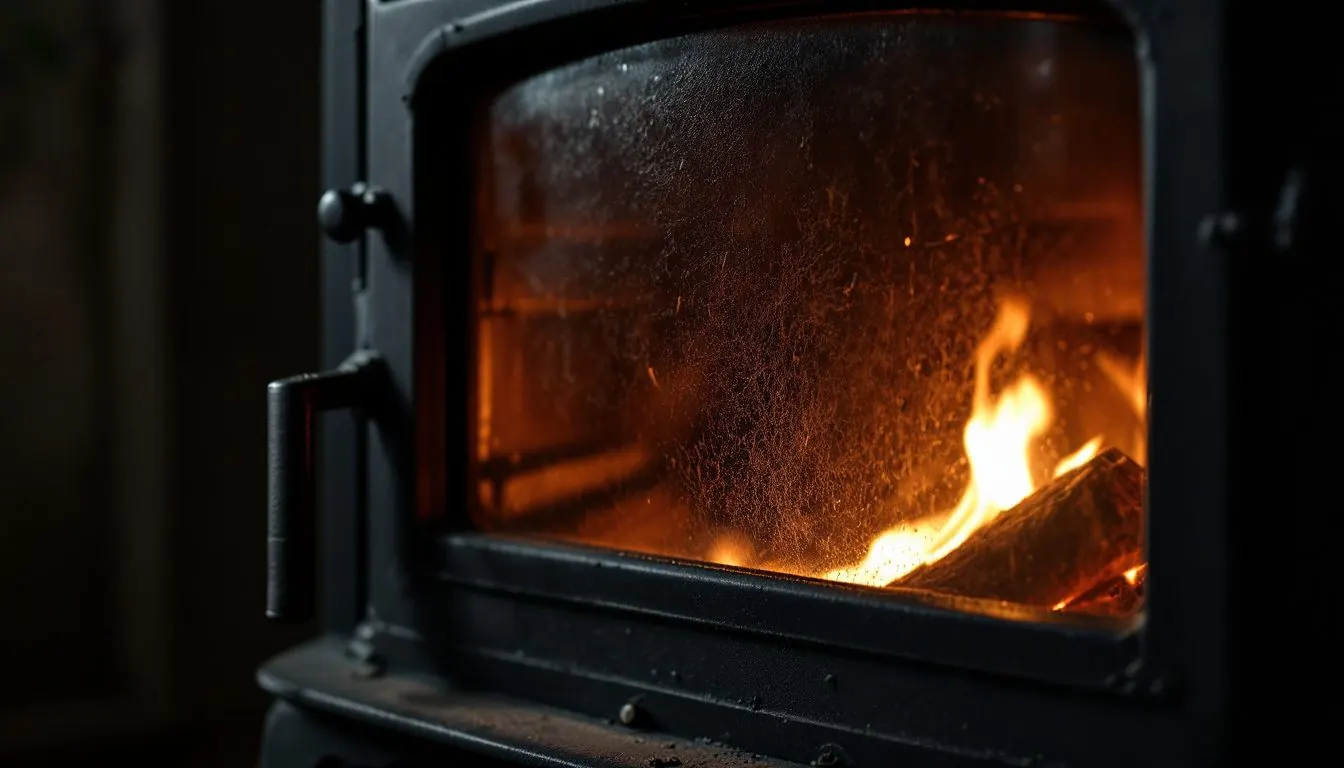
Wood stove glass turning black means smoke is condensing on glass the air wash cannot keep clean: the air control is turned too low, the wood is above 20% moisture, a load smoldered overnight, a split is touching the glass, or a gasket leaks. Burn the next load hot with the air fully open, and it usually clears.
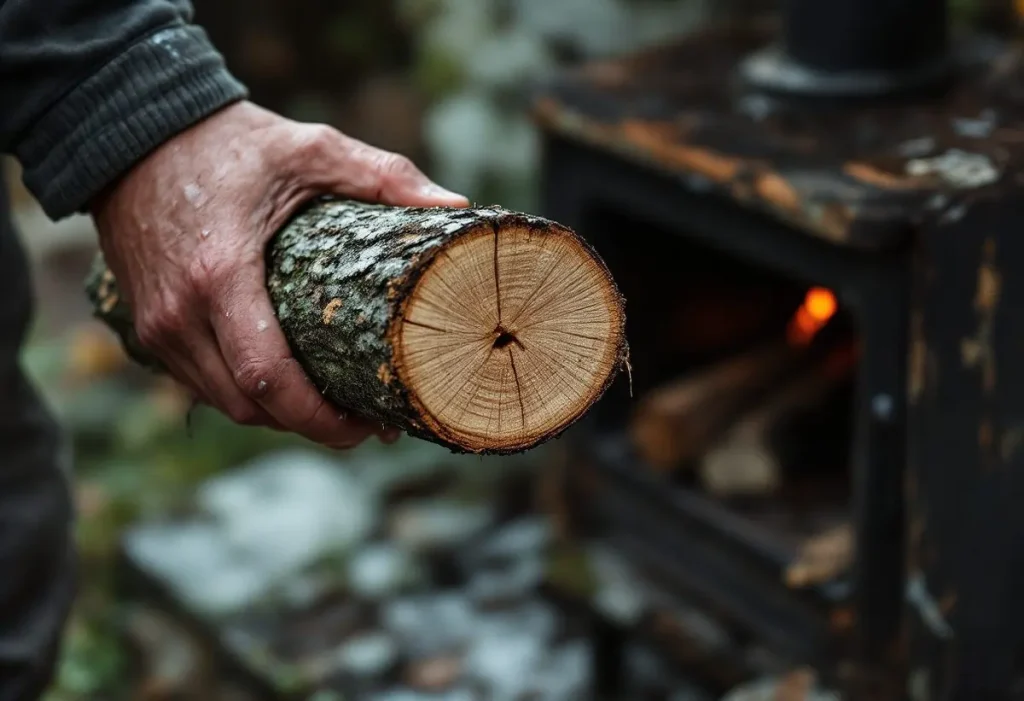
Which of the 5 causes is blackening your stove glass?
Each cause leaves a different pattern. Englander’s 15‑W03 manual lists three causes for “Glass is dirty” (wet or green wood, a low burn rate, wood loaded too close to the glass), and Jotul’s troubleshooting chart adds turning down too early, burning all day in mild weather, and leaking gaskets.
| What the glass looks like | Most likely cause | What the maker document says | Fix |
|---|---|---|---|
| Light brown film in the lower corners | Air control at minimum; air wash too weak | Drolet: accumulation in the lower corners at minimum air “is normal” | Burn hot with air fully open for 1 hour or more |
| Black over most of the glass every morning | Load smoldered all night, often on damp wood | Jotul: “Turning down too much”, “Turning down too early” | Fire each load hot until the firebox is full of flames |
| Black or brown even on hot fires | Wet or green wood | Englander: burn wood “seasoned for at least one year” | Check splits with a moisture meter; Drolet’s range is 15% to 20% |
| A black patch where a split rests near the door | Wood touching or close to the glass | Englander: “Never load wood so that it is touching the ceramic glass” | Load splits back from the door |
| Brown or black streaks starting at one edge of the glass | Leaking glass gasket or door gasket | Drolet: streaks “coming from the edge” mean replace the glass gasket | Dollar bill test; replace the full gasket |
| Glass dirty only in spring and fall | Burning continuously in mild weather | Jotul: light one fire a day when it is above 0°C (32°F) | Short hot fires instead of one turned-down fire |
Compiled by The HVAC Brief from the Drolet wood stove owner’s manual (2023) and Classic EPA manual, the Englander 15‑W03 manual and Jotul’s troubleshooting chart.
If smoke also enters the room on reloads or in wind, the problem is draft; our wood stove smoking into the house diagnosis sorts it by when the smoke appears.
White haze, light brown or solid black: what does each color on the glass mean?
White dust is normal, light brown means a smoky low fire, brown streaks from an edge mean a gasket, and solid black means heavy creosote from a smoldering fire. The Drolet wood stove owner’s manual (2023) says that with dry wood “a whitish, dusty deposit will form on the inner surface of the glass after a week or so of use,” which wipes off cold with a damp cloth or paper towel.
The same Drolet manual says light brown stains, “especially in the lower corners,” show “the fire has been smoky” and also mean “faster formation of creosote in the chimney.” Natural Resources Canada’s Guide to Residential Wood Heating (2002, archived copy) sets the bar for a well run stove: glass with an air wash “will be clear,” glass without one “will be hazy, but it should never be black.”
On catalytic and hybrid stoves, Regency says “dark glass” in a long low burn is just less light from the fire and “nothing to worry about.”
Why does the glass go black overnight and clear up by afternoon?
Because the air wash runs on the air you turn down for a long burn. NRCan describes it as air entering “through a narrow strip above and behind the glass panel” that “flows down across the glass”; the 15‑W03 manual says the majority of primary air enters this way. Close the control for an overnight burn and that curtain of air shrinks with it.
The fix is a hot period after every reload. The Drolet Classic EPA manual says the glass “will clean itself when burning a hot fire during one hour or more with the air control at its maximum setting.” Regency’s shorter rule is the air damper “fully open for at least 20 minutes” on each load.
Do not run whole burn cycles wide open; Drolet’s Classic EPA manual caps a magnetic stovetop thermometer at 475°F. If the glass blackens even after an hour of hot burning, test the wood: EPA’s Burn Wise best practices say wood burns best below 20 percent moisture and should season at least six months.
Is the door or glass gasket leaking? The dollar bill test
Streaks that start at one edge of the glass point to a leak, and Englander’s 15‑W03 manual gives the test. Close a dollar bill in the door, latch it, and pull: “If the dollar bill slides in and out easily, the gasket needs to be replaced.” Repeat around the whole perimeter, because gaskets “will sometimes seal tightly on one side.”
Englander says glass gasket leaks “can generally be located by following the prevailing soot trails.” It says the 3/4 inch door rope gasket should be replaced “at least every year,” and the door stays latched for 24 hours while the cement cures.
Drolet says not to run the stove with deteriorated gaskets: leakage can overheat it or, in very airtight homes, push smoke and CO into the room. Check that a CO alarm sits where our carbon monoxide detector placement guide shows.
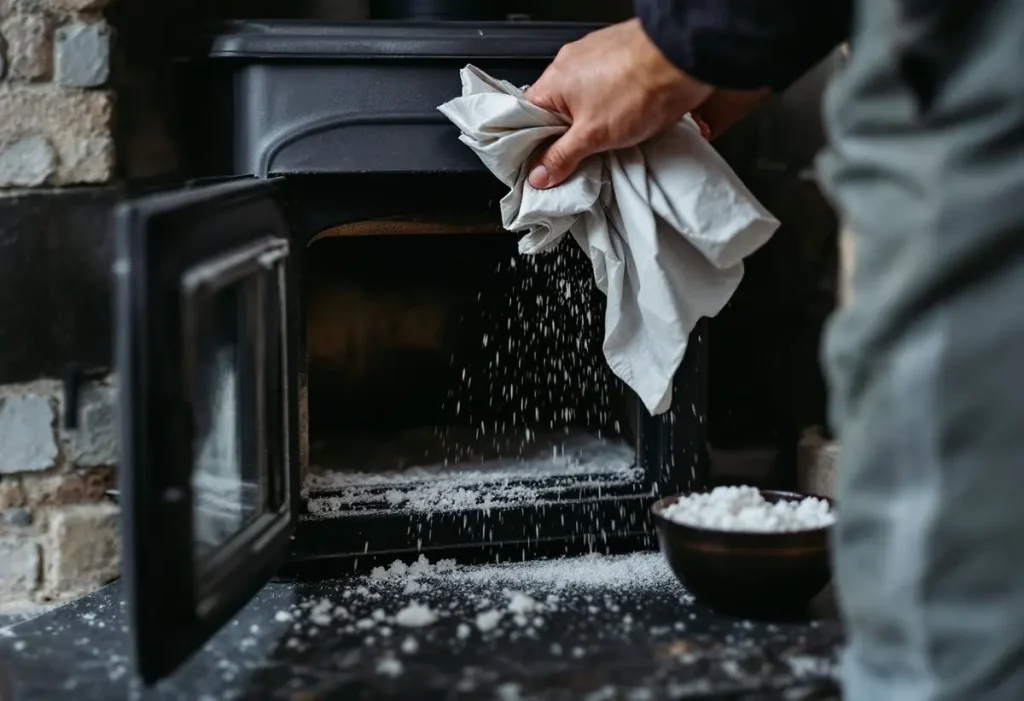
How do you clean black wood stove glass without scratching it?
Wait until the glass is completely cool, then use water or a damp cloth first and a ceramic stove glass cleaner for what remains. None of the 5 documents below allows scraping or abrasives.
| Source | When to clean | First step | For stubborn soot | Do not |
|---|---|---|---|---|
| Englander 15‑W03 | Stove and glass completely cool | Water “is normally sufficient” | A cleaner made for the purpose; rinse, dry | Scrape or use abrasive cleaners |
| Drolet owner’s manual (2023) | When the heater is cold | Damp cloth or paper towel, then dry | Special wood stove glass cleaner | Abrasive products; clean while hot |
| Regency | After the stove cools | Damp newspaper dipped in ash | Burn it clean with the damper open on reload | Not stated on the page |
| NRCan guide (2002) | After the appliance has cooled | Damp cloth or paper towel | Stove glass cleaner that will not scratch | Strike the glass with a hard object |
| PelPro PP130 (pellet) | Never when hot | Ceramic glass cleaner | Non-abrasive cloth | Strike, scratch or slam the glass |
Compiled by The HVAC Brief from five maker and government documents opened November 2026.
Englander adds a step most guides skip: rinse with clean water and dry the glass “before resuming normal operation.” If brown film returns within 1 or 2 days, the burning needs to change, not the cleaner.
Why does pellet stove glass keep turning black?
On a pellet stove, black glass usually means too much fuel for the air. The PelPro PP130 manual (7104‑171V) lists “Large, lazy flame, orange color. Black ash on glass.” with three causes: a dirty stove, high ash fuel, and the wrong air to fuel adjustment.
PelPro’s fix for the trim dial is to rotate it “counterclockwise one level at a time and allow 15 minutes for stabilization” before the next change, after cleaning the fire pot and exhaust path. Englander’s 25‑PDVC manual lists a lazy fire under five causes: control board settings, a bad exhaust blower, pellet moisture, excess ash and low quality pellets. It says to clean the burn pot area daily; our wood and pellet stove explainer covers how the two stove types differ.
If the glass stays clean because the stove will not light at all, the start sequence is the problem; our pellet stove not igniting guide walks through it by maker code.
When does the glass or the whole door need replacing?
Replace the glass when it is cracked, not because it is black. Englander’s 15‑W03 manual says “Never replace ceramic glass with tempered or any other type of glass,” and Drolet says not to use the stove with broken glass.
Sizes differ by model. Englander’s 15‑W03 uses 5 mm ceramic glass, 12.75 in. x 16.75 in. (part AC‑G50), and its 25‑PDVC pellet stove a 9″ x 9″ ceramic glass (AC‑G9, sold with gasket). The Drolet Classic EPA takes a 10 1/8″ x 16 7/8″ 5 mm ceramic panel, and Drolet says to change the glass gasket whenever the glass is replaced.
A glass door kit for an open fireplace is a different product. NRCan notes “the tempered glass used in most fireplace doors (unlike the ceramic glass used for new wood stoves)” blocks much of the radiant heat. A fireplace insert with ceramic glass and an air wash is the upgrade, and it usually needs a chimney liner sized to its outlet.
Frequently asked questions
How do I keep my wood stove glass from turning black?
Burn wood below 20 percent moisture, the EPA Burn Wise target, and give every load a hot start: Regency says air damper fully open for at least 20 minutes after each reload. Keep splits off the glass and replace leaking gaskets.
What is the best cleaner for soot on glass?
A cleaner made for ceramic stove glass, used only on cool glass. Englander’s 15‑W03 manual says water is normally enough and a purpose made cleaner is for stubborn soot. Drolet, NRCan and PelPro specify a non scratching stove glass cleaner and forbid abrasives. Regency suggests damp newspaper dipped in ash.
Why does wood fireplace glass turn black?
For the same reasons: a smoldering fire, wet wood or wood against the glass. NRCan’s 2002 guide says glass with an air wash stays clear, and glass without one “will be hazy, but it should never be black.”
Does wood stove glass gasket replacement stop black streaks?
Yes, if the streaks start at the edge of the glass. Drolet’s 2023 manual says brown streaks “coming from the edge of the glass” mean it is time to replace the gasket around the glass, and that the gasket should be self adhesive and genuine. Englander sells its window gasket as kit AC‑GGK, folded over the glass edge in a U shape.
How we researched this
On November 24, 2026 we read two Drolet manuals, two Englander manuals, the PelPro PP130 manual, Jotul’s troubleshooting chart, Regency’s care guide, EPA Burn Wise and NRCan’s 2002 wood heating guide (archived copy). We excluded the vinegar and baking soda paste one top ranking blog recommends, because no maker manual we read approves it, and used no forum post for any figure. Draft problems are left to our smoking stove page.
Sources
- Drolet. “Wood Stove Owner’s Manual.” https://www.drolet.ca/file/46231_UA_2023-04-28.pdf. Accessed November 2026.
- Drolet. “Owner’s Manual, Classic EPA Wood Stove.” https://www.drolet.ca/file/45145A.pdf. Accessed November 2026.
- Englander. “15‑W03 Manual.” https://cdn.shopify.com/s/files/1/0782/2077/files/W03.pdf. Accessed November 2026.
- Englander. “25‑PDVC Pellet Stove Manual.” https://cdn.shopify.com/s/files/1/0782/2077/files/25PVD.pdf. Accessed November 2026.
- PelPro. “PP130 Owner’s Manual.” https://downloads.hearthnhome.com/installmanuals/PELPRO_PP130_PELLET_FS_INSTALL_OWNERS_7104_171.pdf. Accessed November 2026.
- Jotul. “A Troubleshooting Chart for Your Wood Stove or Insert.” https://jotul.com/how-tos/troubleshooting-chart-your-wood-stove-or-insert. Accessed November 2026.
- Regency. “How To Avoid Black Glass on a Wood Stove.” https://www.regency-fire.com/en/Owners/Service-Maintenance/Fireplace-Care-Guides/How-To-Avoid-Black-Glass-on-a-Wood-Stove. Accessed November 2026.
- US EPA. “Best Wood-Burning Practices” (Burn Wise). https://www.epa.gov/burnwise/best-wood-burning-practices. Accessed November 2026.
- Natural Resources Canada. “A Guide to Residential Wood Heating” (2002, archived copy). https://web.archive.org/web/2020id_/http://dsp-psd.pwgsc.gc.ca/Collection/M92-23-2002E.pdf. Accessed November 2026.
Leave a Reply