Original data and independent reporting for the HVAC trade

Author: The HVAC Brief Editorial Team

  • HVAC Capacitor: What It Does and How It Fails

    HVAC Capacitor: What It Does and How It Fails

    Last reviewed: September 2026 · By the HVAC Brief Editorial Team · Our sourcing and editorial standards

    The short answer

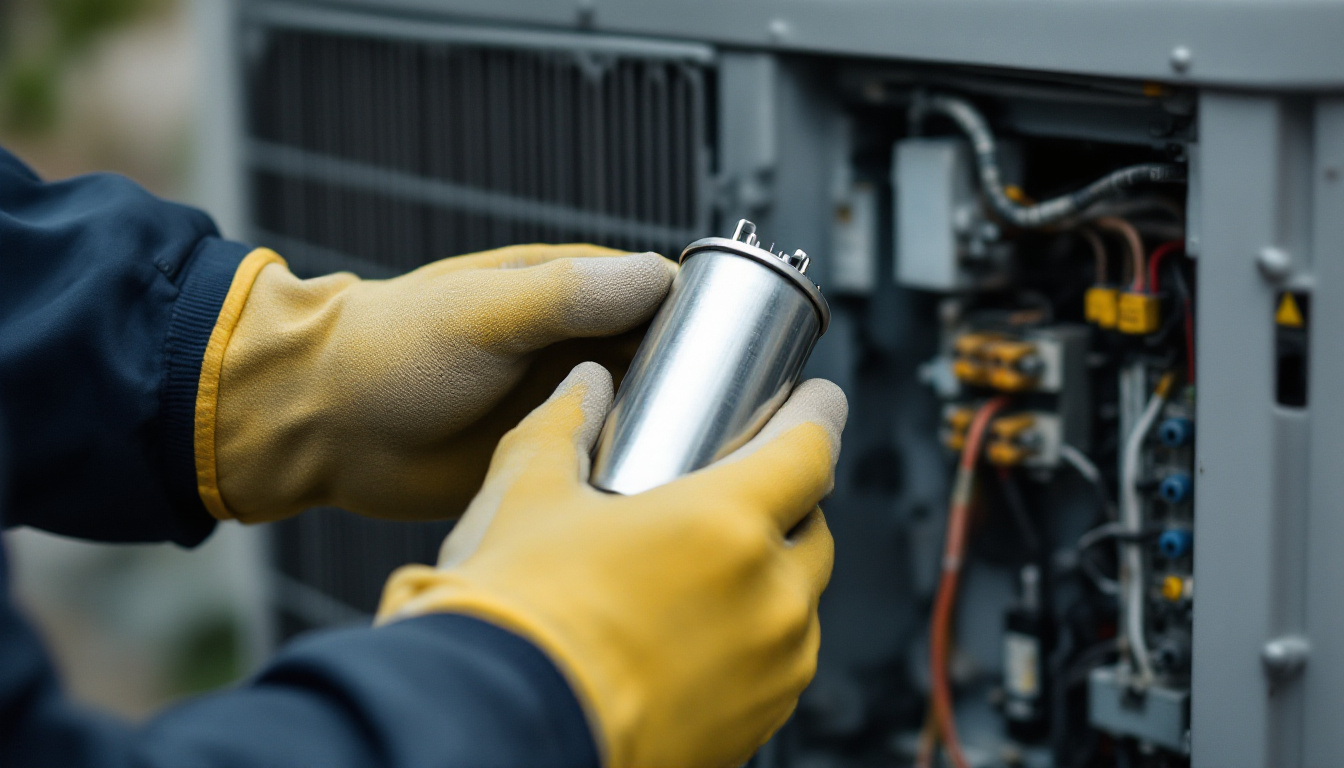
    An HVAC capacitor is a small electrical component that helps start, and keep running, the motors in an air conditioner or heat pump: the compressor, the outdoor fan and often the indoor blower. The classic sign of failure is an outdoor unit that hums but does not start.

    It is one of the least expensive parts in the system. It is still a job for a technician, because a capacitor can hold a dangerous charge after the power is switched off.

    What a capacitor does

    A capacitor stores electrical charge and releases it in step with the motor. That shifts the timing of current in a second motor winding, which gives a single-phase motor the push it needs to start and the balance it needs to run efficiently.

    Without it, a compressor or fan motor receives power but cannot turn, or turns weakly. That is why a failed capacitor so often looks like a failed motor from the outside, and why the two are told apart by measurement rather than by looking. See what an AC condenser does for the rest of the outdoor unit.

    Start, run and dual run capacitors

    Residential systems use two kinds of job, sometimes combined in one part: a run capacitor that stays in the circuit, and a start capacitor that helps only at start-up.

    Type Job Typically found on
    Run capacitor Stays in the circuit while the motor runs, for efficient operation Outdoor fan motors, blower motors, compressors
    Dual run capacitor One case serving two motors, with terminals usually marked HERM, FAN and C Outdoor condensing units, serving compressor and fan
    Start capacitor Adds a burst of starting torque, then is switched out Some compressors, and hard start kits
    Hard start kit An added start capacitor with a relay Compressors that struggle to start

    Signs a capacitor has failed

    Most capacitor symptoms are about motors not starting properly. Each one has other possible causes, which is why a technician tests before replacing anything.

    • The outdoor unit hums but the fan does not turn. The most common pattern. A failed contactor or a seized motor can look the same. More in what HVAC noises mean.
    • The compressor tries to start and trips the breaker. A weak start or run capacitor is one cause; a failing compressor is another.
    • The fan starts slowly or not at all while the compressor runs.
    • The system runs but blows warm air. If the compressor is not starting, the indoor blower can still move uncooled air. See AC running but not cooling.
    • A visibly swollen or leaking case. A domed top is a clear sign, but many failed capacitors look perfectly normal.

    If the outdoor unit is humming without starting, switch the system off at the thermostat. A motor that keeps receiving power without turning can overheat.

    Why it is not a do-it-yourself part

    A capacitor can retain a charge after the disconnect is off, and the outdoor unit runs on a 240-volt circuit. Fitting one with the wrong rating can damage the motor it is meant to protect, and confirming the fault takes a meter. Replacing a capacitor does not open the refrigerant circuit, so EPA Section 608 certification does not govern that task itself, but state and local electrical rules may.

    Reading the label

    Every capacitor is printed with its capacitance in microfarads, shown as µF or MFD, and a voltage rating, commonly 370 or 440 volts AC on residential equipment.

    A replacement should match the capacitance the equipment calls for and meet or exceed the voltage rating. On a dual run capacitor both capacitance values matter, one for the compressor and one for the fan. The equipment wiring diagram, not the old part alone, is the reference, because the old part may itself be the wrong one.

    Why a small part matters

    A capacitor is cheap; the motors it serves are not, and they are getting more expensive. The BLS producer price index for motor and generator manufacturing reached 318.1 in 2026-08, up 3.9% on a year earlier and 47.5% above its 2019 average.

    That is a factory-gate index for motors in general, not a price for HVAC replacement motors. It still makes the practical point: dealing with a failing capacitor promptly costs less than letting a motor strain against it.

    What a capacitor replacement costs

    No federal series measures HVAC repair prices, so any figure you see for a capacitor replacement is a vendor survey or a contractor estimate. We do not publish one.

    The part is inexpensive and the visit is short, which puts it at the low end of HVAC repairs. Ask for part and labour separately, and ask why it failed: a capacitor that fails twice in two seasons points to a different problem. Our page on what HVAC repair costs are actually measured explains the gap in the data.

    Frequently asked questions

    What does a capacitor do on an AC unit?

    It stores and releases electrical charge to help the compressor, outdoor fan and sometimes the indoor blower motor start and run efficiently. Without a working capacitor, those single-phase motors receive power but cannot turn, or turn weakly.

    How do I know if my AC capacitor is bad?

    The usual sign is an outdoor unit that hums but does not start, or a fan that will not spin while the compressor runs. A swollen or leaking case confirms it, but many failed capacitors look normal. A failed contactor or motor can cause the same symptoms, so a technician tests it with a meter.

    Can I replace an AC capacitor myself?

    It is not recommended. A capacitor can hold a dangerous charge after the power is off, the outdoor unit runs on 240 volts, and the wrong rating can damage a motor. EPA refrigerant certification does not govern the task, but state and local electrical rules may.

    What is a dual run capacitor?

    A single capacitor case that serves two motors, usually the compressor and the outdoor fan, with terminals commonly marked HERM for the compressor, FAN for the fan motor and C for common. It carries two capacitance ratings, and a replacement must match both.

    Methodology and limitations

    This page describes how motor capacitors work in residential air conditioners and heat pumps in general terms. Equipment-specific ratings come from the manufacturer’s wiring diagram and data plate.

    • No federal source measures capacitor failure rates or replacement prices, and we publish neither.
    • The motor price index is BLS series PCU335312335312, not seasonally adjusted, and covers motors broadly rather than HVAC replacement parts.
    • Nothing here is electrical safety advice for a specific installation.

    Sources

    1. US Bureau of Labor Statistics, Producer Price Index series PCU335312335312, motor and generator manufacturing.
    2. US Environmental Protection Agency, Section 608 of the Clean Air Act, refrigerant management requirements.

    The HVAC Brief is an independent trade publication. We do not sell equipment, take manufacturer advertising, or accept payment for placement in our research. Corrections welcome.
  • What Is Central Heating? Forced Air, Boilers and Heat Pumps

    What Is Central Heating? Forced Air, Boilers and Heat Pumps

    Last reviewed: September 2026 · By the HVAC Brief Editorial Team · Our sourcing and editorial standards

    The short answer

    Central heating is any system that produces heat in one place and distributes it through the house, by ducts or by pipes. In the US it usually means a forced-air furnace: 74.42 million homes, 63.2% of those that heat, use a central warm-air furnace as their main heating equipment, according to EIA’s Residential Energy Consumption Survey.

    Add central heat pumps and 90.55 million homes, 76.9%, heat with ducted forced air. Boilers feeding radiators or radiant floors, which is what central heating usually means in Britain, are the main system in 9.29 million.

    63%Homes heating mainly with a central furnace
    72%Of those furnaces burn natural gas
    20%Homes whose main heating equipment is 20 years old or more
    95%Federal AFUE minimum for new gas furnaces from December 18, 2028

    How forced-air central heating works

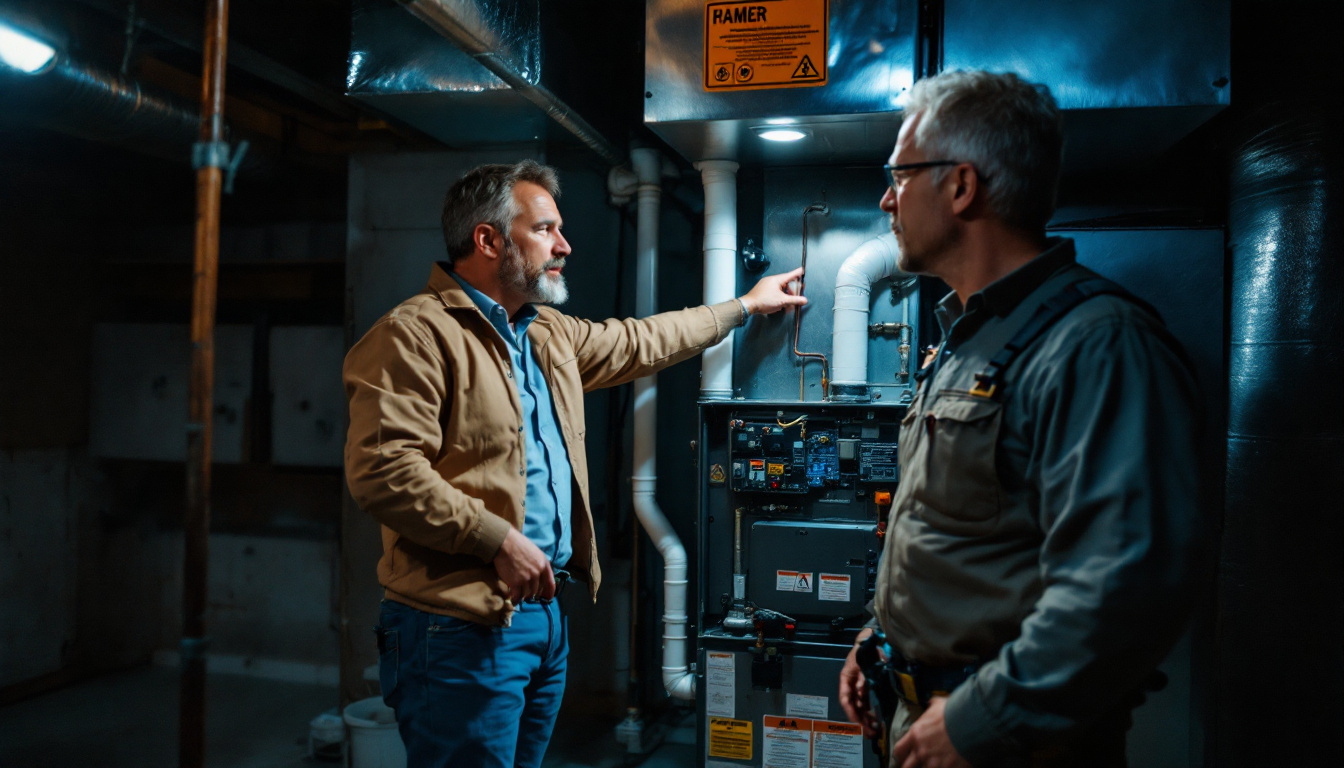
    A furnace heats air and a blower pushes that air through ducts. The flame or element never touches the air you breathe; a heat exchanger sits between them.

    1. The thermostat calls for heat.
    2. The furnace produces heat, by burning gas, propane or oil, or by passing current through electric resistance elements.
    3. A heat exchanger transfers that heat to the air while keeping combustion gases in a separate path.
    4. The blower pushes warmed air into the supply ducts and out through registers in each room.
    5. Return ducts draw cooler room air back to the furnace, through the filter, to be heated again.
    6. Combustion gases vent outdoors through a flue or, on high-efficiency condensing furnaces, through plastic vent pipe.

    A heat pump does the same distribution job but moves heat from outdoor air instead of making it. See heat pump versus gas furnace.

    What US homes heat with

    Forced air dominates. The central furnace alone is the main system in more homes than every other type of heating equipment combined.

    Main heating equipment Homes (millions) Share of homes that heat
    Central warm-air furnace 74.42 63.2%
    Heat pump 16.13 13.7%
    Steam or hot water system 9.29 7.9%
    Built-in electric units 7.65 6.5%
    Built-in oil or gas room heater 3.49 3.0%
    Portable electric heaters 3.03 2.6%
    Wood-burning stove 1.94 1.6%
    Ductless heat pump (mini-split) 1.06 0.9%
    Some other equipment 0.74 0.6%
    Homes using heating equipment 117.74 100%

    Figures are EIA RECS 2020, table HC6.1, and may not sum exactly because of rounding. Fuel shares across all equipment types are covered in how American homes are heated.

    Does central heating use gas?

    Usually, but not always. Of the 74.42 million homes heating mainly with a central furnace, 71.6% burn natural gas.

    Furnace fuel Homes (millions) Share of furnace homes
    Natural gas 53.26 71.6%
    Electricity 13.82 18.6%
    Propane 4.03 5.4%
    Fuel oil or kerosene 3.10 4.2%

    Electric furnaces are the second largest group. They have no flame and no flue, and they convert electricity to heat one for one, which makes them expensive to run where electricity is expensive.

    Forced air versus hot water

    Both are central heating. The difference is what carries the heat: air through ducts, or water through pipes to radiators, baseboards or floors.

    Factor Forced air Hot water (hydronic)
    Heat carrier Air, through ducts Water, through pipes
    Shares ducts with central air Yes No, cooling needs a separate system
    Filtration and humidity control Built into the air path Not part of the system
    Federal efficiency metric AFUE for furnaces, HSPF2 for heat pumps AFUE for boilers
    Homes using as main heat 90.55M with heat pumps 9.29M

    More on the water side in radiant floor heating.

    Federal efficiency minimums for furnaces

    A new non-weatherized gas furnace must reach 80% AFUE today, and 95% for units manufactured from December 18, 2028, under 10 CFR 430.32(e).

    Furnace class Current minimum AFUE From December 18, 2028
    Non-weatherized gas furnace 80.0% 95.0%
    Mobile home gas furnace 80.0% 95.0%
    Weatherized (outdoor) gas furnace 81.0% No change scheduled
    Non-weatherized oil-fired furnace 83.0% No change scheduled
    Weatherized oil-fired furnace 78.0% No change scheduled
    Mobile home oil-fired furnace 75.0% No change scheduled
    Electric furnace 78.0% No change scheduled

    AFUE is determined under the federal test procedure, so these are rating floors rather than measured performance in a given house. The 2028 change and what it means for venting is covered in the 95% furnace standard.

    What central heat costs to run, by fuel

    At 2025/26 heating season average prices, heat from an 80% gas furnace cost about $18.81 per million Btu delivered, against $52.10 from an electric furnace and $23.70 from a minimum-efficiency heat pump.

    The full comparison, including propane, oil and the prices used, is in what heat costs by fuel.

    How old heating systems are

    Heating equipment is kept much longer than cooling equipment. 20.0% of homes that heat run main heating equipment 20 years old or more, against 9.6% of air conditioned homes for cooling equipment.

    Age of main heating equipment Homes (millions) Share of homes that heat
    Less than 2 years 13.29 11.3%
    2 to 4 years 17.19 14.6%
    5 to 9 years 26.77 22.7%
    10 to 14 years 22.29 18.9%
    15 to 19 years 14.66 12.5%
    20 years or more 23.54 20.0%

    Ages are reported by households, grouped in bands, and cover all main heating equipment, including long-lived boilers.

    Frequently asked questions

    What is central heating?

    A system that produces heat in one place and distributes it through the whole house, either as warm air through ducts or as hot water through pipes. In the US the most common form is a forced-air furnace, the main heating equipment in 74.42 million homes, per EIA RECS 2020.

    Does central heating use gas?

    Most often. Of 74.42 million homes heating mainly with a central furnace, 53.26 million, 71.6%, use natural gas. The rest use electricity, propane or fuel oil. Central heat pumps and electric furnaces use no gas at all.

    What is forced air heating?

    Heating that warms air in a furnace or heat pump and pushes it through ducts with a blower. Furnaces and central heat pumps together are the main heating system in 90.55 million US homes, 76.9% of homes that use heating equipment.

    What is the most common heating system in the US?

    The central warm-air furnace, the main heating equipment in 74.42 million homes, 63.2% of those using heating. Heat pumps are second at 16.13 million and steam or hot water systems third at 9.29 million, per EIA RECS 2020.

    Methodology and limitations

    Household counts and ages are EIA RECS 2020, table HC6.1. Efficiency minimums are quoted from 10 CFR 430.32(e). Running costs use EIA season average prices and federal minimum efficiencies, as documented on our fuel cost page.

    • RECS 2020 is a survey estimate and the latest vintage for equipment data, with the 2024 survey’s equipment tables due in spring 2027 See what the 2024 survey release covers.; we do not project it forward.
    • Furnace fuel rows do not sum to the furnace total because of rounding and suppressed cells.
    • We publish no installed prices, because no federal series measures them.

    Sources

    1. US Energy Information Administration, Residential Energy Consumption Survey 2020, table HC6.1.
    2. Code of Federal Regulations, 10 CFR 430.32(e), furnace and boiler standards.

    The HVAC Brief is an independent trade publication. We do not sell equipment, take manufacturer advertising, or accept payment for placement in our research. Corrections welcome.
  • How to Choose an HVAC Contractor: What to Verify First

    How to Choose an HVAC Contractor: What to Verify First

    Last reviewed: September 2026 · By the HVAC Brief Editorial Team · Our sourcing and editorial standards

    The short answer

    Choose an HVAC contractor on what you can verify: a licence that covers HVAC work, EPA certified technicians, a written load calculation, a quote naming the matched equipment and refrigerant, and a clear answer on who pulls the permit.

    Reviews and price matter, but neither tells you whether the system will be sized and installed correctly. The checks below do, and a good contractor will answer all of them without hesitation.

    Nine checks, in order

    Work through these before comparing prices, because a cheaper quote that fails one of them is not comparable.

    1. A licence that covers the work. Look it up with your state licensing board or local building department. Requirements vary, and some states license HVAC at state level while others leave it to cities or counties.
    2. EPA certified technicians. Anyone who works on the refrigerant circuit must hold Section 608 certification, and a company cannot legally buy refrigerant unless it employs a certified technician. See what 608 certification means.
    3. A load calculation. Ask how the size was chosen. The industry procedure is ACCA Manual J, done room by room. A quote that simply matches the old unit’s size has not been sized. Our sizing guide explains why that matters.
    4. A matched system on paper. The quote should give model numbers for the outdoor unit and the indoor coil or air handler. Efficiency ratings apply to the certified combination, which you can check in the AHRI Directory of Certified Product Performance.
    5. The refrigerant named. New residential systems now use A2L refrigerants such as R-454B or R-32. Do not accept a quote that leaves the refrigerant out.
    6. Regional efficiency compliance. In the federal Southeast and Southwest regions, a split air conditioner under 45,000 Btu/h installed since January 1, 2023 must reach 14.3 SEER2. The rule turns on where and when the system is installed.
    7. Permit and inspection. Ask who pulls the permit and whether an inspection follows. Permit rules are local.
    8. Warranty in writing. Get the labour warranty term on paper and ask who registers the manufacturer warranty. See what an HVAC warranty covers.
    9. Payment terms. Compare the total amount repayable on any financing, not the monthly figure, and ask when each payment is due.

    What a written quote should include

    A quote is only comparable to another quote if both describe the same scope. These are the lines that most often go missing.

    Line on the quote Why it matters
    Outdoor unit model number Identifies the exact equipment and its certified ratings
    Indoor coil or air handler model number Ratings apply to the matched pair, not the outdoor unit alone
    AHRI certified reference number Lets you confirm the combination’s SEER2 and capacity
    Refrigerant type Affects parts, service and future refrigerant cost
    Basis for capacity Shows whether a load calculation was done
    Ductwork scope Existing ducts reused, modified or replaced
    Permit Who obtains it and whether inspection is included
    Removal and disposal Includes refrigerant recovery from the old system
    Labour warranty Term, and what it excludes
    Payment schedule Deposit, stage payments and final payment trigger

    Our walk-through of what happens on installation day shows what each of those lines looks like when the work is done.

    Your right to cancel a sale made at home

    If a seller signs you up at your home for a contract of $25 or more, the FTC’s Cooling-Off Rule generally gives you until midnight of the third business day to cancel.

    The rule, at 16 CFR 429.1, requires the seller to give you a contract stating, in substance: “You, the buyer, may cancel this transaction at any time prior to midnight of the third business day after the date of this transaction.” It also requires a notice of cancellation form.

    The rule has limits. It does not cover a sale that followed prior negotiations at the seller’s permanent business location, and it excludes certain emergency situations where you initiated the contact. Many states add their own home improvement protections on top.

    Red flags

    None of these proves a contractor is bad, but each one is a reason to slow down.

    • A size quoted without anyone measuring the house or asking about insulation and windows.
    • Pressure to sign the same day, especially with a discount that expires tonight.
    • A quote with a brand name but no model numbers.
    • Reluctance to pull a permit.
    • No answer on what refrigerant the new system uses.
    • A request for most of the price before any work starts.
    A small company is normal

    Census counted 111,207 plumbing, heating and air conditioning contractor establishments in 2023, and 58.3% had fewer than five employees. Size tells you little about quality; the checks above tell you more. See the contractor industry by the numbers.

    Frequently asked questions

    How do I choose a good HVAC contractor?

    Verify a licence that covers HVAC work, confirm technicians hold EPA Section 608 certification, ask for a room-by-room load calculation, and insist on a written quote with matched model numbers, the refrigerant type, permit responsibility and a labour warranty. Compare prices only between quotes that pass those checks.

    What should an HVAC quote include?

    Model numbers for the outdoor unit and the indoor coil or air handler, the AHRI certified reference number, the refrigerant, the basis for the capacity chosen, ductwork scope, permit responsibility, removal and refrigerant recovery, the labour warranty and the payment schedule.

    Do HVAC contractors need to be certified?

    Technicians who work on refrigerant circuits must hold EPA Section 608 certification, and a company can only buy refrigerant if it employs a certified technician. Contractor licensing is separate and is set by states and localities, so requirements differ by where you live.

    Can I cancel an HVAC contract after signing?

    If you signed at home with a seller who came to you and the price is $25 or more, the FTC Cooling-Off Rule generally lets you cancel until midnight of the third business day. It does not cover every sale, including some emergency repairs you requested, and state law may add protections.

    Methodology and limitations

    This checklist is built from federal rules we can cite: the EPA refrigerant sales restriction, 10 CFR 430.32 regional standards and the FTC Cooling-Off Rule. Industry procedures are named, not reproduced.

    • We rate and recommend no contractors.
    • Licensing, permit and deposit rules vary by state and locality, and we do not summarise them.
    • Nothing here is legal advice.

    Sources

    1. US Environmental Protection Agency, Refrigerant Sales Restriction.
    2. Code of Federal Regulations, 16 CFR Part 429, Cooling-Off Period for Sales Made at Homes or at Certain Other Locations.
    3. Code of Federal Regulations, 10 CFR 430.32(c)(6), regional standards for central air conditioners.
    4. US Census Bureau, County Business Patterns 2023, NAICS 238220.

    The HVAC Brief is an independent trade publication. We do not sell equipment, take manufacturer advertising, or accept payment for placement in our research. Corrections welcome.
  • Starting an HVAC Business: What the Census Counts Show

    Starting an HVAC Business: What the Census Counts Show

    Last reviewed: September 2026 · By the HVAC Brief Editorial Team · Our sourcing and editorial standards

    The short answer

    There were 111,207 plumbing, heating and air conditioning contractor establishments with paid employees in the US in 2023, and 58.3% of them employed fewer than five people, according to the Census Bureau’s County Business Patterns.

    Starting one is federally simple and locally complicated. There is no federal contractor licence, but a business can only buy refrigerant if it employs an EPA certified technician, and licensing is set by states and localities.

    111,207Contractor establishments with payroll, 2023
    58%Employ fewer than five people
    $0.1kAnnual payroll per employee, 2023
    69%Organised as S corporations

    How big the trade is

    The contractor industry grew on every measure between 2022 and 2023, and payroll grew fastest: up 8.9% against 3.2% more employees.

    NAICS 238220 2022 2023 Change
    Establishments 109,601 111,207 +1.5%
    Employees, mid-March 1,176,759 1,214,761 +3.2%
    Annual payroll $82.24B $89.52B +8.9%
    Payroll per employee $69,883 $73,693 +5.5%
    Average employees per establishment 10.7 10.9

    One caveat shapes every number here. The federal industry code, NAICS 238220, covers plumbing, heating and air conditioning contractors together, and Census does not publish HVAC-only firms separately. County Business Patterns also counts only establishments with paid employees, so a one-person business with no payroll is not in these figures.

    Most firms are small

    A business with fewer than five employees is the typical contractor, not the exception. Only 1,656 establishments, 1.5%, employ 100 people or more.

    Employees Establishments, 2023 Share Cumulative
    Fewer than 5 64,871 58.3% 58.3%
    5 to 9 20,587 18.5% 76.8%
    10 to 19 13,148 11.8% 88.7%
    20 to 49 8,384 7.5% 96.2%
    50 to 99 2,561 2.3% 98.5%
    100 to 249 1,300 1.2% 99.7%
    250 to 499 256 0.2% 99.9%
    500 to 999 76 0.1% 100.0%
    1,000 or more 24 0.0% 100.0%

    For a new owner, that distribution cuts both ways. Small is a normal starting point, and most competitors are also small; but the few large operators have scale in purchasing, marketing and hiring that a start-up does not.

    How HVAC firms are organised

    More than two thirds of contractor establishments belong to S corporations, and the share of sole proprietorships is shrinking.

    Legal form 2022 2023 Change Share, 2023
    S corporation 73,280 76,190 +4.0% 68.5%
    C corporation 16,103 15,841 -1.6% 14.2%
    Sole proprietorship 12,858 11,821 -8.1% 10.6%
    Partnership 7,306 7,299 -0.1% 6.6%
    Nonprofit 43 42 -2.3% 0.0%
    Other 11 14 +27.3% 0.0%

    This shows what existing firms do, not what a new one should do. Entity choice is a tax and liability decision for an accountant or attorney who knows your state.

    What is required federally, and what is not

    Federal rules for an HVAC business are mostly about refrigerant and employment. Licensing to contract is not federal.

    1. Refrigerant purchasing. EPA’s sales restriction says “Only EPA-certified technicians are allowed to purchase” ozone-depleting refrigerants or their non-ozone-depleting substitutes, with limited exceptions. An employer can buy if it gives the wholesaler written evidence that it employs at least one properly certified technician.
    2. Technician certification. Technicians who maintain, service, repair or dispose of equipment that could release refrigerant need Section 608 certification. See what the EPA 608 certification covers.
    3. Employer registration. A business with employees needs an employer identification number from the IRS and has federal payroll tax obligations.
    4. Everything else is state or local. Contractor licensing, business registration, insurance and workers’ compensation requirements, and permits vary by state and often by city or county. No federal source consolidates them.

    Labour is the constraint to plan around

    Hiring costs more every year. Average hourly earnings at plumbing, heating and air conditioning contractors reached $42.61 in July 2026, a preliminary BLS figure, up 40.2% from $30.39 in 2019.

    Employment in the same industry was 1,355,400 in July 2026, also preliminary, up 18.8% from the 2019 average. More on pay in what HVAC contractors pay and the latest employment and wage readings.

    Why the two headcounts differ

    County Business Patterns counts 1,214,761 employees in the pay period including March 12, 2023. The BLS Current Employment Statistics survey puts the industry at 1,355,400 in July 2026. They are different surveys, three years apart, and both include plumbing. Use CBP for firm structure and CES for the current trend.

    Frequently asked questions

    How many HVAC companies are there in the US?

    Census County Business Patterns counted 111,207 plumbing, heating and air conditioning contractor establishments with paid employees in 2023. That code includes plumbing contractors, and it excludes businesses with no payroll, so no federal source gives an HVAC-only count.

    Do you need a license to start an HVAC business?

    There is no federal contractor licence. Licensing is set by states and often by cities or counties. Federally, technicians who handle refrigerant need EPA Section 608 certification, and a business can only buy refrigerant if it employs at least one certified technician.

    Can an HVAC company buy refrigerant without certification?

    Only with a certified technician on staff. EPA allows an employer to purchase refrigerant if it provides the wholesaler with written evidence that it employs at least one properly certified technician. Only Section 608 certified technicians can buy refrigerant intended for stationary air conditioning equipment.

    Are most HVAC businesses small?

    Yes. In 2023, 58.3% of plumbing, heating and air conditioning contractor establishments had fewer than five employees, and 1.5% had 100 or more, according to Census County Business Patterns.

    Methodology and limitations

    Establishment, employee, payroll, size and legal form figures are County Business Patterns 2023 and 2022 national files for NAICS 238220. Earnings and employment trends are BLS Current Employment Statistics series CEU2023822003 and CEU2023822001; July 2026 values are preliminary and subject to revision.

    • NAICS 238220 includes plumbing contractors, and CBP counts establishments, not firms.
    • Nonemployer businesses are excluded from CBP.
    • We publish no revenue, margin or start-up cost figures, because CBP does not measure them and we do not use vendor surveys.
    • Nothing here is legal, tax or licensing advice.

    Sources

    1. US Census Bureau, County Business Patterns, 2023 and 2022, NAICS 238220.
    2. US Environmental Protection Agency, Refrigerant Sales Restriction.
    3. US Bureau of Labor Statistics, Current Employment Statistics series CEU2023822001 and CEU2023822003.

    The HVAC Brief is an independent trade publication. We do not sell equipment, take manufacturer advertising, or accept payment for placement in our research. Corrections welcome.
  • What Is Central Air? How It Works and Who Has It

    What Is Central Air? How It Works and Who Has It

    Last reviewed: September 2026 · By the HVAC Brief Editorial Team · Our sourcing and editorial standards

    The short answer

    Central air is a cooling system that serves the whole house from one outdoor unit and one indoor coil, moving cooled air to every room through ducts. It is how most American homes are cooled: 82.69 million homes, 75.5% of those using air conditioning, rely on central equipment as their main system, according to the EIA Residential Energy Consumption Survey.

    Central air runs on electricity. It usually shares ductwork and a blower with the furnace, which is why the pairing gets sold and discussed as central heat and air.

    82.7MHomes using central air as their main cooling, including central heat pumps
    76%Share of air conditioned homes
    21.4MHomes relying mainly on window or wall units
    13.4Federal minimum SEER2 for a split central air conditioner in northern states

    How central air works

    A central air conditioner does not make cold air. It moves heat from inside the house to outside, using refrigerant that absorbs heat at the indoor coil and releases it at the outdoor coil.

    1. The thermostat calls for cooling. It switches on the outdoor unit and the indoor blower.
    2. The blower pulls room air through the return ducts and pushes it across the indoor evaporator coil.
    3. Refrigerant in the coil evaporates and absorbs heat from that air. Moisture condenses on the cold coil and drains away, which is how central air dehumidifies.
    4. The compressor in the outdoor unit pumps the refrigerant vapour up to high pressure and temperature.
    5. The outdoor condenser coil and fan release the heat to outside air, and the refrigerant condenses back into a liquid.
    6. An expansion device drops the pressure and the cold refrigerant returns indoors, while the cooled air leaves through the supply ducts.

    The parts of a central air system

    Every central system has the same core parts split between an outdoor cabinet and an indoor section, joined by refrigerant lines and served by ductwork.

    Part Where it sits What it does
    Condensing unit Outdoors, on a pad or bracket Holds the compressor, condenser coil and fan, and rejects heat outside
    Evaporator coil Indoors, on the furnace or inside an air handler Absorbs heat and removes moisture from house air
    Blower In the furnace or air handler Moves air across the coil and through the ducts
    Refrigerant lines Between the two units Carry refrigerant in a sealed loop
    Supply and return ducts Throughout the house Deliver cooled air and bring room air back
    Condensate drain Under the indoor coil Carries away the water pulled out of the air
    Thermostat Living space Starts and stops the cycle

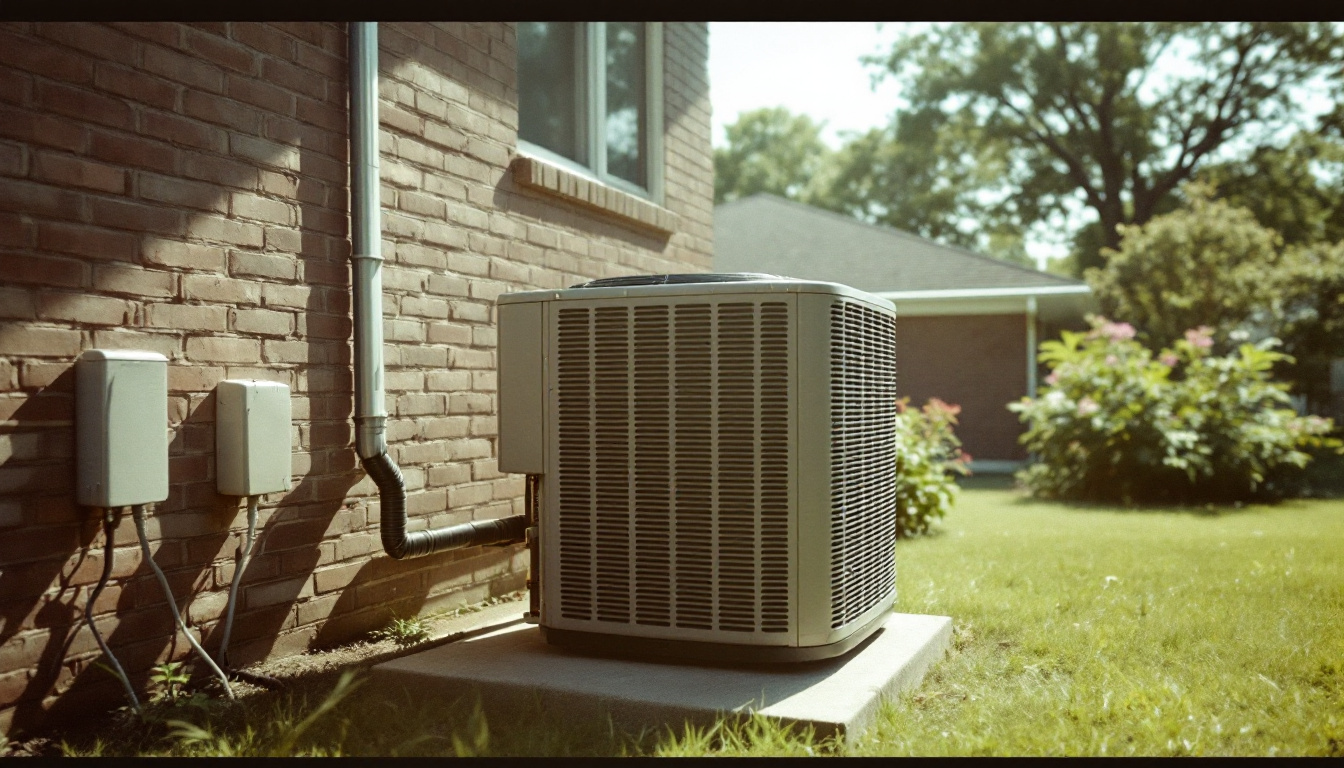
    The outdoor unit is covered in detail in what an AC condenser does. Ducts decide more of a system’s real performance than most owners expect, which is why ductwork and airflow problems so often get blamed on the equipment.

    How many homes have central air

    Central equipment is the main cooling system in 66.9% of all US homes. It is close to standard in houses and noticeably less common in apartments.

    Main cooling equipment Homes (millions) Share of AC users
    Central air, including central heat pumps 82.69 75.5%
    Window or wall air conditioner 21.43 19.6%
    Portable air conditioner 2.68 2.4%
    Ductless heat pump (mini-split) 1.76 1.6%
    Evaporative or swamp cooler 0.95 0.9%
    All homes using air conditioning 109.51 100%
    Housing type Homes using AC (millions) Central as main system (millions) Central share
    Single-family detached 69.75 57.73 82.8%
    Single-family attached 6.57 5.15 78.4%
    Apartment, 2 to 4 units 7.57 3.80 50.2%
    Apartment, 5 or more units 19.56 12.11 61.9%
    Mobile home 6.07 3.90 64.3%

    Another 14.02 million homes use no air conditioning at all.

    Central air versus the alternatives

    The real choice is between systems that need ducts and systems that do not. Central air and central heat pumps need them; mini-splits, window units and portables do not.

    System Needs ducts Area served Also heats
    Central air conditioner Yes Whole house No, paired with a furnace
    Central heat pump Yes Whole house Yes
    Ductless mini-split No One zone per indoor head Usually, as a heat pump
    Window or wall unit No One room Some models
    Portable unit No One room Some models

    A central heat pump is the same machine as central air with a reversing valve added, so it can run the cycle backwards in winter. See how a heat pump works.

    Does central air use gas?

    No. The compressor, fans and controls all run on electricity. The confusion comes from the furnace: in a house with a gas furnace, central air shares the furnace blower and ducts, so the two look like one appliance.

    The word gas also gets used loosely for refrigerant. Refrigerant is a working fluid that circulates in a sealed loop, not a fuel that gets burned, and a correctly working system does not use it up.

    What the federal efficiency rules require

    New central air conditioners must meet a minimum SEER2 rating set by the Department of Energy, and for split systems the minimum depends on where the system is installed.

    Product North Southeast Southwest
    Split air conditioner, under 45,000 Btu/h 13.4 SEER2 14.3 SEER2 14.3 SEER2, plus EER2
    Split air conditioner, 45,000 Btu/h or more 13.4 SEER2 13.8 SEER2 13.8 SEER2, plus EER2
    Split heat pump 14.3 SEER2, 7.5 HSPF2 14.3 SEER2, 7.5 HSPF2 14.3 SEER2, 7.5 HSPF2

    Under 10 CFR 430.32, the Southeast covers Alabama, Arkansas, Delaware, Florida, Georgia, Hawaii, Kentucky, Louisiana, Maryland, Mississippi, North Carolina, Oklahoma, South Carolina, Tennessee, Texas, Virginia, the District of Columbia and US territories. The Southwest is Arizona, California, Nevada and New Mexico. The regional rules apply to systems installed on or after January 1, 2023. Our SEER2 guide covers how the rating works.

    How old central air systems are

    About one in five air conditioned homes runs main cooling equipment that is at least 15 years old: 21.56 million homes, or 19.7%.

    Age of main AC equipment Homes (millions) Share of AC users
    Less than 2 years 15.63 14.3%
    2 to 4 years 21.76 19.9%
    5 to 9 years 30.08 27.5%
    10 to 14 years 20.49 18.7%
    15 to 19 years 11.01 10.1%
    20 years or more 10.55 9.6%

    These bands cover all main cooling equipment, not central systems alone, and ages are as reported by households. RECS publishes the distribution but no average age and no failure rate. Our guide to HVAC lifespan explains what that does and does not tell you.

    Frequently asked questions

    What is central air?

    Central air is a whole-house cooling system with an outdoor condensing unit, an indoor evaporator coil and a blower that sends cooled air through ducts to every room. It is the main cooling system in 82.69 million US homes, 75.5% of homes that use air conditioning, per EIA RECS 2020.

    Does central air use gas?

    No. Central air runs on electricity. It often shares ductwork and a blower with a gas furnace, which is why the two can seem like one system. Refrigerant is sometimes called gas, but it is a sealed working fluid, not a fuel.

    What is the difference between central air and a heat pump?

    A central heat pump is a central air conditioner that can also run in reverse to heat the house. Both use an outdoor unit, an indoor coil and ducts. A central air conditioner only cools and relies on a separate furnace or boiler for heat.

    How common is central air in the US?

    Central equipment is the main cooling system in 82.69 million of 123.53 million US homes, or 66.9%. Among single-family detached houses that use air conditioning the share is 82.8%, and among apartments in buildings with five or more units it is 61.9%.

    Methodology and limitations

    Household counts are from EIA RECS 2020 table HC7.1, the latest vintage for equipment data, and include central heat pumps in the central category. Efficiency minimums are quoted from the Code of Federal Regulations.

    • RECS 2020 is a survey estimate with sampling error, and we do not project it forward.
    • Equipment age is reported by households, grouped in bands, and covers all main cooling types.
    • We publish no installation prices, because no federal series measures them.

    Sources

    1. US Energy Information Administration, Residential Energy Consumption Survey 2020, table HC7.1.
    2. Code of Federal Regulations, 10 CFR 430.32(c)(5) and (c)(6), energy conservation standards for central air conditioners and heat pumps.

    The HVAC Brief is an independent trade publication. We do not sell equipment, take manufacturer advertising, or accept payment for placement in our research. Corrections welcome.
  • Radiant Floor Heating: Hydronic vs Electric, by the Numbers

    Radiant Floor Heating: Hydronic vs Electric, by the Numbers

    Last reviewed: September 2026 · By the HVAC Brief Editorial Team · Our sourcing and editorial standards

    The short answer

    Radiant floor heating warms a room from the floor up, using hot water tubing or electric cables under the surface. The Department of Energy’s guidance says radiant heating “is more efficient than baseboard heating and usually more efficient than forced-air heating because it eliminates duct losses.”

    Running cost depends on the heat source. A hydronic floor fed by a minimum-efficiency gas boiler delivered heat for about $17.92 per million Btu at 2025/26 prices; an electric floor is resistance heat, at about $52.10.

    3Types: radiant air, electric and hydronic
    $17.92Per million Btu, hydronic from an 84% gas boiler
    $52.10Per million Btu, electric radiant floor
    9.29MHomes heating mainly with steam or hot water systems

    How radiant floor heating works

    Heat passes from a warm floor surface directly to people and objects in the room, rather than being carried by moving air. There are no ducts to lose heat along the way.

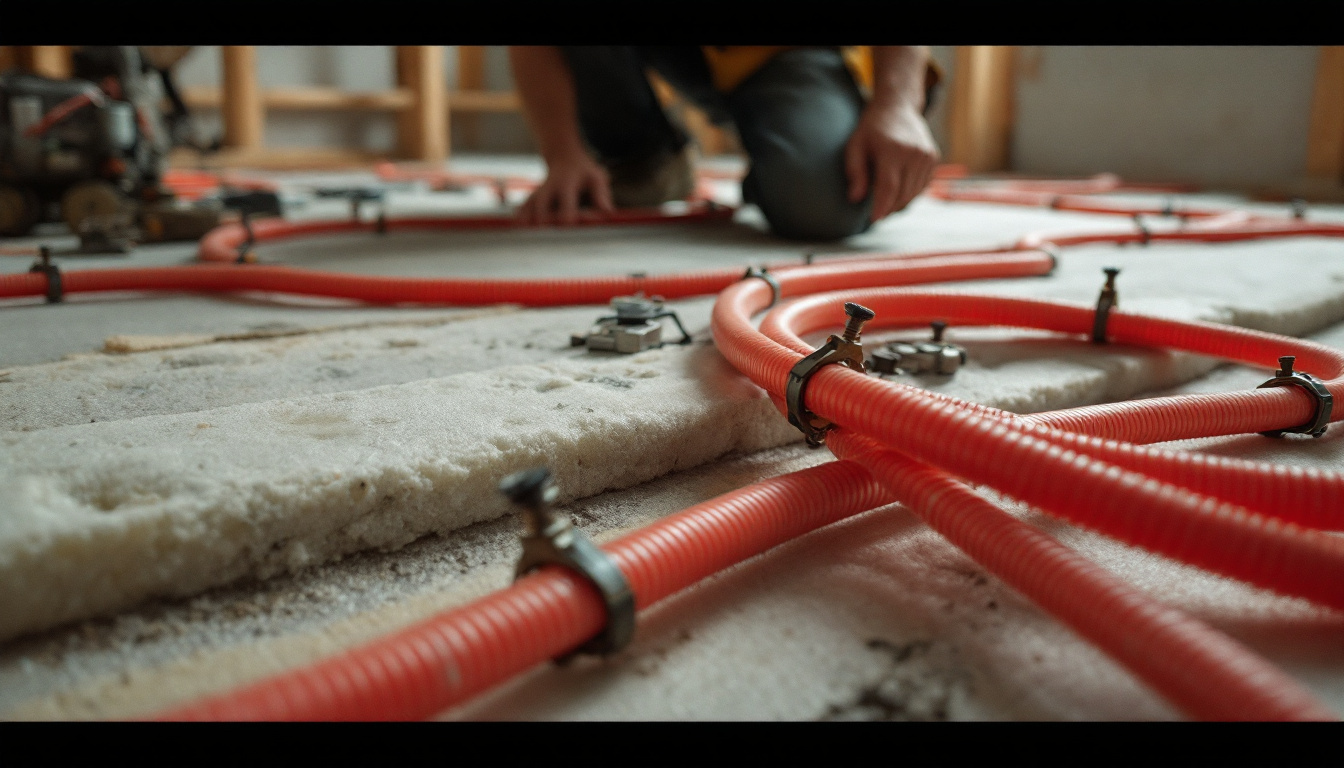
    DOE separates installations into two kinds. “Wet” installations embed tubing or cables in a concrete slab or lightweight concrete, using its thermal mass. “Dry” installations run them in an air space under the floor, which is faster and cheaper to build but needs the system to run at a higher temperature.

    Hydronic, electric and radiant air floors

    Of the three types, DOE calls hydronic systems “the most popular and cost-effective radiant heating systems for heating-dominated climates.”

    Type How it heats DOE’s assessment
    Hydronic Pumps heated water from a boiler through tubing under the floor Most popular and cost-effective in heating-dominated climates
    Electric Heating cables or mats built into the floor Usually cost-effective only with significant thermal mass and time-of-use electricity rates
    Radiant air Pumps heated air through the floor Not cost-effective in homes and seldom installed

    Hydronic systems can heat the water with gas or oil boilers, wood-fired boilers or solar water heaters. Our guide to boilers and baseboard heating covers the boiler side.

    What radiant floor heating costs to run

    The floor only distributes heat; the source sets the running cost. At 2025/26 season prices and federal minimum efficiencies:

    Heat source Federal minimum Cost per million Btu delivered
    Gas hot water boiler 84% AFUE $17.92
    Oil hot water boiler 86% AFUE $33.68
    Electric cables or mats Resistance, 100% $52.10

    Federal AFUE minimums for hot water boilers are 84% for gas and 86% for oil under 10 CFR 430.32(e)(2); electric hot water boilers have no AFUE minimum. For how these compare with furnaces and heat pumps, see what heat costs by fuel.

    How electric floors can make sense

    DOE’s guidance explains that with a thick concrete floor and time-of-use rates, you can “charge” the slab with heat during off-peak hours, approximately 9 p.m. to 6 a.m. If the thermal mass is large enough, the stored heat “will keep the house comfortable for eight to ten hours without any further electrical input.” Without both conditions, an electric floor is simply expensive heat.

    Which floor coverings work

    DOE says ceramic tile “is the most common and effective floor covering for radiant floor heating, because it conducts heat well and adds thermal storage.” Anything that insulates the floor from the room lowers efficiency.

    • Tile and stone: the best match.
    • Carpet: use thin carpet with dense padding, and as little as possible.
    • Wood: DOE recommends laminated wood flooring over solid wood, to reduce shrinking and cracking.
    • Mixed rooms: rooms with a different covering should have their own tubing loop, because water under a covered floor has to run hotter.

    The disadvantages

    The main drawbacks are slow response, no cooling, and cost and disruption to install in an existing home.

    • Slow response. DOE notes thick slabs have a “slow thermal response time, which makes strategies such as night or daytime setbacks difficult if not impossible,” and most experts recommend a constant temperature.
    • No cooling. A radiant floor heats only. Cooling needs a separate system, such as a ductless mini-split.
    • Installation cost. DOE says hydronic installation cost varies with location, home size, installation type, floor covering, site remoteness and labour. No federal series measures it.
    • Floor limits. Coverings and floor build-up are constrained, especially in retrofits.

    How many homes use it

    EIA does not count radiant floors separately. Its Residential Energy Consumption Survey reports that 9.29 million homes, 7.9% of those that heat, use a steam or hot water system as their main heating equipment, a group that includes radiators, baseboards and radiant floors. Forced air is far more common; see what central heating is.

    Frequently asked questions

    Is radiant floor heating efficient?

    DOE’s guidance says radiant heating is more efficient than baseboard heating and usually more efficient than forced-air heating because it eliminates duct losses. Running cost still depends on the heat source: about $17.92 per million Btu from an 84% gas boiler against $52.10 for electric floors at 2025/26 prices.

    Is electric radiant floor heating expensive to run?

    Usually, because it is resistance heat. At the 2025/26 heating season average electricity price it cost about $52.10 per million Btu delivered. DOE says electric floors are usually cost-effective only with significant thermal mass and time-of-use rates, or in additions where extending the main system is impractical.

    What is the best flooring for radiant heat?

    Ceramic tile, which DOE calls the most common and effective covering because it conducts heat well and adds thermal storage. Carpet should be thin with dense padding, and laminated wood is preferred over solid wood to limit shrinking and cracking.

    What are the disadvantages of radiant floor heating?

    Slow response in thick slabs, which makes thermostat setbacks difficult; no cooling, so a separate system is needed; limits on floor coverings; and an installation cost that DOE says varies widely with home size, installation type and labour.

    Methodology and limitations

    DOE statements are quoted from its Energy Saver guidance on radiant heating, which no longer resolves at energy.gov; we cite the archived copy. Running costs use EIA 2025/26 season average prices and federal minimum efficiencies, documented on our fuel cost page.

    • We publish no installed prices, because no federal series measures them.
    • Costs exclude distribution pumps, boiler standby losses and fixed utility charges.
    • RECS 2020 does not separate radiant floors from other hot water systems.

    Sources

    1. US Department of Energy, Energy Saver: Radiant Heating, archived copy.
    2. Code of Federal Regulations, 10 CFR 430.32(e)(2), residential boiler standards.
    3. US Energy Information Administration, Residential Energy Consumption Survey 2020, table HC6.1.

    The HVAC Brief is an independent trade publication. We do not sell equipment, take manufacturer advertising, or accept payment for placement in our research. Corrections welcome.
  • Geothermal Heat Pumps: Loops, Ratings and the Ended Credit

    Geothermal Heat Pumps: Loops, Ratings and the Ended Credit

    Last reviewed: September 2026 · By the HVAC Brief Editorial Team · Our sourcing and editorial standards

    The short answer

    A geothermal heat pump heats and cools a house by exchanging heat with the ground, which the Department of Energy describes as holding a relatively constant 40 to 70°F a few feet below the surface. Because the ground is warmer than winter air and cooler than summer air, the system works less hard than an air-source heat pump.

    The federal 30% tax credit that covered these systems has ended. The IRS states the Residential Clean Energy Credit “is not available for any property placed in service after December 31, 2025.”

    40 to 70°FShallow ground temperature range, per DOE
    3.6ENERGY STAR minimum COP, closed loop water-to-air
    50+ yrsDOE estimated life of the ground loop
    0%Federal credit for systems placed in service in 2026

    How geothermal heating and cooling works

    It is a heat pump, the same refrigeration cycle as central air, that trades heat with the ground through buried pipe instead of with outdoor air.

    1. Water or a water and antifreeze mix circulates through a buried loop, picking up the ground’s heat in winter.
    2. A heat exchanger passes that heat to the refrigerant in the indoor heat pump unit.
    3. The compressor raises the refrigerant’s temperature and the heat is delivered to the house, usually through ducts.
    4. In summer the cycle reverses, pulling heat from the house and rejecting it into the ground.

    DOE notes that geothermal units can also supply hot water if so equipped. For the underlying cycle, see how a heat pump works.

    The four types of ground loop

    DOE describes four basic loop types: three closed loops, horizontal, vertical and pond or lake, and one open loop. Climate, soil conditions, available land and local installation costs decide which fits a site.

    Loop How it is installed Where it fits
    Horizontal, closed Pipe laid in trenches at least four feet deep DOE calls it generally most cost-effective for homes, especially new construction with enough land
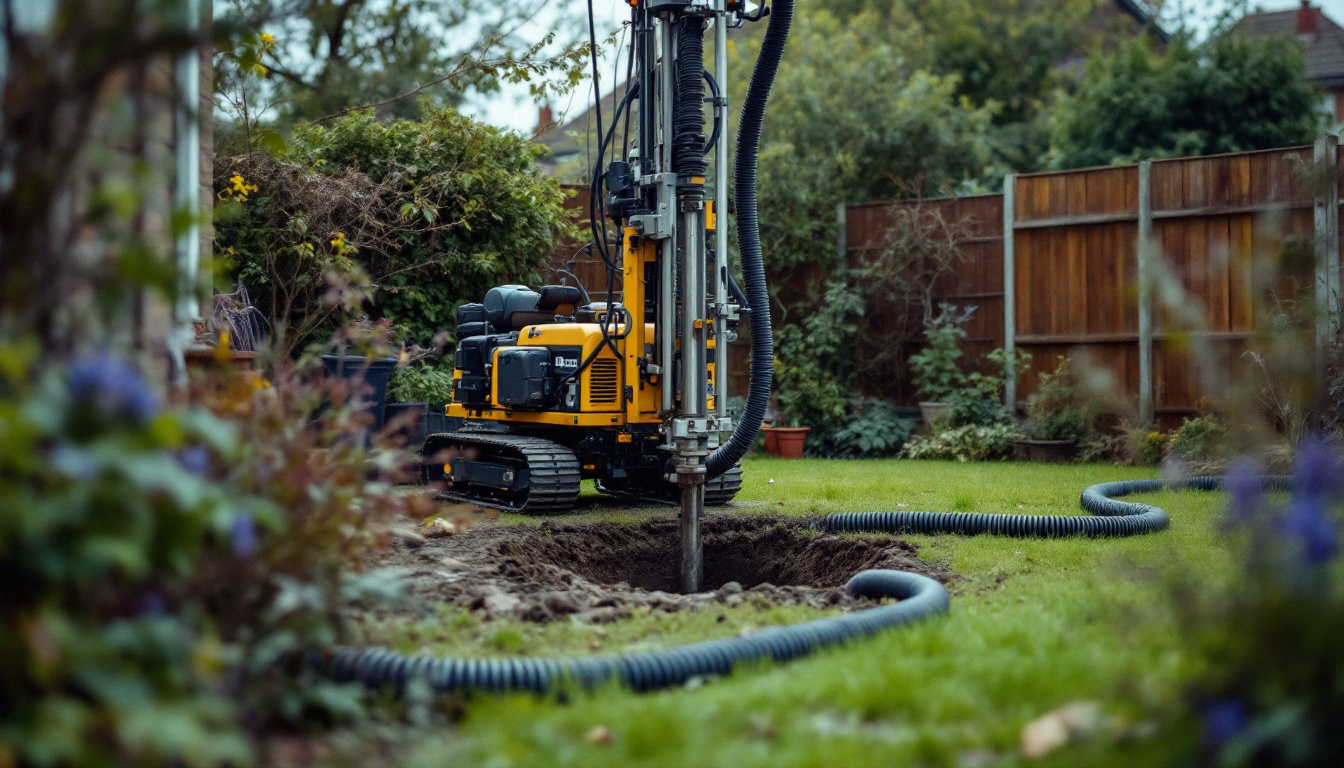
    Vertical, closed Holes about four inches wide, about 20 feet apart and 100 to 400 feet deep Sites where land for horizontal loops is limited
    Pond or lake, closed Loop submerged in a body of water Properties with suitable water nearby
    Open loop Circulates water from a well or surface source instead of a sealed loop Sites with adequate water supply and discharge options

    A variant called direct exchange skips the water loop and pumps refrigerant through buried copper tubing.

    How efficient geothermal heat pumps are

    ENERGY STAR certification sets minimum efficiency by product type. A closed loop water-to-air unit must reach an EER of 17.1 and a COP of 3.6.

    ENERGY STAR product type Minimum EER Minimum COP
    Closed loop water-to-air 17.1 3.6
    Open loop water-to-air 21.1 4.1
    Closed loop water-to-water 16.1 3.1
    Open loop water-to-water 20.1 3.5
    Direct geoexchange (DGX) 16.0 3.6

    At a COP of 3.6 and the 2025/26 season’s average electricity price, heat from a geothermal unit works out to about $14.47 per million Btu, against $23.70 for a minimum-efficiency air-source heat pump and $18.81 for an 80% gas furnace. That COP is a rated value at test conditions, not a measured seasonal figure. The full comparison is in what heat costs by fuel.

    What it costs and how long it lasts

    No federal series measures installed geothermal prices. DOE’s guidance gives only a relative figure: installation “can be several times that of an air-source system of the same heating and cooling capacity.”

    DOE’s guidance says the extra cost “may be returned in energy savings in 5 to 10 years, depending on the cost of energy and available incentives in your area.” That estimate was written while the 30% federal credit was available, so for a 2026 installation the incentive part of the calculation is smaller.

    On lifespan, DOE estimates system life “up to 24 years for the inside components and 50+ years for the ground loop.” The loop is the expensive part, and it outlasts several indoor units.

    The federal tax credit has ended

    Geothermal heat pumps qualified for the Section 25D Residential Clean Energy Credit, worth 30% of costs, but only for property placed in service by December 31, 2025.

    Question What the IRS says
    Credit rate 30% of the costs of new, qualified clean energy property
    Efficiency requirement “Geothermal heat pumps must meet Energy Star requirements in effect at the time of purchase.”
    Deadline “The credit is not available for any property placed in service after December 31, 2025.”
    Timing rule “You must claim the credit for the tax year when the property is installed, not merely purchased.”

    Some older pages, including government pages written before the change, still describe the credit running into the 2030s. The IRS page governs. State and utility incentives are separate and may still apply. The parallel expiry of the heat pump credit is covered in our 25C report.

    Geothermal versus air-source heat pumps

    DOE’s comparison is that geothermal units are quieter, more efficient, last longer and need little maintenance, and do not depend on outdoor air temperature. The trade-off is the loop: land or drilling, and a much higher installed price.

    EIA’s Residential Energy Consumption Survey does not report ground-source heat pumps separately from other heat pumps, so there is no federal count of homes that use them. For the air-source comparison with gas, see heat pump versus gas furnace.

    Frequently asked questions

    How does geothermal heating and cooling work?

    A heat pump circulates water or antifreeze through pipe buried in the ground or submerged in water, exchanging heat with earth that DOE says holds at roughly 40 to 70°F. In winter it moves ground heat into the house; in summer it moves house heat into the ground.

    Is there still a tax credit for geothermal heat pumps in 2026?

    Not federally. The IRS says the 30% Residential Clean Energy Credit “is not available for any property placed in service after December 31, 2025,” and the credit is claimed for the year the property is installed, not purchased. State and utility incentives may still be available.

    How long do geothermal systems last?

    DOE estimates system life at up to 24 years for the inside components and 50 years or more for the ground loop. No federal survey measures actual replacement ages.

    Is geothermal more efficient than an air-source heat pump?

    Generally yes, because ground temperature is more stable than air temperature. ENERGY STAR closed loop water-to-air units must reach a COP of 3.6, while the federal minimum for split air-source heat pumps, HSPF2 7.5, equates to a seasonal COP of about 2.2. The ratings use different test conditions.

    Methodology and limitations

    DOE statements are quoted from its Energy Saver guidance on geothermal heat pumps, which no longer resolves at energy.gov; we cite the archived copy. ENERGY STAR criteria and the IRS credit rules were checked in September 2026.

    • We publish no installed prices or payback periods of our own, because no federal series measures them.
    • The cost per million Btu uses a rated COP and a national average electricity price.
    • Nothing here is tax advice.

    Sources

    1. US Department of Energy, Energy Saver: Geothermal Heat Pumps, archived copy.
    2. ENERGY STAR, Geothermal Heat Pumps Key Product Criteria.
    3. Internal Revenue Service, Residential Clean Energy Credit.
    4. US Energy Information Administration, Residential Energy Consumption Survey 2020, table HC6.1.

    The HVAC Brief is an independent trade publication. We do not sell equipment, take manufacturer advertising, or accept payment for placement in our research. Corrections welcome.

  • What Heat Costs by Fuel: Gas, Propane, Oil and Heat Pumps

    What Heat Costs by Fuel: Gas, Propane, Oil and Heat Pumps

    Last reviewed: September 2026 · By the HVAC Brief Editorial Team · Our sourcing and editorial standards

    The short answer

    At 2025/26 heating season prices and federal minimum efficiencies, a gas furnace delivered heat for about $18.81 per million Btu, a heat pump for $23.70, propane and oil furnaces for about $34.89, and electric resistance heat for $52.10.

    The most efficient system is not automatically the cheapest to run. Electric resistance heat is 100% efficient and still the most expensive, because the fuel price matters as much as the efficiency.

    $18.81Per million Btu from an 80% gas furnace
    $23.70From a minimum-efficiency air-source heat pump
    $52.10From electric resistance heat
    14.1¢Electricity price where a heat pump matches gas

    What a million Btu of heat cost, by system

    Ranked from cheapest to most expensive, using the same season’s average fuel prices for every system and each system’s federal minimum efficiency.

    System Cost per million Btu delivered Index, 80% gas furnace = 100 Efficiency basis
    Geothermal heat pump, closed loop $14.47 77 COP 3.6, ENERGY STAR minimum at rated conditions
    Gas furnace, 95% AFUE $15.84 84 Federal minimum from December 18, 2028
    Gas hot water boiler, 84% AFUE $17.92 95 Current federal minimum
    Gas furnace, 80% AFUE $18.81 100 Current federal minimum
    Air-source heat pump, HSPF2 7.5 $23.70 126 Current federal minimum, seasonal COP about 2.20
    Propane furnace, 95% AFUE $29.38 156 Federal minimum from December 18, 2028
    Oil hot water boiler, 86% AFUE $33.68 179 Current federal minimum
    Propane furnace, 80% AFUE $34.89 185 Current federal minimum
    Oil furnace, 83% AFUE $34.89 185 Current federal minimum
    Electric resistance, furnace or baseboard $52.10 277 Converts electricity to heat one for one

    A million Btu is a unit of heat delivered into the house, so the table compares like with like regardless of fuel. It is not an annual bill, which depends on how much heat your house needs.

    The fuel prices behind the numbers

    Each price is the average across the October 2025 to March 2026 heating season, converted to a cost per million Btu of fuel using EIA heat content factors.

    Fuel Season average price Btu per unit Cost per million Btu of fuel Series
    Natural gas $15.59 per Mcf 1,036,000 per Mcf $15.05 EIA monthly residential price, N3010US3
    Propane $2.55 per gallon 91,452 per gallon $27.91 EIA weekly residential propane price
    Heating oil $4.01 per gallon 138,500 per gallon $28.96 EIA weekly residential heating oil price
    Electricity 17.77¢ per kWh 3,412 per kWh $52.10 EIA Electric Power Monthly, Table 5.3

    Delivered cost is the fuel cost divided by efficiency. An 80% furnace needs 1.25 million Btu of gas to put one million Btu into the house. A heat pump with a seasonal coefficient of performance of 2.20 needs only 0.45 million Btu of electricity. Heating oil prices by season are tracked in our heating oil price series.

    Efficient is not the same as cheap

    Efficiency tells you how much of the fuel becomes heat. Cost per unit of heat also depends on what that fuel costs, and electricity costs far more per Btu than gas.

    • Electric resistance turns 100% of electricity into heat, but electricity cost $52.10 per million Btu against $15.05 for gas, so it is the most expensive heat in the table.
    • A heat pump moves heat rather than making it. At the HSPF2 7.5 federal minimum it delivers about 2.2 units of heat per unit of electricity, which is why it undercuts resistance heat by more than half.
    • Propane and oil furnaces land close together at these prices, roughly 1.9 times the cost of gas heat.
    • The 2028 gas furnace standard raises the minimum to 95% AFUE, which cuts delivered cost by about 16% at the same gas price. See the 95% furnace rule.

    When a heat pump beats gas

    At federal minimum efficiencies and 2025/26 season gas prices, an air-source heat pump matches an 80% gas furnace when electricity costs about 14.1 cents per kWh, and a 95% furnace at about 11.9 cents.

    Against propane or oil, the break-even is about 26.2 cents, well above the season’s average electricity price of 17.77 cents. Higher rated heat pumps move the line:

    Heat pump rating Status Seasonal COP Cost per million Btu
    HSPF2 7.5 Federal minimum 2.20 $23.70
    HSPF2 8.5 Higher rated 2.49 $20.91
    HSPF2 9.5 Higher rated 2.78 $18.71

    Local prices can swamp all of this. June 2026 residential electricity ranged from 13.11 cents in Nevada to 52.72 cents in Hawaii; see electricity prices by state. Gas prices vary by state too.

    What these figures leave out

    HSPF2 is a seasonal rating under a standard federal test climate. In colder places a heat pump’s real seasonal performance is lower, and backup resistance heat raises the cost. Duct losses, fixed monthly gas charges, and minimum delivery terms for propane and oil are also excluded. The geothermal figure uses a rated COP at test conditions, not a seasonal measurement.

    Frequently asked questions

    What is the cheapest way to heat a house?

    At 2025/26 national average prices, gas heat was cheapest among common systems: $18.81 per million Btu from an 80% furnace and $15.84 from a 95% furnace. A minimum-efficiency heat pump delivered heat for $23.70, propane and oil for about $34.89, and electric resistance for $52.10. Local prices can change the order.

    What is the most efficient heating system?

    By energy delivered per unit consumed, heat pumps: a minimum-efficiency air-source heat pump delivers about 2.2 units of heat per unit of electricity, and ENERGY STAR closed loop geothermal units are rated at a COP of at least 3.6. Efficiency is not the same as running cost, which also depends on fuel price.

    Is a heat pump cheaper to run than a gas furnace?

    It depends on local prices. At federal minimum efficiencies and 2025/26 season gas prices, a heat pump matches an 80% gas furnace at about 14.1 cents per kWh. The season’s national average was 17.77 cents, so gas was cheaper on average, but a heat pump beat propane, oil and resistance heat.

    Is propane or heating oil cheaper for heating?

    They were nearly identical in 2025/26. Propane averaged $2.55 a gallon and heating oil $4.01, which at 80% and 83% efficiency gives about $34.89 and $34.89 per million Btu of delivered heat.

    Methodology and limitations

    Prices are simple averages of EIA observations from October 2025 through March 2026. Heat content factors are EIA’s. Efficiencies are federal minimums from 10 CFR 430.32 and the ENERGY STAR geothermal heat pump criteria. HSPF2 is converted to a seasonal COP by dividing by 3.412.

    • National averages; state and utility prices differ, in some cases by several times.
    • Minimum efficiencies, not the efficiency of any installed system.
    • Excludes equipment cost, installation, fixed charges, delivery fees and distribution losses.

    Sources

    1. US Energy Information Administration, natural gas residential prices, series N3010US3.
    2. US Energy Information Administration, Heating Oil and Propane Update, weekly residential prices.
    3. US Energy Information Administration, Electric Power Monthly, Table 5.3.
    4. US Energy Information Administration, British thermal units, heat content factors.
    5. Code of Federal Regulations, 10 CFR 430.32.
    6. ENERGY STAR, Geothermal Heat Pumps Key Product Criteria.

    The HVAC Brief is an independent trade publication. We do not sell equipment, take manufacturer advertising, or accept payment for placement in our research. Corrections welcome.
  • Electricity Prices Rose in 46 States in June 2026

    Electricity Prices Rose in 46 States in June 2026

    Last reviewed: September 2026 · By the HVAC Brief Editorial Team · Our sourcing and editorial standards

    The short answer

    Residential electricity averaged 18.34 cents per kilowatt hour in the US in June 2026, up 5.0% from 17.47 cents a year earlier, and prices rose in 46 of 51 states including the District of Columbia.

    The increases were uneven. Hawaii rose 28.7% and Idaho 19.1%, while Connecticut fell 10.6%. Figures are from the EIA Electric Power Monthly released in August 2026.

    18.34¢US residential average, June 2026, per kWh
    +5.0%Change on June 2025
    46 of 51States with higher prices than a year earlier
    52.72¢Hawaii, the highest state price

    The biggest increases

    Hawaii led by a wide margin. Ten states saw residential prices rise by 10.2% or more on the year.

    State June 2026 (cents/kWh) June 2025 Change
    Hawaii 52.72 40.96 +28.7%
    Idaho 14.37 12.07 +19.1%
    Washington 14.91 12.96 +15.0%
    New Hampshire 27.01 23.51 +14.9%
    Maryland 21.84 19.29 +13.2%
    Virginia 17.22 15.23 +13.1%
    New York 29.49 26.55 +11.1%
    Michigan 22.99 20.82 +10.4%
    Pennsylvania 21.73 19.69 +10.4%
    North Carolina 14.74 13.38 +10.2%

    Where prices fell

    Only 5 jurisdictions paid less than a year earlier, and Connecticut accounted for the only double-digit decline.

    State June 2026 (cents/kWh) June 2025 Change
    Arizona 15.18 15.23 -0.3%
    Florida 15.10 15.35 -1.6%
    West Virginia 15.45 15.82 -2.3%
    Massachusetts 29.61 30.33 -2.4%
    Connecticut 24.32 27.19 -10.6%

    The EIA table reports prices, not causes, and we do not attribute these moves to any single factor.

    The national trend in 2026

    Every month of 2026 so far has been more expensive than the same month of 2025. The year-to-date average is 18.16 cents, up 7.4%, and the 12 months to June averaged 17.90 cents, up 6.6%.

    Month 2025 (cents/kWh) 2026 Change
    January 15.94 17.45 +9.5%
    February 16.43 17.65 +7.4%
    March 17.09 18.56 +8.6%
    April 17.55 18.83 +7.3%
    May 17.37 18.44 +6.2%
    June 17.47 18.34 +5.0%

    The annual average rose from 13.01 cents in 2019 to 17.30 cents in 2025, an increase of 33.0%.

    What it means for air conditioning and heat pumps

    Electricity price is half of any running cost calculation, and in June it varied about 4-fold between Nevada and Hawaii. That spread matters more to a cooling bill than the difference between two efficiency ratings.

    For heating, it decides whether a heat pump beats gas. At federal minimum efficiencies and 2025/26 heating season gas prices, a heat pump matches an 80% gas furnace at about 14.1 cents per kWh. See what heat costs by fuel, what air conditioning costs to run and heat pump versus gas furnace.

    Every state, ranked by price

    19 states paid more than the US average of 18.34 cents in June 2026. Nevada had the lowest average at 13.11 cents.

    State June 2026 (cents/kWh) June 2025 Change
    US average 18.34 17.47 +5.0%
    Hawaii 52.72 40.96 +28.7%
    California 34.74 33.59 +3.4%
    Massachusetts 29.61 30.33 -2.4%
    Maine 29.59 28.14 +5.2%
    New York 29.49 26.55 +11.1%
    Rhode Island 29.23 26.84 +8.9%
    Alaska 28.21 26.87 +5.0%
    New Hampshire 27.01 23.51 +14.9%
    New Jersey 24.95 24.88 +0.3%
    Vermont 24.44 23.00 +6.3%
    District of Columbia 24.39 22.70 +7.4%
    Connecticut 24.32 27.19 -10.6%
    Michigan 22.99 20.82 +10.4%
    Maryland 21.84 19.29 +13.2%
    Pennsylvania 21.73 19.69 +10.4%
    Illinois 19.89 18.29 +8.7%
    Wisconsin 19.56 18.52 +5.6%
    Delaware 19.29 18.16 +6.2%
    Ohio 19.19 17.50 +9.7%
    Minnesota 17.52 17.12 +2.3%
    Indiana 17.51 16.48 +6.2%
    Virginia 17.22 15.23 +13.1%
    Colorado 17.13 16.04 +6.8%
    Alabama 16.40 16.06 +2.1%
    Georgia 16.36 15.96 +2.5%
    Oregon 16.32 15.80 +3.3%
    Missouri 16.22 15.91 +1.9%
    Texas 15.94 15.26 +4.5%
    Iowa 15.93 15.33 +3.9%
    Kansas 15.71 15.04 +4.5%
    South Carolina 15.55 14.79 +5.1%
    West Virginia 15.45 15.82 -2.3%
    South Dakota 15.36 14.22 +8.0%
    Wyoming 15.24 14.89 +2.4%
    Arizona 15.18 15.23 -0.3%
    Montana 15.14 14.81 +2.2%
    Florida 15.10 15.35 -1.6%
    New Mexico 15.06 14.68 +2.6%
    Washington 14.91 12.96 +15.0%
    Mississippi 14.88 14.07 +5.8%
    North Carolina 14.74 13.38 +10.2%
    Idaho 14.37 12.07 +19.1%
    Oklahoma 14.33 13.63 +5.1%
    Kentucky 14.26 13.40 +6.4%
    North Dakota 14.12 13.71 +3.0%
    Arkansas 14.12 13.37 +5.6%
    Tennessee 14.07 13.82 +1.8%
    Louisiana 13.49 12.74 +5.9%
    Utah 13.37 13.10 +2.1%
    Nebraska 13.25 13.14 +0.8%
    Nevada 13.11 12.26 +6.9%

    Frequently asked questions

    What is the average electricity price in the US?

    18.34 cents per kilowatt hour for residential customers in June 2026, up 5.0% from 17.47 cents in June 2025, according to the EIA Electric Power Monthly. The 2026 year-to-date average was 18.16 cents.

    Which state has the highest electricity prices?

    Hawaii, at 52.72 cents per kWh in June 2026, up 28.7% on a year earlier. The next highest were California at 34.74 cents and Massachusetts at 29.61 cents.

    Which state has the cheapest electricity?

    Nevada had the lowest residential average in June 2026 at 13.11 cents per kWh, followed by Nebraska at 13.25 cents and Utah at 13.37 cents. Monthly rankings shift with seasonal rate structures.

    Did electricity prices go up in 2026?

    Yes. The US residential average was higher in every month from January to June 2026 than a year earlier, and prices rose in 46 of 51 states in June. The year-to-date average was up 7.4%.

    Methodology and limitations

    State figures are EIA Electric Power Monthly Table 5.6.A, average price of electricity to ultimate customers by end-use sector, residential, June 2026 and June 2025. National monthly and annual figures are Table 5.3. Changes are calculated by The HVAC Brief.

    • The 51 jurisdictions are the 50 states and the District of Columbia; census division subtotals are excluded.
    • Recent EIA monthly values are preliminary and may be revised.
    • Average price is revenue divided by sales and includes delivery; it is not a tariff rate for any customer.
    • June prices reflect summer rate structures and are not a heating season comparison.

    Sources

    1. US Energy Information Administration, Electric Power Monthly, Tables 5.3 and 5.6.A, August 2026.

    The HVAC Brief is an independent trade publication. We do not sell equipment, take manufacturer advertising, or accept payment for placement in our research. Corrections welcome.

  • HVAC Equipment Prices Set a New High in August

    HVAC Equipment Prices Set a New High in August

    Last reviewed: September 2026 · By the HVAC Brief Editorial Team · Our sourcing and editorial standards

    The short answer

    Producer prices for HVAC equipment rose 0.26% in August 2026 to an index of 324.82, the highest reading in the Bureau of Labor Statistics series. Prices were 3.9% higher than a year earlier and 60.0% above the 2019 average.

    BLS also revised July down, from 324.903 to 323.984. The July gain is now 0.94%, not the 1.23% first reported, and August, not July, holds the record.

    324.8HVAC equipment PPI, August 2026, a series high
    +3.9%Change on August 2025
    +60%Change since the 2019 average
    21 of 31Monthly increases since January 2024

    The August reading

    The index edged up 0.84 points in August 2026, a smaller move than July’s but enough to set a new high above the revised July figure of 323.984.

    Month Index Month on month Year on year
    January 2026 313.036 +0.37% +5.0%
    February 2026 316.782 +1.20% +5.5%
    March 2026 319.543 +0.87% +6.7%
    April 2026 320.385 +0.26% +5.4%
    May 2026 320.638 +0.08% +4.0%
    June 2026 320.966 +0.10% +2.9%
    July 2026 323.984 +0.94% +4.1%
    August 2026 324.820 +0.26% +3.9%

    Since December 2025, the index is up 4.2%. Prices have risen in 21 of the 31 month-on-month comparisons since January 2024, so the direction has been persistent rather than a single step.

    Monthly HVAC equipment producer price index, January 2025 to August 20263003103203302025-01: 298.02025-02: 300.12025-03: 299.62025-04: 304.02025-05: 308.22025-06: 311.82025-07: 311.32025-08: 312.62025-09: 309.82025-10: 312.02025-11: 312.32025-12: 311.92026-01: 313.02026-02: 316.82026-03: 319.52026-04: 320.42026-05: 320.62026-06: 321.02026-07: 324.02026-08: 324.82025-012025-042025-072025-102026-012026-042026-072026-08
    BLS producer price index PCU333415333415, air conditioning, refrigeration and forced air heating equipment manufacturing, not seasonally adjusted. The latest month is highlighted. Chart by The HVAC Brief.

    What changed in July

    July was revised down by 0.919 points. The month still rose, but by less, and it no longer holds the series high.

    July 2026 First published Revised
    Index 324.903 323.984
    Change on June +1.23% +0.94%
    Series high at the time Yes Superseded by August 2026

    Producer price indexes are preliminary when first published, and BLS revises recent months as late survey responses arrive. We have added a correction note to our July report and updated the pages that cited the first figure.

    Heating equipment set a record too

    The separate BLS commodity index for heating equipment, WPU106, rose 0.65% in August 2026 to 440.459, its highest reading.

    Index August 2026 Month on month Year on year Since 2019
    HVAC equipment manufacturing, PCU333415333415 324.82 +0.26% +3.9% +60.0%
    Heating equipment, WPU106 440.46 +0.65% +2.5% +57.7%

    The two indexes overlap but are not the same: the first covers the output of an industry, the second a group of products wherever they are made.

    Against general inflation

    Equipment prices are still outrunning consumer prices. The consumer price index rose 3.4% in the year to July 2026, against 3.9% for HVAC equipment in the year to August 2026.

    Over the longer run the gap is wider: HVAC equipment producer prices are up 60% since 2019, consumer prices 31%. Our HVAC price index tracks both series month by month.

    What it means for buyers

    This is a factory-gate price, not what a homeowner pays. Increases reach installed prices through distributors and contractors, with a lag and alongside labour and refrigerant costs that this index does not include.

    No federal series measures installed system prices, which is why we do not publish one. For how the pieces add up, see what HVAC replacement costs in 2026, and for the timing question, whether to replace now or wait.

    Frequently asked questions

    Are HVAC equipment prices still going up?

    Yes. The BLS producer price index for HVAC equipment manufacturing rose 0.26% in August 2026 to 324.82, a series high, and was 3.9% above a year earlier. Prices have risen in 21 of 31 monthly comparisons since January 2024.

    What was the HVAC equipment PPI in August 2026?

    324.820 for BLS series PCU333415333415, not seasonally adjusted. That is up 0.26% on the revised July figure of 323.984 and 60.0% above the 2019 average of 203.04.

    Why was the July 2026 figure revised?

    Producer price indexes are preliminary when first released, and BLS revises recent months as late survey responses come in. July moved from 324.903 to 323.984, which cut its monthly gain from 1.23% to 0.94%.

    How much have HVAC equipment prices risen since 2019?

    About 60%. The producer price index went from a 2019 average of 203.04 to 324.82 in August 2026. Consumer prices rose about 31% over a similar period.

    Methodology and limitations

    Figures are BLS producer price indexes PCU333415333415 and WPU106 and consumer price index CUUR0000SA0, all not seasonally adjusted, retrieved from the BLS public data API in September 2026. Percentage changes are calculated by The HVAC Brief from index values.

    • Recent PPI months are preliminary and may be revised again.
    • 2019 comparisons use the simple average of the twelve monthly values.
    • Producer prices are not retail or installed prices.

    Sources

    1. US Bureau of Labor Statistics, Producer Price Index, series PCU333415333415 and WPU106.
    2. US Bureau of Labor Statistics, Consumer Price Index, series CUUR0000SA0.

    The HVAC Brief is an independent trade publication. We do not sell equipment, take manufacturer advertising, or accept payment for placement in our research. Corrections welcome.