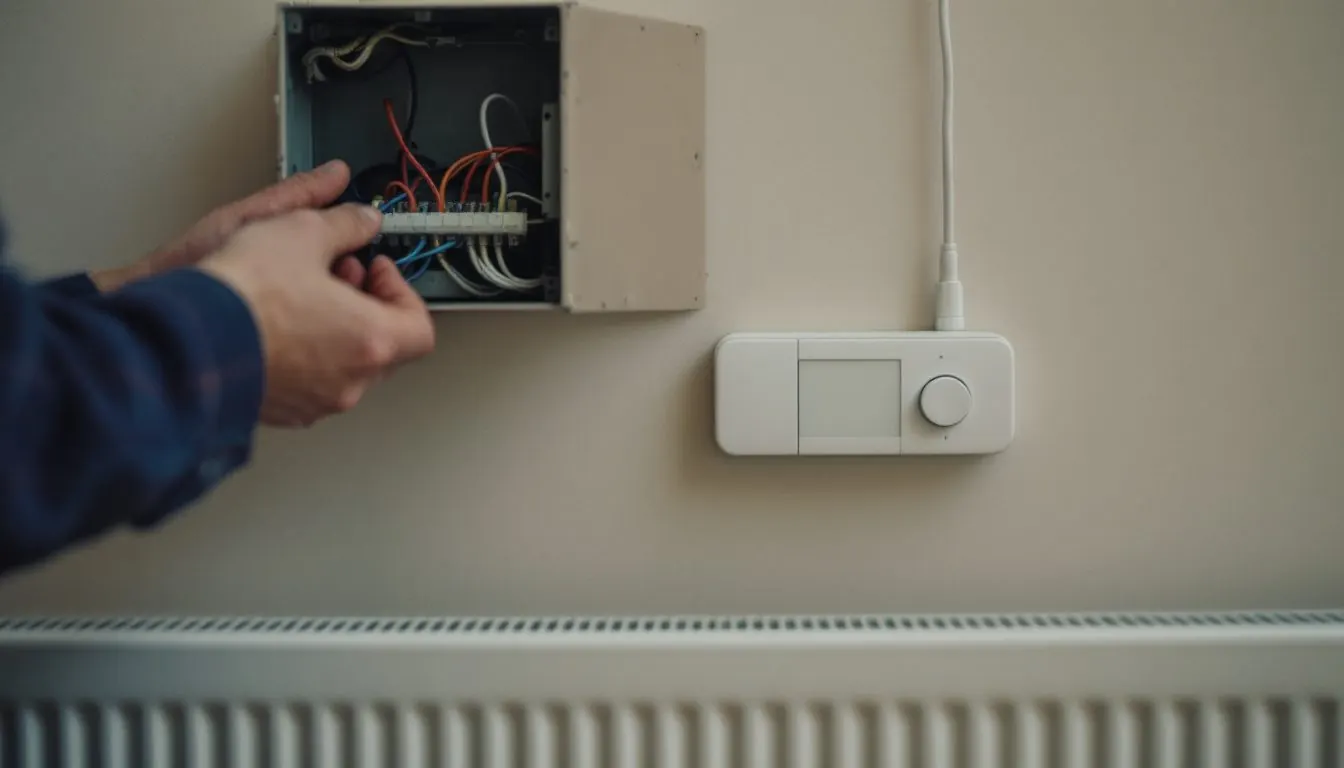
To wire a baseboard heater thermostat, shut off and lock the breaker, prove the wires dead, then connect the two supply wires from the panel to the thermostat’s LINE leads and its LOAD leads to the heater, ground to the green screw. At 240 V both supply wires are hot; at 120 V the white neutral bypasses the thermostat.
Which wires go to LINE and which go to LOAD on each maker’s thermostat?
LINE takes the cable from the breaker and LOAD feeds the heater; only the labels and colors change. Built-in units from Cadet, Dimplex and Marley use red leads for supply and black for the heater, so “black is LINE” fails on them. Honeywell’s CT410 uses screw terminals L1, L2 (line) and T1, T2 (load).
| Thermostat (type) | LINE: from breaker | LOAD: to heater | Maker’s rating | OFF opens both hots? |
|---|---|---|---|---|
| Honeywell CT410A (wall, single pole) | L1 | T1; L2 runs straight to the heater | 22A at 120-240 Vac | No: single-line break |
| Honeywell CT410B (wall, double pole) | L1, L2 | T1, T2 | 22A at 120-240 Vac | Yes: positive OFF |
| LUX LV1 (wall, single pole) | LINE | LOAD | 22 A at 250/277 VAC (5000 W) | No: dial stops at LO |
| LUX LV2 (wall, double pole) | LINE 1, LINE 2 | LOAD 1, LOAD 2 | 22 A at 250/277 VAC (5000 W) | Yes; only LINE 1 cycles |
| Cadet/Dimplex BTF1 (built-in, single pole) | Red lead | Black lead | Not printed | No |
| Cadet/Dimplex BTF2 (built-in, double pole) | Two red leads | Two black leads | Not printed | Yes |
| Marley 2500 built-in, double pole | Red leads (L1, L2) | Black leads | Not printed | Yes |
| Mysa BB V2 (smart) | L1 (L) from panel | Heater between Load and L2 (N) | 16 A; 3800 W at 240 VAC | Not stated |
| Sinopé TH1123ZB-G2 (smart) | Leads non-polarized; 2-wire or 4-wire install | 12,5 A / 3000 W at 240 V | Not stated | |
Compiled by The HVAC Brief from the Honeywell 69-1681EF-1, LUX LV1/LV2, Dimplex #720107, Marley 2500, Mysa BB V2 and Sinopé TH1123ZB-G2 (French) documents, November 2026.
How do you wire a 240 V (220) baseboard heater to a double-pole wall thermostat?
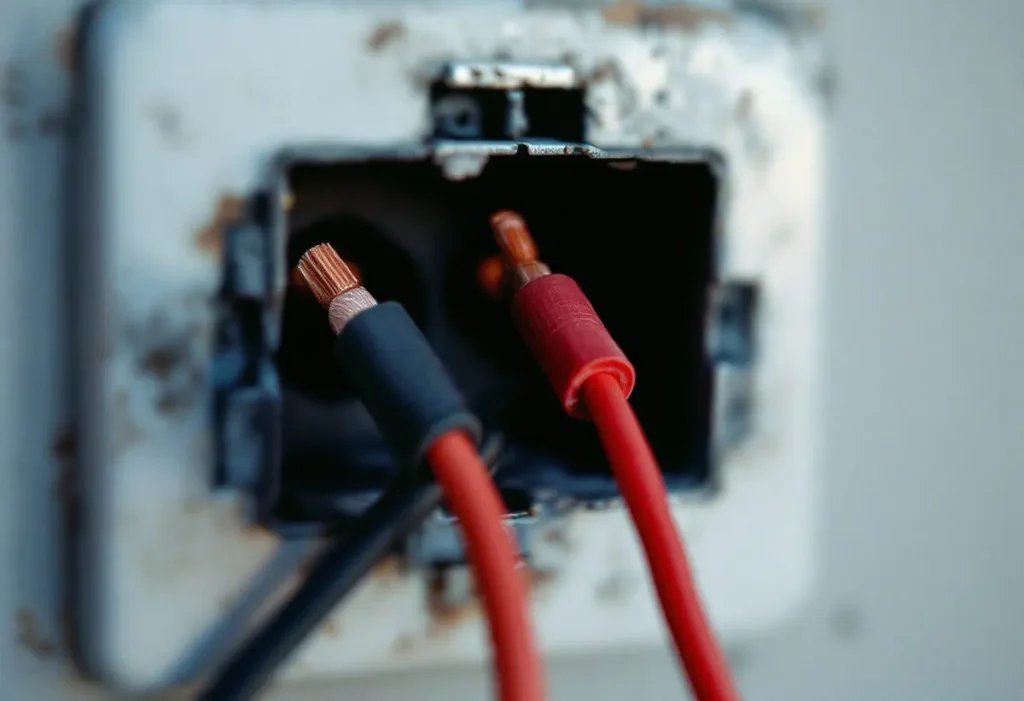
Bring the cable from the 2-pole breaker into the thermostat box, put its two hots on LINE, and run a second cable from LOAD to the heater. Cadet’s route is “from the circuit breaker to the wall thermostat, and then to the heater,” with “2 hots and 1 ground; no neutral needed,” so the white wire is a hot and Cadet says to tape it black.
- Breaker off. Dimplex lists a volt meter as a required tool: “Verify power has been turned off before starting any work!” Expect 0 V from L1 to L2 and from each hot to ground.
- Label old wires; Honeywell says to “tape the end and label it with the letter of the terminal designation.”
- Join supply hots to L1 and L2 and the heater cable to T1 and T2. On aluminum wiring Honeywell requires “CO/ALR solderless connectors.”
- Bond all grounds to the ground screw, keeping bare copper off the terminals (LUX). LUX suggests a “deep” style box.
- Power up. Honeywell: knob fully clockwise, a click, heat within two minutes; fully counterclockwise, heat stops. Marley allows 3 to 5 minutes at each end.
Honeywell mounts the thermostat “about 5 ft (1.5m) above the floor and on an inside wall,” and LUX says never directly above a baseboard; the rest is in our thermostat location guide.
How is a 120 V baseboard heater thermostat wired differently?
Only the hot goes through the thermostat. Cadet’s 120 V supply is “1 hot, 1 neutral and 1 ground,” and the white neutral connects straight to the white heater wire. On a double pole BTF2, Dimplex jumpers “the red thermostat wire labeled L2 to the black thermostat wire labeled OFF” and lands the hot on the other red lead.
Confirm the heater’s voltage first. Marley color codes element leads (yellow 120 V, blue 208 V, red 240 V, brown 277 V), and Cadet warns that a voltage “higher than what’s listed on its rating label will destroy the heater and could start a fire.”
How do you wire a built-in thermostat into the baseboard heater itself?
The supply cable goes from the breaker straight to the heater; Cadet says to route it “directly to the heater” for a BTF or Smart-Base unit. Each heater end has a factory splice joining element and return wire, and Cadet says to cut “ONLY ONE factory connection and ONLY on the side you will be wiring” (on 120 V models, the splice with one black and one white wire).
Marley’s 2500 sheet uses an orange wire nut for that splice: separate the two wires, put the thermostat’s black (load) leads on them and its red leads on the supply. With a wall thermostat instead, the supply wires go directly onto those two heater wires.
Single-pole or double-pole: which thermostat does the circuit need?
Single pole (2-wire) breaks one hot and has no OFF; double pole (4-wire) breaks one hot while cycling and both at OFF. Cadet: “A double-pole thermostat has an OFF setting; a single-pole thermostat does not.” On 240 V a single pole unit leaves one leg live at any setting, so shut the breaker before opening the heater.
EC&M’s restatement of NEC 424.20 says a thermostat used as the disconnect “must directly open all ungrounded conductors when placed in the OFF position.” LUX sells its LV2 “where local codes require that a double line disconnect thermostat be used.” Your local inspector decides which rules apply.

How many baseboard heaters can one thermostat control?
As many as fit under the lower of 80% of the breaker or the thermostat’s rating. Cadet and Dimplex both say the load is limited to “80% of the circuit breaker capacity, or the maximum amperage rating of the thermostat, whichever is lower,” which matches the 125% continuous-load sizing EC&M cites from NEC 424.3(B).
| Thermostat (rating) | 20 A, 240 V circuit | 30 A, 240 V circuit | 1,500 W heaters on 30 A |
|---|---|---|---|
| Honeywell CT410B (22 A) | 16 A = 3,840 W | 22 A = 5,280 W | 3 (4,500 W) |
| LUX LV2 (22 A, printed 5000 W) | 16 A = 3,840 W | 22 A, capped at 5000 W | 3 (4,500 W) |
| Mysa BB V2 (16 A, printed 3800 W) | 3800 W | 3800 W | 2 (3,000 W) |
| Sinopé TH1124ZB-G2 (16,7 A / 4000 W) | 16 A = 3,840 W | 16,7 A / 4000 W | 2 (3,000 W) |
| Sinopé TH1123ZB-G2 (12,5 A / 3000 W) | 12,5 A / 3000 W | 12,5 A / 3000 W | 2 (3,000 W) |
HVAC Brief calculation: limit = lower of 0.8 x breaker amps and the thermostat rating; watts = amps x 240 V, capped at any watt figure the maker prints. One 1,500 W heater draws 6.25 A.
Wire follows the breaker: Marley’s Table 1 pairs up to 12 A with #14 copper on 15 A, 12.1 to 16 A with #12 on 20 A, and 16.1 to 24 A with #10 on 30 A. Cadet requires a circuit “dedicated to electric heaters,” with heaters and thermostat that “must be in the same room.” Our watts and amps explainer has the arithmetic.
Parallel means a 3-wire splice in heater 1: one cable to the thermostat, one on to heater 2, each cut heater lead joined to one wire of each, plus a copper pigtail tying both grounds to the screw (Cadet). Cadet’s chart lists “Multiple baseboard heaters wired in series” under a heater that does not get hot.
What do Mysa and Sinopé smart line-voltage thermostats need in the box?
Mysa needs two cables in the box; Sinopé needs a minimum load. Mysa’s BB V2 guide requires “at least two (2) 120-240 VAC cables,” and says one cable “will result in a non-functional thermostat.” It also says “Do not use it with aluminum wire,” where Honeywell and Sinopé allow CO/ALR connectors.
Mysa’s panel L1 goes to Mysa L1 (L) and the heater sits between Load and L2 (N), the second hot at 240 V and the neutral at 120 V. Sinopé’s TH1123ZB-G2 leads are non-polarized, with a minimum baseboard load of 2 A / 500 W at 240 V. Neither is a 24 V device; Mysa says it is “not compatible with 24 V systems,” and a furnace thermostat cannot switch a baseboard either, as our low-voltage thermostat wiring guide explains.
What happens if you wire a baseboard thermostat wrong?
The heater never stops, never heats, or runs weak:
- Heater wire on the panel L1 supply of a Mysa: “the heater does not shut off.”
- No heater between Load and L2 (N): Mysa code H2, it “did not detect a heater.”
- Heaters in series: no real heat (Cadet); 750 W instead of 3,000 W in the diagram.
- A 240 V heater on 120 V: by our arithmetic, (120/240)² = 25% of rated watts.
- Too much load: tripping and hot contacts; see why breakers trip.
The stop line is the panel: if you cannot identify the heater’s breaker, Mysa says to stop and call an electrician. That electrician proves the circuit dead, reads 240 V between the supply wires after restoring power, checks breaker and wire gauge against Table 1, and tightens every splice. If a finished install still will not heat, work through electric baseboard heater not working.
Frequently asked questions
How do you wire a baseboard heater without a thermostat?
You should not. Cadet’s guide says “All baseboard heaters require a thermostat (sold separately),” and Marley says its heaters “must be thermostatically controlled for efficient, safe operation.” Cadet lists “No thermostat hooked up to control heater” as the reason a heater never turns off. For a simple on and off switch, use a built-in double pole thermostat.
How do you install a Cadet baseboard heater thermostat?
For a built-in Cadet or Dimplex BTF, bring the supply cable straight to the heater, cut one factory splice on that end, connect the red thermostat lead or leads to the supply and the black lead or leads to the loose heater wires. Dimplex guide #720107 shows the 120 V version, with the white neutral joined to the white heater wire.
What is the difference between a 2 wire and 4 wire baseboard thermostat?
A 2-wire thermostat is single pole: it switches one hot and has no OFF, so one leg stays live at 240 V. A 4-wire unit is double pole. LUX says its LV2 cycles only LINE 1 and that “Both LINE 1 and LINE 2 are broken when the dial is turned to the OFF position.” Honeywell calls this “positive OFF” on the CT410B.
How we researched this
On 21 November 2026 we read installation documents for the Honeywell CT410A/B, LUX LV1/LV2/LV3, Cadet baseboards (#720001), Dimplex BTF (#720107), Marley 2500, Mysa BB V2 and Sinopé TH1123ZB-G2/TH1124ZB-G2. Code points come from EC&M’s restatement of NEC Article 424; we did not open NFPA 70. YouTube results and a doityourself.com forum thread were excluded as user content. Calculations are in the table notes.
Sources
- Honeywell. “CT410A,B Installation Instructions 69-1681EF-1.” https://pdf.lowes.com/productdocuments/77477153-9053-4d1f-86cc-e7a1bd9afd71/02959472.pdf. Accessed November 2026.
- LUX Products. “Mechanical Line Voltage Thermostats LV1, LV2, LV3” (archive.org copy). https://archive.org/download/manualsonline-id-a9967ac2-5b8c-40a4-8718-354cc0a81be2/a9967ac2-5b8c-40a4-8718-354cc0a81be2.pdf. Accessed November 2026.
- Cadet. “Baseboard Owner’s Guide #720001.” https://pdf.lowes.com/productdocuments/efed3cd8-70d1-42ea-a1b6-5a1e75bd7e95/44367606.pdf. Accessed November 2026.
- Glen Dimplex Americas. “Electric Baseboard Heater Thermostat Owner’s Guide #720107.” https://www.dimplex.com/sites/g/files/emiian436/files/downloads/48734_Owners_Manual_1.pdf. Accessed November 2026.
- Marley Engineered Products. “Wiring Instructions for Marley 2500 Series Electric Baseboard Heaters.” https://www.marleymep.com/wp-content/uploads/f2500wiring.pdf. Accessed November 2026.
- Marley Engineered Products. “2500 and C2500 Series Installation, Operation and Maintenance Instructions.” https://marleymep.com/wp-content/uploads/5200-2194-010_2.pdf. Accessed November 2026.
- Mysa. “Mysa BB V2 Quick Overview.” https://media-www.canadiantire.ca/manual/product/0528901/bb2-wiring-en-f2a6d0af-fe41-4a3d-996c-bea59a8edcec.pdf. Accessed November 2026.
- Sinopé Technologies. “Guide d’installation TH1123ZB-G2 / TH1124ZB-G2.” https://support.sinopetech.com/wp-content/uploads/2025/12/660-0300-0000-B-Guide-installation-TH1123ZB-G2-FR-web.pdf. Accessed November 2026.
- EC&M. “Article 424: Fixed Electric Space-Heating Equipment.” https://www.ecmweb.com/national-electrical-code/article/20900735/article-424-fixed-electric-space-heating-equipment. Accessed November 2026.
Leave a Reply