
An electric baseboard heater buzzing or humming while it heats is usually the element pinched against a bowed cabinet, which Cadet fixes by loosening and retightening the mounting and element screws. A buzz at the wall thermostat, or crackling from the wiring box, is different: switch the breaker off, because loose 240 V connections are a fire risk.
Find where the sound comes from first: stand at the heater while it runs, then at the wall thermostat, and match it to the table. Cadet calls its baseboards “virtually noise-free,” so a sound worth searching for has a cause. Furnace and heat pump sounds are sorted in HVAC noises and what they mean.
| Where you hear it | What it sounds like, and when | Likely cause | What the maker document says to do | Fire risk? |
|---|---|---|---|---|
| Inside the heater, along its length | Steady hum or buzz whenever it is on, sometimes a ping | Element pinched by a cabinet bent to fit an uneven wall | Cadet: loosen mounting and element screws, tap, retighten | No |
| Inside the heater, new install | Loud hum, heater far too hot | 120 V heater wired to a 240 V circuit | Cadet: breaker off, replace the heater | Yes |
| Whole cabinet | Ticking or creaking after it turns on or off | Metal expanding and contracting | Stelpro: normal; Marley: screws backed off ¼ turn | No |
| Near one end of the heater | Click off, click on, repeating in a cold room | Safety limit opening because the heater overheats | Marley: limit “should not operate”; clear it, then service | Warning sign |
| Wall thermostat (dial type) | Buzz or sizzle as the room nears the set temperature | Worn or slow contacts carrying full heater current | Honeywell CT410: a good one clicks, it does not buzz | Yes |
| Wiring box at the heater end, or the thermostat box | Crackling, sizzling, hot plastic smell | Loose splice or terminal arcing | Cadet: power off, tighten all connectors | Yes: stop now |
Compiled by The HVAC Brief from Cadet, Marley, Stelpro and Honeywell documents; fire risk column from Technical Safety BC investigations of loose 240 V connections.
Why does an electric baseboard heater hum or buzz the whole time it is on?
Usually because the element is pinched. Cadet’s own noise article says the sound “is essentially caused by the heating element being installed on a wall that is warped or slightly uneven,” and its baseboard owner’s guide #720001 lists “creaking, popping or humming noises” with the fix “cabinet may need slight adjustment.”
The factory builds the element square to the cabinet back; a bowed wall twists the cabinet as the screws go in. That pinch, Cadet says, “more often than not is what causes the humming noise.” Fix it as the Cadet noise article shows:
- Run the heater 15 minutes, then switch off its breaker.
- Loosen, without removing, the screws holding the cabinet to the wall.
- Loosen the element grounding screw near the middle, seen through the top vent.
- Bump the cabinet with your palm so the element settles.
- Tighten mounting screws, then the element screw; restore power.
Marley’s 2500/C2500 manual adds one detail the Cadet video skips: after driving each mounting screw, back it out at least ¼ turn “to allow heater to expand and contract during use.”
Could the wrong voltage make a baseboard heater hum?
Yes, and it is the one heater hum that needs the breaker off right away. Cadet names a 120 V baseboard on a 240 V supply as a cause of “a humming noise,” and its technical troubleshooting page says such a heater “will try to deliver four times its rated wattage, causing it to overheat.” The opposite mistake is quiet but weak, a cause covered in electric baseboard heater not working.
| Heater nameplate | Circuit it is wired to | Watts actually drawn | Share of rating | Amps |
|---|---|---|---|---|
| 1,000 W at 120 V | 120 V | 1,000 W | 100% | 8.33 A |
| 1,000 W at 120 V | 240 V | 4,000 W | 400% | 16.67 A |
| 1,000 W at 240 V | 240 V | 1,000 W | 100% | 4.17 A |
| 1,000 W at 240 V | 208 V | 751 W | 75% | 3.61 A |
| 1,000 W at 240 V | 120 V | 250 W | 25% | 2.08 A |
HVAC Brief calculation: element resistance R = V² ÷ P at the nameplate rating (14.4 ohms for 120 V, 57.6 ohms for 240 V), then watts = V² ÷ R and amps = V ÷ R at the supply voltage. The 400%, 75% and 25% results match the figures on Cadet’s troubleshooting page.
If the nameplate reads 120 V and a two pole breaker feeds the heater, it is on 240 V. Correct supply wiring is in our baseboard heater thermostat wiring guide.
Is ticking or popping from a baseboard heater normal?
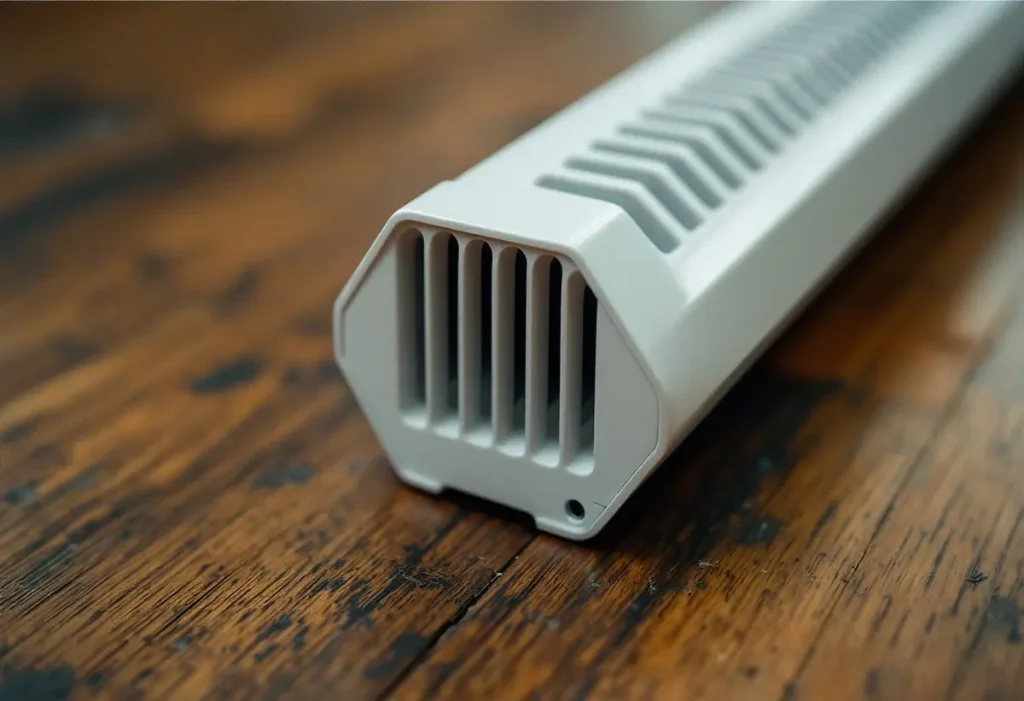
Yes. Stelpro’s support FAQ answers it directly: “Metal expands when the heat comes on and contracts when the temperature cools. This is what causes the clicking sounds.”
Stelpro adds that “electronic thermostats greatly reduce these expansion/contraction noises,” and Resideo explains why. Its TH401 TRIAC thermostat page says these units “can operate on 15-second cycles,” which means fewer “clicking at the thermostat, or crackling at their baseboard heaters.” Short cycles keep the steel from swinging between cold and full heat.
Does a baseboard thermostat buzzing mean it is failing?
On a dial (mechanical) line voltage thermostat, a sustained buzz usually means the contacts are not seating cleanly while they carry the heater’s full current. Honeywell’s CT410 instructions describe the healthy behavior as a “clicking sound” as the switch makes contact and another as it breaks; none of the maker documents we read describes a buzz as normal.
A buzzing switch passes amps through a poor contact, which makes heat at the dial. Warmth alone is not proof on an electronic unit (Stelpro says its housing “can become hot to the touch” normally), but a hot, discolored or crackling dial thermostat should be switched off at the breaker and replaced. A replacement must match the single or double pole design and the current rating; Honeywell rates the CT410 at 22 A at 120 to 240 V.
Where a low voltage thermostat drives the heater through a relay, which Cadet allows only when the load exceeds a line voltage thermostat’s rating, the hum may come from that relay box.
Which baseboard heater sounds are a fire hazard?
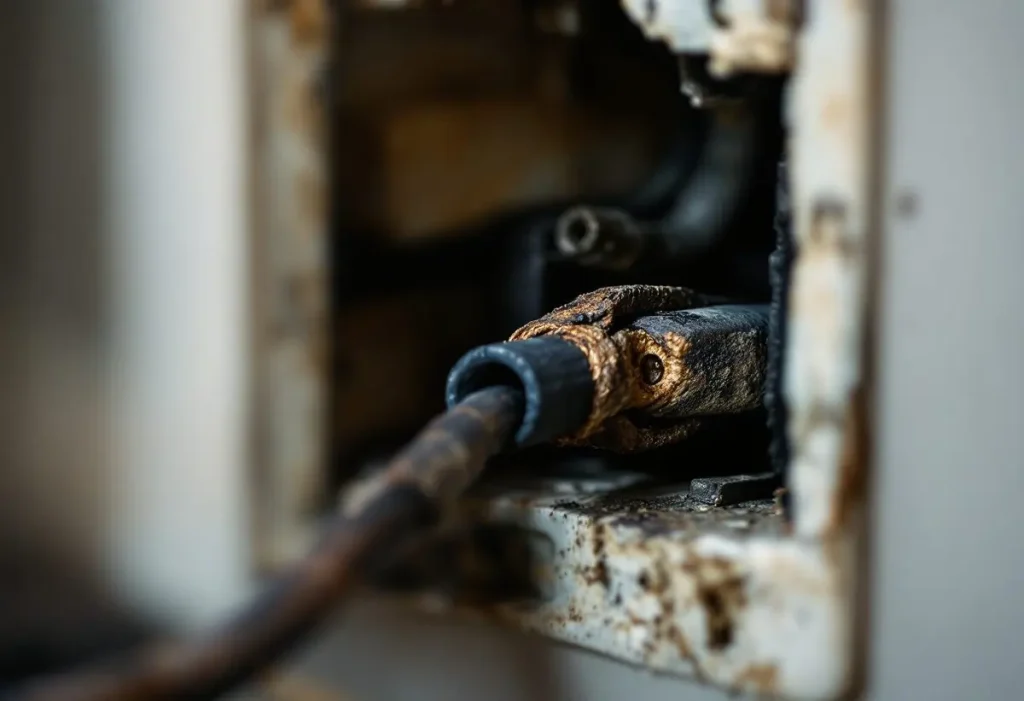
Crackling, sizzling or buzzing from a wiring box, or any sound with a hot plastic smell. Those mark a loose 240 V connection arcing, and a breaker does not reliably stop it.
Technical Safety BC, British Columbia’s electrical regulator, investigated a baseboard heater that “caught fire explosively” in a Whistler family room in October 2016. Its incident summary 5608515 found it “plausible that a loose 240 volt wire connection created a condition of excessive heat,” or a loose connection inside the heater’s relay. The circuit was loaded at only 8 amps on a 22 amp relay, and the firefighter stated “the circuit breaker did not trip.”
A second Technical Safety BC investigation, in a Nelson building with electric baseboard heat, describes the sequence: a loose termination produced “a high impedance arcing condition,” which “resulted in an elevated temperature at the termination point” until it exceeded the insulation rating and started a fire. A loose termination of this kind heats without adding load current, so a breaker sized for the heater can stay closed, as the Whistler breaker did.
Switch the breaker off and leave it off. Cadet’s fix for loose supply connections is to turn off power at the main panel and “inspect and/or tighten all the wire connectors inside the heater at connection points inside junction boxes or at the wall thermostat.” An electrician will look for browned insulation or a scorched connector and remake any heat damaged splice. A sharp smell without a sound is covered in electric heater smells like burning.
Why does my baseboard heater click off and on while the room is still cold?
That pattern points at the safety limit, not the thermostat. Cadet’s owner’s guide says every baseboard has a high temperature shutoff that “automatically resets after cooling,” so an overheating heater clicks off, cools and clicks back on.
Marley is clear that this is not normal: “During normal use, this safety control should not operate.” Marley asks for 6 inches between furniture and the heater, and Cadet’s guide asks for at least 12 inches clear above and in front. Lint packed in the fins also trips it; Marley says to vacuum them. If it still cycles, Marley says to disconnect power and have it serviced. The limit itself is covered with a resistance test in our baseboard troubleshooting sequence, and the risks of running a unit nonstop are in can you leave baseboard heaters on all the time.
Frequently asked questions
Do electric baseboard heaters make noise?
A little. Cadet calls its baseboards “virtually noise-free,” and Stelpro says the normal sound is clicking as the metal expands when heat comes on and contracts as it cools. A steady hum, a buzz at the thermostat or crackling from a wiring box is not normal operating noise.
Why is my electric baseboard heater humming?
Usually an element pinched by a cabinet bent to fit an uneven wall. Cadet’s fix: breaker off, loosen the mounting screws and the element ground screw, tap the cabinet, retighten. Cadet also lists a 120 V heater on a 240 V supply as a humming cause; that one means replacing the heater.
Is a buzzing baseboard heater a fire hazard?
It is when the buzz comes from a thermostat or wiring box. Technical Safety BC traced a 2016 Whistler baseboard fire to a plausible loose 240 V connection, and the breaker did not trip, because a loose connection makes heat without raising the current. A hum along the element from a pinched cabinet is a nuisance, not a fire sign.
What is the life expectancy of electric baseboard heaters?
Cadet’s technical troubleshooting page says baseboard heaters “often have a life more than 20 years,” against 8 to 12 years for wall heaters. On an old heater, the wiring box and thermostat contacts are what an electrician checks first for heat damage.
Electric baseboard heaters are typically controlled by what kind of thermostat?
A line voltage thermostat. Cadet says a line voltage thermostat “is typically used with single-room heaters, such as electric wall heaters or electric baseboard heaters,” and that a low voltage thermostat should be used only with a relay when the load exceeds the line voltage thermostat’s rating. Our electric baseboard heater guide covers sizing and running cost.
How we researched this
On 24 November 2026 we read the nine maker and regulator documents listed below, including Cadet’s noise article and video transcript and two Technical Safety BC investigations (5608515 and II-966933-2020). The wrong voltage table is our own calculation from Ohm’s law, checked against Cadet’s stated 400%, 75% and 25% figures. Ranking forum threads (Mike Holt, doityourself.com, diychatroom) supplied no facts. National Electrical Code torque rules were not opened and are not cited.
Sources
- Cadet. “Fix A Buzzing Baseboard Heater Sound In 5 Easy Steps.” https://www.cadetheat.com/en-us/articles/fix-baseboard-heater-noise. Accessed November 2026.
- Cadet. “Baseboard Owner’s Guide #720001.” https://pdf.lowes.com/productdocuments/efed3cd8-70d1-42ea-a1b6-5a1e75bd7e95/44367606.pdf. Accessed November 2026.
- Cadet. “Technical Troubleshooting.” https://www.cadetheat.com/en-us/support/technical-troubleshooting. Accessed November 2026.
- Marley. “Electric Baseboard Heaters 2500 and C2500 Series Installation, Operation and Maintenance Instructions.” https://marleymep.com/wp-content/uploads/5200-2194-010_2.pdf. Accessed November 2026.
- Stelpro. “Support and FAQ.” https://www.stelpro.com/en/tools-and-support/support-and-faq/. Accessed November 2026.
- Resideo. “Line Volt Manual TRIAC Electric Heat T-Stat TH401/U.” https://www.resideo.com/us/en/pro/products/air/thermostats/line-volt-thermostats/line-volt-manual-triac-electric-heat-t-stat-th401-u. Accessed November 2026.
- Honeywell. “CT410A,B Installation Instructions 69-1681EF-1.” https://pdf.lowes.com/productdocuments/77477153-9053-4d1f-86cc-e7a1bd9afd71/02959472.pdf. Accessed November 2026.
- Technical Safety BC. “Incident Summary 5608515: Electric fault sets baseboard heater on fire.” https://files.technicalsafetybc.ca/v3/assets/bltdec2ded849740f4d/bltff94c4e0591113c3/63326f5e33c35161a7930dcf/electrical_incident_summary_reference_5608515_whistler_15oct2016.pdf. Accessed November 2026.
- Technical Safety BC. “Loose conductor termination creates arcing conditions.” https://www.technicalsafetybc.ca/regulatory-resources/incident-investigations/loose-conductor-termination-creates-arcing-conditions. Accessed November 2026.
Leave a Reply