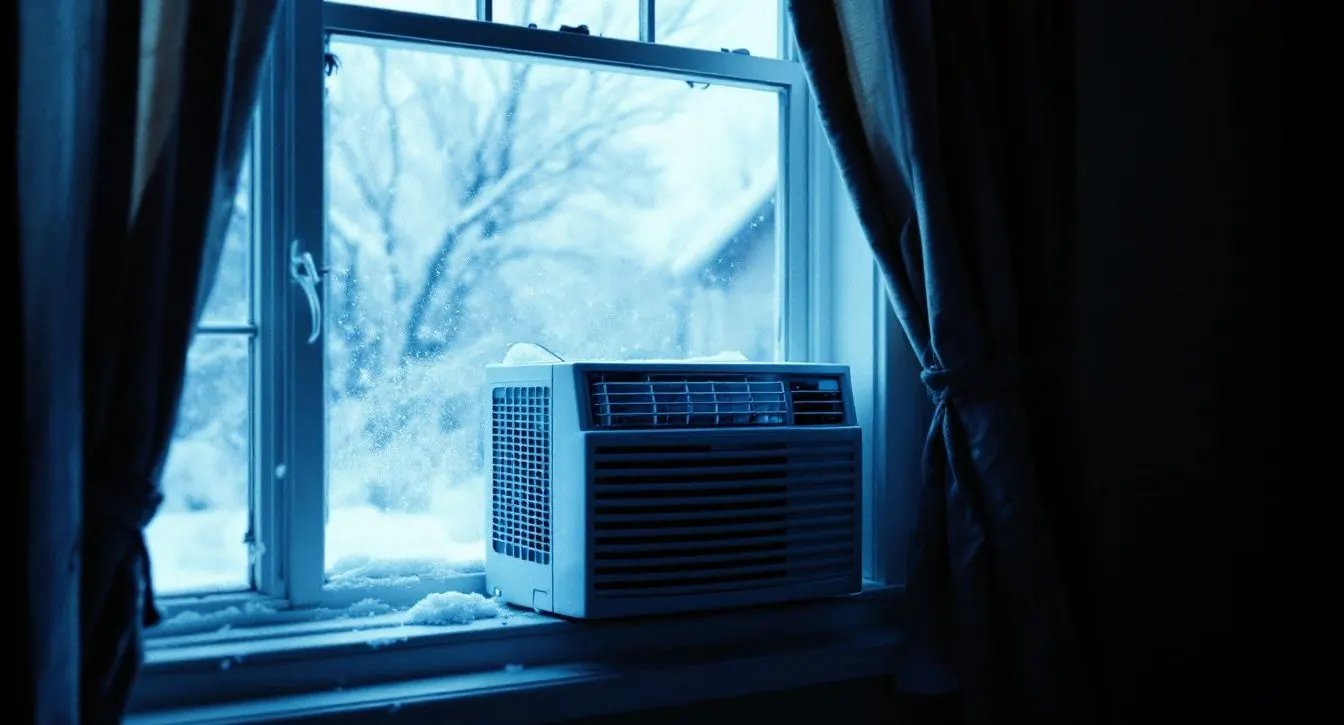
Yes, in a heated home it is bad to leave a window AC in the window all year. Every manual we read with a winter section says to remove it, and NREL’s lab data imply 5 to 42 cfm of cold air past an installed unit, about $14 to $120 of furnace gas over a Chicago winter.
The only sanctioned alternative comes from the national lab, not the makers. NREL’s guide for the Department of Energy says: “Remove unit from window or seal it up completely on the inside after cooling season is over; otherwise, air will leak through the unit itself” (NREL/DOE guide, archived copy).
What do Whirlpool, Midea, GE and LG manuals say about leaving the unit in all winter?
All six manuals with a winter section say to take the unit out, and none of the 11 we read says it may stay in through winter. Whirlpool’s WHAW050BW is the bluntest: under “Winter Storage”, step 1 is “Remove the air conditioner according to the installation instructions” (Whirlpool WHAW050BW, p. 19).
| Manual | Winter instruction, as printed | Water and cold weather |
|---|---|---|
| Whirlpool WHAW050BW | Remove it; cover with plastic or the original box | No base pan step |
| Toshiba RAC-WK0512CMRU, Keystone KSTAW06QD | “If you plan to store the air conditioner during the winter, remove it carefully from the window” | Not addressed |
| Midea MAW08V1QWT | Same removal wording; store “in a cool dry place” | “If water is present, carefully drain it” |
| Midea MAW08S1VWWT | “carefully uninstall the unit from the window” | Not addressed |
| Black+Decker BWAC08WTB | Store “in dry environment”, plastic or original box | Pull the rear drain plug while the unit is still outdoors |
| Keystone KSTAW05A | “The carton is the best way to store unit during winter” | Not addressed |
| GE AEM08, Haier QHC08 | No winter section | Must not be used below freezing (32°F) |
| LG LW8019ER | No winter section | Store and install away from temperatures below freezing |
| GE AEC08 | Protect the refrigerant tubing in storage | Not addressed |
| NREL guide for DOE | Remove, or seal it up completely on the inside | Otherwise air leaks through the unit |
Compiled by The HVAC Brief from the 11 maker manuals and the NREL guide listed in How we researched this, read November 2026. Quotation marks mark exact wording.
LG’s line reads like boilerplate for a unit whose back half lives outdoors, but it is printed (LG LW8019ER, p. 4).
How much heat escapes past a window AC left in the window over a winter?
About 8 to 65 therms of heat in a Chicago winter for one unit, depending on the installation. That is $14 to $120 on an 80 percent gas furnace, or $41 to $346 with electric resistance heat, at current average US prices.
| Winter setup | Air leak (cfm) | Heat lost, Chicago winter | Gas furnace, 80% AFUE | Electric resistance |
|---|---|---|---|---|
| Unit removed, sash shut and locked | 0 added | 0 | $0 | $0 |
| Left in, side gaps foam sealed, cabinet uncovered | 5 to 9 | 7.7 to 13.9 therms | $14 to $26 | $41 to $74 |
| Left in, stock accordion panels | 15 to 42 | 23.2 to 65.0 therms | $43 to $120 | $124 to $346 |
| Left in, sealed completely on the inside | Not measured | Near zero only if airtight | Not calculated | Not calculated |
HVAC Brief calculation: heat = 1.08 × cfm × 24 h × heating degree days. Leaks read from NREL’s charts at 5 Pa and 10 Pa; Chicago O’Hare normal of 5,974 heating degree days (NOAA 1991 to 2020, base 65°F); gas $15.34 per thousand cubic feet (EIA, 2025) at 1,036 Btu per cubic foot; electricity 18.16 cents per kWh (EIA, August 2026).
The 1.08 is 0.075 lb per cubic foot × 60 minutes × 0.24 Btu per lb °F, so each cfm leaking all winter costs about 155,000 Btu in Chicago. Data: NOAA’s 1991 to 2020 normals, EIA’s residential gas series and Electric Power Monthly Table 5.6.A and EIA’s units page.
Other cities scale by degree days: New York’s Central Park normal is 4,553 (0.76 times Chicago), Minneapolis 7,399 (1.24 times) and Atlanta 2,531 (0.42 times). The 80 percent is the federal floor for non-weatherized gas furnaces in 10 CFR 430.32(e); a 95 percent furnace trims each gas figure by about 16 percent.
The math holds the leak at one steady pressure all winter, and it leaves out conduction through the cabinet, because no maker we read publishes a U-factor for a window AC case. A blower door test in a home energy audit measures your actual house.

Where does the cold air get in: around the window AC or through it?
Mostly around it. In NREL’s chamber tests the installation gaps leaked 10 to 35 cfm at 5 to 10 Pa, while the cabinet itself leaked about 5 to 9 cfm (Winkler, Booten et al., NREL slides, 2012).
NREL tested two Frigidaire 10,000 Btu/h units and a Haier 5,000 Btu/h unit. At 50 Pa the cabinets alone leaked about 18 to 26 cfm and the installations about 52 to 90 cfm. For a whole house, the slide puts it at “~10-20% more leakage for a 1960’s 1,280 sq. ft. house,” and the guide calls it the equivalent of “a 5-in2 hole in the outside wall.”
The 5 and 10 Pa pressures are realistic. Stack effect alone pushes about 2.7 Pa across a window 3 m below a house’s neutral plane at 32°F outdoors and about 5.4 Pa at 0°F (3,463 × height × the difference of the inverse absolute temperatures), and wind adds to that.

If the window AC has to stay in all year, what makes it less bad?
Close both leak paths from the inside before the first frost. NREL puts the materials at $10 to $15.
- Swap the accordion panels for rigid foam. NREL says ¾ to 1½ inch foam fits most window channels; tape it to the window, frame and unit.
- Replace the sash foam strip with backer rod. NREL found the maker strips “prone to air leaks.” Plug the top of each side channel too.
- Close the vent lever. Toshiba’s RAC-WK0512CMRU names the position Vent Closed, in its filter cleaning steps; our guide to the vent lever during wildfire smoke explains what it opens.
- Seal the indoor grille. This is NREL’s “seal it up completely on the inside”: foam around the unit does nothing for the 5 to 9 cfm through it.
- Drain the base pan. Black+Decker’s BWAC08WTB has a rubber drain plug at the back, lower left corner, for this.
An outdoor wrap alone does not do NREL’s job, because the measured cabinet leak runs from the room through the unit. Advice on our AC unit cover in winter page is for central condensers, a different machine. Check the brackets and sill against our window AC installation guide before snow season.
Can you run a window AC in winter, or does it need to be a heat pump?
Not a cool-only unit below freezing. GE’s AEM08 manual says: “This cool-only air conditioner was not designed for freezing outdoor conditions. It must not be used when the outdoor temperature is below freezing (32°F)” (GE AEM08, p. 5). Haier’s QHC08 prints the same 32°F line. A unit that heats is meant to stay in, though the leak paths above still apply; our window heat pump guide compares the models.
What goes wrong when you take a window AC out for the winter?
Spilled water, bent tubing and a unit stored on its side. Midea’s MAW08V1QWT says “Be careful not to spill any potentially standing water from the unit’s base pan” and to store it “in a cool dry place” (Midea MAW08V1QWT manual PDF). Black+Decker has you pull the drain plug “while it is still outdoors” (Black+Decker BWAC08WTB, p. 15).
GE’s AEC08 says to “avoid damage to the refrigerant tubing” in storage, and Keystone’s KSTAW05A calls the carton “the best way to store unit during winter” (Keystone KSTAW05A, p. 14). Store it upright; if it winters on its side, our page on how long to wait before turning on a window AC covers the restart. Then lock the sash: the zero in our table assumes a shut, latched window.
Frequently asked questions
Can I leave a window AC in winter if I cover it from the outside?
An outside cover keeps snow off but does not meet NREL’s standard, which is to remove the unit or “seal it up completely on the inside.” NREL measured about 5 to 9 cfm leaking through the cabinet itself at 5 to 10 Pa, so the airtight seal belongs on the room side.
How do I store a window AC for winter?
Remove it per the installation steps, drain the base pan, then cover the unit with plastic or put it back in its box. Whirlpool’s WHAW050BW lists exactly those two steps under Winter Storage, and Midea’s MAW08V1QWT adds storing it in a cool dry place. Keep it upright.
Can I use a window AC inside, away from a window?
No. A window unit dumps its heat from the back half. Keystone’s KSTAW05A installation page says the rear of the unit “must be outdoors, not inside a building or garage,” with clear air space for airflow through the condenser. Run indoors, it heats the room.
Does a window AC left in the window raise the heating bill?
Yes, by the air it lets in. Using NREL’s leak data and NOAA’s 5,974 heating degree days for Chicago, our calculation puts one unit at about $14 to $120 a winter on an 80 percent gas furnace, or $41 to $346 with electric resistance heat.
How we researched this
In November 2026 we read the winter, storage and cold weather pages of 11 window AC manuals: Whirlpool WHAW050BW, Toshiba RAC-WK0512CMRU, Keystone KSTAW06QD and KSTAW05A, Midea MAW08V1QWT and MAW08S1VWWT, Black+Decker BWAC08WTB, GE AEM08 and AEC08, Haier QHC08 and LG LW8019ER, mostly through the ManualsLib Mexico mirror. Leak figures are read off NREL’s 2012 slide charts; the full report, NREL/TP-5500-57617, was not retrievable. Scripts are kept with this article.
We excluded ranking contractor and affiliate pages, which cite no measurements. NREL’s slide lists a “47 in2” reduction beside 90 CFM50; our orifice math for 90 cfm at 50 Pa gives about 47 cm2 (7.2 square inches), so we did not use it.
Sources
- NREL for DOE Building America. “A Homeowner’s Guide to Window Air Conditioner Installation for Efficiency and Comfort.” Archived copy. https://webarchive.library.unt.edu/web/2016id_/http://www.nrel.gov/docs/fy13osti/58187.pdf. Accessed November 2026.
- NREL (Winkler, Booten, Christensen, Tomerlin). “Laboratory Performance Testing of Residential Window Mounted Air Conditioners.” https://www.energy.gov/sites/default/files/2013/12/f5/testing_residential_ariconditioners_booten_winkler.pdf. Accessed November 2026.
- Whirlpool. “WHAW050BW Use and Care Guide.” https://www.manualslib.mx/manual/804165/Whirlpool-Whaw050Bw.html?page=19. Accessed November 2026.
- LG. “LW8019ER Owner’s Manual.” https://www.manualslib.mx/manual/627282/Lg-Lw8019Er.html?page=4. Accessed November 2026.
- GE Appliances. “AEM08 Owner’s Manual.” https://www.manualslib.mx/manual/269240/Ge-Aem08.html?page=5. Accessed November 2026.
- Midea. “MAW08V1QWT Manual.” https://pdf.lowes.com/productdocuments/d81ddad6-fa54-4f90-98da-85710743efa9/84328808.pdf. Accessed November 2026.
- Black+Decker. “BWAC08WTB Instruction Manual.” https://www.manualslib.mx/manual/970786/Black-And-Decker-Bwac08Wtb.html?page=15. Accessed November 2026.
- Keystone. “KSTAW05A User Manual.” https://www.manualslib.mx/manual/236438/Keystone-Kstaw05A.html?page=14. Accessed November 2026.
- NOAA NCEI. “U.S. Climate Normals 1991 to 2020, annual heating degree days.” https://www.ncei.noaa.gov/access/services/data/v1?dataset=normals-annualseasonal-1991-2020. Accessed November 2026.
- U.S. EIA. “U.S. Price of Natural Gas Delivered to Residential Consumers.” https://www.eia.gov/dnav/ng/hist/n3010us3a.htm. Accessed November 2026.
- U.S. EIA. “Electric Power Monthly, Table 5.6.A.” https://www.eia.gov/electricity/monthly/epm_table_grapher.php?t=epmt_5_06_a. Accessed November 2026.
- U.S. EIA. “Units and calculators explained.” https://www.eia.gov/energyexplained/units-and-calculators/. Accessed November 2026.
Leave a Reply