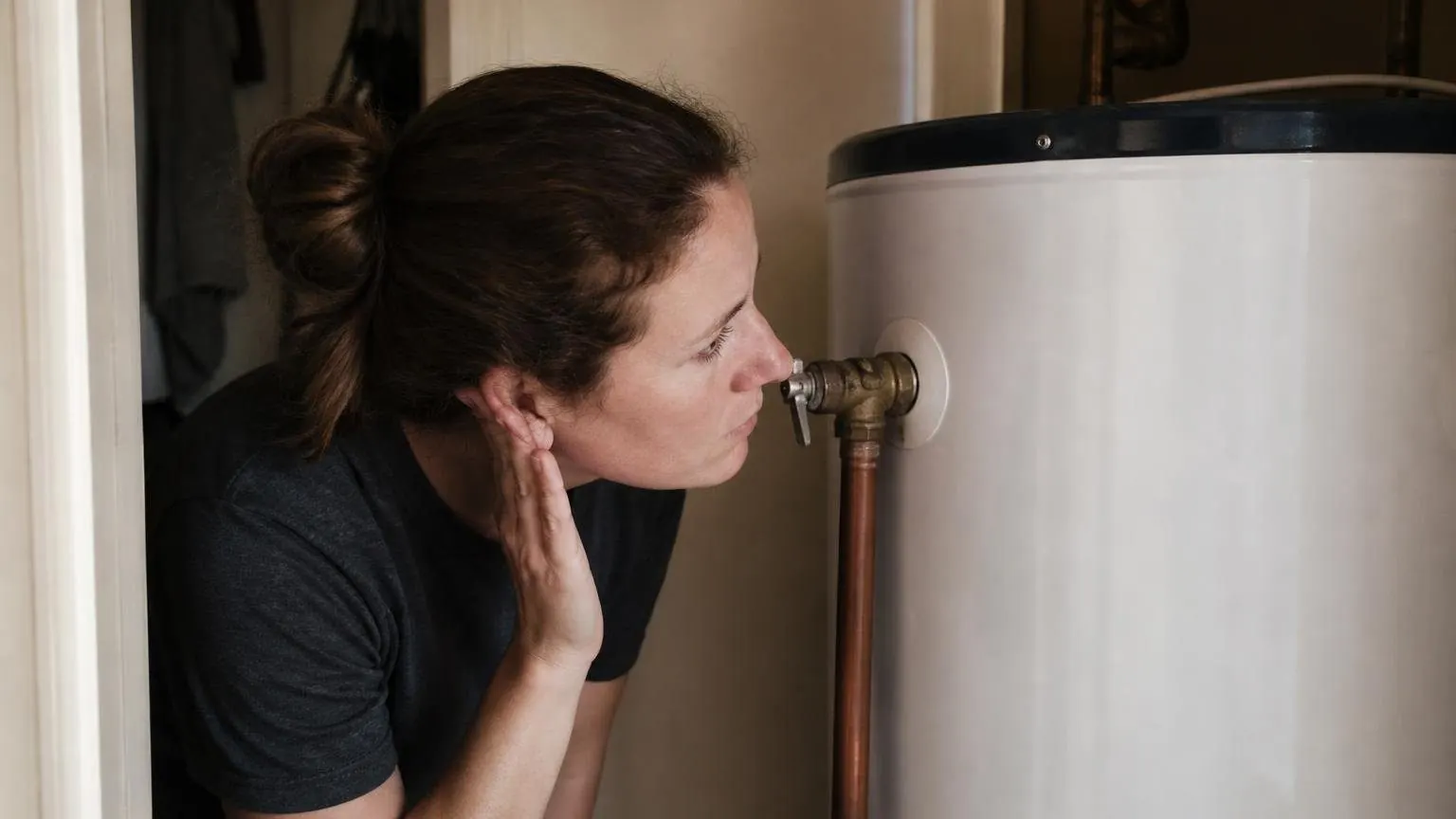
A water heater whistling noise is water or gas forced through a narrow opening. On a tank, check three spots: a partly closed cold inlet valve, the relief valve weeping under thermal expansion, or limed electric elements. On gas and tankless units, suspect burner, vent or inlet screen. A relief valve gushing very hot water means shut the gas off.
Where on the heater is it whistling, and when does it start?
Timing sorts it: a whistle only while a tap runs is a water restriction; one after the taps close, during reheat, is pressure or combustion. Rheem’s noise guide says “When water is pushed through a constricted opening, it creates a whistling or screeching sound” (Rheem, 2026).
| Where | When | Cause the document gives | Fix | Urgency |
|---|---|---|---|---|
| Cold inlet valve on top of the tank | While water runs or the tank refills | Partly closed inlet valve (Rheem guide) | Open it fully; never run the heater with it closed (A.O. Smith 326940) | Low |
| Relief (T&P) valve, slow weep | During reheat, no taps open | Thermal expansion in a closed system (Rheem AP21980; State bulletin 45) | Add pressure control; never plug the outlet | Medium |
| Relief valve, gush of very hot water | Any time | “a malfunctioning thermostat” (State bulletin 52) | Gas off (A.O. Smith FVIR guide) or breaker off; call service | Stop now |
| Electric tank, element covers | While elements heat | “Lime formation on elements” (Bradford White 238-54711) | Clean or replace elements | Low |
| Gas tank burner, vent or blower | Only while the burner fires | Dirty blower wheel, blocked vent, failed bearings (A.O. Smith info center) | Clear vent and blower; motor swap by a pro | Medium; high with gas odor |
| Tankless cabinet | While hot water flows | Clogged inlet screen; combustion leak, venting or gas pressure (Bosch GWH 715 ES) | Clean the screen; gas pressure reading by a technician | Medium |
| Recirculation pump line | Only while the pump runs | Not in any maker document we read (our inference: loop valve) | Unplug the pump to confirm | Low |
Compiled by The HVAC Brief from Rheem AP21980 and Rheem’s 2026 noise guide, A.O. Smith 326940, 100400765 and info center, State handbook 320990 and bulletin 52, Bradford White 238-54711 and Bosch’s GWH 715 ES page.
Is a whistling relief valve dangerous, and when do you shut the heater off?
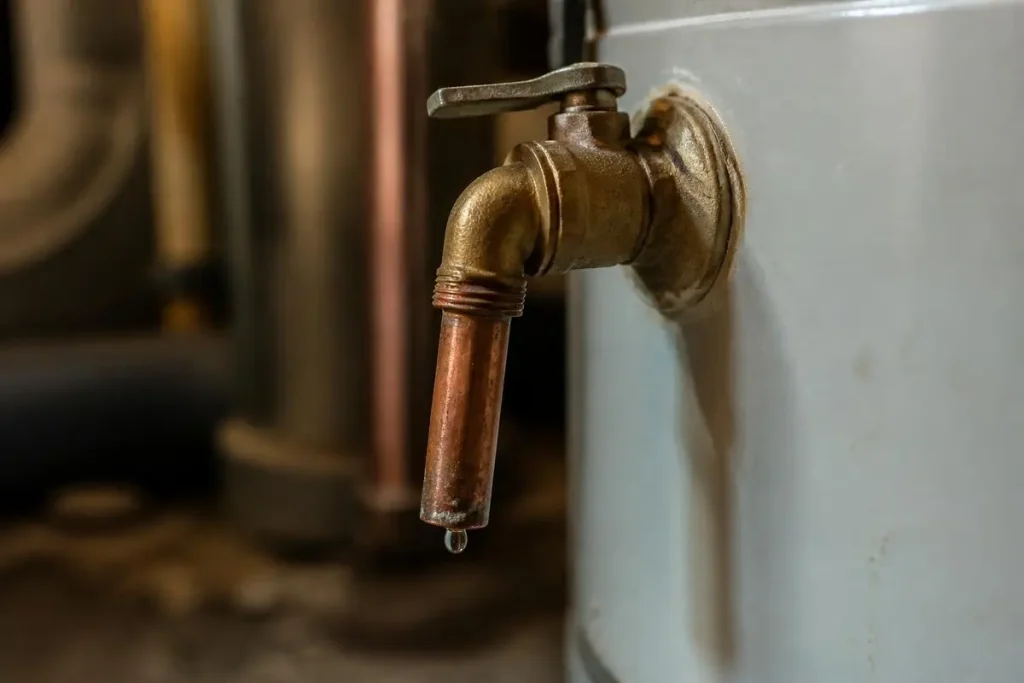
A slow weep and whistle during reheat is a pressure fault to fix within days; a large flow of very hot water is an overheating tank and the heater goes off now. State bulletin 52 says the valve “relieves water slowly when actuating on pressure” and “quickly when actuating on temperature,” and for the fast case, “The only cause of this problem is a malfunctioning thermostat” (State bulletin 52).
For that case the A.O. Smith FVIR guide says “turn the gas supply valve off and call a qualified person,” and warns “Do not cap or plug the T&P Relief Valve or discharge pipe” (A.O. Smith 100400765). On electric, use the breaker. Bulletin 52 puts the usual ratings at 210°F and “generally 150 psi.” Testing and pipe rules sit in our water heater relief valve guide; if water is pooling, start with finding where the tank is leaking.
Why does the water heater whistle after a shower, then stop?
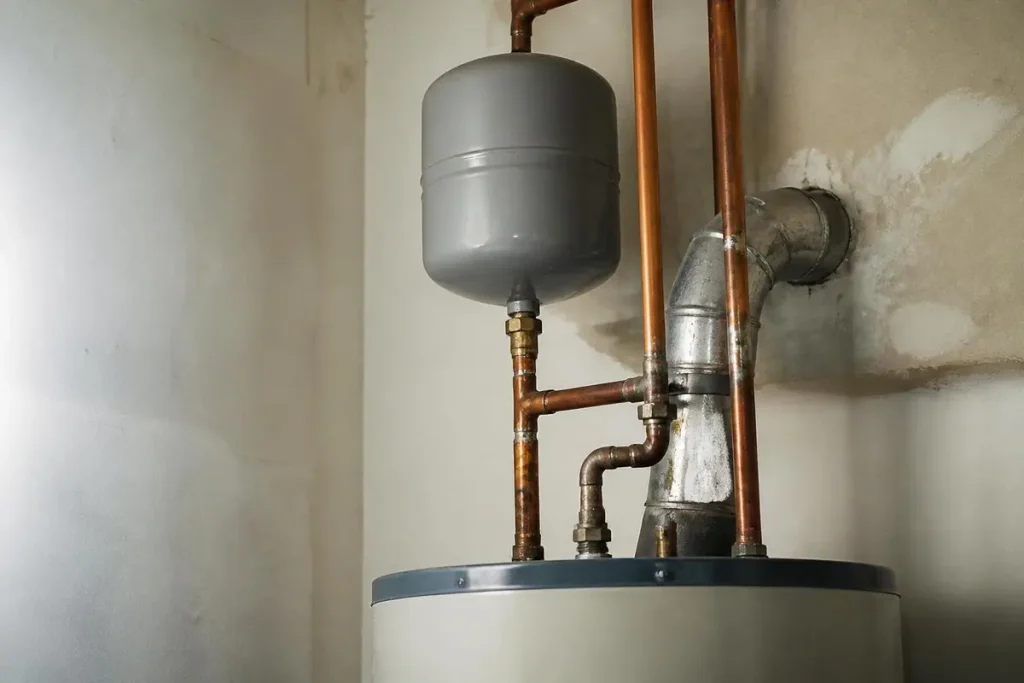
A shower starts two things: cold water refills the tank through the inlet valve, and the burner or elements fire. A whistle that fades as the refill slows is the inlet; one that starts a minute or two later with every tap closed is the relief valve or the burner.
For the inlet, open the handle fully: A.O. Smith manual 326940 says in capitals not to operate the heater with the cold water inlet valve closed (A.O. Smith 326940). For the reheat case, State’s handbook lists thermal expansion symptoms as effects “only noticeable after hot water use followed by periods of no water use,” a relief valve that drips during recovery, creaking pipes and dripping faucets (State handbook 320990, bulletin 45).
How much water does a reheating tank push back in a closed system?
About half a gallon per full reheat of a 50 gallon tank at 120°F, and in a home with a check valve, backflow preventer or pressure reducing valve that water has nowhere to go but the relief valve. We calculated it from the USGS density table (USGS):
| Incoming water | 50 gal to 120°F | 50 gal to 140°F |
|---|---|---|
| 40°F (winter) | 0.57 gal (73 oz) | 0.84 gal (108 oz) |
| 50°F | 0.56 gal (72 oz) | 0.83 gal (107 oz) |
| 60°F | 0.52 gal (67 oz) | 0.80 gal (102 oz) |
| 70°F (summer) | 0.47 gal (60 oz) | 0.74 gal (95 oz) |
HVAC Brief calculation: tank gallons × (density at inlet ÷ density at set point, minus 1), USGS densities 0.99999 g/cm³ at 40°F, 0.99802 at 70°F, 0.98870 at 120°F, 0.98338 at 140°F. Full tank reheat (the upper bound); tank steel ignored. Script whw-calc.py.
Winter water adds about a fifth (73 oz against 60 oz), so a marginal system quiet in August can whistle in November; a 140°F setting adds about 35 oz more. State bulletin 45 says water in a closed tank at 50 psi, “when heated just 10 degrees, will reach a pressure of 250 psi.” The relief valve opens first: that is the whistle.
The 2021 IRC, as reprinted by Seattle, says static pressure “shall be not greater than 80 psi” (P2903.3.2) and that where a check valve or backflow device closes a system with storage water heating, “a device for controlling pressure shall be installed” (P2903.4.2) (Seattle Residential Code, Chapter 29). Local amendments vary and the inspector decides. A.O. Smith recommends 50 to 60 psi. The usual device is a potable thermal expansion tank, a different product from the boiler tanks in our expansion tank explainer.
Why does an electric water heater sing or hiss while it heats?
Scale on the elements. Bradford White service manual 238-54711 lists “Noisy (singing or hissing) Elements” with one cause, “Lime formation on elements” (Bradford White 238-54711). Rheem AP21980 says new elements make some sound, but “If the hissing or singing sound level increases excessively, the electric heating element may require cleaning” (Rheem AP21980). The ohm test and dry fire warning are in our water heater element guide. A pop or rumble from a gas tank bottom is sediment instead, covered by our water heater popping noise decoder.
Why does a gas or tankless water heater whistle only while the burner runs?
A whistle that starts at ignition and stops with the burner is combustion side: air, vent or gas. Bosch’s GWH 715 ES page lists a sealed combustion leak (“Leaky seals create improper combustion resulting in noise”), wrong or overlong venting, short combustion air, intake and exhaust too close, and low gas pressure (Bosch GWH 715 ES). On blower models A.O. Smith names a dirty blower wheel, a blocked vent or failed motor bearings (A.O. Smith info center). After a November snowfall, clear the sidewall terminals first. Gas pressure and CO2 are a stop line: Bosch says CO2 adjustments must be done by a certified gas technician.
A tankless unit can whistle on the water side too. Bosch says a clogged inlet filter screen “can result in unequal pressures between the cold and hot water lines,” and the unit needs at least 0.65 GPM to fire; a whistle with the gas off and water still flowing is a water restriction. Flow basics are in our tankless water heater guide. Any gas odor changes the job: follow water heater smells like gas and leave first.
What should the plumber measure before replacing the relief valve?
Pressure over a full day, then a closed system test; a new valve on a closed, high pressure system will whistle again.
- 24 hour pressure. A.O. Smith says to gauge an outside faucet over 24 hours; the highest pressures often occur at night, and in some homes exceed 100 psi.
- Thermal expansion test. State bulletin 45: gauge on the drain valve, run off 15% to 20% of the tank, close everything, let it reheat. A closed system climbs “steadily and rapidly.”
- Valve rating. Watts says system pressure must not exceed 75% of the valve set pressure (Watts LF100XL, distributor copy): 150 × 0.75 = 112.5 psi.
- Expansion tank. A.O. Smith says it must be sized to the tank and pressurized to match incoming water pressure.
State’s fix is a PRV where supply exceeds 60 to 70 psi plus a sized expansion tank, and it says “DO NOT DEPEND ON THE T&P VALVE TO HANDLE THERMAL EXPANSION!” A.O. Smith agrees the valve “is not intended for the constant relief of thermal expansion.”
Frequently asked questions
Is it normal for a water heater to whistle?
A faint sing from electric elements is normal by Rheem’s account; only an excessive rise in hissing or singing calls for cleaning. A sharp whistle is not normal. Rheem’s noise guide ties it to water forced through a constricted opening, such as a partly closed inlet valve, a faulty relief valve or mineral buildup.
Why is my water heater whistling and leaking?
Water at the relief valve pipe plus a whistle is usually pressure relief: State bulletin 52 says the valve relieves slowly on pressure and quickly on temperature. Slow drips after reheating mean thermal expansion or high supply pressure. A large flow of very hot water means a failed thermostat, and A.O. Smith says to turn the gas supply off and call a qualified person.
Why does my water heater make a high pitched noise when running?
If it sounds only while the burner fires, it is combustion side: Bosch lists combustion seal leaks, wrong venting, short combustion air and low gas pressure. If it sounds only while water flows, it is a restriction such as a partly open valve or a clogged tankless inlet screen.
What are the first signs of a water heater going bad?
Rheem’s noise guide lists noise that continues after a flush, loud repeated banging or rumbling, persistent screeching, hissing or sizzling, visible leaks or moisture, and a unit 8 to 12 or more years old. A.O. Smith adds that thermal expansion can cause premature tank failure.
How we researched this
Researched November 26, 2026, from the twelve documents listed under Sources, all read in full text. A ranking contractor blog was read for gaps only; no figure comes from it. Excluded: Reddit, JustAnswer and forum threads (unverifiable). No maker document we opened describes a recirculation check valve whistle or a gas orifice whistle, so those carry no figures.
Sources
- Rheem. “The Ultimate Guide to Water Heater Noises.” https://www.rheem.com/water-heating/articles/the-ultimate-guide-to-water-heater-noises-whats-normal-and-what-isnt/. Accessed November 2026.
- Rheem. “Electric Residential Water Heaters,” AP21980. https://files.rheem.com/blobazrheem/wp-content/uploads/sites/2/AP21980-Rev-02-Electric-Residential-WH-with-e-control-HIGH-TIER.pdf. Accessed November 2026.
- A.O. Smith. “Residential Gas Water Heaters,” manual 326940. https://assets.aosmith.com/damroot/Original/10001/326940.pdf. Accessed November 2026.
- A.O. Smith. “Residential Gas Water Heater (FVIR) Use & Care Guide,” 100400765. https://assets.hotwater.com/damroot/Original/10017/100400765.pdf. Accessed November 2026.
- A.O. Smith. “Water Heater Making a Noise?” https://www.hotwater.com/info-center/water-heater-making-a-noise.html. Accessed November 2026.
- State Industries. “Residential Electric Water Heater Service Handbook,” 320990. https://assets.statewaterheaters.com/damroot/Original/10008/320990-000.pdf. Accessed November 2026.
- State Water Heaters. “Technical Bulletin 52.” https://www.StateWaterHeaters.com/lit/bulletin/bulletin52.pdf. Accessed November 2026.
- Bradford White. “Service Manual,” 238-54711-00. https://docs.bradfordwhite.com/Service_Manual/238-54711-00_Current.pdf. Accessed November 2026.
- Watts. “ES-LF100XL specification” (distributor copy). https://cdn11.bigcommerce.com/s-h7xitcpvze/content/products/specifications/ES-LF100XL%20spec%20sheet.pdf. Accessed November 2026.
- Bosch Home Comfort. “Troubleshoot GWH 715 ES.” https://www.bosch-homecomfort.com/us/en/residential/service/technical-support/troubleshooting/troubleshoot-gwh-715-es. Accessed November 2026.
- City of Seattle. “2021 Seattle Residential Code, Chapter 29.” https://www.seattle.gov/documents/Departments/SDCI/Codes/SeattleResidentialCode/2021SRCChapter29.pdf. Accessed November 2026.
- U.S. Geological Survey. “Water Density.” https://www.usgs.gov/special-topics/water-science-school/science/water-density. Accessed November 2026.
Leave a Reply