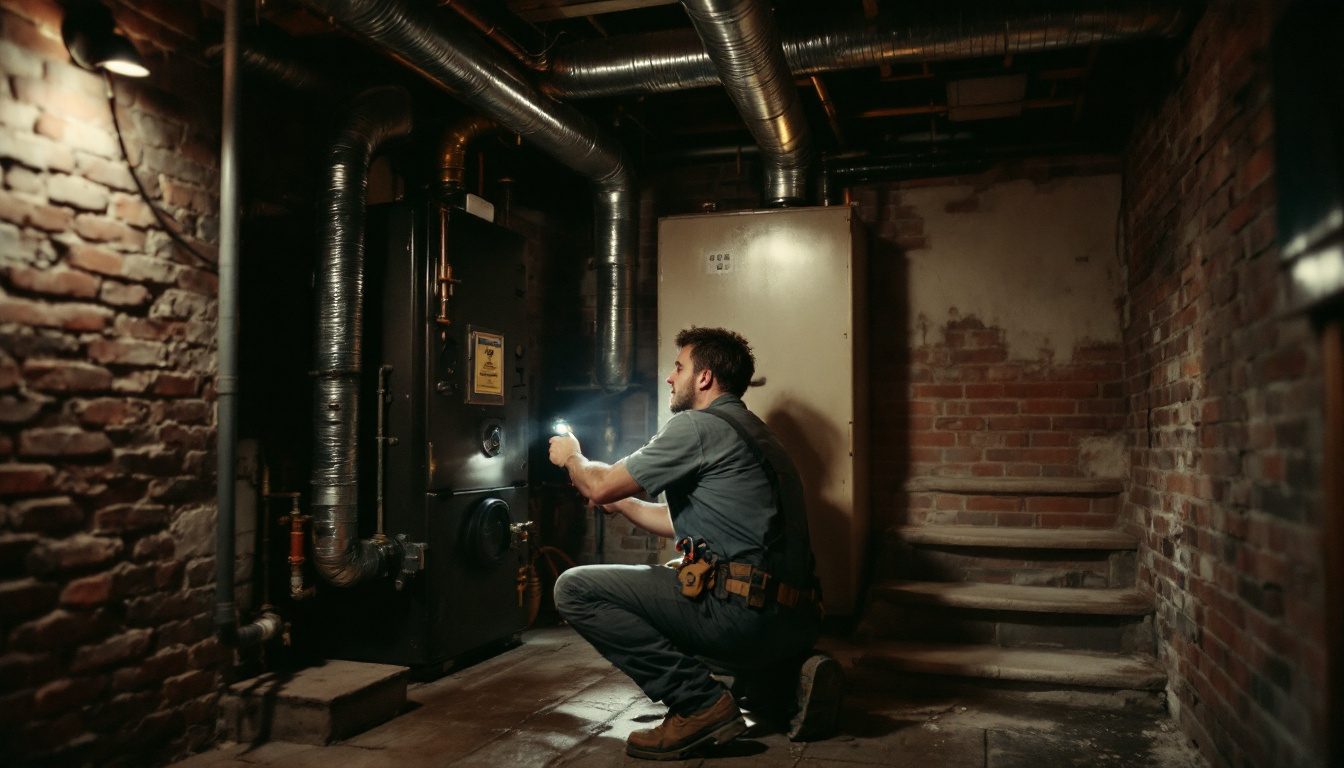
What is a steam heating system? A steam heating system is a boiler that turns water into low pressure steam, which rises through pipes to radiators, gives up its heat as it condenses, and drains back to the boiler as water. A well tuned home system runs at 2 psi or less.
Key Takeaways
- 9.29 million US homes heated mainly with steam or hot water in 2020; 6.01 million were in the Northeast (EIA RECS 2020).
- Building America recommends dry steam at no more than 2 psi; typical buildings are set at 2 to 5 psi (Building America).
- New gas-fired steam boilers must reach 82% AFUE, below the 84% floor for gas hot water boilers (10 CFR 430.32).
- Minnesota’s boiler inspectors call the low-water cutoff the most important device for keeping a safe water level (Minnesota DLI).
- In seven New York apartment buildings, steam-to-hydronic conversions averaged 40.5% heating savings and steam-to-steam replacements 0.6% (NYSERDA, 2009).
- Steam distribution must often be converted to hot water before an air-to-water heat pump can serve it (DOE, 2024).
What is a steam heating system?
A steam heating system is a central boiler that boils water and sends the steam, under its own pressure and with no pump, through pipes to radiators. It is one branch of boiler-based heat.
The visible parts are the boiler and its gauge glass, a pressure control, a safety valve, steam mains in the basement, and an air vent or trap at each radiator. To see where steam fits among furnaces and heat pumps, use our guide to home heating system types.
How does a steam heating system work?
A steam heating system works by letting steam push air out of the pipes, condense inside the radiators, and drain back to the boiler by gravity. The heat comes from condensation, so a home system needs very little pressure.
- The burner fires and the boiler water boils.
- Steam collects in the steam chest above the waterline, where droplets fall out.
- Steam drives air out through vents, which close once steam reaches them.
- Steam condenses in the radiators and releases its heat.
- Condensate drains down sloped pipes to the boiler.
Building America says a typical building boiler “may be set to operate at a range of 2-5” psi and recommends dry steam at no more than 2 psi. At 5 psi, trapped air in a one pipe radiator compresses about 25%, so the radiator keeps heating with its valve closed; at 2 psi only 12% fills.
Why do steam pipes bang?
Banging, or water hammer, is condensate in the wrong place: “backpitched steam mains can create low spots where water collects,” which hammer “especially at the start of a heating cycle” (Building America). Uneven heat usually traces to air binding, where air left in the mains blocks steam from distant rooms.
Many systems were built for slow coal fires and small vents; gas and oil burners cycle at full fire and need the air out fast. Vent, pitch and valve fixes are in our radiator repair walkthrough.

One pipe vs two pipe steam: what is the difference?
One pipe steam uses a single pipe per radiator for steam in and condensate out; two pipe steam adds a return pipe and a steam trap at each radiator. Building America says one pipe systems are “commonly found in older buildings, especially those built before 1970” (Building America).
| Feature | One pipe steam | Two pipe steam | Hot water (for contrast) |
|---|---|---|---|
| Pipes per radiator | One, shared by steam and condensate | Two: steam supply and condensate return | Two: supply and return |
| How air leaves | Air vent on each radiator plus main vents | Through traps and returns to central vents | Bled at high points |
| What moves the heat | Steam pressure, gravity return | Steam pressure, gravity or pumped return | Circulator pump |
| Thermostatic radiator valve | On the vent side, because the inlet clogs | At the inlet, where it can block steam entirely | At the inlet |
| Classic fault | Air binding, spitting vents, hammer | Failed traps passing steam into returns | Air in radiators, low pressure |
On one pipe steam the radiator vent is the control, so a clogged vent means a cold radiator. On two pipe steam the weak point is the trap: a failed one passes steam into the return.
Which safety controls does a steam boiler need?
A steam boiler needs a gauge glass, a low-water cutoff, a pressure control (pressuretrol) with a high-limit backup, and a safety valve. Minnesota’s boiler safety guide calls the low-water cutoff “the most important electrical/mechanical device on your boiler for maintaining a safe water-level” (Minnesota DLI).
Safety point: the risk is low water, not high pressure
Minnesota classes boilers above 15 psig of steam as high pressure, and home systems should run at 2 psi or less. The danger is firing with too little water, which Minnesota warns “could very well result in an overheating and explosion.” If no water shows in the gauge glass, shut the boiler off and call a qualified technician.
Minnesota tells licensed operators to test the low-water cutoff at least weekly and low pressure safety valves at least quarterly. DOE’s home list for steam is to drain sediment, test the low-water cutoff and high-limit, and drain the float chamber (DOE Energy Saver). Add these items to your annual boiler service visit.
A tripped cutoff looks like a dead boiler, so start with our no-heat boiler checklist. Any fuel-burning boiler also needs carbon monoxide alarms in the right places.
How efficient is a steam heating system?
A steam heating system is less efficient than a hot water system, and federal rules set a lower floor for it. DOE says steam boilers “operate at a higher temperature than hot water boilers, and are inherently less efficient” (DOE, archived copy). Under 10 CFR 430.32(e)(2), steam boilers have their own classes.
| Residential boiler class | Made before Sept. 1, 2012 | Sept. 1, 2012 to Jan. 14, 2021 | Made on or after Jan. 15, 2021 |
|---|---|---|---|
| Gas-fired steam boiler | 75% AFUE | 80% AFUE | 82% AFUE |
| Gas-fired hot water boiler | 80% AFUE | 82% AFUE | 84% AFUE |
| Oil-fired steam boiler | 80% AFUE | 82% AFUE | 85% AFUE |
| Oil-fired hot water boiler | 80% AFUE | 84% AFUE | 86% AFUE |
Overheating adds losses. Building America quotes DOE that each degree F above set point can raise annual fuel use by as much as 3%. DOE’s 2024 guidance gives steam one point: it is “typically better at transferring heat to each room” (DOE).
The 24% figure is from a 2009 NYSERDA survey of 63 New York apartment buildings, where steam buildings averaged 159.4 kBtu of source energy per square foot per year; NYSERDA says the causes need more study.

Where are steam heating systems still used?
Steam heating systems survive mostly in the Northeast and in older apartment buildings. EIA counts 9.29 million homes, 7.5% of 123.53 million, heated mainly by a “steam or hot water system,” and does not split the two (EIA RECS 2020, Table HC6.1).
Of those, 6.01 million (65%) are in the Northeast and 4.48 million in New York, New Jersey and Pennsylvania (EIA, Table HC6.7). By building type, 4.31 million are detached houses and 2.80 million are apartments in buildings of five or more units. By fuel, 6.51 million burn natural gas and 1.62 million burn fuel oil or kerosene; see our explainer on oil-fired heat.
New York City is the steam capital. An Urban Green Council model for NYSERDA estimates that 86 percent of multifamily properties of 5,000 to 50,000 square feet are steam heated (Urban Green Council, 2019). National context is in our breakdown of how US homes are heated.
Should you keep, replace or convert a steam heating system?
Keep and tune a steam heating system if it works; convert it when the boiler is due. The measured evidence is small but stark: in NYSERDA’s 2009 case study, four buildings that swapped old steam boilers for hydronic boilers averaged 40.5% heating savings, while three that installed new steam boilers averaged 0.6% (NYSERDA).
- Tune first. Urban Green estimated 14 percent fuel savings from fixing a large building’s steam distribution, rising to 22 percent when done with a boiler replacement.
- Convert to hot water at boiler replacement. In NYSERDA’s two best results, the whole distribution system was converted, not just the boiler. Our boiler replacement guide covers sizing and contractor questions.
- Go electric with eyes open. DOE says air-to-water heat pumps deliver 120 to 130 F water, against the roughly 180 F a boiler supplies, so steam must often be converted to hot water first. The ductless alternative skips the pipes: a 1926, 10-unit building in DOE’s case studies replaced its one pipe oil-fired steam boiler with ten 3-ton cold-climate heat pumps.
Running cost decides the rest: DOE’s interviewees said natural gas still has lower life cycle costs in the Northeast and Midwest, while heat pumps compare better against oil, propane or district heating.
How we researched this
Research date: October 8, 2026. We consulted 17 sources and cited the 10 listed below; the DOE Energy Saver page is an archived copy because the live page returns 404.
Excluded: ranking contractor, manufacturer and engineering-blog pages that cite no data; a Canadian apprenticeship textbook, where US sources covered the same points; and a single-stakeholder conversion cost in DOE’s guidance with no sample basis, so no prices appear. Reddit was skipped because boilers are a safety topic. EIA does not separate steam from hot water, so we publish no steam-only national count.
Frequently asked questions
What pressure should a home steam boiler run at?
Low. DOE Building America recommends tuning a steam boiler to deliver dry steam at no more than 2 psi, although many buildings are set at 2 to 5 psi. Minnesota’s boiler inspectors class anything above 15 psig of steam as a high pressure boiler.
How often should a steam boiler low-water cutoff be tested?
Minnesota’s boiler inspectors tell licensed operators to test it at least weekly. For a house, DOE lists testing the low-water cutoff and draining its float chamber as routine steam maintenance. Follow the boiler manufacturer’s instructions, which set the method and interval for your model.
Can you bleed a steam radiator?
No. A steam radiator lets air out through an automatic vent that closes when steam arrives. Building America recommends slow vents on radiators and fast vents on the mains, so all radiators start filling with steam at about the same time.
Is steam heat more expensive to run than hot water?
Usually, per unit of heat delivered. DOE calls steam boilers inherently less efficient, the federal minimum is 82% AFUE for a new gas steam boiler against 84% for gas hot water, and NYSERDA found 24% higher source energy use in New York steam buildings.
Can a heat pump work with steam radiators?
Not directly. DOE’s 2024 guidance says air-to-water heat pumps make 120 to 130 F water and that steam distribution must often be converted to hot water first. Ductless heat pumps skip the piping, as in DOE’s case study of a 1926 apartment building.
Are steam heating systems still installed?
Yes. Federal rules still set an 82% AFUE minimum for gas-fired steam boilers made since January 15, 2021, and NYSERDA found New York apartment buildings as recent as five years old built with steam boilers.
Sources
- U.S. Energy Information Administration. “RECS 2020 Table HC6.1.” https://www.eia.gov/consumption/residential/data/2020/hc/pdf/HC%206.1.pdf. Accessed October 2026.
- U.S. Energy Information Administration. “RECS 2020 Table HC6.7.” https://www.eia.gov/consumption/residential/data/2020/hc/pdf/HC%206.7.pdf. Accessed October 2026.
- eCFR. “10 CFR 430.32.” https://www.ecfr.gov/current/title-10/chapter-II/subchapter-D/part-430/subpart-C/section-430.32. Accessed October 2026.
- DOE Building America Solution Center. “Thermostatic Radiator Valves on Steam Heating Systems.” https://basc.pnnl.gov/resource-guides/thermostatic-radiator-valves-steam-heating-systems. Accessed October 2026.
- DOE Building America Solution Center. “Steam System Balancing for Multifamily Existing Buildings.” https://basc.pnnl.gov/resource-guides/steam-system-balancing-multifamily-existing-buildings. Accessed October 2026.
- U.S. Department of Energy, Energy Saver. “Furnaces and Boilers.” Archived copy. https://web.archive.org/web/2025id_/https://www.energy.gov/energysaver/furnaces-and-boilers. Accessed October 2026.
- U.S. Department of Energy. “Guidance Document on Space Heating Electrification for Large Commercial Buildings with Boilers.” April 2024. https://www.energy.gov/sites/default/files/2024-04/Large%20Building%20Boiler%20Electrification%20Guidance.pdf. Accessed October 2026.
- Minnesota Department of Labor and Industry. “Boiler safety.” https://www.dli.mn.gov/sites/default/files/pdf/boiler-safety.pdf. Accessed October 2026.
- NYSERDA Multifamily Performance Program. “Case Study: Steam Boiler System Replacements.” 2009. https://www.nyserda.ny.gov/-/media/Project/Nyserda/Files/Programs/MPP-Existing-Buildings/library/Steam-Boiler-System-Requirements.pdf. Accessed October 2026.
- Urban Green Council for NYSERDA. “Demystifying Steam: Smaller Buildings.” October 2019. https://www.urbangreencouncil.org/wp-content/uploads/2022/11/2019.10.15-Demystifying-steam-smaller-buildings.pdf. Accessed October 2026.
Leave a Reply