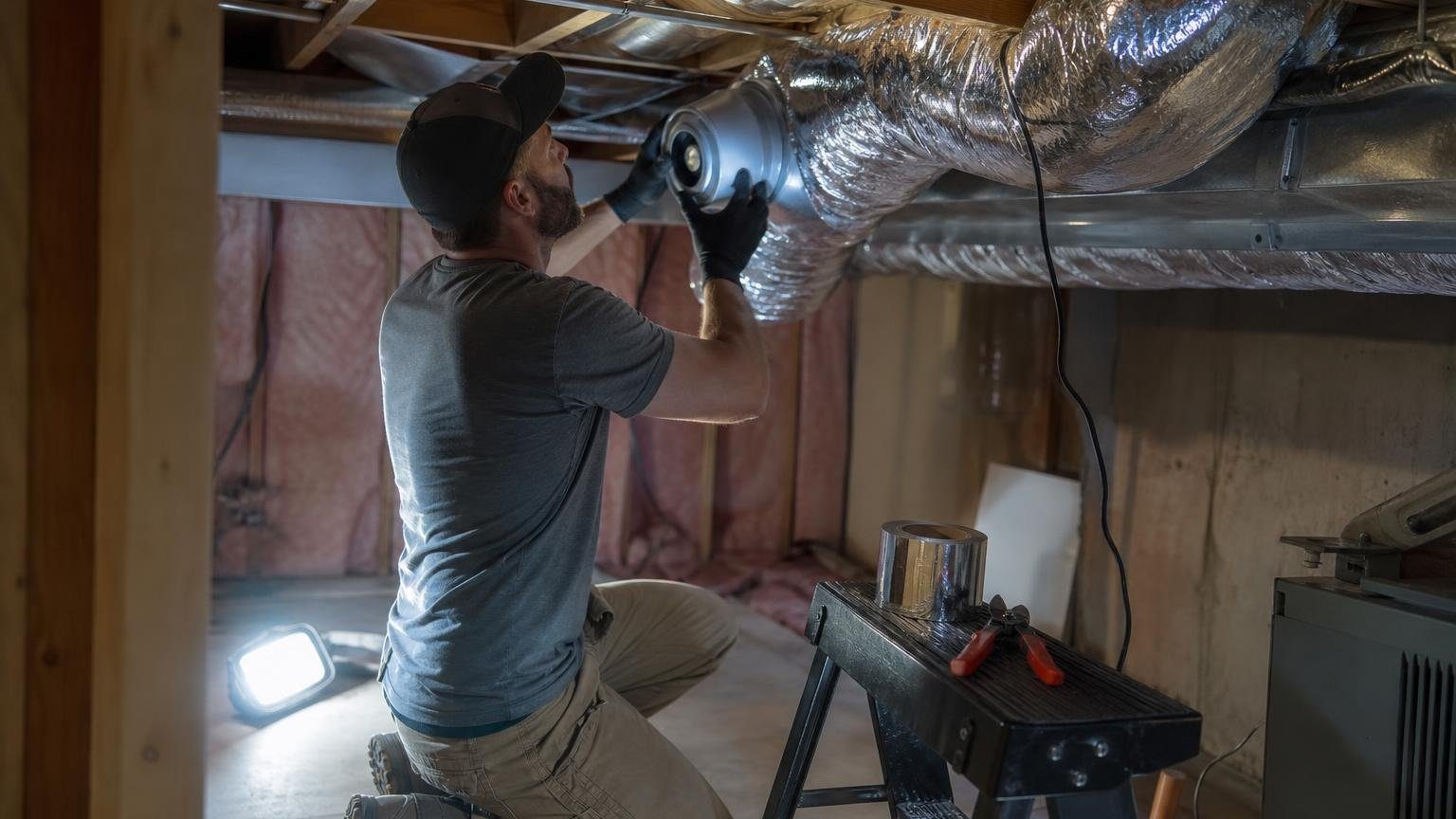
What is an inline duct fan? An inline duct fan is a small motorized fan spliced into a duct to push more air through it. Used as a duct booster fan, it can lift one weak supply branch. It cannot fix leaks, crushed duct or a closed damper, and it needs care around gas furnaces.
Key Takeaways
- ENERGY STAR says a typical house loses 20 to 30 percent of duct air to leaks.
- A June 2018 DOE review of 44 reports found low airflow more than 50% of the time in every region studied.
- Fantech’s FR 150 spec sheet lists 263 cfm at zero pressure but 198 cfm at 0.4 in. w.g.
- Tjernlund limits its DB-2 Duct Booster to branch ducts serving individual rooms, not the main trunk.
- Suncourt recommends no more than 2 boosters per 8 registers.
- Suncourt says never wire its fans to a variable-speed (ECM) furnace blower or a 240 volt circuit.
What is an inline duct fan?
An inline duct fan has a round collar on each end and mounts inside a duct run, not at a grille. In heating and cooling it is sold as a duct booster fan: it sits in one supply branch and adds pressure so more conditioned air reaches one room.
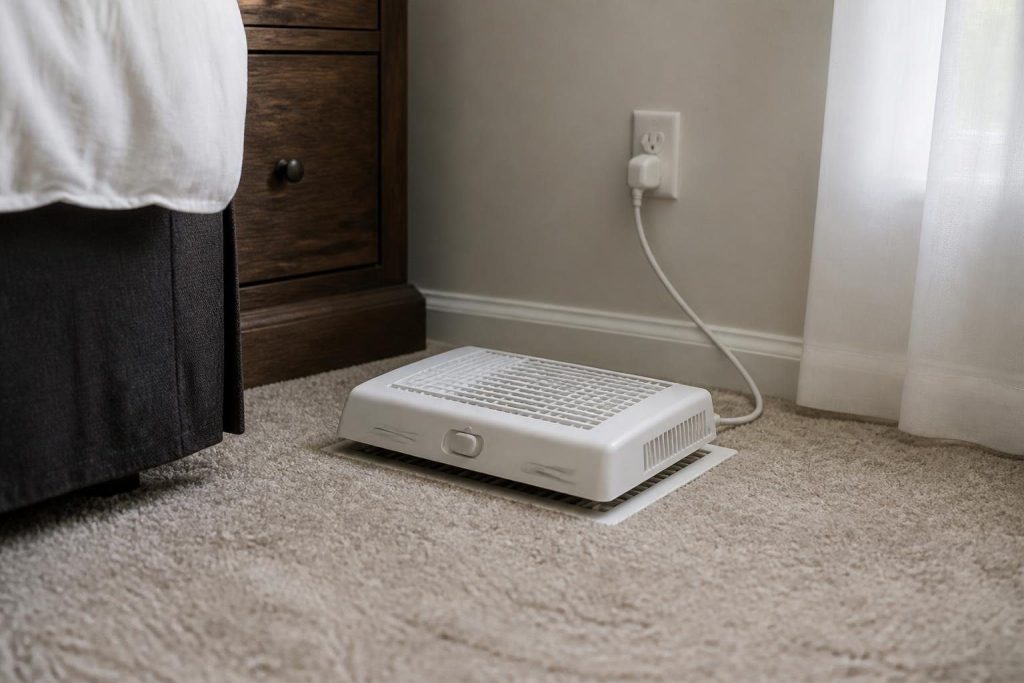
Three products share the name: the inline booster in a round branch, the register booster that replaces a grille, and the inline exhaust fan that vents a bathroom or kitchen outdoors. A 2011 ACHR News article by fan maker Tom Tjernlund names 6 and 8 inch round as the most popular residential booster sizes.
A booster adds pressure to one branch, not capacity to the system. If the real problem is undersized trunks or high static pressure, the fan treats a symptom.
Do duct booster fans work for a weak airflow room?
Duct booster fans work when one sound branch is simply too long or too small. Suncourt’s FAQ claims a weak register delivering 20 or 30 cfm should roughly double with a booster, and a healthy register gains 30% to 50%.
They fail when air escapes before it reaches the room. ENERGY STAR lists rooms that are difficult to heat and cool as a sign of leaky or kinked ducts, and DOE’s review found most studies put 90-100% of tested systems in need of duct sealing or repair.
| Cause of the weak room | How to spot it | Does a booster fix it? | Fix first |
|---|---|---|---|
| Undersized branch duct | Small duct, all others fine | Partly | Larger duct, or booster |
| Long run at the end of a trunk | Farthest register is weakest | Often | Seal and straighten, then boost |
| Leaky or disconnected duct | Air felt in attic or crawlspace | No | Seal or reconnect the duct |
| Closed damper, crushed flex | Handle shut, kinked duct | No | Open damper, replace duct |
| Closed door, no return path | Room fine with door open | No | Transfer grille, jump duct or undercut |
| Whole system short of air | Every room is weak | No, it steals air | Static pressure and load check |
Leaks and crushed runs are a duct repair job, and branches in attics also need insulation to the right R-value or the air arrives lukewarm.
DOE’s Building America Solution Center says inadequate return pathways cause room to room pressure imbalances; closed-door rooms belong to air balancing. A floor that is wrong every season is a case for zoning with separate thermostats.
How much air does an inline duct fan really move?
An inline duct fan moves less air than its headline rating, because airflow falls as the duct pushes back. That resistance is static pressure, in inches of water column (in. w.g.), and every maker publishes a curve of cfm at each pressure. Size from the curve, not the box.
Fantech’s November 2009 FR Series spec sheet gives an example. The FR 150, a 6 inch fan rated at 71 watts, moves 263 cfm at 0 in. w.g., 230 cfm at 0.2 in., 198 cfm at 0.4 in., 167 cfm at 0.6 in., 136 cfm at 0.8 in. and 106 cfm at 1.0 in. At 1.5 in. it manages 17 cfm.
At 0.4 in. the fan delivers 198 of its 263 rated cfm, about 25% less; at 1.0 in., about 60% less. Fantech notes the ratings exclude anything else in the airstream, so grilles and elbows cut further.
Supply boosters are smaller: Tjernlund’s DB-2 motor is rated 40 watts at 1550 RPM, tested to AMCA Standard 210, the fan test code.
Inline duct fan or register booster fan: which fits?
Choose an inline duct fan when you can reach the branch in a basement or attic, and a register booster when you cannot. The register booster puts the motor at the grille, inside the room, where any hum is heard.
| Feature | Inline duct booster | Register booster | Inline exhaust fan |
|---|---|---|---|
| Where it goes | Inside a round supply branch | In the boot, replacing the grille | In the exhaust duct, vented outdoors |
| Common sizes | 6 and 8 inch round (ACHR News) | 4 by 10 and 4 by 12 inch boots (ACHR News) | 4 to 10 inch round (Fantech FR line) |
| Power, maker figures | About 27 W running (Suncourt DB206); 40 W (Tjernlund DB-2) | Check the label | 71 W rated (Fantech FR 150) |
| Control | Pressure, temperature or wall switch | Varies by model | Wall switch or timer |
| Best for | A reachable long or small branch | No duct access | Bath or kitchen exhaust |
Suncourt rates its inline fans at 50 to 60 dBA. If quiet matters, compare ratings using our guide to decibel and sone ratings.
How to install a duct booster fan
To install a duct booster fan, put it in the supply branch feeding the weak room, near that room, sealed, supported and wired to run only with the main blower.
- Confirm the diagnosis with the table above.
- Pick the branch, not the trunk. Tjernlund says the DB-2 is limited to branch ducts serving individual rooms; several Suncourt models are rated only for single-room discharge.
- Place it near the room. Suncourt recommends 6 to 10 feet from the register; Tjernlund says the outlet end of the duct performs best.
- Match the arrow to the airflow, seal seams with foil tape and leave the fan accessible for cleaning, which Suncourt says should happen no less than twice a year.
- Wire it to code. Suncourt specifies a 120 volt circuit protected at a minimum of 15 amperes and a solid-state speed control, never a dimmer.
- Interlock it. A pressure switch sensing duct pressure is the usual method, per ACHR News; Suncourt also sells a duct temperature switch.
- Stop at two. Suncourt advises no more than 2 boosters per 8 registers.
Suncourt warns never to connect to a 240 volt or variable-speed (ECM) furnace blower; here is how to tell PSC and ECM blower motors apart. Hire a licensed electrician or technician, and check whether your jurisdiction requires a permit.
Is a duct booster fan safe with a furnace?
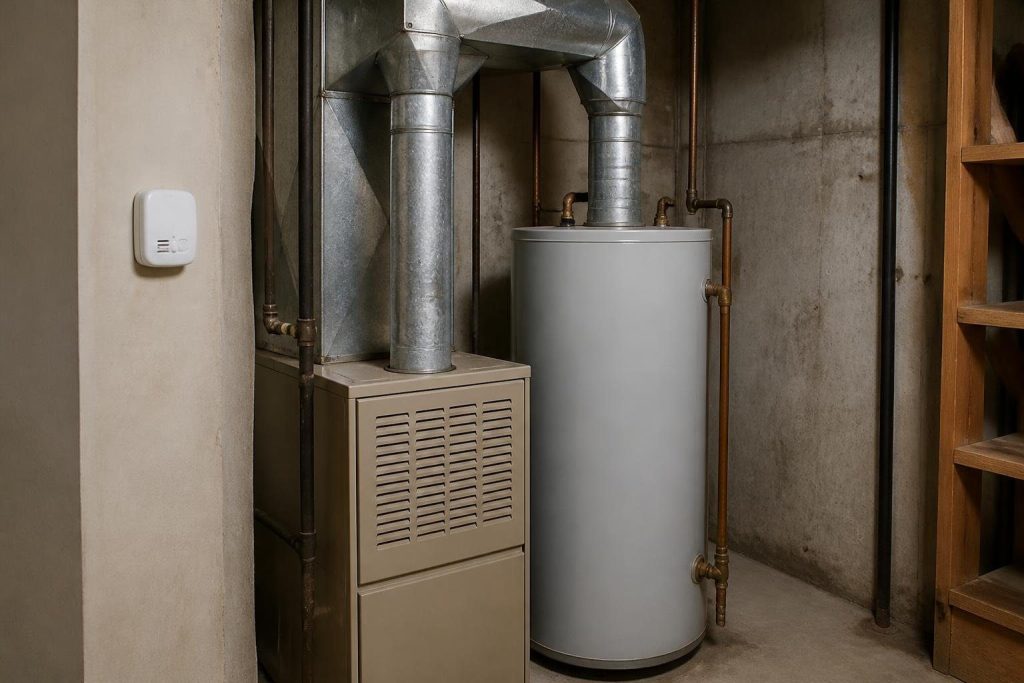
A duct booster fan is safe with a furnace when it sits on a supply branch, within the maker’s temperature limit, on a system that already moves enough air. The risks are heat damage, a starved furnace and a depressurized appliance room.
Suncourt rates its fans for air between 40°F and 140°F. Tjernlund allows the DB-2 up to 200°F, a temperature it says is rare on forced air systems but possible near the furnace on a gravity system.
A booster cannot rescue a furnace already short of air. Goodman’s GKS9 furnace instructions warn that too much external static pressure causes excessive temperature rise, limit switch tripping and heat exchanger failure.
Safety: keep boosters off the return side near gas appliances
Goodman says never use a room, closet or alcove as a return air chamber, so the blower cannot interfere with combustion air or draft, and warns that house depressurization can cause back drafting and carbon monoxide exposure. Fantech’s FG inline fan instructions carry a back drafting warning. The Suncourt and Tjernlund instructions describe supply installations only. Never use an inline fan to pull air from a furnace or water heater room.
With an open-flue furnace or water heater, ask for a combustion safety test. DOE’s Building America Solution Center describes the CAZ test as checking that no emissions are pulled back indoors with every exhaust fan running. Working carbon monoxide alarms are the backstop.
What about inline fans for bathroom and kitchen exhaust?
Inline fans also exhaust bathrooms and kitchens through a long duct, with the fan in the attic and only a grille in the room. Fantech markets its FR line for multiple point exhaust.
Fantech’s FG instructions say ducted exhaust fans must always vent outdoors. ENERGY STAR sets a minimum efficacy of 3.8 cfm per watt for in-line ventilating fans; its sound table caps bathroom fans up to 200 cfm at 2.0 sones and lists no sone cap for in-line fans.
Sizing for baths is in our bathroom exhaust fan guide, and cooking exhaust in our range hood ventilation guide.
How we researched this
Research date: October 9, 2026. We consulted 16 sources and cite 12: five from ENERGY STAR and DOE, six maker documents (Suncourt, Tjernlund, Fantech, Goodman) labeled as claims, and one ACHR News article.
Excluded: contractor and vendor blogs with untraceable figures, retailer listings with conflicting specs, and installed prices, which no federal series publishes. No Reddit material was used because the topic involves combustion safety.
Frequently asked questions
Do register booster fans work?
For one room with a long or small duct and nothing wrong upstream, often yes. Suncourt claims a weak register at 20 or 30 cfm can roughly double. They do nothing for leaks or crushed duct, which DOE’s 2018 review found in most systems tested.
Can you put a duct booster fan on a return air duct?
The Suncourt and Tjernlund instructions describe supply branches only. Near a gas furnace or water heater, a return side fan risks depressurizing the appliance room, and Goodman warns depressurization can cause back drafting and carbon monoxide exposure. Get a combustion safety test before any return change.
Will a duct booster fan fix a hot second floor?
Rarely on its own. Suncourt says upstairs cooling problems are often worsened by undersized ductwork and suggests the largest fan that fits. A floor that is wrong every summer usually needs duct changes or zoning, and Suncourt advises no more than 2 boosters per 8 registers.
Are inline duct fans loud?
Suncourt rates its inline duct fans at 50 to 60 dBA. Mounting the fan in the duct keeps the motor out of the room, and Suncourt recommends 6 to 10 feet between fan and register for performance and low noise.
Can I use an inline duct fan for a dryer vent?
Not a general purpose one. Suncourt says never use its inline duct fans for dryer venting, and its instructions forbid exhausting air laden with lint, grease or oil. Follow the dryer maker’s venting instructions and local code.
How much electricity does a duct booster fan use?
Little. Suncourt says its 6 inch DB206 draws about 42 watts starting and 27 watts running, and Tjernlund rates the DB-2 motor at 40 watts. Annual use depends on how long your main blower runs.
Sources
- U.S. EPA, ENERGY STAR. “Duct Sealing.” https://www.energystar.gov/saveathome/heating-cooling/duct-sealing. Accessed October 2026.
- U.S. EPA, ENERGY STAR. “Ventilating Fans Key Product Criteria.” https://www.energystar.gov/products/ventilation_fans/key_product_criteria. Accessed October 2026.
- U.S. DOE. “Residential HVAC Installation Practices: A Review of Research Findings.” June 2018. https://www.osti.gov/biblio/1470985. Accessed October 2026.
- U.S. DOE Building America Solution Center. “Combustion Appliance Zone (CAZ) Test.” https://basc.pnnl.gov/building-science-measures/combustion-appliance-zone-caz-test. Accessed October 2026.
- U.S. DOE Building America Solution Center. “Transfer Grilles.” https://basc.pnnl.gov/resource-guides/transfer-grilles. Accessed October 2026.
- Suncourt. “Installation Instructions for In-Line Duct Fans.” https://www.sylvane.com/cdn/shop/files/owner-manual-suncourt-in-line-duct-fan.pdf. Accessed October 2026.
- Suncourt. “In-Line Duct Fan FAQ’s.” https://cdn.shopify.com/s/files/1/0060/8659/0528/files/In-LineDuctFan_FAQ.pdf?441. Accessed October 2026.
- Tjernlund Products. “DB-2 Duct Booster Owners Instructions.” https://hvacquick.com/catalog_files/Tjernlund_DB2_IOM.pdf. Accessed October 2026.
- Fantech. “FR Series Inline Exhaust Fans” spec sheet, November 2009. https://wizard.youngsupply.com/files/155-j240101.pdf. Accessed October 2026.
- Fantech. “Installation and Maintenance Instructions for Model FG.” https://wizard.youngsupply.com/files/155-j110102.pdf. Accessed October 2026.
- Goodman. “GKS9 Gas-Fired Warm Air Furnace Installation Instructions.” https://resource.ecmdi.com/is/content/Watscocom/Gemaire/goodman_gks90703bx_article_1371468297814_en_ii.pdf. Accessed October 2026.
- Tjernlund, Tom. “In-Duct Fans Offer Ductwork Fixes.” ACHR News, September 26, 2011. https://www.achrnews.com/articles/117883-induct-fans-offer-ductwork-fixes. Accessed October 2026.
Leave a Reply