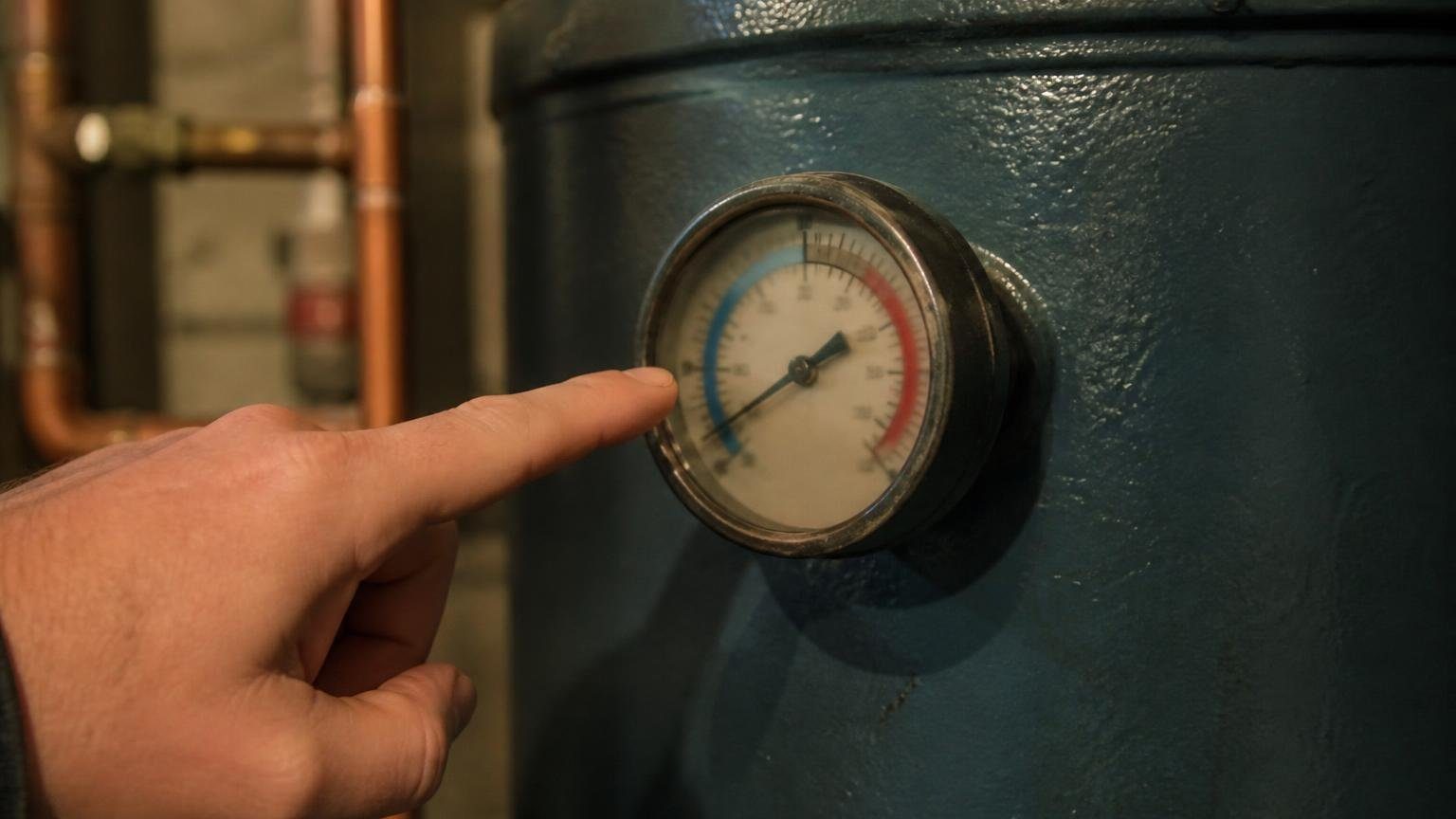
What should boiler pressure be? On a US hot water boiler, about 12 psi cold, the fill setting Burnham and Taco publish. It rises as the water heats but should stay well below the 30 psi relief valve. Steam boilers are a different world: about 0.5 to 2 psi.
Key Takeaways
- Burnham fills its ES2 to 12 psi cold, and Taco ships its boiler feed valve set to 12 psi (Taco sheet 102-006).
- Taco’s rule for taller homes: feet of lift times 0.43, plus 3 psi; a 30 foot lift needs 15.9 psi.
- Weil-McLain tells owners a hot water boiler gauge should not exceed 24 psig (user’s manual, 2024).
- Burnham’s ES2 and Navien’s NFB-H ship with 30 psi relief valves; Lochinvar Knight valves are 30 or 50 psi by model (ES2 manual).
- U.S. DOE Building America says one-pipe steam should typically run at ½ to 1½ psig (2013 measure guideline).
- Delaware’s boiler law defines a heating boiler as steam up to 15 psi or hot water up to 160 psi and 250°F (7 Del. C. § 7402B).
What should boiler pressure be?
Normal boiler pressure for a residential hot water system is about 12 psi cold. Burnham’s ES2 manual fills the loop “until the pressure gauge reads 12 psi,” and Lochinvar calls 12 psi the minimum cold fill for a residential Knight system. The real target depends on the height of your house, not the boiler.
The pressure has one job: push water up to the highest radiator or baseboard with some to spare, so the top of a sealed hot water loop never drops into a vacuum and draws in air. Taco publishes the rule in its feed valve instructions: measure the feet from the valve to the top of the highest radiation, multiply by 0.43 and add 3 psi.
Working out the cold pressure for your house
- Measure from the feed valve to the top of the highest radiator or baseboard run. Say 20 feet in a two story house.
- Multiply by 0.43: 20 × 0.43 = 8.6 psi.
- Add 3 psi of margin: 11.6 psi. Taco’s 12 psi factory setting covers it, and by our arithmetic covers about 21 feet of lift.
- For a 30 foot lift, the same rule gives 15.9 psi, inside the valve’s 10 to 25 psi setting range. Adjusting the valve is installer work.
UK combi guides quote bar; Taco lists its 12 psi setting as 83 kPa, or 0.83 bar. The hardware differs too: Burnham pipes a separate expansion tank and notes that a makeup line with a pressure reducing valve “will automatically fill to 12 psi,” where UK guides describe a hand-opened filling loop. Even US combi boilers follow US maker manuals.
| Maker document | Cold fill pressure | Relief valve | Other stated limit |
|---|---|---|---|
| Burnham ES2 manual (10/21) | 12 psi | 30 psi, shipped with boiler | Maximum working pressure 50 psi |
| Lochinvar Knight manual (KB-i&o-01) | 12 psi minimum; feed valve 15 psi nominal | 30 or 50 psi by model | None stated |
| Taco 329 feed valve sheet (102-006) | 12 psi factory; 10 to 25 psi range | 30 psi (Dual Control) | None stated |
| Navien NFB-H quick guide | Not stated | 30 psi maximum, included | None stated |
| Weil-McLain user’s manual (2024) | Not stated | Not stated | Gauge not above 24 psig (water) or 15 psig (steam) |
Maker data for the named models. Your boiler’s rating label and manual govern.
Is 20 psi too high for a boiler?
Usually not, on a hot boiler. Lochinvar’s Knight manual notes that pressure “will rise when boiler is turned on and system water temperature increases,” and Weil-McLain’s owner ceiling for hot water boilers is 24 psig. Twenty psi cold is different: it sits well above the 12 psi fill and eats into the margin below the relief valve.
Read the gauge twice: cold, after hours off, and hot, after a long firing. The gap between the two readings is the water growth your expansion tank absorbs. For what the gauge needle means during a no-heat call, see our boiler troubleshooting checks.
Correction: 30 psi is not a running pressure
Some ranking pages describe about 30 psi as normal at full heat. It is the relief valve setting: Taco’s Dual Control “is set to relieve at 30 psi.” A boiler that reaches it discharges hot water.
What makes boiler pressure too high, and how do you lower it?
Boiler pressure too high usually traces to four things: an expansion tank that has lost its air charge, a feed valve that keeps passing water, a leaking coil in an indirect water heater, or a gauge that reads wrong. Weil-McLain’s owner manual names the tank and the gauge first.
| What the gauge does | Likely cause | Who handles it |
|---|---|---|
| Normal cold, climbs past 24 psig hot | Expansion tank waterlogged or undersized | Technician |
| Creeps up while the boiler is off | Feed valve passing water, or a leaking indirect or tankless coil | Technician |
| Needle never moves | Stuck or failed gauge | Technician |
| Reads above 30 psi | Relief valve not opening, or a bad gauge | Shut down, call now |
A coil leak raises pressure because house water can sit far above loop water: Taco rates its feed valve for supply pressure up to 100 psi against a 12 psi loop. That is our reasoning from the ratings; confirming it is a technician’s test.
How to lower boiler pressure? The manuals treat it as service work. Burnham’s installer procedure opens a hose bib on the supply piping “until pressure is reduced to 12 PSI (cold)” and warns “Do not plug or change pressure relief valve.” Draining without fixing the cause only resets the clock. The owner’s part:
- Write down the cold and hot readings.
- If the hot reading tops 24 psig or the relief valve discharges, shut the boiler off using the operating instructions on the jacket and call a technician.
- Never cap or plug the relief valve, and keep clear of its discharge pipe.
Why does boiler pressure keep dropping?
Boiler pressure that keeps dropping means water is leaving the loop or the automatic fill has stopped replacing it. Weil-McLain’s owner troubleshooting for low system pressure reads: “Fill to correct pressure. Check for leaks in boiler or piping. Have qualified service technician repair at once.”
Check the shutoff valve ahead of the feed valve first. Taco says it “must be open at all times during operation so that the Boiler Feed Valve can maintain pressure automatically.” Loss and gain can also be one fault: Weil-McLain’s indirect water heater manual warns that undersized expansion tanks cause water to be lost from the relief valve and makeup water added, and “eventual boiler failure can result.”
If pressure is normal but one area stays cold, a stuck zone valve or a failed circulator pump is the likelier fault.
Why is the boiler pressure relief valve leaking?
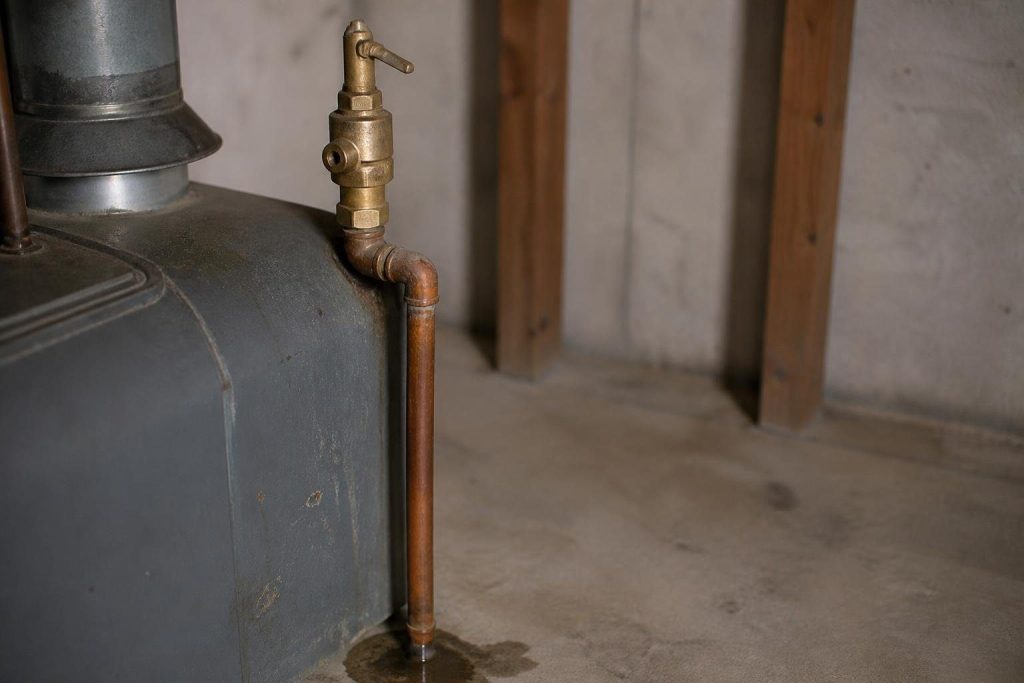
A dripping relief valve is usually doing its job: pressure is reaching its setting. Weil-McLain’s owner manual says that if the valve often weeps on a water boiler, “the expansion tank may not be working properly,” and on a steam boiler the “limit control may be set too high.” Both call for a technician.
Weil-McLain asks owners to operate the valve every 6 months, only with a metal discharge line to a safe place. Water should flow freely and the valve should reseat. If it keeps weeping after a second lift, call a technician. If nothing flows, the manual says the valve or discharge line may be blocked: shut the boiler down immediately. Our guide to an annual boiler service visit covers the rest of the checklist.
What is normal steam boiler pressure?
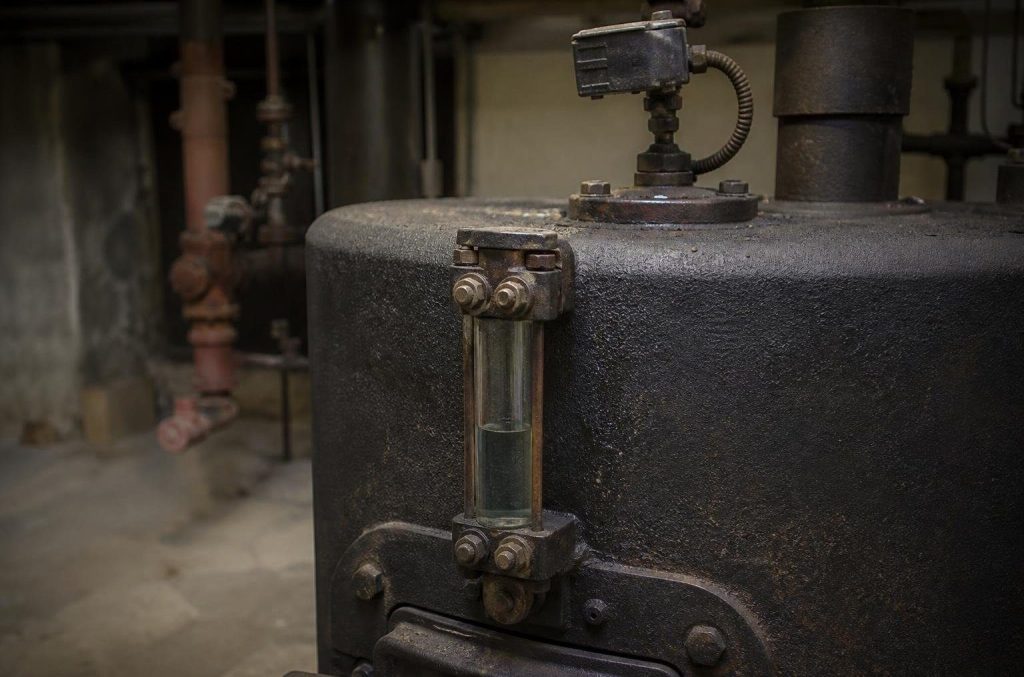
Normal steam boiler pressure is measured in fractions of a psi. U.S. DOE Building America says one-pipe steam systems should typically operate at ½ to 1½ psig, and Burnham’s Independence manual sets the limit to cut out at 1 psi with a 0.5 psi differential, or at 2 psi on another control model.
The control is a pressuretrol: Resideo’s PA404A product data lists an additive version adjustable from 0.5 to 9 psi that breaks at set point plus differential, so 0.5 plus a 1 psi differential cuts out at 1.5 psi. DOE warns that incorrect settings cause short cycles and distribution problems. Steam boilers also carry a gauge glass; Burnham fills to the “normal water line” before startup. Our steam heating explainer and radiator repair guide cover the rest.
Is a home boiler a high pressure boiler?
Generally no. Delaware’s boiler law defines a heating boiler as steam up to 15 psi or hot water up to 160 psi and 250°F, and exempts boilers in residences of 6 or fewer living units from field inspection only. Other states set their own rules, and the commercial plant steam controls on some ranking pages are a separate class.
How we researched this
We read 11 primary documents in October 2026 and cite 10: installation and owner manuals from Burnham, Lochinvar, Navien and Weil-McLain, Taco’s feed valve sheet, Resideo’s PA404 data, a U.S. DOE Building America guideline and Delaware’s boiler statute. Manufacturer figures are maker data for the named model.
We excluded UK combi pages, contractor blogs and commercial plant steam guides as number sources. Reddit was skipped entirely because relief valves and pressure are a safety topic. Owner steps are limited to what the manuals assign to owners.
Frequently asked questions
Is 25 psi boiler pressure too high?
On a hot water boiler, usually yes. Weil-McLain tells owners the gauge should not exceed 24 psig and that higher pressure may indicate a problem with the expansion tank or gauge. At 25 psi it sits 5 psi below a typical 30 psi relief valve, so have a technician check the tank and feed valve.
Does running hot water reduce boiler pressure?
Not in a healthy system. Lochinvar designs its Knight for a closed loop pressurized system not less than 12 psi; tap water runs in a separate circuit. If heating pressure moves when you use hot water, have a technician check the indirect coil or combi heat exchanger.
What happens if boiler pressure is too high?
The relief valve opens, at 30 psi on the Burnham, Navien and Taco hardware we checked, and dumps hot water through its discharge pipe. Repeated discharges cost loop water, and Weil-McLain warns that excessive makeup water addition can eventually cause boiler failure.
Can I add water to my boiler myself?
Only as your boiler’s owner manual allows. Weil-McLain’s owner troubleshooting says to fill to correct pressure and have leaks repaired by a qualified technician at once. Burnham notes that a pressure reducing valve on the makeup line fills to 12 psi automatically.
How often should a boiler relief valve be tested?
Weil-McLain tells owners to operate the relief valve every 6 months and to inspect the valve and discharge pipe for weeping monthly. If no water flows when you lift the lever fully, shut the boiler down and call a technician.
Why does my steam boiler gauge read almost zero?
Often because it is working correctly. Burnham’s Independence limit cuts out at 1 or 2 psi, so the needle barely leaves zero. Weil-McLain says a steam gauge above 15 psig indicates a problem with the gauge or limit control.
Sources
- Burnham. “ES2 Installation, Operating and Service Instructions, 103780-07.” https://res.cloudinary.com/dzhpkjoqj/US%20Boiler%20-%20Burnham/ES2_IO_Manual_ht4xvg.pdf. Accessed October 2026.
- Burnham. “Independence Installation, Operating and Service Instructions, 103538-08.” https://res.cloudinary.com/dzhpkjoqj/TradeService/BURNHMINST00031.pdf. Accessed October 2026.
- Taco, Inc. “Boiler Feed Valves and Dual Controls, Instruction Sheet 102-006.” https://s3.amazonaws.com/s3.supplyhouse.com/manuals/1319637262560/67032_PROD_FILE.pdf. Accessed October 2026.
- Weil-McLain. “User’s Manual, CGa, CGi, EG, PEG and LGB Boilers, 550-142-301/0224.” https://www.weil-mclain.com/wp-content/uploads/Users-Manual-CGa-S3-CGi-S4-EG-PEG-S6-LGB-S2-S3-0224.pdf. Accessed October 2026.
- Weil-McLain. “PLUS Line Indirect-Fired Water Heaters Series 3 Manual.” https://www.weil-mclain.com/wp-content/uploads/indirect-fired-water-heater-manual_1.pdf. Accessed October 2026.
- Lochinvar. “Knight Installation and Operation Manual, KB-i&o-01” (InspectAPedia copy of maker document). https://inspectapedia.com/heat/Lochinvar-Knight-Boiler-manual.pdf. Accessed October 2026.
- Navien. “NFB-H Quick Installation Guide.” https://www.navieninc.com/downloads/nfb-h-quick-installation-guide-en/download. Accessed October 2026.
- Resideo. “PA404A, B Pressuretrol Controllers, Product Data 60-2341-02.” https://res.cloudinary.com/dzhpkjoqj/Resideo/60-2341.pdf. Accessed October 2026.
- U.S. DOE Building America. “Measure Guideline: Steam System Balancing and Tuning for Multifamily Residential Buildings” (2013). https://www1.eere.energy.gov/buildings/publications/pdfs/building_america/measure_guide_steam_system_balancing.pdf. Accessed October 2026.
- State of Delaware. “Delaware Code Title 7, Chapter 74B, Boiler Safety Program.” https://delcode.delaware.gov/title7/c074b/index.html. Accessed October 2026.
Leave a Reply