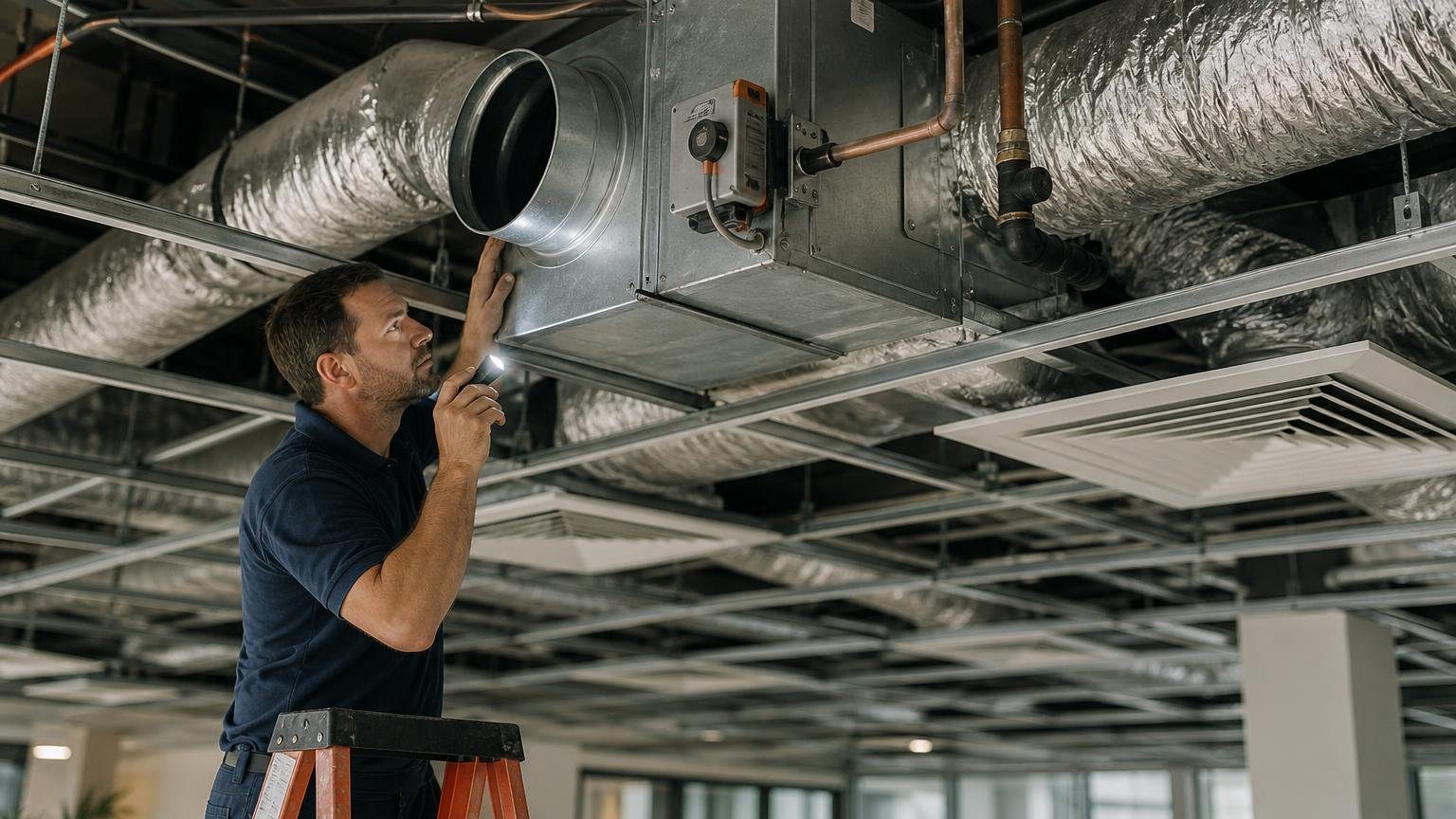
What is a VAV box? A VAV box (variable air volume box) is a terminal unit in commercial ductwork that uses a damper and airflow sensor to vary how much cool air one zone gets, often with a reheat coil.
Key Takeaways
- A VAV system is typically an air handler with “one VAV box per zone,” per PNNL’s O&M best practices for VAV systems.
- PNNL’s 2023 Re-tuning Measure Guide recommends minimum airflow of 10%-15% of each box’s maximum.
- Cutting minimums from 40% to 25% saved 4.9% to 16.1% of whole-building energy, depending on building type, per that PNNL guide.
- ASHRAE 90.1-2013 section 6.5.2.1 caps DDC dead band airflow at 20% of zone design peak and reheated airflow below 50%, per ASHRAE Interpretation IC 90.1-2013-6.
- Lower minimums cut cooling energy 13.5% and 28.8% at two California sites, per UC Berkeley’s Center for the Built Environment.
What is a VAV box?
A VAV box is the zone end of a variable air volume system: a sheet-metal terminal unit, usually above the ceiling, that meters supply air from the air handler into one zone. It changes airflow, not air temperature, to follow the cooling load.
PNNL describes an air handler feeding boxes, “typically with one VAV box per zone.” That is one of the clearest differences between commercial and residential HVAC: a house rarely has a controller per room that measures its own airflow; buildings that skip VAV often use VRF systems.
The air handler is often cooled by a chiller plant or is a rooftop unit. Each box trims that shared air with its own damper, a cousin of the control dampers used elsewhere in ducts.
PNNL’s checklist covers the core parts of a pressure-independent box with reheat:
- An inlet airflow sensor.
- A modulating damper and actuator.
- A controller wired to a zone sensor.
- An optional electric or hot-water reheat coil.
How does a VAV box work?
A VAV box compares zone temperature with setpoint, resets an airflow target, then moves the damper until measured airflow matches it. PNNL describes three modes for a reheat box: cooling at variable flow, a dead band at minimum flow for ventilation, and reheat.
The airflow sensor makes a box pressure-independent, the more common type per PNNL. A pressure-dependent box moves its damper on temperature alone, which PNNL says “can lead to temperature swings and excessive noise.” Pressure-independent minimums and maximums are verified during air balancing.
The controller converts the sensor’s pressure signal to cfm with a K-factor. Price Industries explains that the K-factor “is unique to each size of terminal unit.” Flow rises with the square root of pressure, so low flows give tiny signals: Titus notes a plain pitot tube needs 4,005 fpm to produce 1 in. w.g.
Price advises design velocity pressure of at least 0.02 in. w.g. and inlet velocity at most 2,000 fpm (0.25 in. w.g.). For an 8-inch inlet (0.349 sq ft):
| Case (8-inch inlet) | Signal | Airflow | Share of 699 cfm max |
|---|---|---|---|
| Maximum, plain pitot reading | 0.25 in. w.g. | 699 cfm | 100% |
| Lowest reliable reading, plain pitot | 0.02 in. w.g. | 198 cfm | 28% |
| Titus AeroCross sensor, K = 904 | 0.02 in. w.g. | 128 cfm | 18% |
| Titus K = 904, controller reading 0.004 in. w.g. | 0.004 in. w.g. | 57 cfm | 8% |
Our calculation: fpm = 4,005 × √(velocity pressure); cfm = fpm × area; amplified cfm = K × √(signal). K = 904 is Titus’s 8-inch value (2002); Titus reports amplification of 1.7 to 2.9. Price says some controllers read 0.004 in. w.g. with extra calibration.
The lesson: a 10% minimum here (about 70 cfm) sits below what even the amplified sensor gives at 0.02 in. w.g. Without a controller calibrated for low signals, that minimum is a guess.
What are the types of VAV boxes?
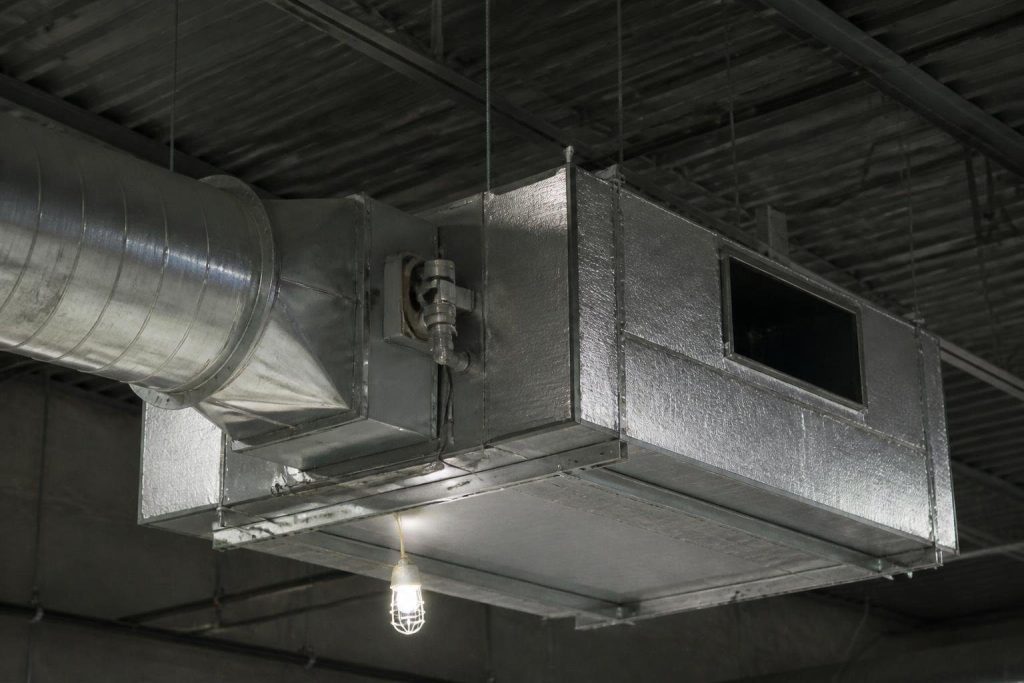
The three types most guides name are single duct (cooling only or reheat), fan-powered (series or parallel) and dual duct. PNNL adds induction boxes and calls single duct “the simplest and most common.”
| Box type | Fan in box? | How it heats or runs | Source |
|---|---|---|---|
| Single duct, cooling only | No | Throttles cool air only; no heating coil | PNNL |
| Single duct, hot-water reheat | No | Coil on a hot-water loop | PNNL |
| Single duct, electric reheat | No | Electric coil in the box | PNNL |
| Series fan-powered | Yes, always on | Fan in the primary airstream; runs whenever the air handler runs | Nailor (maker) |
| Parallel fan-powered | Yes, intermittent | Fan off in cooling; on in dead band and heating | Nailor (maker) |
| Dual duct | No | Mixes a cold duct and a hot or neutral duct | PNNL |
| Induction | No | Induces plenum air, no fan | PNNL |
Series and parallel operation are as described by maker Nailor Industries. Fan-powered boxes pull warm plenum air to “displace/offset required reheat energy,” per PNNL, and reheat suits zones such as “a perimeter zone with windows.” Hot-water reheat ties the boxes to a hydronic heating loop, unlike a single-zone packaged unit.
What should VAV box minimum airflow be?
PNNL’s 2023 Re-tuning Measure Guide says to limit VAV box minimum airflow to 10%-15% of each box’s maximum, 25% for erratic or critical zones, and 0% for spaces not continuously occupied, such as corridors. Local mechanical code ventilation rules still set the floor.
Minimums exist to deliver ventilation air, but they are set from design occupancy, so zones are often over-ventilated and the excess cool air gets reheated. PNNL calls this “the leading cause of summer gas/steam use in buildings with VAV systems.”
Comfort held up in ASHRAE project RP-1515. The Center for the Built Environment lowered minimums at two California sites: cooling energy fell 13.5% and 28.8%, gas use fell 6.1% and 12.2%, and summer dissatisfaction dropped 32% and 62%.
CBE simulations found cutting office minimums from 30% to 20% can reduce HVAC energy 10% to 20%. Results vary by building.
How does a VAV box with reheat avoid wasting energy?
A VAV box with reheat saves energy through “dual maximum” control: airflow stays at a low dead band minimum while the first stage of heating raises discharge air temperature, and only then rises toward a separate heating maximum. Older single maximum control reheats a higher fixed minimum.
ASHRAE 90.1-2013 section 6.5.2.1 requires zone controls to prevent reheating unless an exception applies. For direct digital control (DDC) zones, ASHRAE’s 2015 interpretation restates the limits: dead band airflow at most 20% of zone design peak supply (or a larger ventilation rate) and reheated airflow below 50%.
Washington’s adopted energy code, section C403.4.4 (2015 edition) spells out the stages:
- Dead band: airflow no higher than 20 percent of zone design peak or the ventilation rate, whichever is larger.
- First stage of heating: raise supply air temperature while airflow stays at the dead band rate.
- Second stage: raise airflow toward the heating maximum, with reheated air below 50 percent of zone design peak.
- Zones without DDC: cut primary air to “Thirty percent of the maximum supply air” or the ventilation minimum before reheating.
ASHRAE Guideline 36 publishes this as a full control sequence. In Lawrence Berkeley National Laboratory’s implementation of Guideline 36 Part 5.E.6, the first half of the heating loop raises discharge temperature up to a default 11 K (about 20°F) above setpoint; the second half raises airflow only if discharge air is over 2.8 K (about 5°F) warmer than the room.
Myth: a box at minimum is saving energy
A box parked at a high minimum in a cool zone is cooling air and then reheating it: simultaneous heating and cooling. PNNL suggests trending zone temperature, damper and heating valve commands to confirm dead band zones sit at minimum without alternating between heating and cooling.
VAV box troubleshooting: what usually goes wrong?
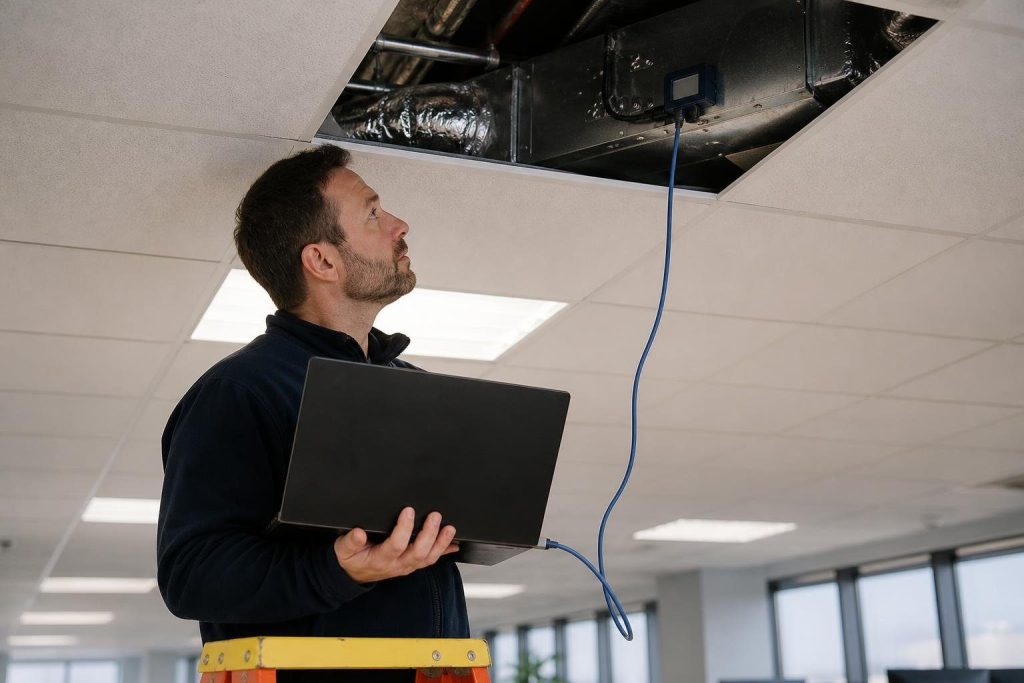
Most VAV box troubleshooting comes down to the airflow sensor, the damper and actuator, and the reheat valve or coil. PNNL’s checklist verifies the airflow sensor semi-annually, checks damper linkage and minimum and maximum positions annually, and re-tunes the system annually.
| Symptom | Likely cause | First check |
|---|---|---|
| Zone always warm, damper always 100% open | Undersized box, failed damper or sensor, bad thermostat location (PNNL “rogue zone”) | Compare damper command, measured cfm and design maximum |
| Temperature swings and noise | Pressure-dependent control | Trend duct static pressure with box airflow |
| Reported cfm does not match the damper | Dirty sensor or wrong K-factor | Clean, verify against a calibrated reading |
| Heating valve open in summer | Minimum set too high for the load | Compare damper position, zone temperature and reheat status |
| Fan-powered box weak or noisy | Clogged box filter | Check, clean or replace the filter |
| Electric reheat trips or smells hot | Loose or overheating connections | Inspect connectors and conductors |
Titus’s 2002 guide shows the K-factor trap: swapping in its new 8-inch sensor without updating K in the controller makes the same pressure read 2.6% lower cfm.
If every box on an air handler loses airflow at once, look upstream: the supply fan, static pressure control, or a duct smoke detector that has shut the fan down. Ask whether service bids include re-tuning; it separates real commercial HVAC service from a filter-and-belt visit.
How we researched this
Research date: October 2026. We opened fourteen sources and cite nine: PNNL, CBE, ASHRAE, Washington’s code, LBNL, and three makers (Price, Titus, Nailor), labeled as maker statements. The airflow table is our arithmetic from published constants and assumes Price’s 0.02 in. w.g. floor applies to the sensor signal.
Excluded: box prices (no federal series), vendor savings claims and contractor blogs. ASHRAE 90.1 and Guideline 36 are paywalled, so we cite ASHRAE’s interpretation and LBNL’s implementation. No Reddit material was used.
Frequently asked questions
What does VAV stand for?
VAV stands for variable air volume. The system varies how much conditioned air each zone receives rather than its temperature. PNNL describes each VAV box opening or closing an integral damper to meet its zone’s temperature setpoint.
Is a VAV box a terminal unit?
Yes. A VAV box is an air terminal unit, the last device before the diffusers, controlling airflow to one zone. PNNL lists AHRI Standard 880 among its references for these units and describes typically one VAV box per zone.
What is a VAV box K factor?
The K-factor converts the airflow sensor’s pressure signal into cfm: airflow equals K times the square root of the signal. Price Industries says it is unique to each unit size. Titus published K = 904 for its 8-inch sensor in 2002.
What is a fan powered VAV box?
It is a VAV box with a small fan that draws warm plenum air into the zone, which PNNL says offsets reheat energy. Per maker Nailor, a series box runs its fan whenever the air handler runs; a parallel box runs it only in dead band and heating.
Can VAV box minimum airflow be set to zero?
Sometimes. PNNL’s 2023 Re-tuning Measure Guide suggests 0% for spaces not continuously occupied, such as corridors and storage, and 10%-15% for most zones. Local ventilation code and accreditation rules still apply, so confirm with the engineer of record.
How much does a VAV box cost?
We do not publish a figure: no federal agency or national lab publishes a VAV box price series, and price varies with size, reheat and controls. Lowering minimums is cheap reprogramming; PNNL projects 3.4% average savings across the GSA portfolio.
Sources
- Pacific Northwest National Laboratory. “O&M Best Practices: Variable Air Volume Systems.” https://www.pnnl.gov/projects/om-best-practices/variable-air-volume-systems. Accessed October 2026.
- Pacific Northwest National Laboratory. “Re-tuning Measure Guide,” 2023. https://www.pnnl.gov/sites/default/files/media/file/Re-tuning%20Measure%20Guide%20PNNL-SA-183964.pdf. Accessed October 2026.
- Center for the Built Environment, UC Berkeley. “Control Strategies that Reduce Minimum Airflow.” https://cbe.berkeley.edu/research/control-strategies-minimum-airflow/. Accessed October 2026.
- ASHRAE. “Interpretation IC 90.1-2013-6,” 2015. https://www.ashrae.org/File%20Library/Technical%20Resources/Standards%20and%20Guidelines/Standards%20Intepretations/IC901-2013-6.pdf. Accessed October 2026.
- Washington State Legislature. “WAC 51-11C-40345” (archived). https://lawfilesext.leg.wa.gov/Law/WACArchive/2019/htm/WAC%20%2051%20%20TITLE/WAC%20%2051%20-%2011C%20CHAPTER/WAC%20%2051%20-%2011C-40345.htm. Accessed October 2026.
- Lawrence Berkeley National Laboratory. “Sequences for VAV reheat terminal unit.” https://simulationresearch.lbl.gov/modelica/releases/v9.0.0/help/Buildings_Controls_OBC_ASHRAE_G36_PR1_TerminalUnits_Reheat.html. Accessed October 2026.
- Price Industries (maker). “How Do You Measure Airflow?” 2026. https://blog.priceindustries.com/how-do-you-measure-airflow. Accessed October 2026.
- Titus (maker). “AeroCross Flow Sensor Application Guide,” 2002. https://www.titus-hvac.com/file/5759/AeroCross%20Flow%20Sensor%20Application%20Guide.pdf. Accessed October 2026.
- Nailor Industries (maker). “VAV Equipment Selection: Fan Powered Terminal Units,” 2021. https://nailor.com/resources/news/vav-equipment-selection-fan-powered-terminal-units. Accessed October 2026.
Leave a Reply