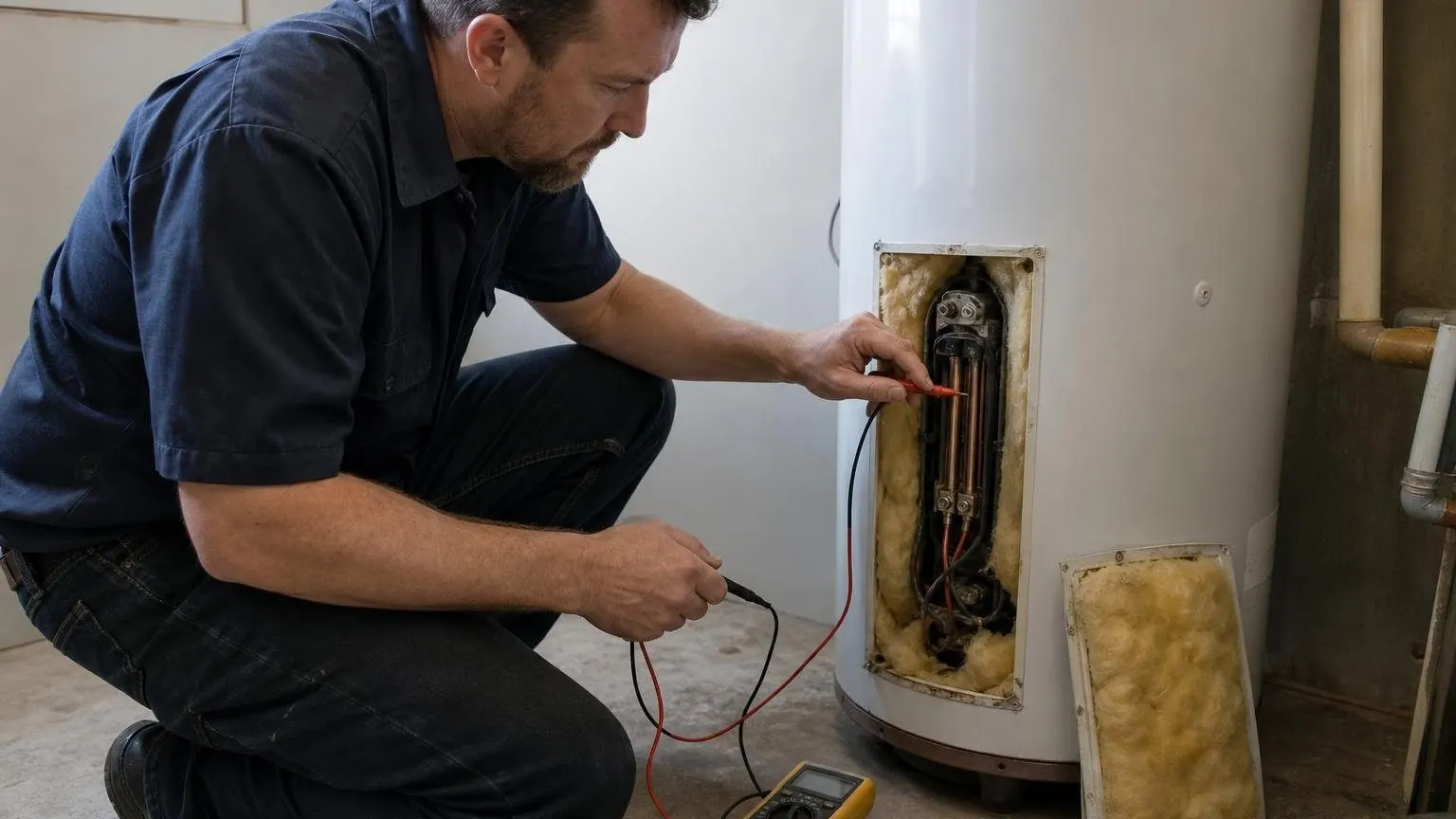
What is a water heater element? A water heater element is the screw-in resistance heater inside an electric tank, often an upper and a lower that take turns. With power off, a 4,500 watt, 240 volt element should read about 12.8 ohms; an open reading, or any continuity to the tank, means replace it.
Key Takeaways
- A 240 V, 4,500 W element should read 12.8 ohms, plus or minus 6%, per the Bradford White service manual.
- A.O. Smith calls 5 to 25 ohms good, tested only after a meter proves the power off (A.O. Smith support).
- In a non-simultaneous tank only the upper OR the lower element heats at one time, per a Rheem technical bulletin.
- Power on before the tank is full and “the upper element will burn out (dry fire),” A.O. Smith warns in its replacement steps.
- Electricity fueled the main water heater in 57.04 million of 123.53 million US homes in 2020, or 46.2% by our arithmetic on EIA RECS Table HC8.1.
- From May 6, 2029, new 20 to 55 gallon electric storage heaters must reach a 2.30 UEF under 10 CFR 430.32(d)(2).
What does a water heater element do, and why are there two?
A water heater element is a sheathed resistance wire immersed in the tank water. Many residential electric tanks carry two, one near the bottom and one about 1/3 of the way down from the top, according to the State Residential Electric Water Heater Service Handbook.
Each element has its own thermostat. Bradford White describes the sequence: on a cold tank the upper element is energized first, and only when the upper thermostat is satisfied does power pass to the lower element, which then handles most reheating as cold water enters through the dip tube.
So a dead upper element means no hot water, while a dead lower element still leaves about 1/3 of the tank hot, per the State handbook.
What wattage and voltage is a water heater element?
Water heater element wattage and voltage are on the heater’s rating plate and ink-stamped on the element’s terminal block; Bradford White’s example reads “4500W 240V.” Rheem lists 3,000 or 4,500 watt copper elements in its Performance standard electric line (maker claim).
A 4,500 W element at 240 V draws 18.75 amps (watts divided by volts). The State handbook sizes wire and breaker at 125% or more of that draw, and Rheem’s use and care manual pairs a 4,500 W, 240 V heater with a 25 amp breaker and 10 AWG copper. Our watts to amps primer applies the same math to other equipment.
On a 208 V supply, a 240 V, 4,500 W element makes about 3,380 W, roughly 75% of its rating, by our arithmetic (volts squared over resistance). At full rating, 4,500 W times 3,413 Btu per kilowatt, divided by 8.33 pounds per gallon times a 90°F rise, gives about 20.5 gallons per hour by our math, near the 21 gallons Rheem claims.
How many ohms should a water heater element read?
A water heater element should read close to its rated volts squared divided by its rated watts. Bradford White passes a 240 V, 4,500 W element at 12.8 ohms plus or minus 6%, about 12.0 to 13.6 ohms; the State handbook allows up to 7.5% variance.
A.O. Smith’s owner page uses a looser 5 to 25 ohm screen; a burned-open element shows no continuity at all. The table is our arithmetic from the formula.
| Element rating (stamped) | Expected ohms at 240 V | Expected ohms at 208 V |
|---|---|---|
| 3,000 W | 19.2 | 14.4 |
| 3,500 W | 16.5 | 12.4 |
| 4,500 W | 12.8 | 9.6 |
| 5,500 W | 10.5 | 7.9 |
Our arithmetic: R = V squared / P. Match the column to the voltage stamped on the element, not to the house wiring.
How to test a water heater element with a multimeter
To test a water heater element, shut off the breaker, prove the circuit dead, disconnect the wires, and read ohms across the two screws, then from each screw to the tank. These steps combine the A.O. Smith and Bradford White power-off procedures.
- Turn the breaker off (or pull the fuses).
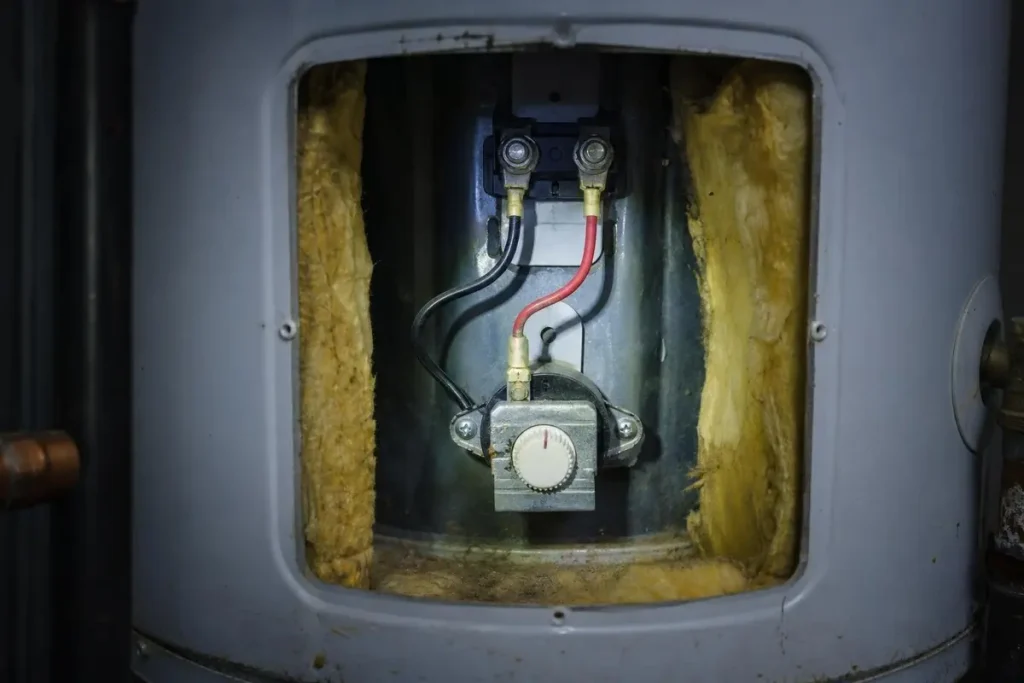
- Remove the cover, insulation and plastic guard. On AC volts, confirm no voltage at the upper thermostat screws.
- Disconnect the two element wires, noting their positions.
- Set the meter to ohms (200 ohm range or lower) and touch the probes together to check it.
- Read across the two element screws and compare with the table above.
- Ground test: one probe on a screw, the other on the flange. Bradford White says any reading indicates a grounded element. Repeat on the second screw.
- Test the other element the same way.
Safety point
Rheem’s manual tells owners not to attempt repair of heating elements and to refer repairs to qualified service personnel, and Bradford White marks its procedure for qualified service providers only. If you cannot prove the circuit dead with a meter, stop.
What are the symptoms of a bad water heater element?
Bad water heater element symptoms split by position: a failed upper element usually means no hot water, a failed lower element means hot water that runs out fast. The table follows Bradford White’s chart; for other causes, see our no-hot-water diagnosis guide.
| Symptom | Element suspect | Also check (maker chart) |
|---|---|---|
| No hot water | Upper element | Breaker, loose wires, upper thermostat, tripped ECO |
| Lukewarm, runs out fast | Lower element | Thermostat setting, dip tube, demand |
| Slow recovery | Lime on element, or a derated element installed | Element stamp versus rating plate |
| Water too hot, ECO keeps tripping | Grounded element | Thermostat contact with the tank |
| Hissing or singing | Lime on elements | Remove and clean, or replace |
A grounded element usually trips the breaker, Bradford White says; if not, it can run continuously, limited only by the ECO. The State handbook adds that lime can make elements overheat and split, and split elements often leak to the outside. For drips at the element, see our water heater leak guide.

How do you replace a water heater element without burning it out?
Water heater element replacement, in the maker procedures, means drain, swap, refill and purge all air before the breaker goes back on. A.O. Smith says a burned upper element on a new heater is almost always dry fire.
- Breaker off. Run a hot tap until cool, which may take 10 minutes or longer.
- Close the cold supply, attach a hose and let the tank drain completely.
- Remove the element with an element wrench or 1 1/2 inch deep well socket.
- Match the new element to the rating plate, clean the threads, and lubricate the gasket with a drop of dishwashing liquid.
- Install, reconnect the wires tightly, close the drain and refill.
- Run a hot faucet at full stream for three minutes to push out the air.
- Check for leaks, refit covers, restore power; heating may take two hours.
The A.O. Smith and Whirlpool steps both drain the tank, and we found no maker procedure that skips it. With the tank empty, it is a good time for a sediment tank flush and a look at the anode rod.
Which replacement element should go back in?
Use the same wattage and voltage as the rating plate. The State handbook warns a higher rating can overload the wiring and a lower one reduces performance; Bradford White lists a derated element as a cause of slow recovery.
Bradford White shows the common screw-in type with a 1-1/2 inch hex flange and a zinc plated copper or Incoloy sheath. Watt density is wattage compared with surface area, the State handbook explains, and for hard water it advises lime-resistant elements, cleaning or a softener.
Do not rewire for both elements at once: the State handbook says that means amperage draw doubles while little is gained in recovery.
When is a new element not the right fix?
A new element is the wrong fix when the tank body leaks, or when water overheats with elements that test good, which points to a thermostat or ECO. A heater discharging hot water belongs in our relief valve safety guide.
We found no federal or verifiable maker figure for element lifespan, so we give none; the State handbook says only that lower elements fail more often than upper ones. A sensible water heater temperature helps: the handbook says water stored at 160°F may be twice as corrosive as water at 140°F.
If you are pricing a new heater instead, 20 to 55 gallon electric storage models made on or after May 6, 2029 must reach a 2.30 UEF, against the 0.92 to 0.93 UEF Rheem lists for its standard Performance models. Our replacement guide and heat pump water heater explainer cover that decision.
A 4,500 W element running one hour uses 4.5 kilowatt-hours; our electricity prices by state shows the local cost.
How we researched this
Researched October 14, 2026. We opened 13 documents and cite 10: service manuals and support pages from A.O. Smith, State, Whirlpool, Bradford White and Rheem (all maker claims), EIA’s 2020 RECS and the eCFR text of 10 CFR 430.32. The ohms table, 208 V output, recovery rate and 46.2% share are our arithmetic.
Excluded: Reddit and forums (electrical safety topic), contractor and retailer blogs with unsourced ohm ranges, and prices, since no federal series covers element replacement.
Frequently asked questions
How do I tell if my water heater element is bad?
With the power off, read ohms across the two screws: an open reading, or one far from volts squared over watts, means it failed. Then test each screw to the flange; Bradford White says any reading there means a grounded element. No hot water points to the upper element.
How many ohms is a 4500 watt water heater element?
About 12.8 ohms if it is rated 240 V, which Bradford White accepts within plus or minus 6%, roughly 12.0 to 13.6 ohms. A 4,500 W element rated 208 V should read about 9.6 ohms by our arithmetic, so check the stamped voltage first.
Can I replace a water heater element without draining the tank?
Not by the maker procedures we read. A.O. Smith and Whirlpool both drain the heater completely before removing the element, then refill and run a hot faucet full stream for three minutes so the new element is never powered dry.
What is the average lifespan of a hot water heater element?
We found no federal or maker figure we could verify, so we give none. The State service handbook says the lower element collects lime faster and fails more often than the upper, and that hard water can make elements overheat and split.
Can I check a water heater element without a multimeter?
Not safely or reliably. Every maker procedure we read uses a meter, first to prove the power is off and then to read ohms. Symptoms only narrow it down: no hot water suggests the upper element, hot water that runs out fast suggests the lower.
Can a bad water heater element trip the breaker?
Yes. Bradford White says an element shorted to ground will in most cases trip the breaker. If the fault current is too low to trip it, the element can run continuously, limited only by the ECO, so repeated ECO trips usually mean a grounded element.
Sources
- A.O. Smith at Lowe’s. “Check the Heating Element.” https://www.aosmithatlowes.com/support/help/voltage-was-correct/23. Accessed October 2026.
- A.O. Smith at Lowe’s. “Replace the Heating Element.” https://www.aosmithatlowes.com/support/help/element-was-out-of-range/24. Accessed October 2026.
- Whirlpool Water Heaters. “Replace the Heating Element.” https://www.whirlpoolwaterheaters.com/support/help/?id=24. Accessed October 2026.
- Bradford White. “Service Manual, Residential and Light Duty Commercial Electric Water Heaters, 238-54711-00A.” https://docs.bradfordwhite.com/Service_Manual/238-54711-00_Current.pdf. Accessed October 2026.
- State Water Heaters. “Residential Electric Water Heater Service Handbook.” https://assets.statewaterheaters.com/damroot/Original/10008/320990-000.pdf. Accessed October 2026.
- Rheem. “Technical Service Bulletin: How An Electric Thermostat Works.” https://res.cloudinary.com/dzhpkjoqj/TradeService/RheemManufacturing_00377_1-3_OTHER1.pdf. Accessed October 2026.
- Rheem. “Use and Care Manual, Electric Residential Water Heaters, AP23124.” https://media.rheem.com/blobazrheem/wp-content/uploads/sites/36/2024/04/Residential-Electric-Side-Connect-Blanketed-Lowboy-UC-Manual-AP23124-1.pdf. Accessed October 2026.
- Rheem. “Performance Series: Standard Electric.” https://www.rheem.com/product/rheem-performance-series-standard-electric-xe40m06st45u1/. Accessed October 2026.
- U.S. Energy Information Administration. “2020 RECS Table HC8.1, Water heating in U.S. homes.” https://www.eia.gov/consumption/residential/data/2020/hc/pdf/HC%208.1.pdf. Accessed October 2026.
- Electronic Code of Federal Regulations. “10 CFR 430.32, Energy and water conservation standards.” https://www.ecfr.gov/current/title-10/chapter-II/subchapter-D/part-430/subpart-C/section-430.32. Accessed October 2026.
Leave a Reply