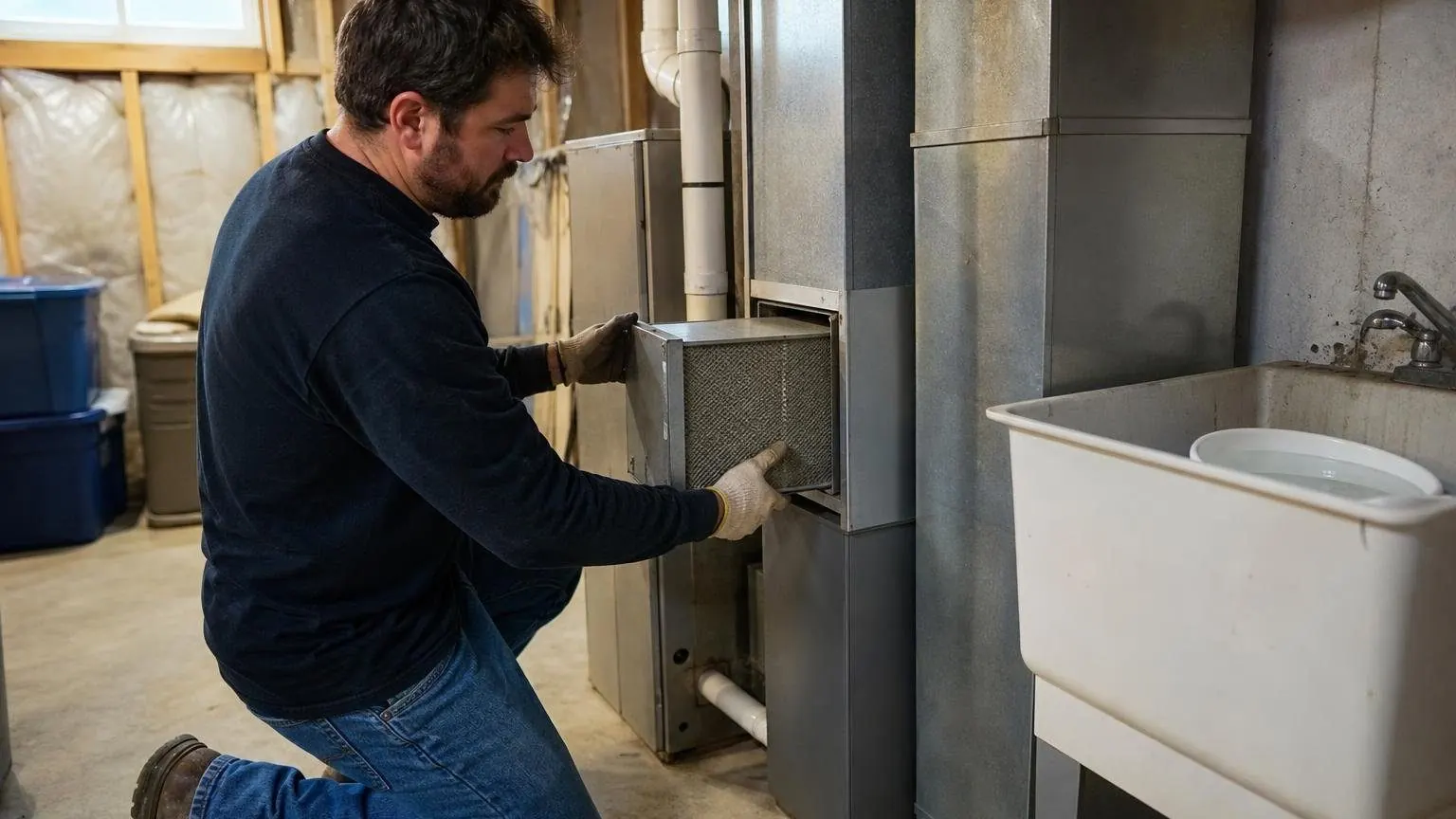
What is an electronic air cleaner? An electronic air cleaner is a two-stage electrostatic precipitator in the return duct: ionizer wires charge particles and charged plates catch them. The cells wash instead of being replaced, but they lose efficiency as they load and can release small amounts of ozone.
Key Takeaways
- Honeywell’s F300E owner’s guide puts ozone output at about 0.005 to 0.010 ppm, highest when new (Resideo guide 69-0756).
- Since October 2020, electronic in-duct air cleaners sold in California must be CARB certified, with ozone at or below 0.050 ppm (CARB).
- Wash intervals differ: Honeywell says twice a year, Trion every two months (Trion HE Plus manual).
- EPA says a clean precipitator often removes 60 percent or more of particles per pass, up to 95 percent at low airflow, losing efficiency as plates load (EPA, 2018).
- ASHRAE says electronic air cleaners are not officially covered by the MERV test standard; a MERV 13 filter removes at least 85% of 1 to 3 micron particles (ASHRAE).
- Occasional snapping is normal; frequent arcing points to wet cells, a broken ionizer wire or a bent plate (Honeywell troubleshooting table).
What is an electronic air cleaner?
An electronic air cleaner, or EAC, is a whole-house particle filter that uses high voltage instead of a fiber mat. It sits in a cabinet on the return side of the furnace or air handler, so all circulating air passes through it. Common examples include the Honeywell F300 (made by Resideo), Trion HE Plus, Aprilaire Model 5000 and Trane CleanEffects.
EPA groups electrostatic precipitators and ionizers as “electronic air cleaners,” but they differ. A precipitator collects charged particles on its own plates; an ionizer lets them land on room surfaces, the approach covered in our review of bipolar ionization evidence.
How does an electronic air cleaner work?
An electronic air cleaner works in two electrical stages behind a mesh prefilter. Particles pick up a charge as they pass thin ionizer wires, then stick to alternately charged collector plates. Honeywell’s owner’s guide describes the sequence:
- Prefilter. A washable mesh catches lint and hair.
- Ionizer. An intense high voltage field around the wires charges particles “down to 0.3 micron,” in Honeywell’s words.
- Collector. Parallel plates charged positive and negative pull the charged particles out of the airstream.
- Optional postfilter. A precharged postfilter catches more small particles; a carbon filter can cut ozone.
The unit only cleans while the blower runs. Honeywell’s owner’s guide recommends the thermostat fan on continuously and lists a draw of 33 watts with two cells, 22 watts with one. It concedes continuous fan operation “adds to your electric bill,” so read our fan on versus auto guide first.
Does an electronic air cleaner produce ozone?
Yes, a little. Honeywell states its cleaners generate “about 0.005 to 0.010 parts per million,” with output highest when the unit is new. Trion’s HE Plus manual says a new cell makes more ozone for the first several weeks because arcing slowly rounds off sharp corners and burrs on the plates.
California sets the hard ceiling. The California Air Resources Board has covered electronic in-duct air cleaners since October 2020, with ozone no higher than 0.050 ppm (50 ppb). CARB’s manufacturer page says in-duct units are ozone tested to CSA C22.2 No. 187:20 and portables to UL 867. Certification “does not reflect air cleaner effectiveness.”
The list includes the Aprilaire Model 5000 (Executive Order G-22-185) and Trane CleanEffects (G-22-334); we found no Honeywell F300 or Trion entry when we searched it on October 18, 2026, so California buyers should check the current list first. If the smell bothers you, Honeywell says a dealer can add a carbon filter or turn down the power supply; our guide to HVAC odors covers other causes.
Correction: whose limit is 0.05 ppm?
Trion’s manual credits the 50 ppb indoor figure to EPA. The federal number is actually an FDA device rule, 21 CFR 801.415, which caps ozone at 0.05 ppm and warns “the odor of ozone is not a reliable index.” EPA’s technical summary adds that ozone below health standards still reacts indoors to form formaldehyde and ultrafine particles.
How do you clean electronic air cleaner cells?
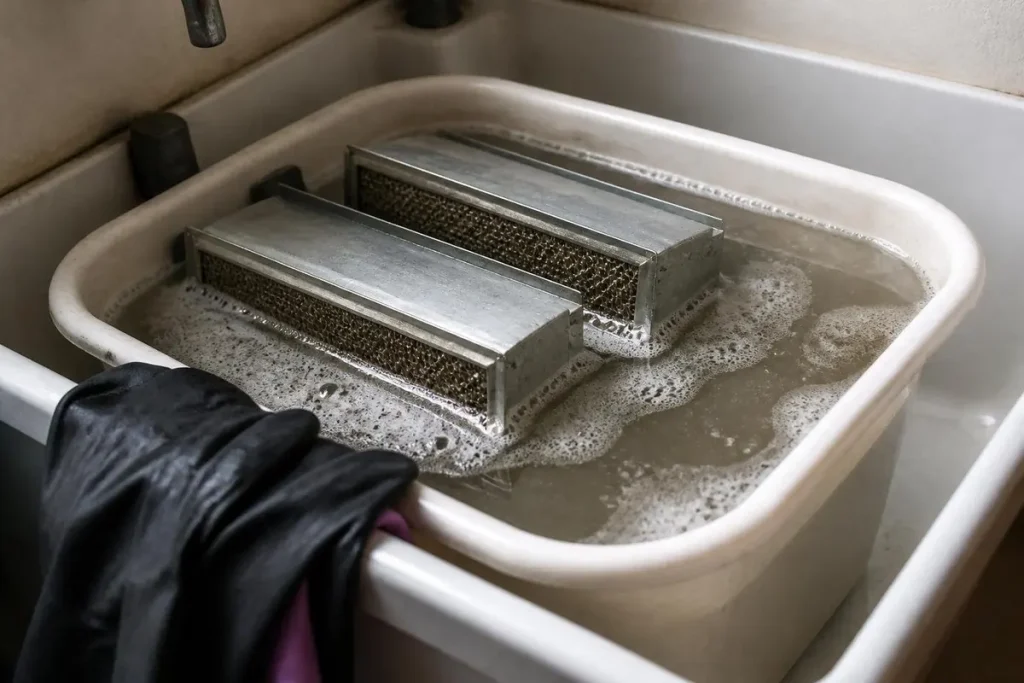
You soak the cells in hot water with automatic dishwasher detergent, rinse until the water no longer feels slippery, wipe the ionizer wires and let them dry. The two manuals we read disagree on frequency by a factor of three, and Honeywell’s guide also says a full wash “can be put off for yearly maintenance” if you wipe the wires between washes.
| Maker guidance | Honeywell F50F and F300E | Trion HE Plus |
|---|---|---|
| Full cell wash | Twice a year with normal use, more with heavy use | Once every two months; monthly in new homes or with heavy smoke |
| Soak | About three-fourth cup detergent per cell, 15 to 20 minutes, or a dishwasher with no dry cycle | 2 to 4 oz. of granulated dishwasher detergent, 30 minutes |
| Snapping noise | Means the cleaner “is working as it should” | Occasional zapping is normal; constant zapping needs cleaning or repair |
| Ozone or arcing fix | Dealer adjusts power supply or adds carbon filter | Move power supply jumper from HIGH to MED or LOW |
Table sources: Resideo guide 69-0756 and Trion manual 155587-001. A tub wash:
- Switch the air cleaner off; the furnace can keep running.
- Pull the cells and prefilter wearing gloves. Never drop a cell, which Trion says causes “excessive arcing and poor performance.”
- Soak and agitate the cells, then the prefilter.
- Rinse with very hot water until the runoff is not slippery.
- Wipe the ionizer wires and contact board with a damp cloth; check for broken wires or bent plates.
- Reinstall with the airflow arrow pointing downstream. If wet cells arc, Honeywell says switch off for two to three hours.
Do not skip the wires: ASHRAE says “silicone buildup reduces efficiency.” Put the wash on the calendar with your HVAC maintenance plan.
Why does an electronic air cleaner make a snapping noise?
An electronic air cleaner snaps when a larger dust particle causes a brief high voltage discharge. Honeywell says the sound means the cleaner “is working as it should,” and a test button on the door forces a snap to prove the cells are powered. EPA also notes precipitators “may make a crackling sound as they accumulate dust.”
Frequency is the clue. Trion lists rapid arcing causes as a broken or loose ionizing wire, a dirty cell, bent collector plates and dirty insulator caps. Silence with the light off usually means the blower is off or the door interlock is open, per Honeywell. For other sounds, see our guide to HVAC noises.
Electronic air cleaner vs media filter: which cleans better?
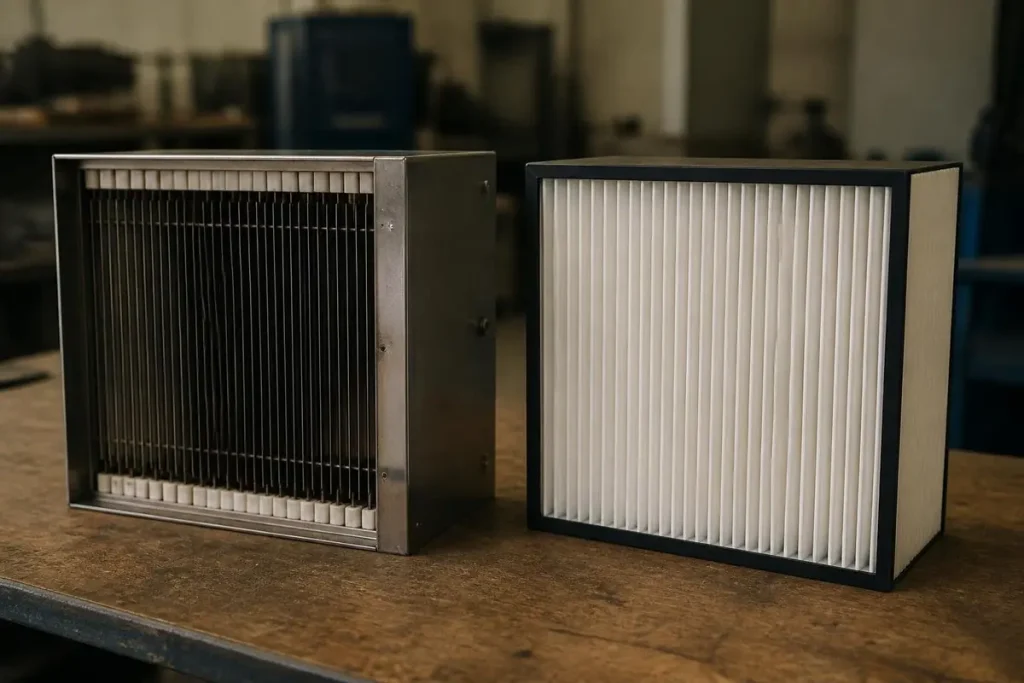
A clean electronic air cleaner can match a good media filter, but a MERV 13 filter gives a rated, repeatable number and an EAC usually does not. EPA’s 2018 technical summary says precipitators “often have an initial single-pass removal efficiency of 60 percent or more,” up to 95 percent at lower airflow, and that efficiency “decreases as the collecting plates become loaded.”
Few EAC boxes show a MERV: ASHRAE says the Standard 52.2 test method “can be used” on many of these devices, but “they are not officially covered by that standard.”
| Device | Efficiency basis | Airflow and upkeep | Ozone |
|---|---|---|---|
| Electronic air cleaner (precipitator) | 60 percent or more per pass when clean, falling as plates load (EPA) | Low pressure drop; wash cells | Possible; California limit 0.050 ppm |
| MERV 13 media filter | At least 85% of 1 to 3 micron particles (ASHRAE) | More resistance; replace on schedule | None from the filter itself |
| Ionizer (bipolar or needlepoint) | No standard rating; particles may settle on room surfaces (EPA) | Low resistance; clean emitters | Possible; check certification |
EPA’s Guide to Air Cleaners in the Home recommends at least MERV 13 or “as high a rating as your system will accommodate,” and says most systems can take MERV 13 if the filter is replaced frequently. Whether yours can is a static pressure question; our explainer on MERV ratings and airflow shows why filter area matters too.
Switching is not a cell swap. Honeywell’s F300 support page says a licensed pro must remove or permanently disable the power supply “to prevent any possible fire hazard,” then fit 4-inch media filters. Our HVAC filter guide covers sizes and change intervals.
Is an electronic air cleaner worth it?
An electronic air cleaner is worth it if you will wash the cells on schedule and want low airflow resistance; a MERV 13 filter is simpler if your system can take one. EPA notes media filters typically have a greater pressure drop than electronic air cleaners, the EAC’s real advantage.
Running cost: Honeywell’s 33 watts, around the clock, is about 289 kWh a year by our arithmetic, before blower energy. EPA notes precipitators “do not remove gases or odors,” and large allergen particles settle before reaching any HVAC filter. For germicidal lamps and other add-ons, see our guide to UV lights and in-duct purifiers.
How we researched this
On October 15 to 18, 2026 we read the Resideo and Trion manuals (maker data, attributed), two EPA documents, ASHRAE guidance, two CARB pages, UL’s UL 867 notice and 21 CFR 801.415, and counted CARB’s list on October 18. Excluded: maker efficiency claims (Trane, Lennox), installed prices (no federal series) and Reddit, since the topic involves high voltage.
Frequently asked questions
Do electronic air cleaners actually work?
Yes, when clean. EPA’s 2018 technical summary says precipitators often remove 60 percent or more of most particle sizes in a single pass, up to 95 percent at low airflow. Efficiency drops as the plates load, and the unit only cleans while the blower runs.
Is the ozone from an electronic air cleaner dangerous?
Honeywell puts its output at about 0.005 to 0.010 ppm, below the 0.050 ppm limit CARB applies to certified cleaners. EPA cautions that even ozone below health standards reacts with indoor chemicals to form formaldehyde and ultrafine particles. A carbon filter or lower power supply setting reduces it.
How often should you clean electronic air cleaner cells?
Follow your maker. Honeywell’s F300E guide says twice a year with normal use, or yearly with a quick wire wipe in between. Trion’s HE Plus manual says every two months, and monthly in new homes or with heavy smoke. Wash more often if the snapping becomes constant.
Can you wash electronic air cleaner cells in a dishwasher?
Honeywell allows it for its cells: lower rack, regular detergent, and never the dry cycle, which bakes on dirt. It says to check the dishwasher manual first, since some makers advise against it, and to keep the prefilter out. Trion describes a tub soak and hose rinse.
What MERV rating is an electronic air cleaner?
Usually none. ASHRAE says its Standard 52.2 method can test many electronic filters, but they “are not officially covered by that standard,” so most carry no MERV. By comparison, ASHRAE says a MERV 13 filter removes at least 85% of 1 to 3 micron particles.
Can I convert a Honeywell electronic air cleaner to a media filter?
Yes, with a professional. Honeywell’s support page says a licensed heating and cooling pro must remove or permanently disable the power supply to prevent a possible fire hazard; unplugging is not sufficient. The cells are then replaced with 4-inch media filters such as the FC100 or FC200.
Sources
- Resideo. “F50F and F300E Electronic Air Cleaners Owner’s Guide, 69-0756-07.” https://digitalassets.resideo.com/damroot/Original/10003/69-0756.pdf. Accessed October 2026.
- Trion. “HE Plus 2000 Manual, 155587-001” (via ManualsDir). https://www.manualsdir.com/manuals/208481/trion-he-plus-2000.html?page=7. Accessed October 2026.
- U.S. EPA. “Residential Air Cleaners: A Technical Summary, 3rd Edition.” https://www.epa.gov/sites/default/files/2018-07/documents/residential_air_cleaners_-_a_technical_summary_3rd_edition.pdf. Accessed October 2026.
- U.S. EPA. “Guide to Air Cleaners in the Home.” https://www.epa.gov/indoor-air-quality-iaq/guide-air-cleaners-home. Accessed October 2026.
- California Air Resources Board. “List of CARB-Certified Air Cleaning Devices.” https://ww2.arb.ca.gov/list-carb-certified-air-cleaning-devices. Accessed October 2026.
- California Air Resources Board. “Air Cleaner Information for Manufacturers.” https://ww2.arb.ca.gov/air-cleaner-information-manufacturers. Accessed October 2026.
- ASHRAE. “Filtration and Disinfection.” https://www.ashrae.org/technical-resources/filtration-disinfection. Accessed October 2026.
- UL Solutions. “Revised Standard for Electrostatic Air Cleaners, UL 867.” https://ul.com/news/revised-standard-ul-867-electrostatic-air-cleaners. Accessed October 2026.
- eCFR. “21 CFR 801.415, Maximum acceptable level of ozone.” https://www.ecfr.gov/current/title-21/section-801.415. Accessed October 2026.
- Honeywell Home (Resideo). “F300 Electronic Air Cleaner support.” https://www.honeywellhome.com/us/en/support/f300-electronic-air-cleaner-3/. Accessed October 2026.
Leave a Reply