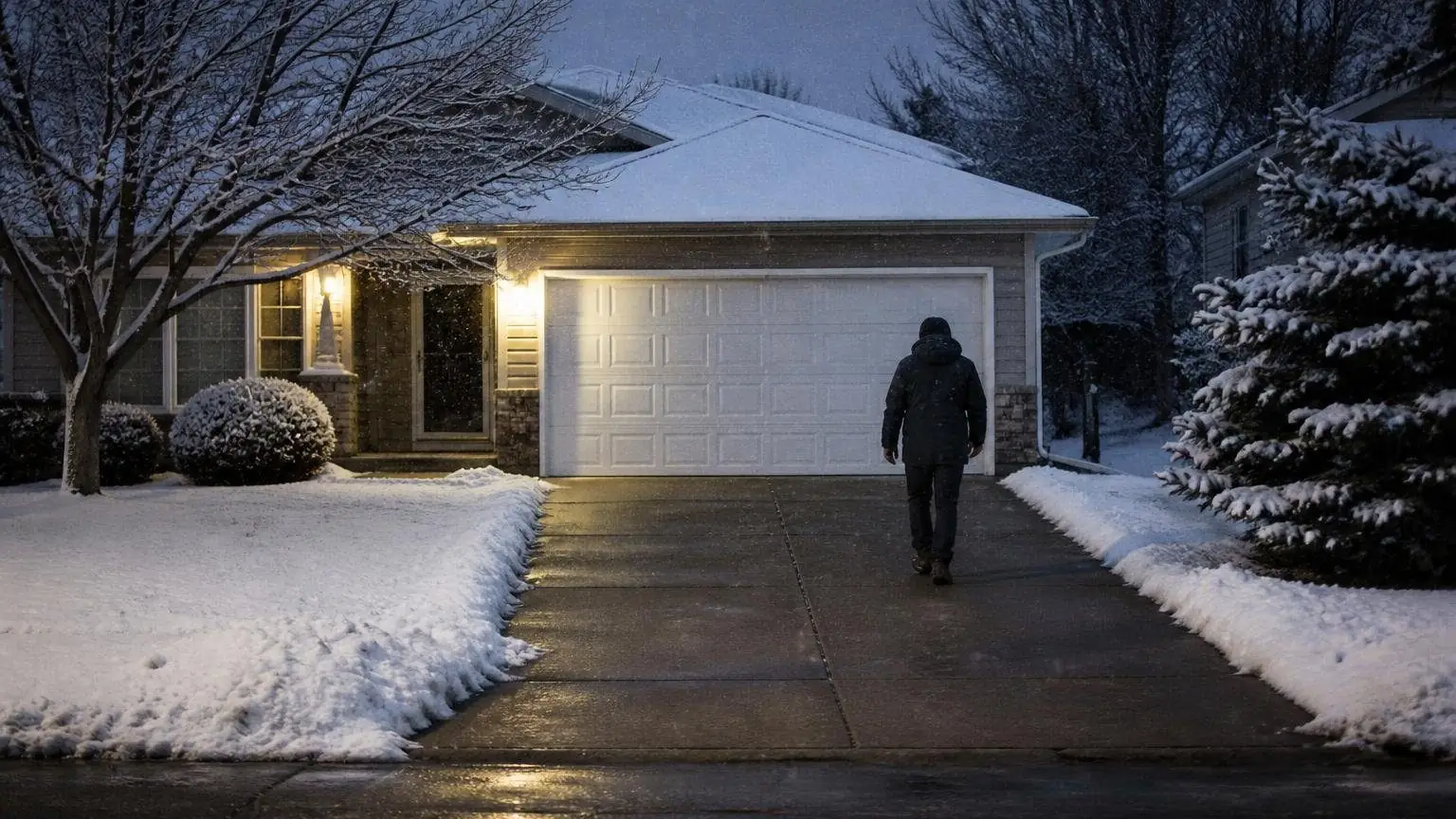
How does a heated driveway work? A heated driveway melts snow with buried electric cable or mats, or with warm glycol pumped from a boiler through tubing. A 400 sq ft electric slab at 50 watts per sq ft draws 20 kW, about $3.63 per running hour at the US average electricity price.
Key Takeaways
- The Plastics Pipe Institute, restating the ASHRAE Handbook, suggests a snow-free area ratio of 0 or 0.5 for a private driveway (PPI Recommendation J).
- Warmup says snow melting takes at least 35 W per sq ft and ships 50 W per sq ft mats (maker data, Warmup).
- At EIA’s August 2026 US residential average of 18.16 cents per kWh, a 20 kW driveway costs $3.63 per running hour (EIA Table 5.6.A).
- The same heat from a gas boiler at the 84% federal AFUE floor costs about $1.09 an hour at January 2026 gas prices of $13.96 per Mcf (EIA).
- Heating two 2 ft tire tracks instead of 400 sq ft cuts the draw to 4 kW, or $0.73 an hour (EIA).
- WarmlyYours advertises “30+ Years Lifespan” but writes a 10-year warranty on its snow melting elements (WarmlyYours).
What is a heated driveway, and how does it work?
A heated driveway is a snow melting system buried in concrete, asphalt or pavers. Heat melts snow from below, then dries the slab so meltwater does not refreeze.
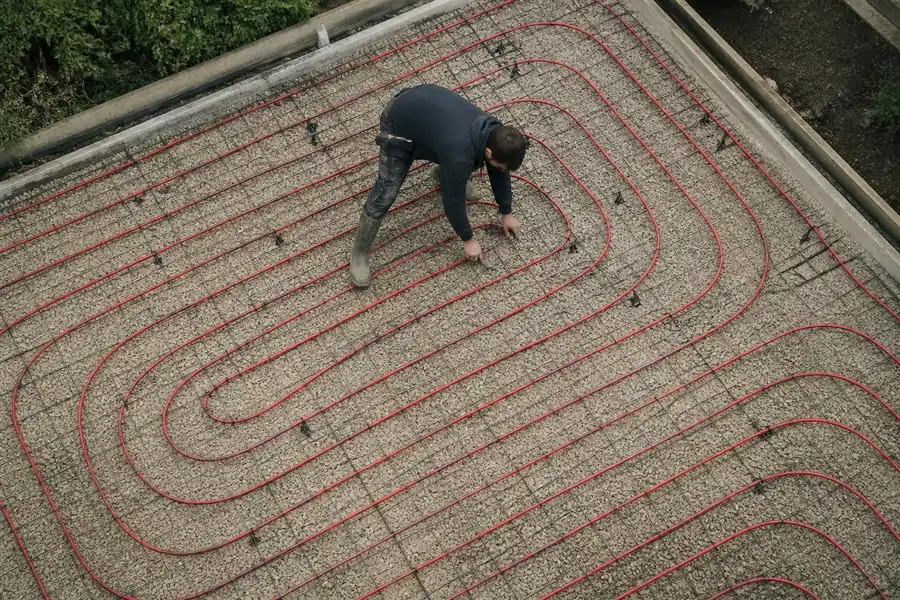
Electric systems use resistance cable or mats, the same idea as heat tape on a frozen pipe scaled up to tens of kilowatts. Hydronic systems circulate “warm anti-freeze mixtures (e.g., glycol and water) through plastic piping” (PPI). PPI says the tubing is typically PEX or PE-RT, the same as indoor radiant floor heating.
Electric or hydronic: which heated driveway system fits?
Electric is simpler for a single driveway because it needs no boiler, pump or antifreeze. Hydronic suits large areas or homes with a boiler, because gas heat costs less than electric heat at current US prices.
| Feature | Electric cable or mat | Hydronic glycol loop |
|---|---|---|
| Output basis | 35 to 50 W per sq ft (maker data) | Btu/h per sq ft from ASHRAE tables |
| Equipment | Contactor panel and sensor | Boiler, pump, manifold, compression tank |
| Cost per hour, 400 sq ft | $3.63 at 50 W per sq ft | $1.09 for the same heat on gas |
| Best fit | Single driveway, tire tracks, retrofit | Large areas, homes with a boiler |
A snowmelt loop is a hydronic heating system outdoors, with its own circulator pump.
How much heat does a heated driveway need?
Maker sizing puts a heated driveway at 35 to 50 watts per sq ft, or 119 to 171 Btu/h per sq ft. Engineers start from ASHRAE surface heat flux tables, which vary by city and snow-free target.
PPI’s March 2026 Recommendation J reproduces the Albany, NY row of the 2023 ASHRAE Handbook, Chapter 52 table. At a snow-free ratio of 0 and 75% frequency the surface needs 37 Btu/h per sq ft. A half-clear slab at 90% needs 86, fully clear at 90% needs 125, and fully clear at 99% needs 212.
Those are surface numbers only: PPI says they are “for only the surface of the slab,” so installed output must also cover heat lost downward and at the edges. EIA’s 3,412 Btu per kWh converts between the units (EIA).
How much does a heated driveway cost to run?
A heated driveway costs its kilowatt draw times your electricity price for each running hour. At EIA’s August 2026 US average of 18.16 cents per kWh, a 400 sq ft driveway at 50 W per sq ft costs $3.63 an hour and $32.69 for a 9 hour storm.
- Draw: 400 sq ft x 50 W = 20 kW.
- Energy: 20 kW x 9 hours = 180 kWh, using a WarmlyYours example of 6 hours melting plus 3 drying (WarmlyYours).
- Cost: 180 kWh x $0.1816 = $32.69.
- Gas: 20 kW x 3,412 = 68,240 Btu/h, or 81,238 Btu/h of input at 84% efficiency; at 1,036 Btu per cubic foot and $13.96 per Mcf, $1.09 an hour.
| Setup | Draw | Per hour | Per 9 hour storm | Per 100 hours |
|---|---|---|---|---|
| Full 400 sq ft, 50 W | 20 kW | $3.63 | $32.69 | $363.20 |
| Full 400 sq ft, 35 W | 14 kW | $2.54 | $22.88 | $254.24 |
| Tire tracks, 80 sq ft, 50 W | 4 kW | $0.73 | $6.54 | $72.64 |
| Gas boiler, 84% AFUE | 81,238 Btu/h | $1.09 | $9.85 | $109.47 |
The 84% is the federal AFUE minimum for gas hot water boilers made on or after January 15, 2021 (10 CFR 430.32). We used January gas because snow falls in winter; July 2026 ran $26.45. The gas row excludes pump power, and an electric boiler on the loop pays the same per kWh as cable.
Two corrections: WarmlyYours prices its 20 kW example at $0.17 per kWh, or $3.40 an hour; EIA’s average makes it $3.63, and our state electricity price table shows local swings. HeatTrak credits the boiler for hydronic’s lower running cost, but the fuel price does the work; see our natural gas prices by state. No federal series counts snowmelt run hours; WarmlyYours estimates 50 to 100 a Midwest season, a maker figure.

Why do controls and idling drive the bill?
Controls set how many hours the slab runs, so after heated area they move the bill most. A sensor starts the system only when it detects moisture at freezing temperatures; a manual switch runs until someone turns it off.
Electric systems switch through a contactor panel, the same relay type as the contactor in an outdoor AC unit. A typical automatic cycle:
- The sensor detects snow or freezing rain.
- The control energizes the cable or fires the boiler until precipitation stops.
- An after-run dries the surface; WarmlyYours says it typically lasts 1 to 3 hours and adds roughly 30 to 50% to a storm’s kWh.
- Warm weather shutdown blocks melting and idling.
Idling is the expensive option. tekmar’s Snow Detector and Melting Control 664 can hold the slab at an idle temperature for 30 minutes to 40 hours, returning to OFF if no snow is detected (tekmar 664 addendum). Its warm weather shutdown exists “in order to conserve energy.” WarmlyYours says “studies” show 30 to 50% lower seasonal energy use with sensor controls but names none, so read it as a maker claim.
Do heated driveways really work in heavy snow?
Yes, within their design limits. A residential system sized for a snow-free ratio of 0 lets snow build up in a heavy storm and melts it from below once the snowfall rate drops.
PPI’s driveway example accepts that “a light layer of snow may be present” to cut capital and operating costs, and suggests a fully clear ratio of 1.0 only for an inclined driveway. PPI also warns the ASHRAE data come from 1982 to 1993 weather that “may have shifted.” Get the design ratio in writing.
New pour, retrofit or tire tracks: what are the install options?
A heated driveway goes in with a new pour, under pavers, or as a saw-cut retrofit. Tire tracks work with all three and shrink the load and the bill.
- New pour: Warmup mats go on a drained gravel base before the pour, or on an existing slab “before an additional 2” pour.”
- Pavers: mats sit on a drained gravel base under sand or fine gravel.
- Asphalt: Warmup recommends hand rolling the surface.
- Retrofit: per WarmlyYours, a contractor “saw-cuts narrow grooves into your existing surface, lays heating cables inside, and seals them flush.”
- Tire tracks: Warmup says they “reduce upfront costs and future operating costs.”
The electrical load is easy to miss: at 50 W per sq ft, 400 sq ft draws 20,000 W, or 83 A at 240 V, before code sizing factors. A hydronic slab instead adds a boiler or zone; our boiler installation guide covers the code items.
Code point: ground-fault protection
The National Electrical Code requires ground-fault protection for fixed outdoor snow melting equipment; EC&M’s Article 426 summary reads “provide ground fault protection [426.28]” (EC&M). Code adoption and permits vary by jurisdiction, so use a licensed electrician.
How long does a heated driveway last, and what are the drawbacks?
No federal or national lab source publishes heated driveway lifespans. The firm number is the warranty: WarmlyYours offers 10 years on its snow melting elements, covering “defects in materials and workmanship.”
The same page carries a “30+ Years Lifespan” badge, and HeatTrak lists 15 to 20 years for electric with no source. Treat anything beyond the written warranty as marketing. The drawbacks: a 20 kW draw, $3.63 per running hour, and buried cable that is costly to reach. If the goal is a warm garage rather than a clear slab, an infrared heater heats people instead of pavement. Holding heat in that garage also depends on the overhead door, where garage door insulation cuts the loss through a bare steel panel.
How we researched this
Research date: October 28, 2026. We read the top three ranking pages and consulted 15 sources, citing 10: three EIA datasets, 10 CFR 430.32, PPI’s restatement of ASHRAE Handbook Chapter 52, EC&M on NEC Article 426, and maker pages from Warmup, WarmlyYours and tekmar, labeled as maker data. Costs are our arithmetic from EIA prices.
Excluded: installed prices (vendor estimates, no federal series), HeatTrak’s cost ranges (unsourced), Warmzone’s package prices (internally inconsistent) and an nVent cable guide (download failed). Reddit was skipped because the topic involves electrical safety.
Frequently asked questions
How many amps does a heated driveway need?
Multiply area by watts per sq ft, then divide by voltage. At Warmup’s standard 50 W per sq ft, 400 sq ft draws 20,000 W, or 83 A at 240 V before code sizing factors. NEC 426.28 also requires ground-fault protection, so an electrician should size the circuits.
Can you add a heated driveway to an existing driveway?
Yes. WarmlyYours describes a retrofit in which a contractor saw-cuts narrow grooves into existing asphalt or concrete, lays heating cable inside and seals it flush. Warmup instead allows mats on an existing slab under an additional 2 inch pour. WarmlyYours calls tire tracks the most popular retrofit format.
Is a heated driveway cheaper to run on gas or electricity?
Gas, at current US prices. Delivering 20 kW of heat costs $3.63 an hour from cable at 18.16 cents per kWh, versus about $1.09 from a gas boiler at the 84% AFUE floor and $13.96 per Mcf. That excludes pump power.
Do heated driveways work under pavers and asphalt?
Yes. Warmup says its mats and cables go under pavers, asphalt or concrete. Under pavers they sit on a drained gravel base below sand or fine gravel; in asphalt, Warmup recommends hand rolling. Use products the maker rates for your surface.
Can I heat only the tire tracks?
Yes. Warmup says tire tracks reduce upfront and operating costs. Two 2 ft wide tracks along a 20 ft driveway total 80 sq ft, which draws 4 kW at 50 W per sq ft and costs about $0.73 an hour at EIA’s August 2026 price.
How long does a heated driveway last?
No federal source publishes a lifespan. The firm number is the written warranty: WarmlyYours offers 10 years on its snow melting elements, covering defects in materials and workmanship. Longer figures on ranking pages carry no source, so treat them as marketing.
Sources
- US Energy Information Administration. “Electric Power Monthly, Table 5.6.A” (August 2026). https://www.eia.gov/electricity/monthly/epm_table_grapher.php?t=epmt_5_6_a. Accessed October 2026.
- US Energy Information Administration. “U.S. Price of Natural Gas Delivered to Residential Consumers.” https://www.eia.gov/dnav/ng/hist/n3010us3m.htm. Accessed October 2026.
- US Energy Information Administration. “British thermal units (Btu).” https://www.eia.gov/energyexplained/units-and-calculators/british-thermal-units.php. Accessed October 2026.
- eCFR. “10 CFR 430.32.” https://www.ecfr.gov/current/title-10/chapter-II/subchapter-D/part-430/subpart-C/section-430.32. Accessed October 2026.
- Plastics Pipe Institute. “PPI Recommendation J” (March 2026). https://plasticpipe.org/Recommendation-J. Accessed October 2026.
- EC&M. “Article 426: Fixed Outdoor Electric Deicing and Snow-Melting Equipment.” https://www.ecmweb.com/national-electrical-code/article/20900801/article-426-fixed-outdoor-electric-deicing-and-snow-melting-equipment. Accessed October 2026.
- Warmup (maker). “Heated Driveway Systems.” https://www.warmup.com/snow-melting/heated-driveway. Accessed October 2026.
- WarmlyYours (maker). “Heated Driveway.” https://www.warmlyyours.com/en-US/snow-melting/heated-driveway. Accessed October 2026.
- WarmlyYours (maker). “Heated Driveway Operating Costs.” https://www.warmlyyours.com/posts/blog-post-heated-driveway-operating-costs-what-to-expect-on-your-electric-bill. Accessed October 2026.
- tekmar (Watts, maker). “Data Brochure Addendum D 664A.” https://www.watts.com/dfsmedia/0533dbba17714b1ab581ab07a4cbb521/81811-source/664-b-06. Accessed October 2026.
Leave a Reply