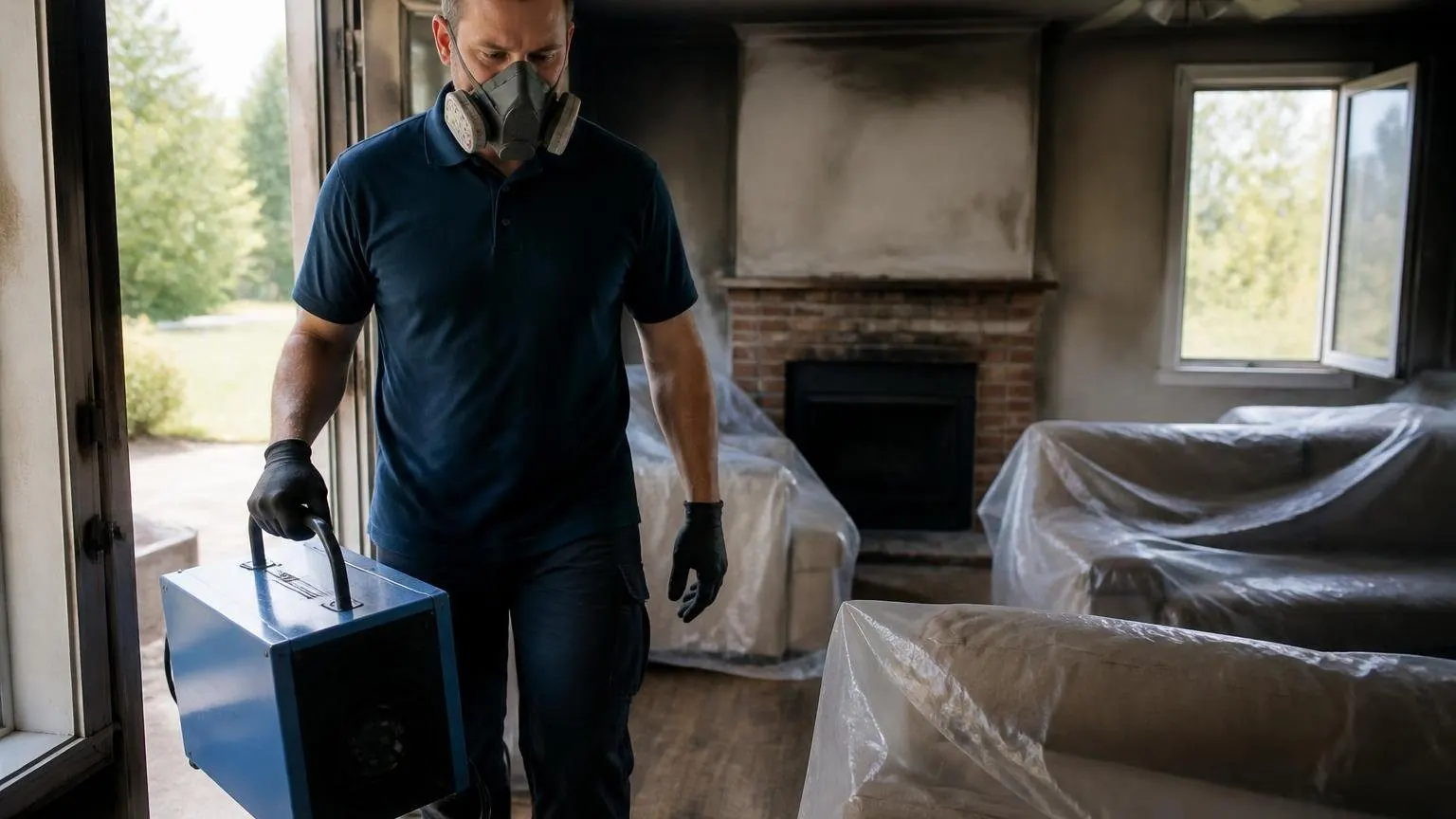
What is an ozone generator, and is it safe? An ozone generator is a machine that makes ozone gas on purpose. EPA says it does little to clean air at levels people can safely breathe, and federal and California limits sit between 0.05 and 0.1 ppm. Use one only in empty, sealed spaces.
Key Takeaways
- Within public health standards, ozone “has little potential to remove indoor air contaminants,” EPA found (EPA).
- FDA treats a device that pushes ozone above 0.05 ppm in a home or office as adulterated or misbranded (21 CFR 801.415).
- OSHA caps workers at 0.1 ppm over 8 hours; NIOSH lists 5 ppm as immediately dangerous to life or health (NIOSH Pocket Guide).
- California bans sales of indoor air cleaners not certified at or below 0.050 ppm, in-duct units included (17 CCR 94802).
- CARB says many commercial ozone generators emit more than 5,000 mg of ozone per hour (CARB).
- Ozone reacting with terpenes can add tens of micrograms per cubic meter of submicrometer particles indoors (Weschler, 2006).
What is an ozone generator, and how does it work?
An ozone generator is an appliance built to release ozone (O3), most often by corona discharge, and sold as an air cleaner or odor remover. Sellers call the gas “activated oxygen,” “super oxygenated” or “energized oxygen,” terms CARB calls misleading.
Output is large. CARB reports that many commercial ozone generators emit more than 5,000 mg of ozone per hour. An electrostatic precipitator or ionizer makes ozone only as a side effect and emits much less, CARB says.
EPA states that “NO agency of the federal government has approved these devices for use in occupied spaces.” An EPA establishment number on the box only identifies the factory.
Do ozone generators clean indoor air?
Not at levels people can breathe. EPA’s review of peer-reviewed studies tested the main sales claims one by one, and ozone within health standards failed each.
| Seller claim | What EPA’s review found | Study EPA cites |
|---|---|---|
| Breaks down household chemicals | For many common indoor chemicals the reaction “may take months or years” | Boeniger, 1995 |
| Removes carbon monoxide and formaldehyde | Not effective for either | Salls, 1927; Esswein and Boeniger, 1994 |
| Clears dust, pollen and allergens | Ozone does not remove particles such as dust and pollen | EPA review text |
| Kills mold, bacteria and viruses | Needs 5 to 10 times the health standards; may miss growth in porous material | Dyas et al., 1983; Foarde et al., 1997 |
| Eliminates odors | Body odor may be masked by the smell of ozone rather than removed | Witheridge and Yaglou, 1939 |
Growth in duct liner may survive even high ozone, so it is no substitute for finding the moisture behind mold in ductwork. EPA’s respiratory virus page is blunter: “Do not use ozone generators in occupied spaces.”
How much ozone is too much? The limits in one table
Federal and California rules set limits between 0.05 and 0.1 ppm for air people breathe, and NIOSH puts the immediately dangerous level at 5 ppm.
| Rule | Ozone limit | Applies to |
|---|---|---|
| FDA device rule, 21 CFR 801.415 | 0.05 ppm | Devices in spaces occupied for extended periods, such as homes and offices |
| California, 17 CCR 94802 | 0.050 ppm | Emission concentration of any indoor air cleaner sold in the state |
| EPA outdoor standard, 40 CFR 50.19 | 0.070 ppm | Outdoor air, daily maximum 8-hour average |
| OSHA, 29 CFR 1910.1000 Table Z-1 | 0.1 ppm (0.2 mg/m3) | Workers, 8-hour time weighted average |
| NIOSH recommended limit | 0.1 ppm ceiling | Workers, never to be exceeded |
| NIOSH IDLH | 5 ppm | Immediately dangerous to life or health |
The OSHA Table Z-1 value is a shift average; the federal outdoor standard is a daily maximum 8-hour average. CARB lists California outdoor standards of 90 ppb (1 hour) and 70 ppb (8 hours).
Correction: EPA’s own page lists an old outdoor limit
EPA’s ozone generator page, updated February 19, 2026, still gives the outdoor standard as 0.08 ppm. The current rule, 40 CFR 50.19, has set 0.070 ppm since an October 26, 2015 rulemaking.
What happens when you run an ozone generator in a room?
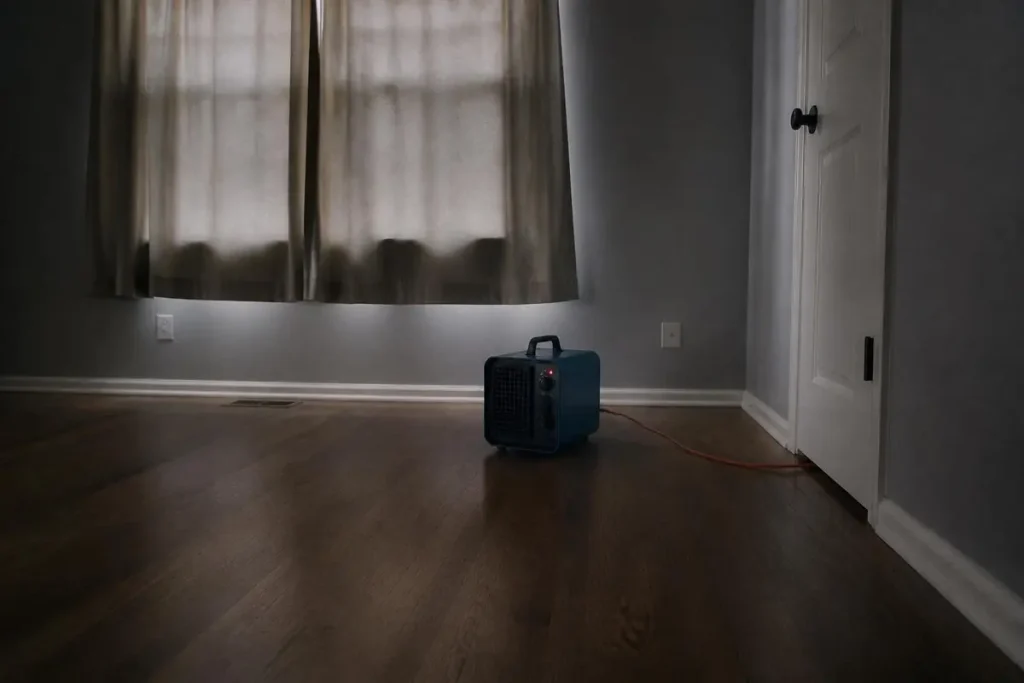
Room levels can pass every limit above, even when the owner follows the directions. In a study EPA cites, a unit rated for spaces “up to 3,000 square feet” ran on high in a 350 square foot room and reached 0.50 to 0.80 ppm.
In EPA’s home test, units on high with interior doors closed often produced 0.20 to 0.30 ppm, and a powerful unit with doors open reached 0.12 to 0.20 ppm in adjacent rooms. The dial is not linear: some high settings produced 10 times the medium level.
A mass check shows why output ratings mislead. Our arithmetic below uses the NIOSH conversion 1 ppm = 1.96 mg/m3, a 12 by 15 foot bedroom with an 8 foot ceiling, and CARB’s 5,000 mg per hour. It ignores ozone lost to surfaces and leaks, so real rooms read lower.
- Room volume: 12 x 15 x 8 = 1,440 cubic feet, or about 40.8 cubic meters.
- Ozone in the air at the 0.05 ppm FDA limit: 0.05 x 1.96 = 0.098 mg/m3, times 40.8 m3, is about 4 mg.
- A 5,000 mg per hour unit releases that in about 3 seconds.
- Ozone at the 5 ppm IDLH level in the same room: about 400 mg, which that unit releases in under 5 minutes.
What does ozone do to people, pets and the house?
Ozone damages lung tissue, and the warning signs can lag. EPA says relatively low amounts can cause chest pain, coughing, shortness of breath and throat irritation. FDA’s regulation adds that pulmonary edema can appear hours after exposure, and that olfactory fatigue makes smell an unreliable gauge of concentration.
CARB notes birds are especially sensitive to ozone, and animal studies in dogs and cats show respiratory effects. EPA lists household damage too: ozone can harm indoor plants and degrade rubber, electrical wire coatings, fabrics and artwork with susceptible dyes and pigments.
Ozone also makes new pollutants. In a carpet experiment EPA cites, ozone produced aldehydes and total organic chemicals in the air rose. CARB says reactions with terpenes, the pine and citrus scents in household products, produce formaldehyde and ultrafine particles. Those scented terpenes are themselves volatile organic compounds, released indoors by cleaners, air fresheners and furnishings. A 2006 review by Charles Weschler found these reactions can add tens of micrograms per cubic meter of submicrometer particles indoors.
Are ozone generators legal? Federal and California rules
No federal rule bans them outright; CARB says no government agency has the authority to fully regulate them. Under FDA’s 21 CFR 801.415, a device is adulterated or misbranded if it pushes ozone above 0.05 ppm in occupied spaces, or if it emits less but is labeled as a germicide or deodorizer.
California goes further. Under 17 CCR 94802, no indoor air cleaner may be sold unless CARB certifies an ozone emission concentration not exceeding 0.050 ppm. A 2020 amendment added in-duct air cleaners within 24 months of October 1, 2020, so CARB’s older fact sheet calling them exempt is outdated.
- Certified packaging must read “Meets California ozone emissions limit. CARB certified” (17 CCR 94806).
- Online listings of uncertified models must say the unit “cannot be shipped to California.”
- Industrial ozone units are exempt only for listed uses, such as fire and smoke remediation by trained personnel with nobody present (17 CCR 94801).
- Those exempt units must carry the advisory “For industrial use only. Use only in unoccupied spaces. Health hazard: emits ozone.”
CARB says over 300 manufacturers have certified devices.
When is ozone shock treatment used, and how is it done safely?
High ozone in empty buildings is sometimes used after fires or for stubborn odors, and EPA says it may be appropriate if no person or pet is exposed. EPA also warns little is known about the byproducts left behind.
No federal agency publishes a re-entry time, and the “wait 4 hours” rule on seller blogs appears in no agency text we read. The one regulatory number is in 17 CCR 94803: manuals for exempt industrial units must recommend the space be well-ventilated for at least one hour before people return.
- Remove every person and pet, plus plants, artwork and rubber items.
- Hire trained remediation personnel, as California’s exemption requires.
- After the run, ventilate for at least one hour.
- Confirm with an ozone meter, not your nose; FDA warns smell is not a reliable index.
If the smell comes from the equipment, a diagnosis of the HVAC odor finds the source ozone would only mask.
What works better than an ozone generator?
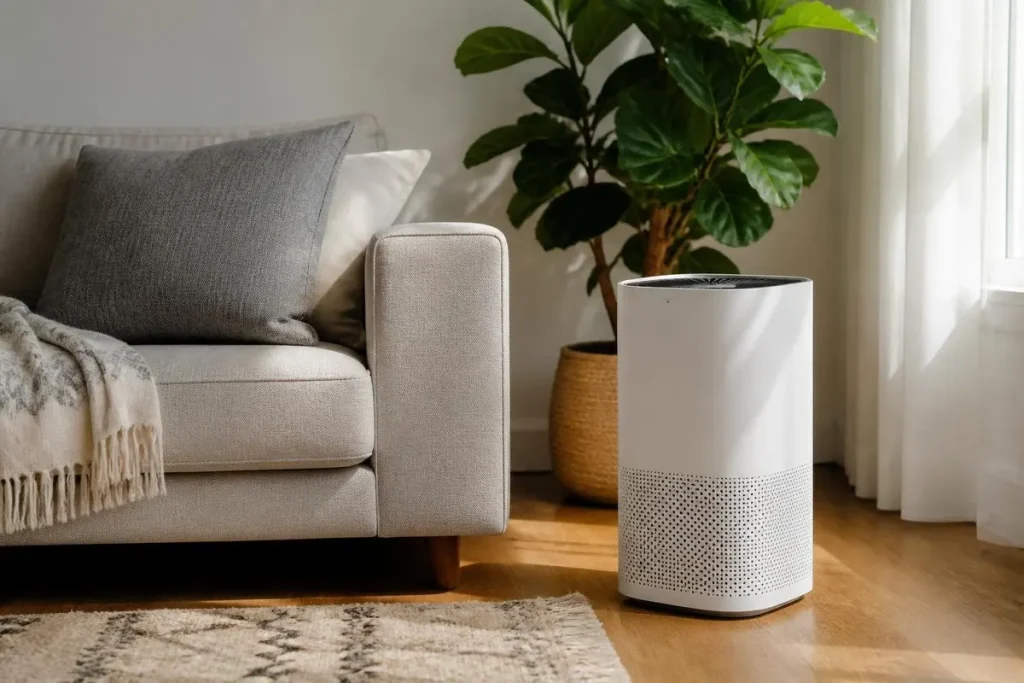
EPA ranks three approaches by effectiveness: source control, then outdoor air ventilation, then proven air cleaning. CARB adds that homes with central forced air should consider at least a MERV 13 filter.
Source control means fixing what makes the odor or dust, and a guide to why a house gets dusty covers the usual suspects. For ventilation, CARB suggests exhaust fans near pollutant sources, such as a ducted range hood over the stove while cooking.
To size whole-house fresh air, start with the air changes per hour math. For particles, a higher MERV filter that the blower can handle is the measured option.
Our reviews of ionizer evidence and UV lights in the air handler cover their ozone questions; California defines UVGI lamps emitting only above 240 nanometers as producing no measurable ozone.
How we researched this
On October 30, 2026 we read two EPA pages, the eCFR text of 21 CFR 801.415, 29 CFR 1910.1000 and 40 CFR 50.19, the NIOSH Pocket Guide, CARB pages, 17 CCR 94801 to 94806 and the Weschler review. We opened the three top-ranking articles; two of them cited no federal exposure limit. Seller re-entry times were excluded. Reddit was skipped because this is a health and safety topic.
Frequently asked questions
Is it safe to use an ozone generator in your home?
Not while anyone is inside. EPA says not to use them in occupied spaces, and one test it cites measured 0.50 to 0.80 ppm in a 350 square foot room, many times the 0.05 ppm FDA limit for homes. Remove plants and rubber items too.
How long after using an ozone generator can you go back in?
No federal agency sets a time. California requires manuals for exempt industrial units to recommend ventilating for at least one hour before re-entry. That is a minimum, not proof of safe levels. Confirm with an ozone meter, because FDA says olfactory fatigue makes smell unreliable.
Do ozone generators kill mold?
Not at safe levels. EPA says decontaminating air would take ozone 5 to 10 times the public health standards, and even high concentrations may not reach growth embedded in porous material such as duct lining or ceiling tile. Fix the moisture source instead.
Do ozone generators remove smoke smell?
Sometimes, at high doses in empty rooms. EPA says ozone appears to react with acrolein, one odorous chemical in secondhand smoke, and high ozone is used in fire restoration. At safe levels, EPA found ozone does not remove many odor chemicals.
Are ozone generators illegal in California?
For occupied spaces, in effect yes. California bars the sale of any indoor air cleaner that CARB has not certified at or below 0.050 ppm of ozone. Units sold only for listed industrial uses, such as smoke remediation by trained personnel, are exempt if they carry the required warning.
Is an ozone generator the same as an air purifier?
No. EPA says ozone does not remove particles such as dust and pollen, the particles behind most allergies. CARB recommends at least a MERV 13 filter for homes with central forced air, and says certified air cleaners have low, usually near-zero, ozone emissions.
Sources
- US EPA. “Ozone Generators that are Sold as Air Cleaners.” https://www.epa.gov/indoor-air-quality-iaq/ozone-generators-are-sold-air-cleaners. Accessed October 2026.
- US EPA. “Air Cleaners, HVAC Filters, and Respiratory Viruses.” https://www.epa.gov/indoor-air-quality-iaq/air-cleaners-hvac-filters-and-coronavirus-covid-19. Accessed October 2026.
- US FDA. “21 CFR 801.415 Maximum acceptable level of ozone.” https://www.ecfr.gov/current/title-21/section-801.415. Accessed October 2026.
- US OSHA. “29 CFR 1910.1000 Air contaminants, Table Z-1.” https://www.ecfr.gov/current/title-29/section-1910.1000. Accessed October 2026.
- US EPA. “40 CFR 50.19 Ambient air quality standards for ozone.” https://www.ecfr.gov/current/title-40/section-50.19. Accessed October 2026.
- NIOSH. “Pocket Guide to Chemical Hazards: Ozone.” https://www.cdc.gov/niosh/npg/npgd0476.html. Accessed October 2026.
- California Air Resources Board. “Hazardous Ozone-Generating Air Purifiers.” https://ww2.arb.ca.gov/our-work/programs/air-cleaners-ozone-products/hazardous-ozone-generating-air-purifiers. Accessed October 2026.
- California Code of Regulations, Title 17, Sections 94801 to 94806 (Cornell LII). https://www.law.cornell.edu/regulations/california/17-CCR-94802. Accessed October 2026.
- Weschler, C.J. “Ozone’s Impact on Public Health.” Environmental Health Perspectives 114(10) (2006). https://pmc.ncbi.nlm.nih.gov/articles/PMC1626413/. Accessed October 2026.
Leave a Reply