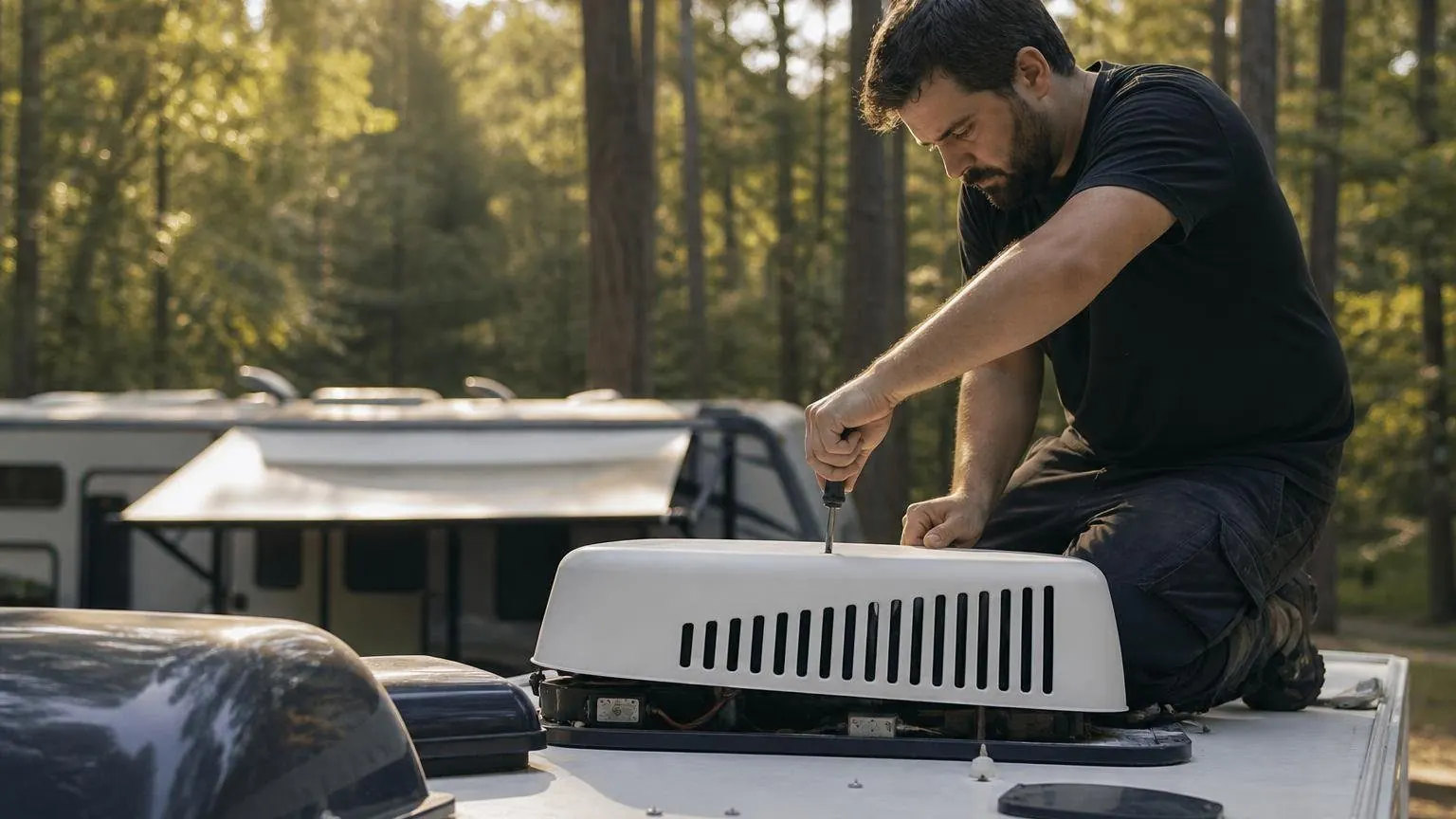
What is an RV air conditioner? An RV air conditioner is a self-contained 120-volt rooftop unit, usually 13,500 or 15,000 Btu/h, that draws about 13 to 16 amps running in the maker spec sheets we read. One fits a 30-amp hookup; two need 50-amp service.
Key Takeaways
- The 2023 National Electrical Code requires a 30-ampere, 125-volt receptacle at 70 percent of powered RV park sites and a 50-ampere, 125/250-volt one at 40 percent of new sites (NEC 551.71, archived copy).
- A 30-amp hookup is 3,600 watts; a 50-amp hookup is 12,000 watts across two legs (our math on the NEC ratings).
- Dometic’s 15,000 Btu/h Brisk II B59516.71X compressor is rated 13.3 running and 70.0 locked rotor amps, with a 3.5 kW minimum generator (Dometic manual 3315085).
- Coleman-Mach rates its 15,000 Btu/h Mach 8 at 1,671 running watts at standard conditions and 1,995 at its desert test (Coleman-Mach spec sheet).
- Micro-Air claims its EasyStart Breeze cuts starting current by up to 75%; that is a maker claim we did not test (Micro-Air).
- Dometic’s FreshJet heat pump does not run below 40°F outdoors (Dometic FreshJet manual).
- The federal 700 GWP limit for self-contained residential and light commercial AC does not name RV rooftop units (40 CFR 84.54).
What is an RV air conditioner and how does it work?
An RV air conditioner is a packaged refrigeration unit bolted over a roof opening. It pulls cabin air up through a ceiling box, cools it across an evaporator coil and rejects heat through a condenser on the same chassis, running on 120-volt power. Boats take a different route, since a marine air conditioner sends its heat into seawater pumped through the condenser.
Dometic’s 2023 FreshJet manual calls for a 14.3 by 14.3 inch opening finished to NFPA 1192, rafters no more than 16 inches on center, and 1.5 to 6.0 inches between roof and ceiling. Dometic and Furrion place twin units at one third and two thirds of coach length.
Makers size by coach length. Furrion’s manual lists its 13,500 Btu/h unit for a 23 feet coach, 14,500 for 26 feet and 15,500 for 31 feet (Furrion manual). A load method like our BTU sizing walkthrough accounts for glass and insulation. If the roof cannot take a unit, the trade-offs resemble our portable versus window unit comparison.
How many amps does an RV air conditioner draw?
Running current sits between 13.1 and 16.3 amps across the seven 13,500 to 15,500 Btu/h units below. Starting current is far higher: compressor locked rotor amps run from 63 to 73.0.
| Unit (maker data) | Btu/h | Running amps | Locked rotor amps | Source |
|---|---|---|---|---|
| Dometic Brisk II B57915.71X | 13,500 | 14.9 (12.4 compressor + 2.5 fan) | 68.0 | Dometic form 3315085, 2018 |
| Dometic Brisk II B59516.71X | 15,000 | 15.3 (13.3 + 2.0) | 70.0 | Dometic form 3315085, 2018 |
| Dometic FreshJet3 FJX3473 | 13,500 | 16.3 (13.0 + 3.3) | 73.0 | Dometic FreshJet manual, 2023 |
| Coleman-Mach Mach 8 A/C | 13,500 | 15.3, 1,599 watts | 63 | Coleman-Mach spec sheet |
| Coleman-Mach Mach 8 A/C | 15,000 | 15.9, 1,671 watts | 63 | Coleman-Mach spec sheet |
| Furrion FACR13SA | 13,500 | 13.1, 1,450 watts | Not listed | Furrion manual |
| Furrion FACR15SA | 15,500 | 15.4, 1,720 watts | Not listed | Furrion manual |
Dometic splits compressor and fan amps; we added them. A 2022 Furrion training handout defines rated load amps as the compressor draw “after 15 minutes at 95 degrees, with 115 volts, and 50% humidity,” and says starting amps fall between one half and two thirds of the locked rotor rating (Furrion training handout). For the B59516 that is 35 to 47 amps at start.
Our watts and amps primer explains the conversion, and the capacitors that help a compressor start and run are covered in our capacitor explainer.
Can you run an RV air conditioner on 30 amp or 50 amp shore power?
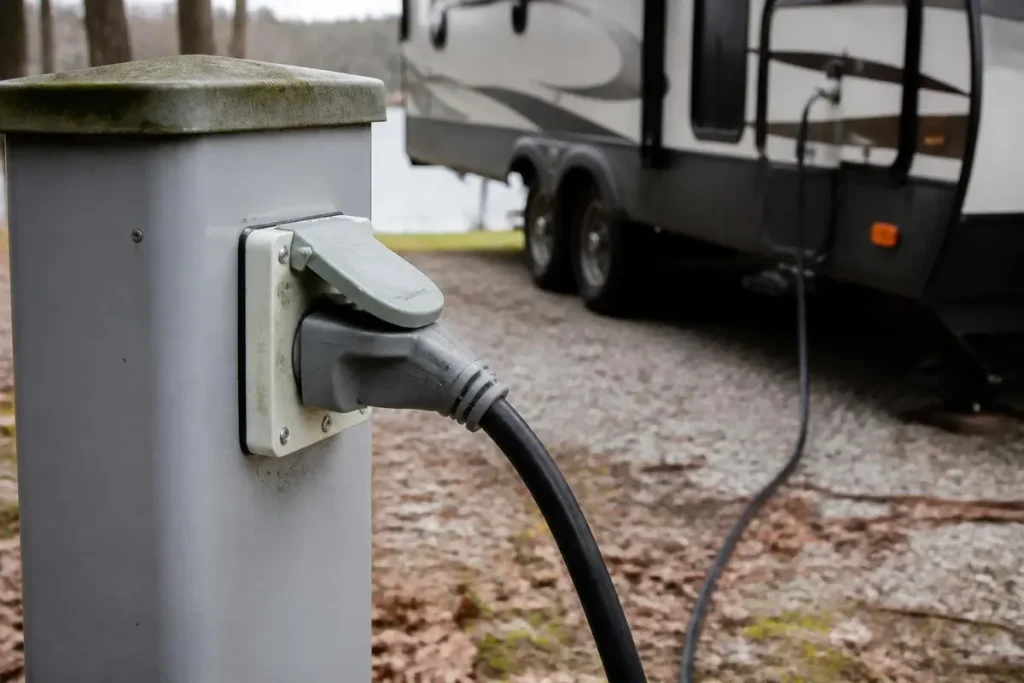
Yes, one unit on 30 amps and two on 50 amps, with room for little else on 30. Where the 2023 NEC is adopted, section 551.71 requires a 30-ampere, 125-volt receptacle at 70 percent of powered sites, a 50-ampere, 125/250-volt receptacle at 20 percent of existing and 40 percent of new sites, and at least one 20-ampere, 125-volt receptacle at every site.
The same section says every 50-amp site must also carry a 30-ampere, 125-volt receptacle, and the weather-resistant rule for 50-amp receptacles took effect January 1, 2026 (NEC text reprinted by Leviton, archived copy).
- 30-amp service: 30 amps times 120 volts is 3,600 watts.
- 50-amp service: two 50-amp legs at 120 volts, 6,000 watts each, 12,000 watts total.
- Subtract each unit’s running amps, then every other load.
On 30 amps, one Dometic B59516 leaves 14.7 amps; a second one would push the total to 30.6 amps. On 50 amps, one unit per leg leaves 34.7 amps on each. On a 20-amp outlet it leaves 4.7 amps.
Amp budgeting does not cover wiring faults. A pedestal can be within its rating and still be miswired; our guide to AC surge protectors covers what those devices catch. For breakers that trip at compressor start, see our breaker tripping guide.
What size generator runs an RV air conditioner?
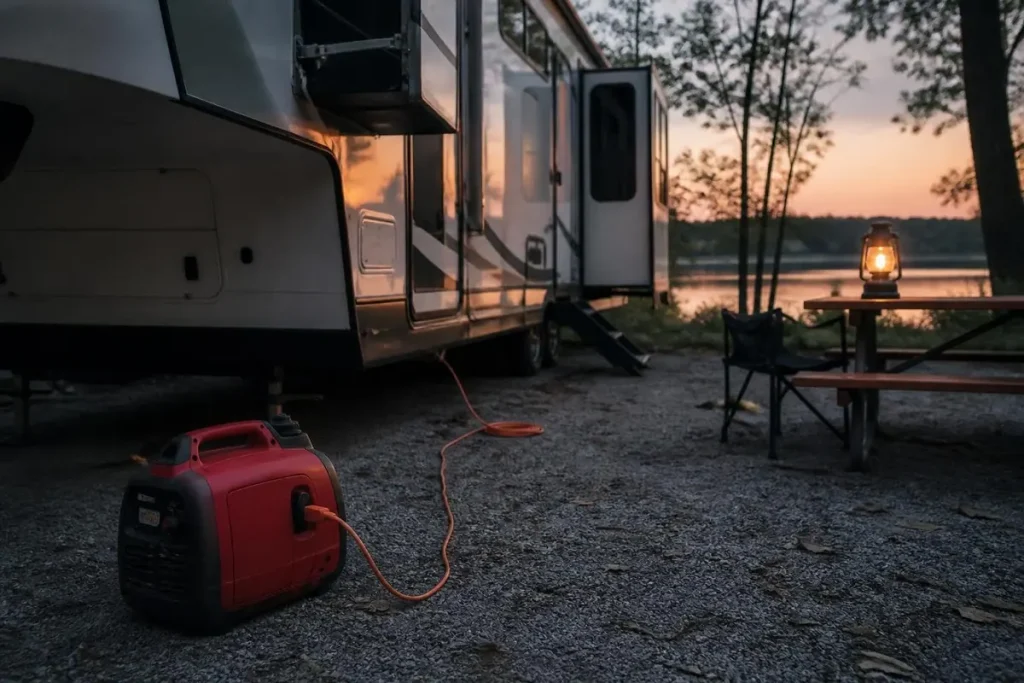
Dometic’s guideline is a 3.5 kW minimum generator for one 13,500 or 15,000 Btu/h Brisk II and 5.0 kW for two. Dometic says these guidelines “come from experiences people have had in actual applications” and that generators lose power at altitude and from poor maintenance (Dometic).
Airxcel, which makes Coleman-Mach, says “It is not the policy of Airxcel, Inc. to size generators.” It tells owners to start from running watts at its Desert Test, 100°F indoor dry bulb and 120°F outdoor, then add every other load (Coleman-Mach). That desert figure is 1,913 watts for the 13,500 Btu/h Mach 8 and 1,995 for the 15,000.
- Take the highest running watts on the spec sheet.
- Add the loads that run with it, such as a microwave.
- Confirm surge capacity for starting current, then derate for altitude and heat.
If starting is the problem rather than running, a hard start kit or a soft starter targets that surge.
Do RV air conditioner soft starters work?
They reduce starting current, not running watts. Micro-Air claims its EasyStart Breeze delivers a “Significant reduction of up to 75% in starting current” and calls it “compatible with every RV air conditioner.” The page gives no test conditions (Micro-Air).
Myth check: a soft starter does not shrink the running load. Coleman-Mach’s 15,000 Btu/h Mach 8 still needs 1,995 running watts at its desert test after it starts. A small generator must still carry that plus every other load.
How long can batteries and an inverter run an RV air conditioner?
Divide usable battery watt-hours by the unit’s running watts. With an assumed 5,000 watt-hour usable bank, a Coleman-Mach 13,500 Btu/h Mach 8 at 1,599 watts runs about 3.1 hours of continuous compressor time; at its 1,913 watt desert rating, about 2.6 hours. Inverter losses and other loads cut that further.
The 5,000 watt-hour bank is an example, not a recommendation. The inverter’s continuous rating must exceed running watts and its surge rating must cover starting current.
Heat pump, ducted or low profile: which RV air conditioner fits?
A heat pump model adds mild-weather heating, a ducted ceiling spreads air through the roof cavity, and a low profile unit cuts height. Dometic’s FreshJet manual says its heat pump “does not operate when the outside ambient temperature is below 40 °F (4 °C),” so below that the coach needs another heat source such as the furnace or a heat strip.
Heat strips draw real power: Coleman-Mach lists 1,748 running watts for the Mach 8 heat strip, more than the 1,599 watts its 13,500 Btu/h unit draws cooling. A rooftop heat pump is not a cold climate heat pump; our heat pump versus air conditioner explainer covers the basics.
Coleman-Mach lists an 8.25 inches exterior shroud height for the Mach 8 ultra low profile; Furrion’s FACR rooftop unit is 13 5/8 inches tall. Coleman-Mach also sells a top-down mount that uses in-roof ducts for supply and return.
Which refrigerant does a new RV air conditioner use, and do EPA limits apply?
Newer lines use R-32, but no federal text we found names RV rooftop units. Under 40 CFR 84.54, no one may make or import “self-contained residential and light commercial air conditioning and heat pump products” using a refrigerant with a global warming potential of 700 or greater, effective January 1, 2025 (eCFR).
We searched EPA’s October 2023 final rule for “recreational vehicle” and found no match. Its one mention of motorhomes concerns upfitted vehicle AC, which EPA chose not to restrict (88 FR 73098). Whether rooftop units fall in the residential subsector is unresolved in the text we read.
Makers are switching anyway. Dometic’s 2023 FreshJet3 manual lists 12.7 oz of R-410A, while its 2026 FreshJet 5 manual says the unit uses flammable R32 and needs a vehicle floor area larger than 43.1 square feet (Dometic FreshJet 5 manual). Our A2L refrigerant explainer covers that safety class.
How we researched this
Research date: October 30, 2026. We read NEC 551.71 (2023 edition, reprinted by Leviton, archived copy), 40 CFR 84.54 via the eCFR API (October 1, 2026 version), EPA’s 2023 Technology Transitions rule, and manuals and spec sheets from Dometic, Coleman-Mach, Furrion and Micro-Air. We consulted 16 sources and cite 10. Maker figures are maker data; we tested no units.
Excluded: retailer listings, SEO roundups and a ranking blog whose 1,300 running watts did not reconcile with its own 13.3 amp figure. No prices appear; no federal series covers them. Reddit was skipped for this electrical safety topic.
Frequently asked questions
Can I run an RV air conditioner from a household outlet?
Only with care. NEC 551.71 puts a 20-ampere, 125-volt receptacle at every powered RV site. On a 20-amp circuit, a Dometic B59516 drawing 15.3 running amps (13.3 compressor plus 2.0 fan) leaves 4.7 amps, and its compressor is rated at 70.0 locked rotor amps.
Can a 30 amp RV run two air conditioners?
Not at the same time without load management. A 30-amp hookup is 3,600 watts at 120 volts. Two Dometic B59516 units draw 30.6 running amps together, above the 30-amp rating before any other appliance runs. One unit leaves 14.7 amps.
What size generator do I need for a 15,000 BTU RV air conditioner?
Dometic’s guideline for its 15,000 Btu/h Brisk II is a 3.5 kW minimum generator for one unit and 5.0 kW for two. Coleman-Mach does not size generators; it says to start from desert-test running watts, 1,995 for its 15,000 Btu/h Mach 8, plus other loads.
Will a soft starter let me run my RV AC on a small generator?
It helps with starting only. Micro-Air claims up to 75% lower starting current for its EasyStart Breeze, without published test conditions. Running load does not change: the Coleman-Mach 15,000 Btu/h Mach 8 still needs 1,995 watts at its desert test.
Why does my RV heat pump stop heating when it gets cold?
Dometic’s FreshJet manual says the heat pump does not operate when outside air is below 40°F (4°C). Below that the system relies on the furnace or an electric heat strip; Coleman-Mach lists 1,748 running watts for its Mach 8 heat strip.
Are RV air conditioners switching to R-32?
Many new models are. Dometic’s 2026 FreshJet 5 manual describes a flammable R32 refrigerant and requires a vehicle floor area over 43.1 square feet. The federal 700 GWP limit in 40 CFR 84.54 covers self-contained residential and light commercial AC, but the rule text we read does not name RV rooftop units.
Sources
- NFPA 70, 2023 edition, as reprinted by Leviton. “551.71 Receptacle Requirements at RV Parks.” https://web.archive.org/web/2024/https://captaincode2023.leviton.com/node/352 (archived copy). Accessed October 2026.
- Dometic. “Roof Top Air Conditioner Installation Instructions, Form 3315085.000.” https://cdn.shopify.com/s/files/1/0463/8271/0952/files/3315085_71275.pdf. Accessed October 2026.
- Dometic. “FreshJet3 Series and FreshJet4 Series Installation Manual.” https://pantherrvproducts.com/content/Air%20Conditioners/DometicFreshjet3-4series_Installation.pdf. Accessed October 2026.
- Dometic. “FreshJet 5 Series Short Installation Manual.” https://pantherrvproducts.com/content/Air%20Conditioners/F5ShortInsManual%20-%209600049571.pdf. Accessed October 2026.
- Coleman-Mach (Airxcel). “Mach 8 Ultra Low-Profile Air Conditioners and Heat Pumps.” https://images.carid.com/coleman/items/pdf/mach-8-product-information.pdf. Accessed October 2026.
- Furrion. “Rooftop Air Conditioner Instruction Manual, FACR13SA/FACR14SA/FACR15SA.” https://images.camperid.com/furrion/items/pdf/729927-manual.pdf. Accessed October 2026.
- Lippert. “Furrion A/C Master Training Hand-out.” https://lci-support-doc.s3.amazonaws.com/Training%20Hand-outs/furrion-air-conditioners-master-training-powerpoint-hand-out.pdf. Accessed October 2026.
- Micro-Air. “EasyStart Breeze AC Soft Starter.” https://www.microair.net/products/easystart-breeze-soft-starter. Accessed October 2026.
- eCFR. “40 CFR 84.54, Restrictions on the use of hydrofluorocarbons.” https://www.ecfr.gov/current/title-40/chapter-I/subchapter-C/part-84/subpart-B/section-84.54. Accessed October 2026.
- U.S. EPA. “Phasedown of Hydrofluorocarbons: Restrictions on the Use of Certain Hydrofluorocarbons Under the AIM Act, 88 FR 73098.” https://www.govinfo.gov/content/pkg/FR-2023-10-24/html/2023-22529.htm. Accessed October 2026.
Leave a Reply