
What is a fume hood? A fume hood is a lab enclosure, closed on five sides with a movable sash, that pulls room air past the user and exhausts it outdoors. No federal rule sets its face velocity; ANSI/ASSP Z9.5 treats 80 to 100 fpm as a starting point and demands proven containment.
Key Takeaways
- OSHA requires fume hoods to be “functioning properly” but sets no face velocity (29 CFR 1910.1450).
- OSHA’s old “typically 60-100 lfm” line survives only in the 2011 CFR edition (govinfo, 2011).
- California is the exception: an average of at least 100 feet per minute and 70 fpm at any point (Cal/OSHA 5154.1).
- Z9.5 “does not specify a mandatory hood face velocity,” per subcommittee member D. Jeff Burton (The Synergist, 2018).
- Z9.5-2022 sets an as-installed tracer gas limit of 0.10 ppm, written 4 AI 0.10 (TSI LC-125 excerpts).
- One hood uses 3.5 times the energy of an average house; about 750,000 are in US use (Lawrence Berkeley National Laboratory, 2006).
What is a fume hood, and what does it actually do?
A fume hood is local exhaust for chemistry. OSHA defines a laboratory-type hood as an “enclosure on five sides with a moveable sash” that draws in lab air, with only hands and arms inside. It is the bench-scale cousin of the capture hoods in our industrial ventilation explainer and of the canopy over a restaurant line in our commercial kitchen hood guide.
OSHA’s QuickFacts sheet (OSHA 3407) calls the hood “often the primary control device” for flammable and toxic chemicals. Its rules: keep materials at least six inches from the sash opening, raise large equipment at least two inches off the base, and close the sash when not working.
Does OSHA set a fume hood face velocity?
No. Paragraph (e)(3)(iii) of 29 CFR 1910.1450 requires the Chemical Hygiene Plan to include “a requirement that fume hoods and other protective equipment are functioning properly,” and names no number. The current Appendix A is non-mandatory and refers employers to “Table 9.3” of the 2011 edition of Prudent Practices.
Correction: the 60-100 lfm figure is no longer in OSHA’s text
Many guides still cite OSHA for “typically 60-100 lfm.” That phrase appears in the 2011 CFR edition of Appendix A, next to “4-12 room air changes/hour” and evaluation “at least every 3 months.” None survives in the current eCFR text, though TSI’s 2023 LC-125 note still quotes the old line. Our air changes per hour guide converts exhaust cfm into ACH.
California writes numbers into law. Cal/OSHA 5154.1 requires “an average face velocity of at least 100 feet per minute with a minimum of 70 fpm at any point.” An unattended hood may drop to 60 fpm under automatic control if a tracer gas test rates it “4.0 AU 0.1 or less.”
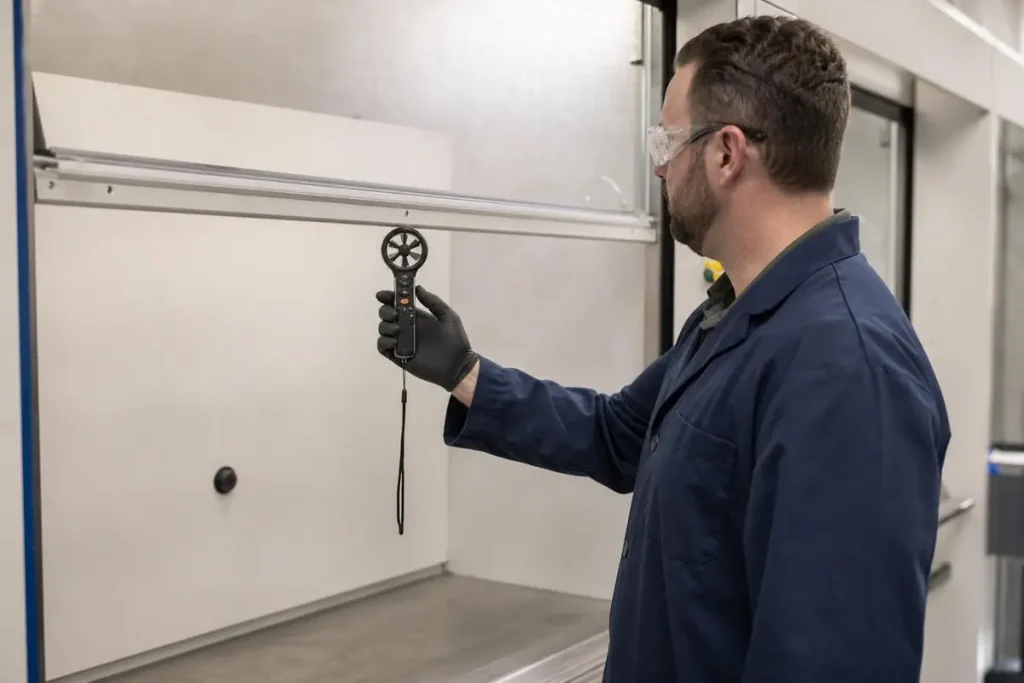
What face velocity should a fume hood run at?
Run the lowest face velocity that proves containment, usually 80 to 100 fpm. Burton writes that Z9.5 “does not specify a mandatory hood face velocity” and that velocities “as low as 60 fpm and as high as 150 fpm” have worked for specific operations. Z9.5-2022 notes add that running “below 60 fpm” is not recommended.
| Source | Face velocity language | Binding? |
|---|---|---|
| OSHA 1910.1450, current | None; hoods must be “functioning properly” | Yes, federal |
| OSHA Appendix A, 2011 CFR | “typically 60-100 lfm” | No; text since removed |
| Cal/OSHA 5154.1 | 100 fpm average, 70 fpm minimum point, 60 fpm unattended | Yes, California |
| ANSI/AIHA Z9.5-2012 | 80 to 100 feet per minute as a starting point | Consensus standard |
| ANSI/ASSP Z9.5-2022 notes | 80 to 100 fpm for most hoods; not below 60 fpm | Consensus standard |
| NFPA 45-2000 annex | 80 to 120 ft/min generally contains | Advisory annex |
| University of Washington EH&S | 100 LFM standard, 70 LFM low flow, at 18 inches | Campus policy |
Face velocity is an average of readings across the opening; cfm equals velocity times open area.
How is fume hood containment tested under ASHRAE 110?
ASHRAE 110 releases a tracer gas, sulfur hexafluoride (SF6), inside the hood and measures how much reaches a mannequin’s breathing zone. Lawrence Berkeley National Laboratory (LBNL) notes the 1995 edition “does not stipulate performance values”; owners and Z9.5 set the pass line.
The University of North Florida protocol shows the setup: an ejector 6 inches behind the sash plane releasing 4 liters per minute (4 L/min) of at least 98 percent pure SF6, with mannequin breathing zones at 18 or 23 inches. Ratings read as release rate, condition and ppm, as in “4.0 AU 0.1.” The three conditions:
- AM, as manufactured: the maker tests the model before purchase. SEFA asks for AM 0.05 but warns “it shall not be implied that this exposure level is safe.”
- AI, as installed: after testing and balancing, in the real lab. Z9.5-2022 caps any 5-minute test at 0.10 ppm unless the owner’s risk assessment sets another value.
- AU, as used: the long-term check of the working hood, which UNF repeats annually.
UNF also caps the peak at 0.5 ppm. Z9.5-2022 wants routine tests “at least annually” that also validate data sent to the building automation system, and a monitor that flags flow “high or low by 20%.”
Which fume hood types exist, and when is a ductless fume hood acceptable?
Ducted hoods fall into three airflow families; ductless hoods are a restricted class. The choice decides whether exhaust tracks the sash, much as a VAV terminal unit tracks a zone’s load.
| Hood type | How airflow behaves | Key limit |
|---|---|---|
| Constant volume (bypass) | Exhaust stays fixed; face velocity changes as the sash moves | Full flow and energy even with the sash closed |
| Variable air volume (VAV) | Dampers and drives cut exhaust as the sash closes, holding face velocity | Saves only if users close the sash |
| High-performance, low flow | Designed to contain at lower face velocity | Must prove containment by tracer gas |
| Ductless (filtered) | Filters the air and returns it to the room | Z9.5 limits it to work safe on an open bench |
LBNL describes VAV as maintaining “a constant face velocity” while standard hoods “experience variable face velocity as the face opening is adjusted.” Its “Berkeley Hood” contained tracer gas on about half the exhaust of a conventional hood running near 100 fpm.
Z9.5-2022 Section 5.2 says users “shall limit hazardous emission activities in ductless hoods to those safely performed on an open bench” unless the unit meets its air cleaning sections. The University of Tampa’s 2025 standard goes further: recirculating hoods are “not permitted” for chemical contaminants.
How much energy does a fume hood use?
A lot. LBNL’s Evan Mills and Dale Sartor wrote that “a fume hood consumes 3.5-times more energy than an average house” and helps make labs four to five times more energy intensive than typical commercial buildings. They modeled a 6-foot hood at 100 fpm, 24 hours a day, at 2003 prices.
Per hood, LBNL put annual cost at $4,600 in Los Angeles and $9,300 in Singapore; all US hoods add 5,100 megawatts of peak demand. Emerging designs could save 50 to 75 percent per hood.
To size the airflow, and the bill, for one hood:
- Measure the sash opening: width times open height, in square feet.
- Multiply by the face velocity to get exhaust cfm.
- Multiply cfm by LBNL’s US average annual energy cost of $4.50 per cfm (2003 prices, 24-hour operation).
Take a hypothetical 5-foot-wide opening. Open 25 inches, a legacy height University of Washington (UW) cites, it needs 1,042 cfm at 100 fpm, about $4,689 a year. At 18 inches it needs 750 cfm, about $3,375; a low-flow hood at 70 LFM needs 525 cfm, about $2,363. Savings require VAV controls and a lowered sash.
Hood static pressure tracks that airflow: in Burton’s fan law example, a hood at 1,150 scfm and 0.95 inch water gauge that slips to 0.65 inch moves about 950 scfm. Our static pressure guide covers the readings.
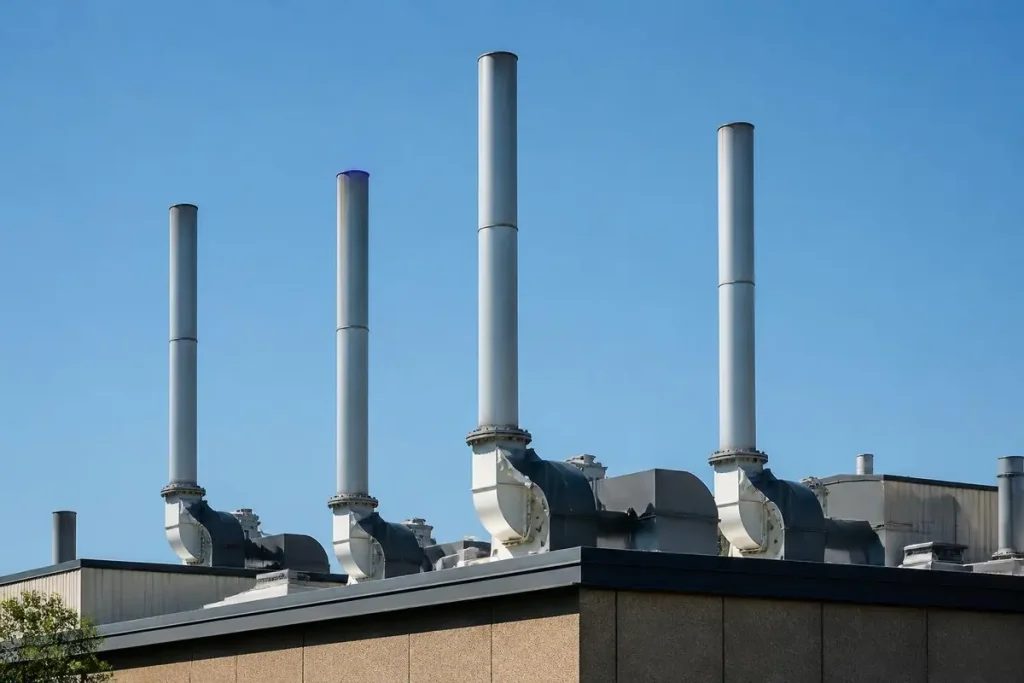
How do room pressure, makeup air and the stack work with a fume hood?
The lab must stay negative, the replacement air must arrive gently, and the exhaust must leave high. OSHA’s current Appendix A asks for a negative pressure differential and says “laboratory air should not be recirculated but exhausted directly outdoors,” the same logic as a negative pressure room.
LBNL notes lab ventilation “is based on 100-percent outside air,” so every exhausted cfm is outdoor air an air handling unit must condition. Z9.5-2022 keeps supply jets below half, preferably one-third, of hood face velocity. Our makeup air explainer covers the balance.
At the roof, Cal/OSHA accepts stacks “extending at least 7 feet above the roof and discharging vertically upward” and bans rain caps that divert exhaust downward. The University of Tampa standard requires 10 ft above adjacent roof lines and a minimum exit velocity of 3000 fpm. Z9.5-2022 adds that hood exhaust “shall not be recirculated to other areas.”
How we researched this
Researched October 30, 2026, from the current and 2011 texts of 29 CFR 1910.1450, Cal/OSHA 5154.1, the 2006 LBNL report, OSHA 3407 and three university hood standards. Z9.5, ASHRAE 110 and SEFA are paywalled, so we cite Burton’s 2018 article and TSI’s excerpts. We could not verify Z9.5 stack numbers. Manufacturer blogs were excluded for numbers; Reddit was skipped for this safety topic.
Frequently asked questions
How often does a fume hood need to be tested?
ANSI/ASSP Z9.5-2022 calls for routine performance tests at least annually. Cal/OSHA requires a smoke test at installation and annually, or every two years with a calibration and maintenance program for the airflow monitor. Campus programs vary; University of Washington EH&S tests about every 18 months.
What is the minimum fume hood face velocity in California?
Cal/OSHA 5154.1 requires an average of at least 100 feet per minute, with no point below 70 fpm, ignoring readings within 1 inch of the opening’s edge. An unattended hood may drop to 60 fpm only under automatic control, after a tracer gas test rated 4.0 AU 0.1 or less.
Can a ductless fume hood replace a ducted one?
Only for limited work. ANSI/ASSP Z9.5-2022 limits hazardous work in ductless hoods to what is safe on an open bench, unless the unit meets its air cleaning sections, and requires signs listing allowed chemicals and filter change schedules. The University of Tampa bans recirculating hoods for chemical contaminants.
What does “4 AI 0.10” mean on a fume hood test report?
It is an ASHRAE 110 rating: tracer gas released at 4 liters per minute, tested as installed, passing at 0.10 ppm in the mannequin’s breathing zone. AM means as manufactured and AU means as used. ANSI/ASSP Z9.5-2022 sets 0.10 ppm for as-installed tests unless the owner’s hazard assessment sets another value.
Is a biological safety cabinet the same as a fume hood?
No. NFPA 45-2000, as excerpted by TSI, says biological safety cabinets, laminar flow cabinets and canopy hoods shall not be used in lieu of laboratory hoods. The University of Tampa standard ties biosafety cabinets to NSF International Standard #49 instead.
Why does a fume hood alarm go off?
Exhaust flow has drifted out of range. ANSI/ASSP Z9.5-2022 requires a monitor that flags flow high or low by 20%, and Cal/OSHA accepts an alarm when airflow falls to less than 80% of the required rate. University of Washington EH&S says to stop using the hood if the alarm continues.
Sources
- eCFR. “29 CFR 1910.1450, Occupational exposure to hazardous chemicals in laboratories.” https://www.ecfr.gov/current/title-29/subtitle-B/chapter-XVII/part-1910/subpart-Z/section-1910.1450. Accessed October 2026.
- govinfo. “29 CFR 1910.1450 (2011 edition).” https://www.govinfo.gov/content/pkg/CFR-2011-title29-vol6/xml/CFR-2011-title29-vol6-sec1910-1450.xml. Accessed October 2026.
- California DIR. “Title 8, Section 5154.1.” https://www.dir.ca.gov/title8/5154_1.html. Accessed October 2026.
- OSHA. “QuickFacts: Laboratory Safety, Chemical Fume Hoods (OSHA 3407).” https://www.osha.gov/sites/default/files/publications/OSHAquickfacts-lab-safety-chemical-fume-hoods.pdf. Accessed October 2026.
- LBNL (Mills and Sartor). “Energy Use and Savings Potential for Laboratory Fume Hoods.” https://eta-publications.lbl.gov/sites/default/files/fumehoodssartormills2006.pdf. Accessed October 2026.
- AIHA, The Synergist (D. Jeff Burton). “Flexible and User Friendly.” https://publications.aiha.org/201808-flexible-and-user-friendly. Accessed October 2026.
- TSI, hosted by Caltech. “Laboratory Guidelines and Standards, LC-125 Rev C.” https://greenlabs.caltech.edu/documents/29173/LC-125_Lab-Guidelines-and-Standards_RevC_US.pdf. Accessed October 2026.
- University of North Florida EHS. “Performance Requirements for Laboratory Fume Hoods.” https://www.unf.edu/ehs/files/Certified.UNF-Fume-Hood-Testing-Protocol-10-16-10-Completed.pdf. Accessed October 2026.
- University of Washington EH&S. “Fume Hoods: Use, Inspection and Maintenance.” https://www.ehs.washington.edu/chemical/fume-hoods-use-inspection-and-maintenance. Accessed October 2026.
- University of Tampa EH&S. “Standards for Environmental Control Devices, Revision 4.0.” https://www.ut.edu/content/dam/ut/uploadedFiles/Academics/Environmental_Health_and_Safety/Lab-Ventilation-Standards.pdf. Accessed October 2026.
Leave a Reply