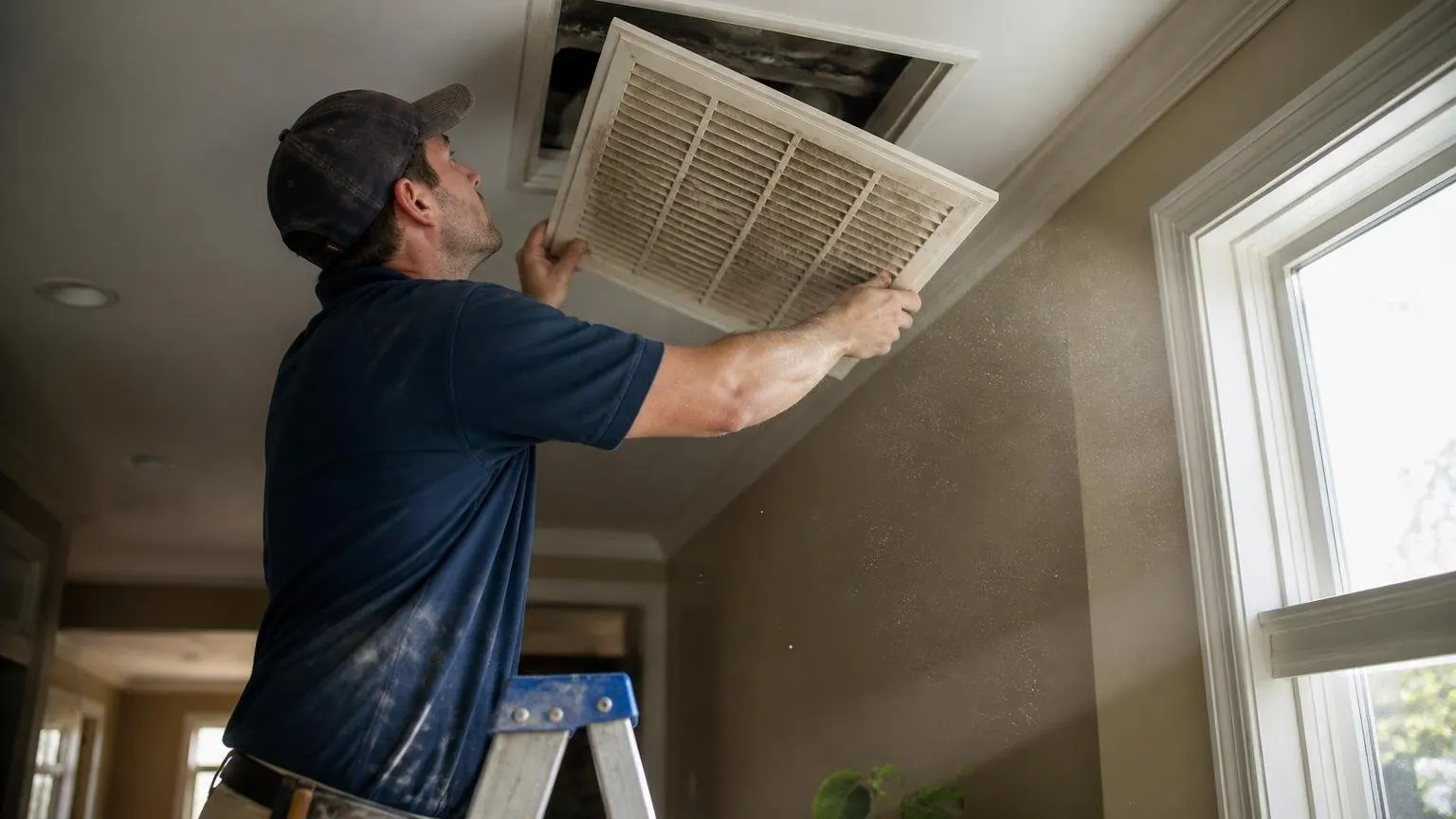
Why is my house so dusty? Usually because particles enter or get stirred up faster than cleaning and filtration remove them: soil tracked in on shoes, outdoor air leaking in, leaky return ducts pulling attic or crawlspace air, filters that air slips around, and a system fan that rarely runs.
Key Takeaways
- The “60% of dust comes from outdoors” line traces to a 2009 model paper by Layton and Beamer, which applied it to “dust mass on floors,” not all dust.
- In that paper’s Midwest homes, tracked-in soil (0.099 grams a day) outweighed skin, fibers and other organic matter (0.074 grams a day).
- ENERGY STAR says a typical house loses about 20 to 30 percent of the air moving through its ducts to leaks.
- EPA reports typical central HVAC runtimes average less than 20 to 25 percent, and a furnace filter cleans nothing while the fan is off.
- EPA recommends at least MERV 13, which must capture at least 50% of 0.3 to 1.0 micron particles, if your system can accommodate it.
- For a portable unit, AHAM advises a CADR of at least two-thirds of the room’s floor area.
Why is my house so dusty? The short answer
A dusty house has a supply and removal imbalance. Dust arrives on feet and pets, rides in on outdoor air and forms indoors from skin, lint and fibers; it leaves when you clean or a filter catches it.
When an input grows (a leaky return, a new dog, a renovation) or a removal path shrinks (a bypassed filter, an idle fan), surfaces gray over faster. Find which side changed.
What is house dust actually made of?
House dust is a mix of organic matter, tracked-in soil and settled outdoor particles. The 2009 Environmental Science and Technology model by David Layton and Paloma Beamer describes it as “a mixture of organic matter (OM) such as shed skin cells and organic fibers, soil tracked-in on footwear, and particulate matter (PM) derived from the infiltration of outdoor air.”
Less is known about the organic share by weight, the authors note, though “skin particles and organic fibers appear to be major constituents.”
Myth check: “dust is mostly dead skin”
The data do not support “mostly.” In the Midwest homes Layton and Beamer analyzed, the model estimated organic matter reaching floors at 0.074 grams a day and soil tracked in on shoes at 0.099 grams a day. Skin is a real ingredient, but in that sample dirt from outside was the larger input.
Where did the “60% of dust comes from outdoors” claim come from?
It comes from a press release, not a measurement of whole homes. On February 18, 2010, the American Chemical Society announced the Layton and Beamer paper with the line “over 60 percent of house dust originates outdoors.”
The paper itself is narrower. It says coarse particles tracked into a residence, together with the finer fraction, “account for over 60% of the dust mass on floors.” That is floor dust in a modeling study.
The abstract’s only percentage is about arsenic: in the U.S. Midwest homes, arsenic in ambient air could account for “nearly 60%” of the arsenic input to floor dust, with soil track-in supplying the rest. Neither figure measured dust on shelves or in the air of a typical house.
Can your HVAC system make a house dusty?
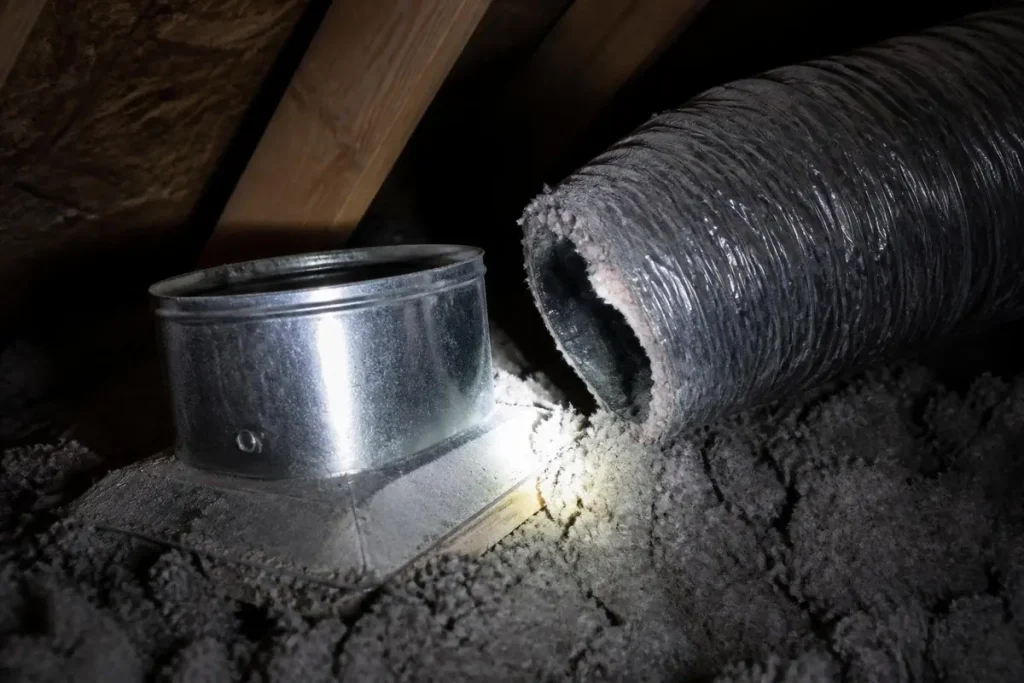
Yes. A forced-air system can add dust when return ducts leak or when air slips around the filter. ENERGY STAR says that in a typical house “about 20 to 30 percent of the air that moves through the duct system is lost due to leaks, holes, and poorly connected ducts.”
Return leaks matter most because returns run under suction. EPA’s Residential Air Cleaners technical summary warns that “if air from unconditioned spaces enters through the return duct, it can circumvent the filter” when the filter sits at a return grille instead of at the air handler. See our guide to testing ducts before repairing them.
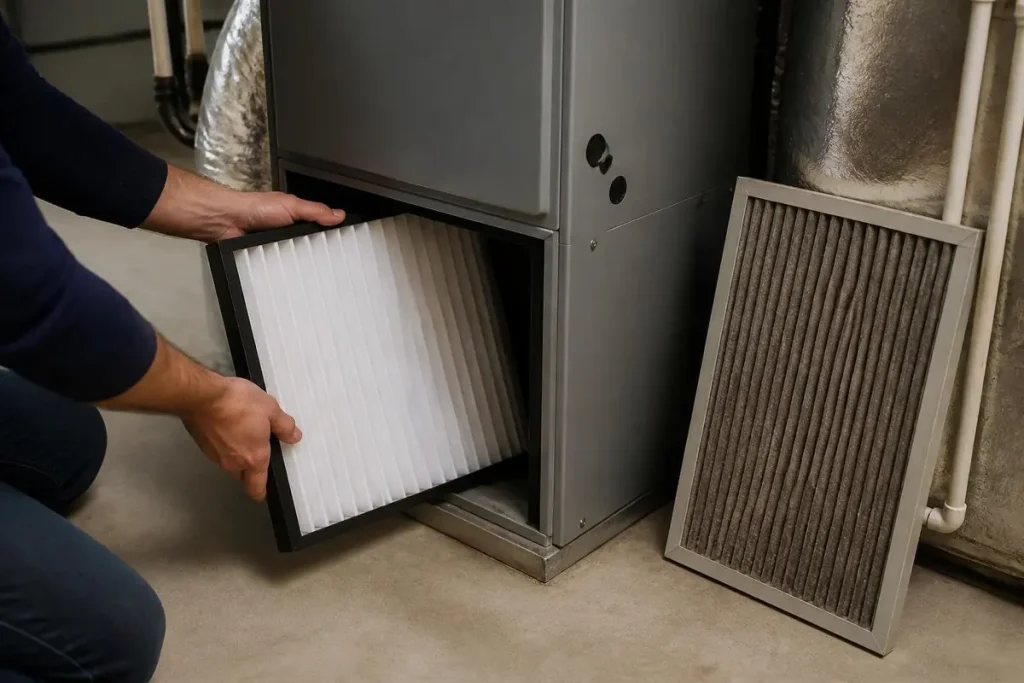
EPA adds that poorly fitted filter frames “can cause bypass airflow,” and its Guide to Air Cleaners in the Home says the filter should fit snugly so air does not leak around it.
Does running the fan or a better filter reduce dust?
Both help, because a filter works only while air moves through it. EPA says in-duct air cleaners “will not filter the air when the HVAC fan is not on,” and that typical central HVAC runtimes “average less than 20 to 25 percent in most residential building types in most climate zones.”
EPA concludes that, given low runtimes, “most MERV 13 to 16 filters” are likely to be almost as effective as HEPA filters at reducing most indoor particle sizes. The same filter grade can clean a single room when taped to a box fan, the design known as a Corsi Rosenthal box. Its MERV table shows MERV 8 must catch at least 70% of 3.0 to 10.0 micron particles, while MERV 13 adds at least 50% of 0.3 to 1.0 micron particles.
Two cautions. EPA notes some fans cannot push enough air through a high pressure drop filter, so check your system’s static pressure first. Continuous fan operation “increases electrical energy consumption and its cost”; see our comparison of the On and Auto fan settings.
The $380 is EPA’s 2018 approximation: about $475 a year running continuously versus about $95 at a typical 20 percent runtime. For filter sizes and change intervals, see our furnace filter guide, and for why the highest MERV is not automatically best, our explainer on MERV and airflow.
Why is my house so dusty right after cleaning?
Because most dust cycles between surfaces and air. The Layton and Beamer model found that resuspension and redeposition account “for more than 90% of the deposition flux of particles,” meaning walking and vacuuming keep relofting floor dust that then settles again.
The same model put the residence time of floor particles at 61 days, with cleaning as the main exit: “over 80% of the As-bearing floor dust was removed by cleaning.” Air leaving the house was “a relatively minor removal pathway.” The authors also note that “vacuuming produces a significant increase in airborne PM” larger than 10 microns, which settles back onto surfaces.
Humidity matters through dust mites, which EPA says live in every home; its asthma guidance advises 30 to 50 percent relative humidity. See our page on ideal indoor humidity by season.
How do you diagnose a dusty house? Clue, source, test, fix
Match the pattern you see to a likely source, then run the cheapest test first. Duct leakage needs a contractor’s duct test or a blower door audit.
| Clue | Likely source | Test | Fix |
|---|---|---|---|
| Dust streaks on the clean side of the filter or around its edges | Filter bypass at a loose frame | Light around the filter; check size and arrow | Correct size; seal gaps in the rack |
| Worse when the system runs; attic smell at registers | Return duct leaks in an attic, crawlspace or garage | Duct leakage test or blower door audit | Seal returns with mastic or metal tape, per ENERGY STAR |
| Gritty dust near entry doors and hallways | Soil track-in on footwear and pets | Compare entry floors with bedrooms | Doormats, shoes off at the door, frequent vacuuming |
| Dust everywhere, worse in mild weather when the system idles | Low fan runtime, so the filter sees little air | Check fan setting and runtime | Scheduled fan runtime with MERV 13 if static pressure allows |
| Fine dust after sanding, demolition or drywall work | Renovation dust, possibly lead in pre-1978 homes | Ask what was disturbed; lead test | Lead-safe certified contractor; replace filter after the job |
| Dust plus drafts when the dryer or range hood runs | House depressurization pulling outdoor air through gaps | Blower door audit | Air sealing; make-up air for large exhaust |
For the depressurization row, our explainer on make-up air and exhaust pressure math shows when a large hood needs it. A blower door energy audit finds both envelope leaks and duct leaks in one visit.
Do air purifiers or duct cleaning fix a dusty house?
A correctly sized portable air cleaner helps in the room it sits in; duct cleaning has weak evidence. EPA’s sizing chart lists a minimum CADR of 65 for 100 square feet and 390 for 600 square feet, assuming 8 foot ceilings.
On ducts, EPA’s duct cleaning guidance says studies do not “conclusively demonstrate that particle (e.g., dust) levels in homes increase because of dirty air ducts,” because “much of the dirt in air ducts adheres to duct surfaces and does not necessarily enter the living space.” Our duct cleaning review lists the cases where EPA does consider cleaning.
Skip ozone-producing “purifiers”: EPA says no federal agency has approved them for occupied spaces (see our ozone generator review).
How we researched this
Researched October 30, 2026. We read the top-ranking pages (HVAC.com, Bob Vila, Real Simple) and traced claims to primary text: the Layton and Beamer paper (PubMed Central full text), the ACS press release, EPA, ENERGY STAR and AHAM; ten sources cited. Excluded: contractor blogs, unsourced humidity and filter schedules, and Reddit. The table is our synthesis of the cited guidance.
Frequently asked questions
Why is there dust around my return vent?
Usually it is normal. EPA’s duct cleaning guidance says “it is normal for the return registers to get dusty as dust-laden air is pulled through the grate,” and that this does not mean the ducts hold heavy deposits. Vacuum the grille. Gray streaks inside the filter slot are different: they point to bypass airflow.
Will a higher MERV filter reduce dust?
Often, if the system can move air through it. EPA recommends at least MERV 13, or as high as your fan and filter slot can accommodate, and notes most furnaces can take MERV 13 if the filter is replaced frequently. MERV 13 must capture at least 50% of 0.3 to 1.0 micron particles in testing.
Should I leave my HVAC fan on to reduce dust?
Running the fan more passes more air through the filter, and EPA says that improves air cleaning. It costs electricity: EPA’s 2018 estimate put a 450 W air handler at about $475 a year running continuously versus about $95 at a typical 20 percent runtime. A scheduled fan cycle is a middle option.
Does air duct cleaning reduce dust in the house?
The evidence is thin. EPA says “duct cleaning has never been shown to actually prevent health problems” and that studies do not show dust levels rise because of dirty ducts or fall after cleaning. EPA does consider cleaning when ducts are clogged, infested or visibly moldy, or when registers release particles.
What size air purifier do I need for dust?
Use AHAM’s two-thirds rule: a CADR at least two-thirds of the room’s floor area. A 10 by 12 foot room is 120 square feet, so AHAM suggests a smoke CADR of at least 80. EPA’s chart gives a minimum CADR of 65 for 100 square feet, assuming 8 foot ceilings; choose higher for taller rooms.
Is renovation dust dangerous?
It can be in older homes. EPA says approximately three-quarters of U.S. homes built before 1978 still contain some lead-based paint, and disturbing it “can easily create dangerous lead dust.” EPA’s RRP Rule requires paid contractors working on painted surfaces in pre-1978 homes to be certified in lead-safe work practices.
Sources
- Layton, D.W. and Beamer, P.I. “Migration of Contaminated Soil and Airborne Particulates to Indoor Dust.” Environmental Science and Technology 43(21), 2009. https://pmc.ncbi.nlm.nih.gov/articles/PMC2782798/. Accessed October 2026.
- American Chemical Society, via EurekAlert. “Answering that age-old lament: Where does all this dust come from?” February 18, 2010. https://www.eurekalert.org/news-releases/761627. Accessed October 2026.
- ENERGY STAR. “Duct Sealing.” https://www.energystar.gov/saveathome/heating-cooling/duct-sealing. Accessed October 2026.
- U.S. EPA. “Residential Air Cleaners: A Technical Summary,” 3rd edition, EPA 402-F-09-002, July 2018. https://www.epa.gov/sites/default/files/2018-07/documents/residential_air_cleaners_-_a_technical_summary_3rd_edition.pdf. Accessed October 2026.
- U.S. EPA. “What is a MERV rating?” https://www.epa.gov/indoor-air-quality-iaq/what-merv-rating. Accessed October 2026.
- U.S. EPA. “Guide to Air Cleaners in the Home.” https://www.epa.gov/indoor-air-quality-iaq/guide-air-cleaners-home. Accessed October 2026.
- AHAM Verifide. “Air Filtration Standards.” https://ahamverifide.org/ahams-air-filtration-standards/. Accessed October 2026.
- U.S. EPA. “Should You Have the Air Ducts in Your Home Cleaned?” EPA 402-K-97-002. https://www.epa.gov/indoor-air-quality-iaq/should-you-have-air-ducts-your-home-cleaned. Accessed October 2026.
- U.S. EPA. “Asthma Triggers: Gain Control.” https://www.epa.gov/asthma/asthma-triggers-gain-control. Accessed October 2026.
- U.S. EPA. “Lead Renovation, Repair and Painting Program.” https://www.epa.gov/lead/lead-renovation-repair-and-painting-program. Accessed October 2026.
Leave a Reply