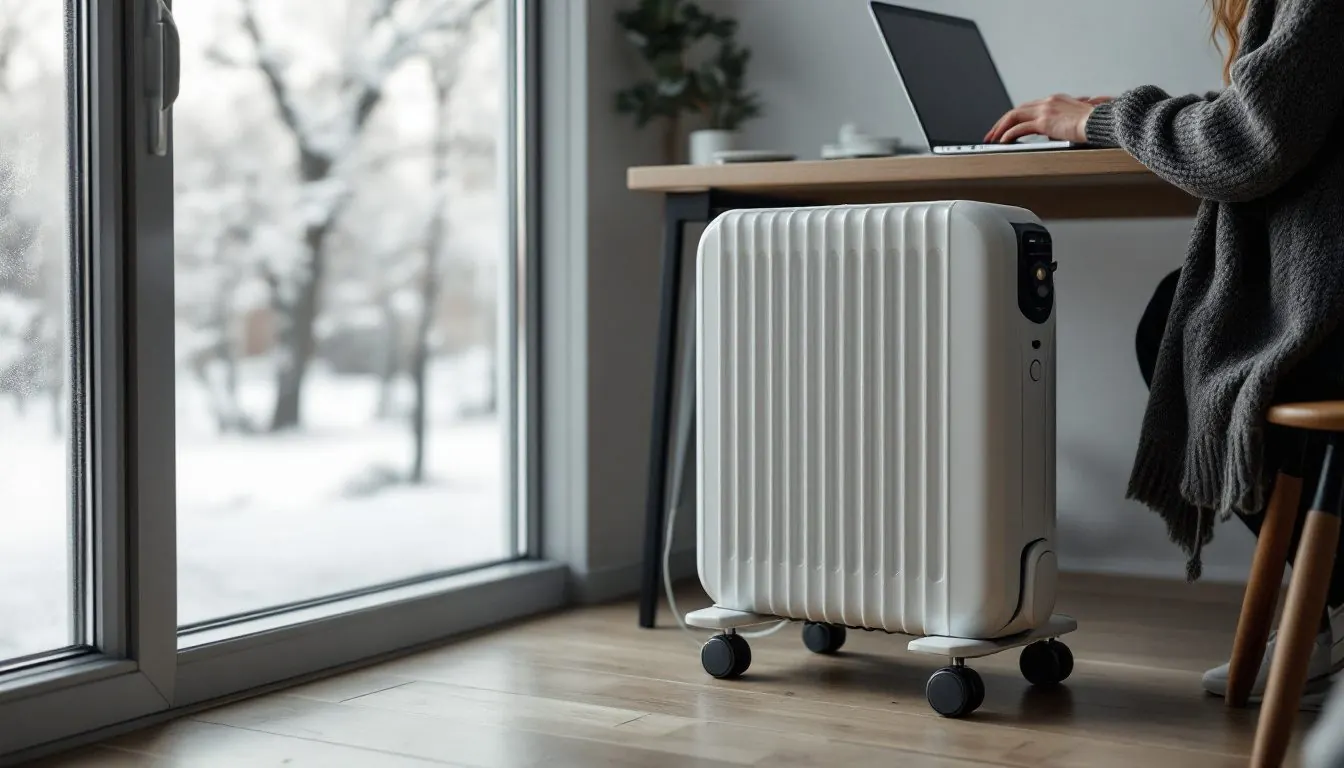
Is an oil filled radiator cheap to run? An oil filled radiator costs the same per hour as any 1,500 watt heater: 1.5 kWh, about 27 cents at the August 2026 US average. The sealed oil is a heat store, not a fuel, so it warms slowly and cycles less.
Key Takeaways
- DOE calls resistance heating 100% efficient, so a 1,500 watt oil filled radiator uses 1.5 kWh an hour at full power (DOE, archived copy).
- At the August 2026 US residential average of 18.16 cents per kWh, a full power hour costs about 27 cents and an 8 hour night $2.18 (EIA Table 5.6.A).
- DOE Energy Saver says oil “provides some heat storage, allowing the heater to cycle less and to provide a more constant heat source” (DOE, archived copy).
- De’Longhi’s MG15T has 600 and 900 watt switches (1,500 watts together) and takes approx. 15 minutes to reach operating temperature (De’Longhi manual).
- CPSC recalled about 202,000 King of Fans oil filled heaters in December 2005 after fin welds broke and leaked oil (CPSC recall 06-044).
- The May 29, 2025 revision of UL 1278 requires a tip-over switch on movable heaters, effective December 12, 2028 (Intertek notice).
What is an oil filled radiator, and is the oil a fuel?
An oil filled radiator is a plug in electric resistance heater with its element inside sealed, oil filled metal fins. The element heats the oil, the oil heats the fins, and the fins warm room air by convection. Nothing burns: the oil is a heat transfer liquid, not a fuel, so it is not consumed.
DOE’s Energy Saver guidance names this design: for convection heaters, “the best types incorporate a heat transfer liquid, such as oil, that is heated by the electric element” (DOE). Because it is electric, DOE notes it avoids the indoor air quality problems that come with a kerosene or other fuel burning room heater.
Myth check
Retailers often call oil filled heaters “more economical.” The oil creates no extra heat: DOE says resistance heat is 100% efficient, so 1.5 kWh yields the same heat from oil, ceramic or quartz. Oil changes when heat arrives, not what it costs.

How does an oil filled radiator heat a room differently?
It heats slowly and coasts. De’Longhi’s MG15T manual says it “will normally require approx.15 minutes to reach operating temperature,” and that the thermostat “operates on room air temperature and not radiator temperature” (De’Longhi). When the thermostat clicks off, the oil keeps releasing heat.
DOE says that heat storage allows “the heater to cycle less and to provide a more constant heat source.” That steadier output suits a room you sit in for hours; a fan heater has no liquid store, so its output drops as soon as the element cycles off. For short visits where you sit in front of the heater, DOE favors radiant infrared heaters instead.
How much does an oil filled radiator cost to run?
At full power, a 1,500 watt oil filled radiator costs about 27 cents an hour at the August 2026 US residential average of 18.16 cents per kWh (EIA). That is a ceiling: once the room is warm, the thermostat cycles the element off and the cost falls.
No federal source publishes a duty cycle for portable heaters, so the last row is an illustration. The formula: watts divided by 1,000, times hours, times your price per kWh.
| Setting (MG15T switches) | Cost per hour | 8 hour night | 30 nights |
|---|---|---|---|
| 600 W switch only | 10.9 cents | $0.87 | $26.15 |
| 900 W switch only | 16.3 cents | $1.31 | $39.23 |
| Both switches, 1,500 W, element always on | 27.2 cents | $2.18 | $65.38 |
| 1,500 W, element on half the time (illustration) | 13.6 cents | $1.09 | $32.69 |
Your state matters more than the heater. The same full power hour costs about 19 cents in Nevada at 12.72 cents per kWh, about 48 cents in Maine at 32.11 cents and about 71 cents in Hawaii at 47.18 cents. Look up your state’s latest residential rate before running the math, and see our space heater cost and fire data breakdown for when one room heater beats central heat.
Oil filled radiator vs ceramic, infrared and baseboard heaters: which costs less?
Per unit of heat, none of them. Every resistance heater turns 1 kWh into the same heat; DOE says heat pumps “easily cut electricity use by 50%” against resistance heat (DOE). The real differences are speed, steadiness and where the heat goes.
| Heater type | How heat leaves | Warm up and cycling | Electricity per unit of heat | Source |
|---|---|---|---|---|
| Oil filled radiator (De’Longhi MG15T) | Convection from sealed oil filled fins | Approx. 15 minutes to warm up; cycles less | Same as all resistance heat | De’Longhi manual; DOE |
| Fan forced ceramic or coil heater | Fan driven convection | No heat store; output stops when the element cycles off | Same as all resistance heat | DOE |
| Electric infrared (quartz or carbon) | Radiant, line of sight | Best for a few hours in line of sight | Same as all resistance heat | DOE |
| Electric baseboard heater | Convection, wired in | Zonal, with room thermostats | Same as all resistance heat | DOE |
| Heat pump | Moves outdoor heat indoors | Whole home or zoned | Cuts electricity use by 50% vs resistance | DOE |
If a room needs heat all winter, a permanent fix usually wins: compare wired electric baseboard heaters and the yearly cost to run a heat pump.
For a cold lower level, our guide to heating a basement walks through ducted and ductless options.
Can an oil filled radiator leak, and what do the recalls show?
Yes. A failed weld can leak or spray hot oil, and CPSC has recalled several models for it. A leak is not a refill job. De’Longhi’s manual says that if the heater “has leaked any oil, discontinue using the heater” and contact the service center.
| Recall (CPSC number, date) | Units | Hazard, in CPSC’s words | Reported incidents |
|---|---|---|---|
| Lakewood Model 5101 (05-094, January 26, 2005) | 70,000 | “Welds can rupture, expelling hot oil” | 28 reports, including one burn injury |
| King of Fans Maxi-Heat (06-044, December 1, 2005) | About 202,000 | Fin welds “can break, allowing oil to leak” | 81 reports; two minor burns, two falls in the oil |
| Holmes HOH2505 and HOH2520 (07-168, April 26, 2007) | About 300,000 | “A poor electrical connection within the heater can lead to overheating” | 59 incidents, including four fires |
| Holmes HOH3000 (15-065, January 29, 2015) | About 34,000 | Heaters “can spray heated oil, posing a scald hazard” | Approximately 40 reports; no injuries |
CPSC notices: Lakewood, King of Fans, Holmes 2007 and Holmes 2015. Lakewood went out of business, so owners were told to “unplug, disable and discard” them.
Is it safe to leave an oil filled radiator on all night?
Federal guidance says no. CPSC’s portable heater safety sheet says “Never leave the heater operating while unattended or while you are sleeping,” and applies to every portable electric heater, oil filled included (CPSC). Retail guides calling oil heaters safe overnight cite no federal source.
If the goal is a warm bed, an electric blanket heats the bed rather than the room, and our review of the best temperature for sleeping covers what the research says about bedroom temperature. Warm the room before bed, then switch the heater off.
Tip protection is changing. Intertek’s UL 1278 notice says “A moveable heater shall employ a tip-over switch,” with the requirement effective December 12, 2028 (Intertek). Until then, look for a tip-over switch, as DOE already advises.

How do you use an oil filled radiator safely?
Follow your manual first; these steps come from De’Longhi’s MG15T instructions and CPSC.
- Keep furniture, bedding, papers and curtains at least 3 feet from the front and top, and never cover the heater.
- Run it upright only, on a level floor where it will not be knocked over.
- Plug it straight into a wall outlet. CPSC says never use an extension cord or power strip.
- Keep other appliances off that outlet and circuit. At 1,500 watts on 120 volts it draws 12.5 amps, and De’Longhi warns a shared circuit risks overload and a tripped breaker or blown fuse.
- A hot plug or cord means unplug; a hot outlet needs an electrician.
- Stop if it ever leaks oil; check SaferProducts.gov for recalls.
Set the thermostat no higher than you need; our guide to winter thermostat settings explains what DOE’s setback advice saves.
How we researched this
Research date: October 31, 2026. We consulted 26 sources and cite 10: two DOE Energy Saver pages (archived copies; live pages return 404), EIA’s August 2026 price table, a De’Longhi manual, five CPSC documents and Intertek’s UL 1278 notice. Costs are shown as calculations.
Excluded: UK retailer costs and “safe overnight” claims, maker claims that oil heaters run cheaper (unmeasured), duty cycle figures (no federal series) and fire statistics, covered in our space heater article. Reddit was skipped because electrical safety is involved.
Frequently asked questions
Do oil filled radiators ever need refilling?
No. The oil is a heat store, not a fuel, so nothing is used up. De’Longhi’s MG15T manual says that if the heater has leaked any oil, stop using it and contact the service center. In the CPSC recalls above, leaks came from failed welds.
How many amps does an oil filled radiator draw?
A 1,500 watt model on a 120 volt outlet draws 12.5 amps, from watts divided by volts. De’Longhi’s manual says no other appliance should share that outlet or the same circuit, to prevent overload. On the 600 watt setting the draw is 5 amps.
Can I plug an oil filled radiator into an extension cord?
CPSC says never power a heater with an extension cord or power strip. De’Longhi’s MG15T manual also says not to, but if one is unavoidable it must be grounded, No. 14 AWG minimum and rated not less than 1875 watts, serving only the heater.
Why does a new oil filled radiator smell?
It is a first use smell. De’Longhi’s MG15T manual says to run it at full power for about two hours the first time, in a well ventilated room, to get rid of the unpleasant smell, and that small cracking sounds on first use are normal.
Is an oil filled radiator cheaper than a heat pump?
No, not per unit of heat. DOE calls resistance heating 100% efficient but says heat pumps easily cut electricity use by 50% compared with it. A radiator makes sense only for one room for a few hours, with the central system turned down.
Where should you put an oil filled radiator?
De’Longhi’s MG15T manual suggests the floor beneath the coldest window to offset drafts, not immediately below a wall outlet, and not in rooms smaller than 4 square meters, about 43 square feet. CPSC adds a stable, level surface away from water, with 3 feet of clearance from anything that can burn.
Can an oil filled radiator stop pipes freezing in an empty room?
Some can. De’Longhi’s MG15T manual describes an antifreeze function that holds a minimum room temperature of approximately 5°C, about 41°F, with minimum energy use. CPSC still advises against leaving any portable heater running unattended, so treat it as a short term measure.
Sources
- US Department of Energy. “Small Space Heaters” (archived copy). https://web.archive.org/web/20260324172457/https://www.energy.gov/energysaver/portable-heaters. Accessed October 2026.
- US Department of Energy. “Electric Resistance Heating” (archived copy). https://web.archive.org/web/20260101034530/https://www.energy.gov/energysaver/electric-resistance-heating. Accessed October 2026.
- US Energy Information Administration. “Electric Power Monthly, Table 5.6.A” (August 2026). https://www.eia.gov/electricity/monthly/epm_table_grapher.php?t=epmt_5_6_a. Accessed October 2026.
- De’Longhi. “Important Instructions, Electric Oil Filled Radiators, Type MG15T” (manufacturer manual). https://dls.delonghigroup.com/files/docs/5/A1-5785004700.pdf. Accessed October 2026.
- US Consumer Product Safety Commission. “CPSC, Lakewood Announce Recall of Oil-Filled Electric Heaters” (05-094). https://www.cpsc.gov/Recalls/2005/cpsc-lakewood-announce-recall-of-oil-filled-electric-heaters. Accessed October 2026.
- US Consumer Product Safety Commission. “CPSC, King of Fans Inc. Announce Recall of Oil-Filled Radiator Heaters” (06-044). https://www.cpsc.gov/Recalls/2006/cpsc-king-of-fans-inc-announce-recall-of-oil-filled-radiator-heaters. Accessed October 2026.
- US Consumer Product Safety Commission. “The Holmes Group Recalls Oil-Filled Electric Heaters Due to Fire Hazard” (07-168). https://www.cpsc.gov/Recalls/2007/the-holmes-group-recalls-oil-filled-electric-heaters-due-to-fire-hazard. Accessed October 2026.
- US Consumer Product Safety Commission. “Sunbeam Recalls Holmes Oil Filled Heaters” (15-065). https://www.cpsc.gov/Recalls/2015/Sunbeam-Recalls-Holmes-Oil-Filled-Heaters. Accessed October 2026.
- US Consumer Product Safety Commission. “7 Highly Effective Portable Heater Safety Habits” (NSN 15-11). https://www.cpsc.gov/s3fs-public/PortableElectricHeaterSafetyNSN.pdf. Accessed October 2026.
- Intertek. “Standards Update Notice: UL 1278” (certification body). https://www.intertek.com/siteassets/resources/sun/2025/ul-1278-sun-rev-5-27-2025-and-5-29-2025-ed-12-12-2028.pdf. Accessed October 2026.
Leave a Reply