
What is a spot cooler? A spot cooler is a self-contained portable air conditioner on casters that aims cold air at a person, rack or machine, while its condenser rejects heat that must be ducted away or carried off by water. MovinCool’s Climate Pro K line runs from 12,000 to 60,000 Btu/h.
Key Takeaways
- DOE says spot coolers are “not currently covered by the portable AC test procedure” in its May 2023 final rule, so no federal efficiency floor applies.
- Under 10 CFR 430.2, a portable air conditioner is powered by single-phase current, so 460 V three-phase units sit outside it.
- An unducted spot cooler heats its own room by its electrical input: a MovinCool K24 drawing 2.9 kW per its spec sheet adds about 9,895 Btu/h.
- Size from watts: 1 Btu/h equals 0.2930711 W in NIST SP 811, so each watt of equipment is 3.412 Btu/h.
- Water-cooled units need a loop: Kwikool lists 1.5 to 6 gpm for its KWIB2421-3, depending on inlet water temperature.
- OSHA’s 2024 proposed heat rule sets an initial heat trigger at a heat index of 80°F and lists an air-conditioned work area as one indoor control.
What is a spot cooler?
A spot cooler is a packaged refrigerant air conditioner, evaporator and condenser in one wheeled cabinet, built to cool a local zone rather than a whole building. Condenser heat leaves through a hot-air duct or a water loop.
Kwikool’s product page pitches its 23,500 Btu/h water-cooled unit for “small server and IDF rooms,” a job our server room sizing guide covers for permanent systems. Sizes run far past home portables: Kwikool’s KPO12-43 is rated 135,000 Btu/h.
How does a spot cooler work, and where does the heat go?
A spot cooler moves heat. The hot exhaust carries the heat pulled from the cold side plus the electrical input, so a MovinCool K24 rated 24,000 Btu/h at 2.9 kW rejects about 33,895 Btu/h. Where that exhaust lands decides whether the space gets cooler.
Correction
DOE describes spot coolers as units that “do not provide net cooling to a space, but rather move heat from one area to another in a space,” because they reject condenser air into the cooled space. Left unducted, the room gains the unit’s input power.
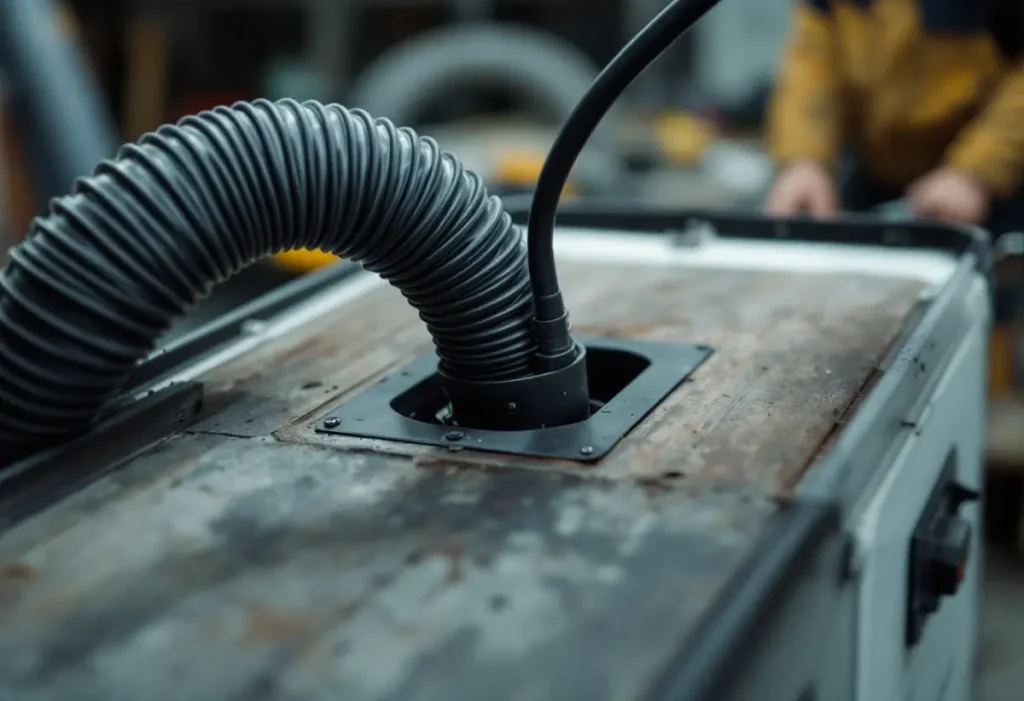
MovinCool’s answer for drop ceilings is a replacement ceiling tile with a 12-inch hole and a duct from the unit’s top outlet. That heat then becomes load on the building’s own system. Kwikool’s owner’s manual warns that a confined discharge point will trip the high-pressure switch, and that the condenser needs fresh makeup air.
Hot duct limits: 60 feet on the K12, 45 feet on the K24 and 100 feet on Kwikool’s KPO series.
Is a spot cooler covered by DOE portable air conditioner standards?
Mostly no. DOE’s efficiency standard at 10 CFR 430.32(cc) applies only to single-duct and dual-duct portable air conditioners made on or after January 10, 2025, and both definitions require ducts attached to an adjustable window bracket. DOE has said it knows of no spot cooler sold with such a bracket.
The January 2020 standards rule spells it out: single-phase products meeting the broad portable AC definition are covered products, but DOE “establishes energy conservation standards only for products that meet the definition of single-duct or dual-duct portable AC.” In that docket, the National Association of Manufacturers said about five small US firms make “portable commercial ACs,” 90 to 95 percent of them single-phase.
Nameplate Btu/h is also measured differently: MovinCool and Kwikool rate at 95°F and 60% RH, while DOE’s appendix CC tests portables with 80°F evaporator inlet air. Home units carry their own penalties, as our breakdown of single-hose portable performance shows.
How do you size a spot cooler? Three worked heat loads
Size a spot cooler to the heat you must remove, in Btu/h, then pick the next capacity up that your circuit can feed. Square-feet-per-ton rules ignore the equipment watts that dominate most spot cooling jobs.
- Add the equipment load: nameplate or measured watts x 3.412 Btu/h.
- Add people: OSHA’s 2024 proposal cites workload categories of light (180 W), moderate (300 W) and heavy (415 W); treat those watts as an upper bound on each worker’s heat.
- For a closed room, add envelope and sun gains.
- Choose capacity at or above the total; confirm circuit and exhaust path.
For small rooms, our room BTU sizing chart restates ENERGY STAR’s method, including 600 Btu/h for each regular occupant beyond two.
| Example space | Load inputs | Heat load | Capacity class |
|---|---|---|---|
| Network closet (IDF) | 3,000 W of switches and UPS, no occupants | 10,236 Btu/h | 1 ton, e.g. MovinCool K12 at 12,000 Btu/h |
| Machine control room | 6,000 W of drives plus 2 light-work staff at 180 W | 21,701 Btu/h | 2 tons, e.g. K24 or Kwikool KWIB2421-3 |
| Assembly workstation | 4 workers at moderate 300 W, open plant | 4,095 Btu/h of body heat | Aim cold air at the people; the building load is a separate problem |
Kwikool sizes its Iceberg units to hold 72°F and warns that lower setpoints without spare capacity can freeze the coil.
Spot cooler specs compared: capacity, voltage, amps and condensate
Capacity tracks voltage. MovinCool’s K12 runs on 115 V, its 2 to 5 ton models need 208/230 V, and Kwikool’s largest units are 460 V three-phase.
| Model | Cooling (maker rating) | Power | Fuse or breaker, plug | Condensate |
|---|---|---|---|---|
| MovinCool Climate Pro K12 (air) | 12,000 Btu/h | 115 V, 10.3 amps, 1.2 kW | 15 amps, NEMA 5-15P | 5 gal tank |
| MovinCool Climate Pro K24 (air) | 24,000 Btu/h | 208/230 V, 12.5 amps, 2.9 kW | 20 amps, NEMA 6-20 | 5 gal tank, pump kit optional |
| MovinCool Climate Pro K36 (air) | 36,000 Btu/h | 208/230 V, 19.9 amps, 4.3 kW | 30 amps, NEMA 6-30P | 2 @ 5 gal tanks |
| MovinCool Climate Pro K60 (air) | 60,000 Btu/h | 208/230 V, 31.5 amps, 6.6 kW | 50 amps, NEMA 6-50 | Auto pump included |
| Kwikool KWIB2421-3 (water) | 23,500 Btu/h | 230 V, 8.9 amps, 1.8 kW | 20 amps, NEMA 6-20 | Internal pump plus 5-gallon tank |
| Kwikool KPO12-43 (air) | 135,000 Btu/h | 460 V three-phase, 29.7 amps | 40 amp breaker, hardwired cam locks | Internal high lift pump |
All ratings are at 95°F and 60% RH per the maker pages (MovinCool R-410A versions). The newer MovinCool “e” models use R-32, a refrigerant covered in our R-32 explainer, and Kwikool lists R-454B.
Check our watts and amps by equipment class and have an electrician confirm circuit capacity before a 230 V or 460 V unit arrives. Condensate is the daily chore: MovinCool’s optional pump kit lifts 17 feet and Kwikool’s built-in pump lifts 20 feet, so a condensate pump to a drain ends tank emptying.
Air-cooled or water-cooled: which spot cooler fits?
Choose air-cooled when you have somewhere to dump hot air, and water-cooled when you have a chilled water loop or tower but no exhaust path. Water-cooled units need no hot duct, which suits sealed rooms.
Kwikool’s manual specifies a recirculating source, such as a chilled water loop or a cooling tower, at 35 to 150 psi and above 40°F but below 85°F. Its spec sheet lists 1.5 to 6 gpm: 6 gpm with 85°F inlet water, 3 gpm at 75°F. The manual rules out tap water for operation “due to the large volume of water required”: at 3 gpm, once-through tap water would run 4,320 gallons a day.
Is a Portacool a spot cooler? Evaporative vs refrigerant cooling
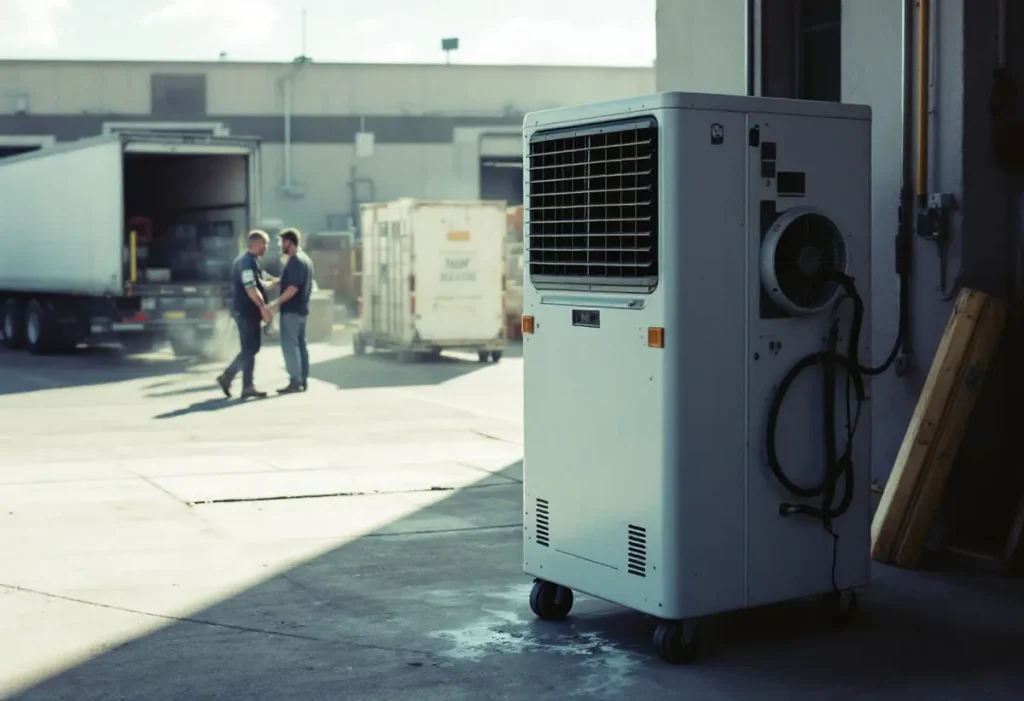
No. A Portacool is an evaporative cooler: it wets a pad and blows air through it, adding moisture instead of removing heat through refrigerant. Portacool markets it for partially enclosed spaces and outdoors, but evaporative cooling weakens as humidity rises.
DOE’s archived evaporative cooler guide says pad-cooled air drops 15° to 40°F and that the method suits only low-humidity areas. It adds that portable evaporative coolers on wheels “provide only a slight cooling effect.” Portacool claims its APEX series drops 10 to 13°F in hot, humid spaces and up to 30°F in arid ones. The limit is the wet bulb temperature, and our swamp cooler climate guide maps where it works.
Do spot coolers help with OSHA heat rules?
They can, if OSHA finalizes its proposal. The August 2024 proposed standard would require controls at an initial heat trigger of 80°F heat index and more at a high heat trigger of 90°F. For hot indoor work areas, an air-conditioned work area is one of three listed options, alongside fans and radiant heat shielding.
Indoor areas where air conditioning “consistently keeps ambient temperature below 80 °F” would be exempt. OSHA held hearings from June 16 to July 2, 2025, then extended post-hearing comments to October 30, 2025; our October 2026 Federal Register search found no final rule. Our heat death counts show the stakes, and our office temperature standards review covers what applies today.
How we researched this
Research date: October 31, 2026. We opened the top search results (PickComfort, a 2007 HPAC Engineering feature, Aggreko; United Rentals and Herc Rentals blocked fetches), then read primary sources: eCFR 10 CFR 430.2, 430.32(cc) and appendix CC; DOE’s 2016, 2020 and 2023 portable AC rules; OSHA’s 2024 proposal and 2025 notice; NIST SP 811; and MovinCool, Kwikool and Portacool spec pages and manuals.
Excluded: square-feet-per-ton rules and maker list prices (no federal price series), and the NIOSH heat criteria PDF (blocked; we used OSHA’s restatement). Reddit was skipped because the topic involves 230 V and 460 V circuits.
Frequently asked questions
Can a spot cooler cool a whole room?
Only if its hot exhaust leaves the room. DOE says spot coolers move heat within a space rather than providing net cooling. Ducted outdoors, a 2-ton MovinCool K24 removes 24,000 Btu/h from the room. Left unducted, it adds about 9,895 Btu/h.
Do spot coolers need to be vented?
Air-cooled spot coolers need their condenser air ducted somewhere that can absorb the heat, or they add their input power to the room. MovinCool allows up to 60 feet of hot duct on the K12. Water-cooled models need no hot duct but must connect to a water loop.
What size spot cooler do I need for a server closet?
Multiply the equipment watts by 3.412 to get Btu/h, then pick the next size up. A closet with 3,000 W of switches and UPS needs about 10,236 Btu/h, which fits a 1-ton unit such as the MovinCool K12 at 12,000 Btu/h.
Can I plug a spot cooler into a regular outlet?
Small ones, yes. MovinCool’s K12 draws 10.3 amps on 115 V with a NEMA 5-15P plug and a 15-amp fuse. Kwikool says its largest 115 V portable is a 2-ton model on a dedicated 20-amp circuit. Larger units need 230 V or 460 V circuits.
Where does spot cooler condensate go?
Into a tank or a pump. MovinCool’s K12 and K24 hold 5 gallons, while the K60 includes an automatic pump. Kwikool’s built-in pump can push water 20 feet up and over 100 feet to an approved drain, and a float switch shuts the compressor off when its 5-gallon tank fills.
Is a spot cooler the same as a portable air conditioner?
It is a type of portable air conditioner, but not one DOE regulates for efficiency. DOE’s January 2025 standard covers only single-duct and dual-duct portables with window-bracket ducts, three-phase units fall outside the federal definition entirely, and DOE says its portable AC test procedure does not cover spot coolers.
Sources
- DOE. “Test Procedure for Portable Air Conditioners,” 88 FR 31102. https://www.federalregister.gov/documents/2023/05/15/2023-09755/energy-conservation-program-test-procedure-for-portable-air-conditioners. Accessed October 2026.
- DOE. “Energy Conservation Standards for Portable Air Conditioners,” 85 FR 1378. https://www.federalregister.gov/documents/2020/01/10/2019-26350/energy-conservation-program-energy-conservation-standards-for-portable-air-conditioners. Accessed October 2026.
- eCFR. “10 CFR 430.2 Definitions.” https://www.ecfr.gov/current/title-10/chapter-II/subchapter-D/part-430/subpart-A/section-430.2. Accessed October 2026.
- eCFR. “10 CFR 430.32(cc) and Part 430 Appendix CC.” https://www.ecfr.gov/current/title-10/chapter-II/subchapter-D/part-430. Accessed October 2026.
- MovinCool. “Climate Pro K12, K24, K36 and K60 Specifications.” https://www.movincool.com/climate-pro-k-series/. Accessed October 2026.
- Kwikool. “KWIB2421-3” and “KPO12-43” product details. https://www.kwikool.com/product-details/kwib2421-3/ and https://www.kwikool.com/product-details/kpo12-43/. Accessed October 2026.
- Kwikool. “KIB II and KWIB II Owner’s Manual” and “FAQ.” https://www.kwikool.com/faq/. Accessed October 2026.
- NIST. “SP 811 Appendix B.9 Conversion Factors.” https://www.nist.gov/pml/special-publication-811/nist-guide-si-appendix-b-conversion-factors/nist-guide-si-appendix-b9. Accessed October 2026.
- OSHA. “Heat Injury and Illness Prevention in Outdoor and Indoor Work Settings,” proposed rule (2024) and extension notice (2025). https://www.federalregister.gov/documents/2025/09/25/2025-18670/heat-injury-and-illness-prevention-in-outdoor-and-indoor-work-settings. Accessed October 2026.
- DOE Energy Saver. “Evaporative Coolers” (archived copy). https://web.archive.org/web/2025id_/https://www.energy.gov/energysaver/evaporative-coolers. Accessed October 2026.
- ENERGY STAR. “Room Air Conditioners”; Portacool. “APEX Series.” https://www.energystar.gov/products/room_air_conditioners and https://www.portacool.com/. Accessed October 2026.
Leave a Reply