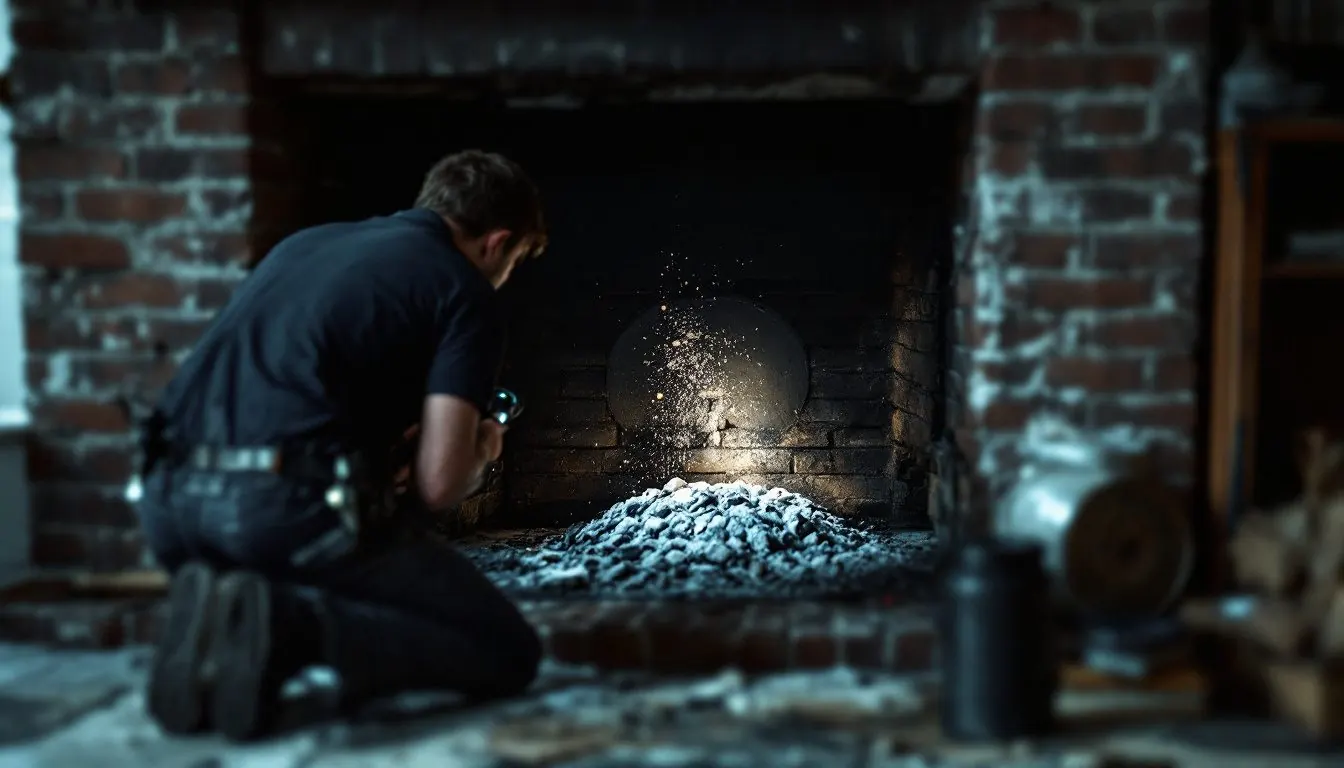
Should a fireplace damper be open or closed? Open whenever wood, embers or gas logs are burning, and tightly closed the rest of the time. DOE says a burning traditional fireplace can pull up to 300 cubic feet per minute of heated room air up the chimney, and closing the damper on hot embers risks carbon monoxide indoors.
Key Takeaways
- A traditional fireplace draws “as much as 300 cubic feet per minute of heated room air” while burning (DOE Energy Saver, archived copy).
- DOE says keep the flue damper “tightly closed when not in use” (DOE, archived copy).
- Do not close the damper until the fire has died out and the embers are cold (New Jersey Division of Fire Safety).
- Code section R1001.7.1 calls for a ferrous metal damper at least 8 inches above a masonry fireplace opening (2021 Seattle Residential Code).
- One gas log maker requires 17.6 to 33.8 square inches of permanent damper opening in a 6 foot masonry chimney (Hargrove manual).
- Energy code R402.4.2 requires tight-fitting flue dampers or doors on new wood-burning fireplaces (Seattle Energy Code).
What does a fireplace damper do?
A fireplace damper is a movable metal plate that opens the chimney flue for a fire and closes it afterward. Open, it lets smoke and carbon monoxide rise. Closed, it keeps warm room air in and rain, cold air and animals out.
Most masonry fireplaces have a throat damper, a hinged plate just above the firebox worked by a handle or knob. A top-sealing damper sits at the chimney crown instead, with its handle inside the firebox. Unlike dampers in ductwork, a fireplace damper carries combustion gases, so a stuck one is a safety issue.
How much heat escapes through an open fireplace damper?
While a fire burns, a lot. DOE says traditional fireplaces “draw in as much as 300 cubic feet per minute of heated room air for combustion, then send it straight up the chimney,” and the DOE Building America Solution Center says a natural-draft fireplace at full burn “can move as much as 400 CFM of air up the chimney.”
Outdoor air leaks in to replace it, and the furnace must heat that air. The sensible heat formula, with 1.08 as ACCA’s “constant for standard air (at sea level),” sizes the load:
- Pick the airflow: 300 cfm (DOE) or 400 CFM (Building America).
- Pick the temperature difference. Our example: 70°F indoors, 30°F outdoors, so 40°F.
- Multiply: 1.08 x 300 x 40 is 12,960 Btu per hour; at 400 CFM it is 17,280 Btu per hour.
These are our calculations, not measurements. DOE’s advice: “When burning a fire, you should turn your heat down or off and open a window near the fireplace.” To price a Btu, see our cost of heat by fuel tables.
An idle closed damper leaks far less, and only a blower door test during a home energy audit measures it. The energy code test procedure says flue dampers “shall be closed, but not sealed beyond intended infiltration control measures,” so a leaky damper shows up in the result.
Throat damper vs top-sealing damper: which fireplace damper seals better?
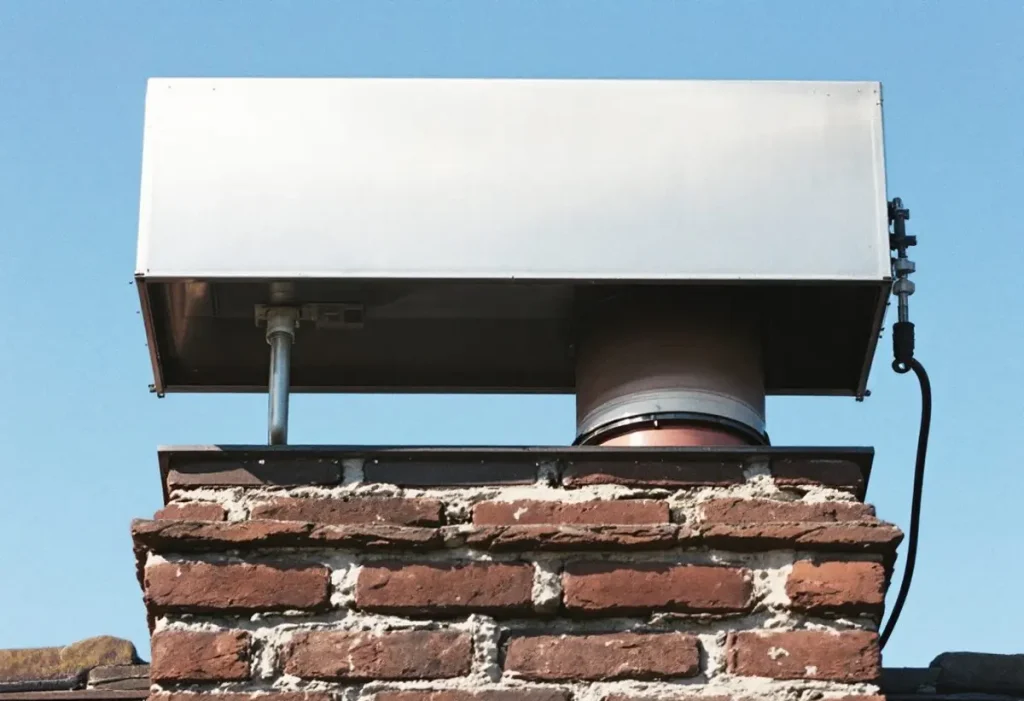
A top-sealing damper is designed to seal better. U.S. Fireplace Products says its Top Damper “seals with a flat rubber gasket when closed,” while DOE warns that metal flue parts can “warp or break, creating a channel for air loss.” No federal test rates either type.
| Damper or seal | Where it sits | How it closes | What the source says |
|---|---|---|---|
| Throat damper | Throat, at least 8 inches above the opening | Handle or knob | R1001.7.1: ferrous metal, operable from the room |
| Top-sealing damper | Chimney crown | Handle in the firebox | Maker claim: flat rubber gasket; no federal leakage test |
| Automatic top damper (gas logs) | On top of the chimney | Motor opens it before gas flows | ICC-ES ESR-3661: 6 to 24 inches; manual damper removed |
| Chimney balloon or flue plug | Below the flue | Inflated or pushed in | DOE: reusable hundreds of times; deflates within seconds of heat |
| Tight-fitting glass doors | Fireplace face | Closed doors | R402.4.2: alternative to a tight damper; UL 127 or UL 907 |
The automatic option is covered by ICC-ES evaluation report ESR-3661: the Field Controls damper opens before gas reaches the burner and closes “after a 30 to 40 second delay.” It is limited to ANSI Z21.60 gas log sets and requires any manual damper blade to be removed.
How do you tell if a fireplace damper is open?
Look before every fire rather than trusting the handle.
- Shine a flashlight up through the throat. Seeing the flue means open; a flat metal plate means closed.
- Feel for a draft at the throat. A cold downdraft with no fire means it is open.
- A top-sealing damper has no plate in the throat, so look up the flue for sky.
When is it safe to close the fireplace damper after a fire?
Only when the fire is out and the embers are cold. New Jersey’s Division of Fire Safety says: “Do not close the damper before the fire has died out and the embers are cold.” Fairfax County Fire and Rescue says keep it open “until the ashes are cool” to prevent carbon monoxide buildup.
Safety point: a dying fire backdrafts easily
DOE Building America notes that when a fire has burned down, “a small kitchen or bath exhaust fan (50 CFM) could backdraft the combustion pollutants from the fireplace into the home.” Fit CO alarms by the detector placement rules.
Hardware fails too. In 2010 the CPSC recalled about 500 Simpson Dura-Vent anchor plates with dampers, sold January 2007 through May 2008, because some stuck or were “assembled backwards and are set to the closed position,” a carbon monoxide risk. Our carbon monoxide death data shows the stakes.
Do gas logs need the fireplace damper open?
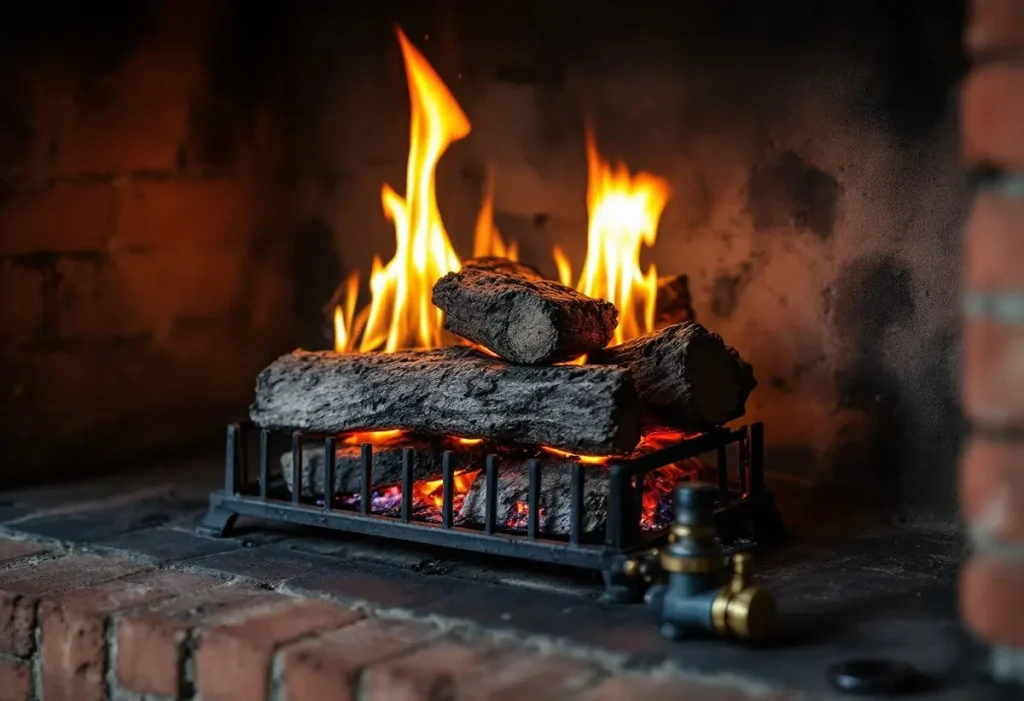
Yes. Vented gas logs burn with the damper open, and their instructions require a clamp or stop so it never fully closes. The code book does not spell out the clamp: Section G2432.1 of the 2021 Seattle Residential Code requires listing to ANSI Z21.60 and installation “in accordance with the manufacturer’s instructions,” and the instructions carry the rule.
Hargrove’s manual says “a permanent free opening must be provided by either the fireplace chimney or chimney damper,” and that in Massachusetts the damper must be “permanently welded in the fully open position or completely removed.” Its masonry table runs from 12.2 square inches (20,000 Btu per hour, 30 foot chimney) upward. For a 40,000 Btu per hour set, the minimum is 33.8 at 6 feet, 31.2 at 8, 28.7 at 10, 26.1 at 15, 23.7 at 20 and 21.6 at 30 feet.
If soot or fumes reach the room with the damper fully open, Hargrove says the draft is defective and the logs should not run. Venting details are in our gas fireplace venting guide.
Does building code require a fireplace damper?
For a new masonry fireplace, generally yes. Section R1001.7.1, as printed in the 2021 Seattle Residential Code, says masonry fireplaces “shall be equipped with a ferrous metal damper located not less than 8 inches (203 mm) above the top of the fireplace opening,” operable “from the room containing the fireplace.”
That edition carries Washington amendments, marked [W], requiring “tightly fitting flue dampers,” an outside combustion air duct of “at least 6 square inches” with “an operable outside air duct damper,” and doors or a draft fan on site-built fireplaces. Outside air is covered in our combustion air explainer.
Section R402.4.2 of the 2018 Seattle Energy Code says new wood-burning fireplaces “shall have tight-fitting flue dampers or doors and outdoor combustion air.” Masonry heaters differ: R1002.2.1 says a closed flue damper must leave at least 5% of the flue area open. Rules vary by jurisdiction and edition, so confirm locally.
Should you fix a leaky fireplace damper or seal the flue?
If you never use the fireplace, seal the flue; if you use it, repair or replace the damper. DOE says to “plug and seal the flue” of an unused fireplace, and notes a forgotten chimney balloon “will automatically deflate within seconds of coming into contact with heat.” Never light a fire with any plug in place.
Have a sweep check the flue first; our chimney liner guide covers when the flue itself needs work. For real heat, DOE suggests an “EPA-certified insert, installed by a certified professional,” compared in our fireplace insert guide.
How we researched this
Research date: October 31, 2026. We opened 22 sources and cite 14. Code text comes from the 2021 Seattle Residential Code and 2018 Seattle Energy Code because codes.iccsafe.org blocks automated reading; Washington amendments are labeled. DOE’s fireplace page is offline, so we used archived DOE pages.
Excluded: the unsourced “up to 30%” bill claim and damper price ranges that rank today (no federal series). The heat example is our arithmetic. Reddit was skipped because this is a carbon monoxide topic.
Frequently asked questions
Should the fireplace damper be open or closed in summer?
Closed, unless something is burning. DOE’s air sealing guidance is to keep the flue damper “tightly closed when not in use,” which applies year round because an open flue lets conditioned air escape. If it no longer seals, DOE suggests a chimney balloon for an unused flue.
Can I close the damper if the fire is almost out?
No. New Jersey’s Division of Fire Safety says not to close the damper before the fire has died out and the embers are cold. DOE Building America warns that a low fire backdrafts easily; even a 50 CFM exhaust fan can pull its pollutants indoors.
What is a damper clamp on a gas fireplace?
A clamp or stop on the damper blade so it cannot fully close while vented gas logs are installed. The Mason-Lite Virginiana manual says its clamp “must be permanently installed.” Hargrove’s table sets the opening at 12.2 to 33.8 square inches for masonry chimneys.
Do all fireplaces have a damper?
Not all. Section R1001.7.1 requires one in masonry fireplaces, and factory-built units follow their listing. DOE Building America says direct-vent gas fireplaces take 100% of their combustion air from outdoors behind tight glass doors; follow that unit’s manual.
Is a chimney balloon safe?
DOE says chimney balloons fit below the flue, can be reused hundreds of times, and deflate within seconds of heat if forgotten. Remove one before every fire, and never use one in a flue serving gas logs, which need a permanent opening.
How much heat goes up an open fireplace damper?
While burning, DOE says a traditional fireplace can draw as much as 300 cubic feet per minute of room air. Reheating that air at a 40°F difference takes about 12,960 Btu per hour, by our calculation with ACCA’s 1.08 constant. Idle leakage needs a blower door test.
Sources
- City of Seattle. “2021 Seattle Residential Code, Chapter 10: Chimneys and Fireplaces.” https://www.seattle.gov/documents/Departments/SDCI/Codes/SeattleResidentialCode/2021SRCChapter10.pdf. Accessed October 2026.
- City of Seattle. “2021 Seattle Residential Code, Chapter 24: Fuel Gas.” https://www.seattle.gov/documents/Departments/SDCI/Codes/SeattleResidentialCode/2021SRCChapter24.pdf. Accessed October 2026.
- City of Seattle. “2018 Seattle Energy Code, Residential Chapter 4.” https://www.seattle.gov/documents/Departments/SDCI/Codes/SeattleEnergyCode/2018SECResidentialChapter4.pdf. Accessed October 2026.
- U.S. Department of Energy, Energy Saver. “Wood and Pellet Heating.” Archived copy. https://web.archive.org/web/20260623235300id_/https://www.energy.gov/energysaver/wood-and-pellet-heating. Accessed October 2026.
- U.S. Department of Energy, Energy Saver. “Air Sealing Your Home.” Archived copy. https://web.archive.org/web/20260627190912id_/https://www.energy.gov/energysaver/air-sealing-your-home. Accessed October 2026.
- DOE Building America Solution Center. “Fireplaces and Wood Stoves Have Proper Ventilation.” https://basc.pnnl.gov/resource-guides/fireplaces-and-wood-stoves-have-proper-ventilation. Accessed October 2026.
- New Jersey Division of Fire Safety. “Fireplace and Chimney Safety” fact sheet. https://www.nj.gov/dca/divisions/dfs/publications/publication/fsf_updated/fs_facts_fireplace_chimney.pdf. Accessed October 2026.
- Fairfax County Fire and Rescue. “Fireplace and Ashes Safety Tips.” https://www.fairfaxcounty.gov/fire-ems/sites/fire-ems/files/Assets/Documents/PDF/fireplace_and_ashes_safety_tips.pdf. Accessed October 2026.
- U.S. Consumer Product Safety Commission. “Simpson Dura-Vent Recalls Fireplace Dampers Due to Carbon Monoxide Poisoning Hazard.” https://www.cpsc.gov/Recalls/2010/simpson-dura-vent-recalls-fireplace-dampers-due-to-carbon-monoxide-poisoning-hazard. Accessed October 2026.
- ICC Evaluation Service. “ESR-3661, Field Controls Automatic Fireplace Damper.” https://icc-es.org/wp-content/uploads/report-directory/ESR-3661-PMG.pdf. Accessed October 2026.
- Hargrove. “Olde World Basket Vented Decorative Appliance Installation and Operation Guide.” https://fireplacedoorsonline.com/images/companies/1/Manuals/Hargrove/OLDE%20WORLD%20BASKET%20VENTED%20_New_.PDF. Accessed October 2026.
- Masonry Fireplace Industries. “Mason-Lite Virginiana Standard Burner Manual.” https://cdn.shopify.com/s/files/1/0813/8725/8148/files/Mason-Lite_Virginiana_Standard_Burner_Manual.pdf. Accessed October 2026.
- U.S. Fireplace Products. “Top Damper” brochure (maker claims). https://zoro.com/static/cms/enhanced_pdf/Lindemann%20Chimney%20dba%20US%20Fireplace%20Products_ThexxTopxxDamperxxxxxxBrochurexx4c49de.pdf. Accessed October 2026.
- ACCA. “A Split in Diagnosis.” https://hvac-blog.acca.org/a-split-in-diagnosis/. Accessed October 2026.
Leave a Reply