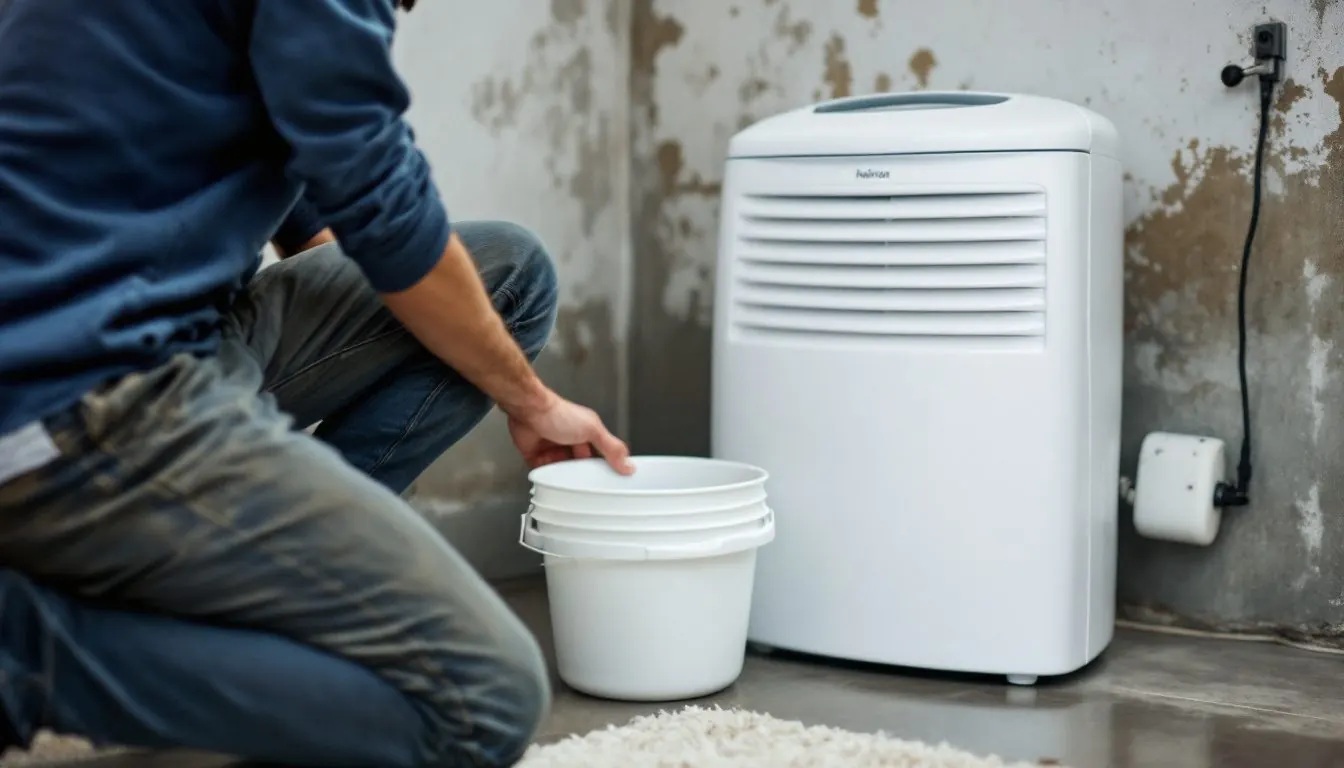
A dehumidifier not collecting water is usually healthy: the room is already drier than the setting, the room is below 41°F so the coil frosts and defrosts, or the water is leaving through a hose. If the exhaust is no warmer than the room once the 3 minute start delay passes, the compressor or refrigerant has failed.
Which 10 minute reading tells you why the bucket is dry?
Five checks sort almost every case. In GE, Frigidaire and Whirlpool documents the middle three are normal behavior; only a code or cool exhaust points at a broken machine.
| Test | Reading | What it means | Maker text behind it |
|---|---|---|---|
| Display code | E3 (Whirlpool) or EC, F0 (Frigidaire) | Refrigerant loss or sealed system failure | Whirlpool and Frigidaire code lists |
| Room thermometer | Below 41°F | Coil frosts; auto defrost turns the compressor off | GE, Frigidaire, Whirlpool all set 41°F as the floor |
| Separate hygrometer | At or below the setpoint | Unit idles by design | GE support 35298 |
| Rear drain fitting | Cap off, hose attached | Water bypasses the bucket | Whirlpool manual |
| Bucket light | On or flashing | Full, not seated, or float stuck: compressor off | Whirlpool, GE manuals |
| Hand over the top grille | Warmer than room air | Compressor is running | Whirlpool, GE manuals |
| Hand over the grille, frost visible | Slightly cooler than room | Defrost cycle, fan only | GE support 18409 |
| Time since power on | Under 3 minutes | Protective compressor delay | GE ADHL22/ADHL35 manual |
Compiled by The HVAC Brief from GE support articles and manual, the Frigidaire error code guide and the 2025 Whirlpool manual. Codes apply only to the brands named.
Is the room already too dry to give up water?
Often yes. Water only forms when air touches a surface colder than its dew point, and Frigidaire states that its evaporator “operates at temperatures close to Freezing.” The gap between dew point and 32°F decides it: big means drips, near zero means frost or nothing.
| Room air | Dew point | Moisture (grains per lb of dry air) | Gap above 32°F | What the bucket does |
|---|---|---|---|---|
| 80°F, 60% RH | 64.9°F | 92.1 | 32.9°F | Fills fast |
| 65°F, 60% RH (DOE test point) | 50.8°F | 55.0 | 18.8°F | Rated pints per day |
| 65°F, 45% RH | 43.2°F | 41.2 | 11.2°F | Slow drip |
| 65°F, 35% RH | 36.7°F | 31.9 | 4.7°F | Close to nothing |
| 55°F, 50% RH | 36.7°F | 32.0 | 4.7°F | Close to nothing |
| 50°F, 50% RH | 32.1°F | 26.6 | 0.1°F | Water arrives as frost |
| 41°F, 50% RH | 23.8°F | 18.8 | None | Frost only, then defrost |
HVAC Brief calculation: vapor pressure from the National Weather Service formula es = 6.11 × 10^(7.5T/(237.3+T)) hPa, humidity ratio at sea level, 7,000 grains per pound.
At 65°F and 35% RH the dew point is 36.7°F, only 4.7°F above freezing, which fits Frigidaire’s warning that below 40% RH at low room temperatures “there is little water that can be extracted from the air.” The federal rating is earned at 65°F and 60% RH under Appendix X1 to 10 CFR Part 430, so a 50 pint label says nothing about a 35% room.
The air itself holds little water. We calculated a 1,000 square foot basement with 8 foot ceilings at 65°F and 60% RH: 274 kg of air carrying 2.16 kg of vapor, about 4.6 pints. Drying it from 60% to 50% removes 0.77 pints. The rest of any full bucket is new moisture entering the space, so in a dry, tight basement a near empty bucket is the right answer. Check the reading on a hygrometer you have salt tested away from the unit, and compare it with the indoor humidity ranges for summer, winter and mold.
The setpoint is the other half. Frigidaire recommends 40% to 60% with a lowest setting of normally 35%, and says comfort “is more important than collecting water.” For a fair test, set CO (continuous) for a few hours; if the room is above 50% and nothing drips, move on.
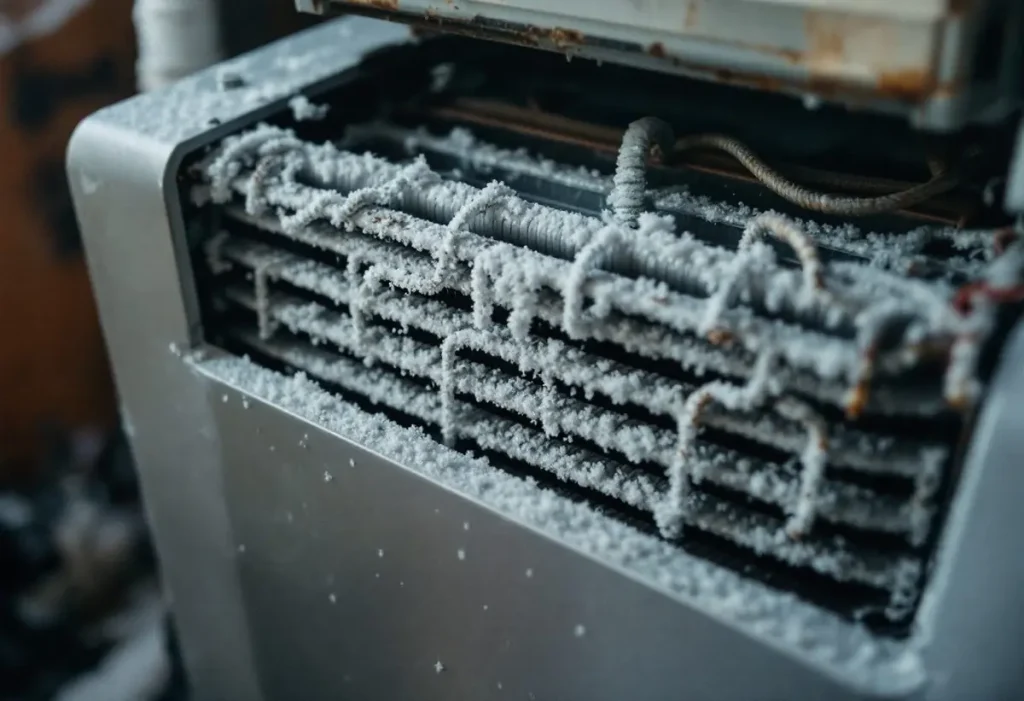
Why does a dehumidifier stop making water in a basement below 41°F?
Because the coil turns the water to frost and the control shuts the compressor off to melt it. GE says a dehumidifier “will not operate satisfactorily at temperatures below 41 degrees Fahrenheit,” that coils may then need defrosting “as often as once per hour,” and that frost controls “do not eliminate freeze ups below 41 degrees.” Whirlpool rates its 2025 models for 41°F to 90°F.
During defrost the fan runs with the compressor off, so the unit sounds busy while collecting nothing. Light frost at start up is normal and clears “within 30 to 60 minutes,” per GE. Frost that stays above 41°F points, per Frigidaire, to restricted airflow, a dirty filter or a setpoint left on CO. A cold space needs heat, not a bigger dehumidifier: see ways to heat a basement. Some GE models sold for “low temperature operation” run below 41°F without icing.
Is the water draining out a hose, or is the bucket switch holding the compressor off?
Look at the back first. On the Whirlpool WHHD501AW family, removing the cap and fitting a hose sends water straight to the drain, so the bucket stays empty. Whirlpool limits the hose to 3.2 feet, says not to immerse the outlet, and warns that on uneven ground or with a badly fitted hose “the water will fill the bucket and the unit will stop running.”
The bucket itself is a switch. GE’s ADHL22 and ADHL35 manual says the fan motor and compressor “will stop as soon as the bucket is removed,” and Whirlpool says the compressor turns off when the bucket is full or out while the fan runs on for a few minutes. If the bucket light glows with a hose connected, GE says the hose is loose or kinked; on pump models Frigidaire’s PU code means the pump failed to empty the bucket in time. Built in pumps clog like any condensate pump.
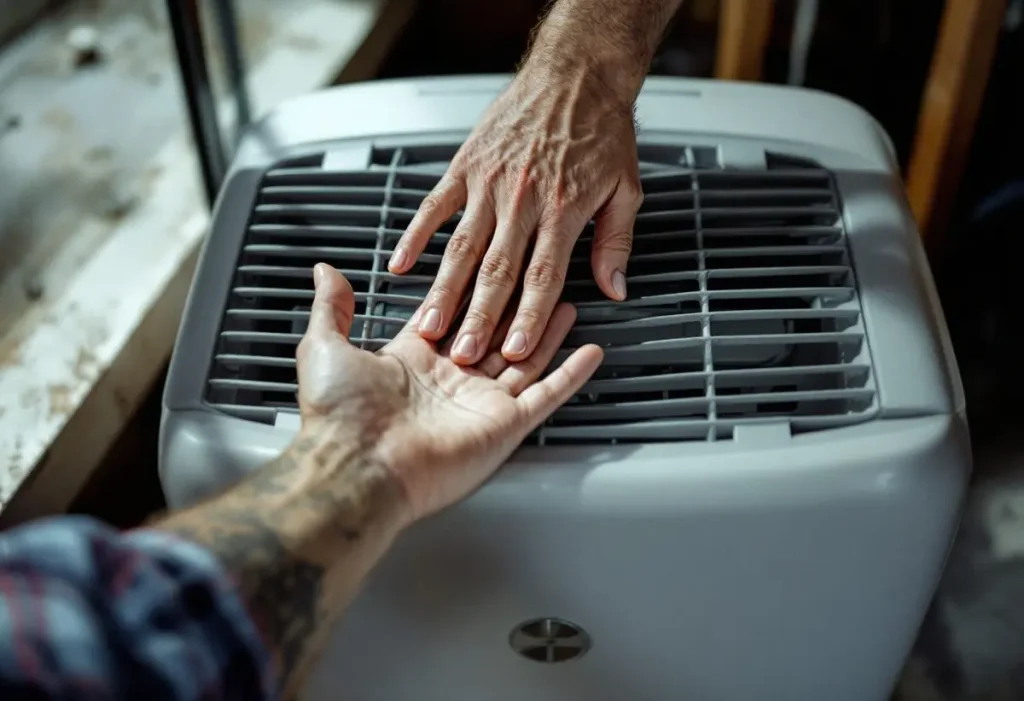
Why is the dehumidifier blowing warm air but not collecting water?
Warm exhaust is the sign the machine is working, not a fault. GE’s ADHL22/ADHL35 manual says room air passes the cold coil, then the condenser, “where it is heated,” and that “it is normal for the surrounding air to become slightly warmer.” Energy balance predicts the heat: all the electricity ends up in the room, plus the latent heat of every kilogram condensed.
For the Whirlpool WHHD501AW, rated in the ENERGY STAR certified data at 50.00 pints per day and 2.01 liters per kWh, we calculated 490 W of electricity plus 685 W of latent heat: 1,175 W, 58% of it from the water itself. So in a humid room a working unit’s exhaust is clearly warm. If the fan blows but the exhaust is no warmer than the room after the 3 minute delay, with no frost on the coil, the compressor is not pumping heat and no setting will make water.
Warm exhaust with a dry bucket in a humid room sends you back to airflow: GE asks for 18 inches of space on all sides, closed doors and a clean filter, and warns that running without one lets lint clog the coil and “reduce performance.”
Does an E3, EC or F0 code mean the refrigerant leaked out?
On the brands that publish them, yes: Whirlpool’s 2025 manual lists E3 as “Refrigerant leakage” when it “appears many times,” and Frigidaire’s error code guide lists EC and F0 as “Sealed system failure.” Both say to call service, and GE’s not collecting water article says a unit that “never, ever collects water” is “not operating correctly” and suggests unplugging it for 30 seconds first.
This is the stop line. The ENERGY STAR data shows the Whirlpool WHAD251AW holds 3.5 oz and the WHHD501AW 5.5 oz of HFC-32, an A2L refrigerant with low flammability, inside a sealed circuit. A technician checks whether the compressor draws current and the coil gets cold; locating a leak is refrigerant leak detection work, which is why both makers route these codes to service. The same GE page states “there are not repair parts available for dehumidifiers,” so check the warranty first. One harmless look alike: Whirlpool says a unit carried on its side must stand upright, unplugged, for 6 hours.
Frequently asked questions
Can I leave a dehumidifier on 24/7?
Yes, with a drain hose, and long runs are normal at first: GE says a unit in a very humid room “may run continually for three or four days” before it holds the target. Frigidaire meant its CO mode for short periods of high humidity, then a setpoint between 40% and 60%.
Can a dehumidifier make damp worse?
It cannot add water vapor; it removes vapor and releases heat, 1,175 W for a 50 pint unit at its rating point by our calculation, and warmer air reads a lower relative humidity. What people notice is a unit in a room under 41°F that frosts, defrosts and removes almost nothing.
Can I use a dehumidifier with aircon?
Yes, but the air conditioner coil already condenses water, so the dehumidifier sees drier air and collects less. Our energy balance puts a 50 pint unit at about 4,010 BTU/h of heat at its rated point, a third of the 12,000 BTU/h in one ton of cooling, which the air conditioner must then remove.
How long before a new dehumidifier starts collecting water?
Minutes, unless something holds it off. The GE ADHL22/ADHL35 manual describes a compressor delay of up to 3 minutes after power returns, and its display is only accurate to plus or minus 5 percent. Whirlpool says to run a new unit in continuous mode for 24 hours, and to stand a unit shipped on its side for 6 hours first.
How we researched this
On November 6, 2026 we read GE support articles 35298, 18409 and 54, the GE ADHL22/ADHL35 manual (49-5000545 Rev. 0), three Frigidaire support pages, the 2025 Whirlpool manual (W11740391A), the eCFR text of Appendix X1 and the ENERGY STAR dehumidifier dataset (571 records). Dew points use the NWS formula; latent heat uses the UCAR NCL value of 2,500.72 J/g at 0°C. We excluded ranking repair blogs as sources, since their figures, including a claimed 65°F cutoff, trace to no maker document. No repair prices: no federal source publishes them. Codes are stated only for the brand that defines them.
Sources
- GE Appliances. “Dehumidifier: Not Collecting Water.” https://products.geappliances.com/appliance/gea-support-search-content?contentId=35298. Accessed November 2026.
- GE Appliances. “Dehumidifier: Compressor Not Operating.” https://products.geappliances.com/appliance/gea-support-search-content?contentId=18409. Accessed November 2026.
- GE Appliances. “Dehumidifier: Ideal Operating Conditions.” https://products.geappliances.com/appliance/gea-support-search-content?contentId=54. Accessed November 2026.
- GE Appliances. “Owner’s Manual, Dehumidifier ADHL22, ADHL35 (49-5000545 Rev. 0).” https://images.thdstatic.com/catalog/pdfImages/4f/4f5dd1d9-dd73-4faa-ab9d-3a07a97b68ca.pdf. Accessed November 2026.
- Frigidaire. “Dehumidifier: Not Collecting Water.” https://support.frigidaire.ca/support-articles/article/1927759-dehumidifier-not-collecting-water. Accessed November 2026.
- Frigidaire. “Dehumidifier: Frost Buildup.” https://support.frigidaire.ca/support-articles/article/1927768-dehumidifier-frost-buildup. Accessed November 2026.
- Frigidaire. “Dehumidifiers Error Code Guide.” https://support.frigidaire.ca/support-articles/article/1838728-dehumidifiers-error-code-guide. Accessed November 2026.
- Whirlpool. “Dehumidifier Use and Care, WHAD251AW, WHAD321AW, WHHD501AW (W11740391A, 2025).” https://www.sylvane.com/cdn/shop/files/owners-manual-whirlpool-50-pint-energy-star-dehumidifier.pdf. Accessed November 2026.
- Electronic Code of Federal Regulations. “Appendix X1 to Subpart B of Part 430: Uniform Test Method for Measuring the Energy Consumption of Dehumidifiers.” https://www.ecfr.gov/current/title-10/chapter-II/subchapter-D/part-430/subpart-B/appendix-Appendix%20X1%20to%20Subpart%20B%20of%20Part%20430. Accessed November 2026.
- ENERGY STAR. “ENERGY STAR Certified Dehumidifiers” dataset. https://data.energystar.gov/resource/mgiu-hu4z.json. Accessed November 2026.
- National Weather Service. “Vapor Pressure.” https://www.weather.gov/media/epz/wxcalc/vaporPressure.pdf. Accessed November 2026.
- UCAR NCAR, NCL documentation. “latent_heat_water.” https://www.ncl.ucar.edu/Document/Functions/Contributed/latent_heat_water.shtml. Accessed November 2026.
Leave a Reply