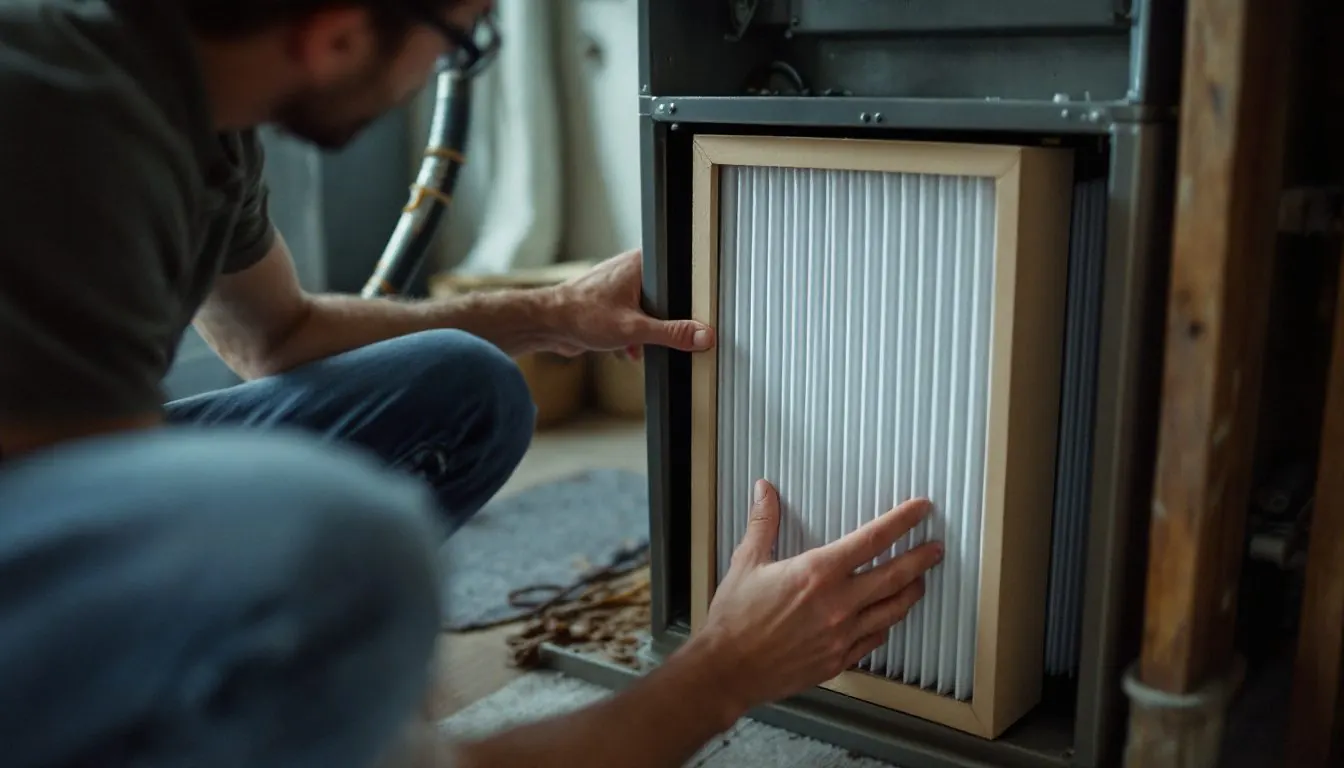
What happens if a furnace filter is installed backwards: a clean pleated filter keeps filtering, but the airstream now pushes the media away from its metal backing instead of into it, so pleats can bow toward the blower as the filter loads. Turn a new filter so the arrow points toward the blower; replace one that has run for weeks.
No filter maker or lab in the 10 documents we read measured a residential filter flipped around, so a page quoting a percentage loss is guessing. The documents do show how the filter is built to take the air’s push, how big that push gets, and what the furnace does past its static limit.
Which way should the arrow point: toward the furnace blower or toward the return grille?
The arrow points the way the air moves, which is always toward the blower. EPA’s Residential Air Cleaners technical summary (3rd edition, page 39) says filters “should be installed so that the directional arrow printed on the side of the filter points in the direction of airflow within the system,” and 3M’s Filtrete installation page says to point it “toward the unit’s blower motor,” including in a wall or ceiling return.
At a return grille in the hall ceiling, that means the arrow points up into the ceiling, away from the room. In an upflow furnace with a bottom return the arrow points up; with a side filter rack it points sideways into the cabinet. Goodman’s GMS95 manual places counterflow filters “at the counterflow top return,” so there the arrow points down. If you are unsure which opening is the return, our guide to supply and return vents shows how to tell them apart.
What actually changes inside a pleated filter when the arrow points the wrong way?
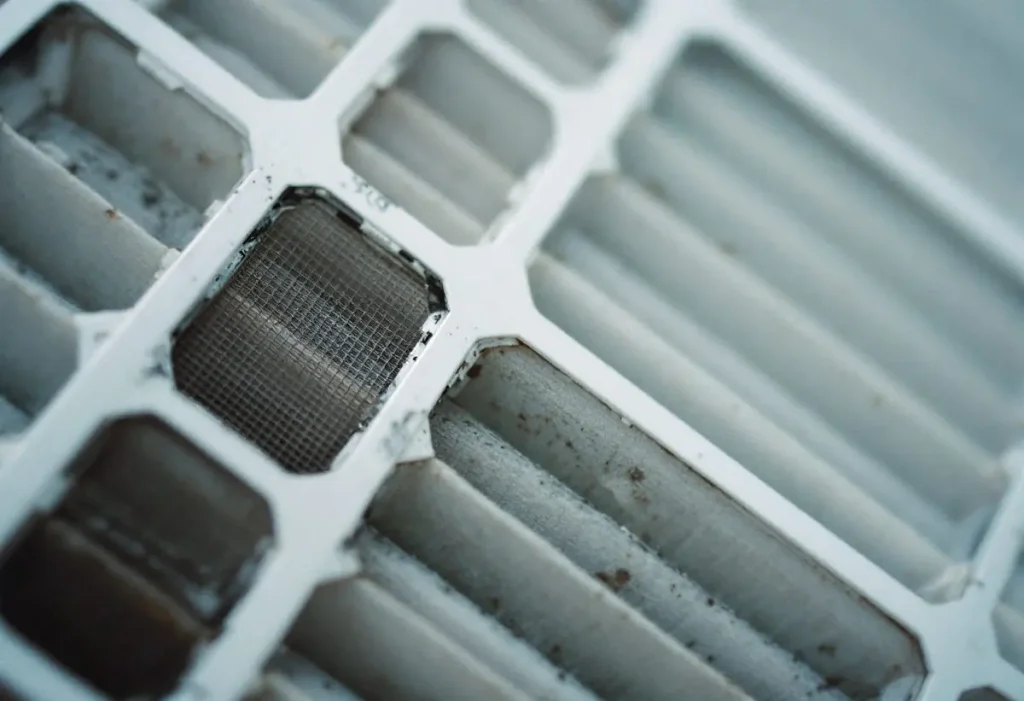
The support ends up on the wrong side. Glasfloss’s Z-Line MR-11 bulletin specifies an expanded metal reinforcement “laminated to the air exit side of the media” to “maintain continuity of the radial pleats”; the ZL and MR-13 bulletins match. Air pushes media downstream, so with the arrow right the pleat tips lean on that grid. Flipped, the grid sits upstream and nothing stands behind the media.
A 3M patent for a framed residential filter, US9174159B2, explains the load. It calls media non-self-supporting if, without its frame, it collapses or deforms once airflow develops 0.4 inch of water, and notes that “the pressure of the moving air will tend to ‘inflate’ the downstream pleats.” The same patent describes a design with bridging filaments on the upstream pleat tips and no support on the downstream face, so the wire side is not a universal tell.
The media itself can also be directional. Glasfloss describes MR-13 fibers made “in an engineered gradient structure,” and a fiberglass filter media patent, US20180044230A1, describes fiber that “progressively increases in density such that the fiber on the air inflow is less dense than the fiber on the air outflow.” Reversed, the tightest layer meets the dust first and loads at the surface; no maker we read says how much sooner it clogs.
How hard does the airstream push on a 16x25x1 filter?
About 3.3 pounds on a clean 16x25x1 MERV 11 filter, rising to about 13.7 pounds at the change point.
| Pressure drop across the filter | Where the number comes from | Push on a 16x25x1 | Push on a 20x25x1 |
|---|---|---|---|
| 0.20 in. w.g. | Glasfloss ZL MERV 10, clean, at 300 FPM | 2.7 lbf | 3.5 lbf |
| 0.24 in. w.g. | Glasfloss MR-11 MERV 11, clean, at 300 FPM | 3.3 lbf | 4.1 lbf |
| 0.35 in. w.g. | Glasfloss MR-13 MERV 13, clean, at 300 FPM | 4.8 lbf | 6.0 lbf |
| 0.4 inch of water | 3M patent: unframed media fails at this load | 5.5 lbf | 6.9 lbf |
| 0.5 in. w.c. | Daikin AMST limit for the whole duct system | 6.9 lbf | 8.6 lbf |
| 1.00 in. w.g. | Glasfloss recommended final resistance | 13.7 lbf | 17.3 lbf |
HVAC Brief calculation: pressure (in. w.c.) x 0.036127 psi x the exact face area Glasfloss lists for the ZL and MR-11 (15.5 by 24.5 and 19.5 by 24.5 inches). Pressures from Glasfloss bulletins, 3M patent US9174159B2 and Daikin IO-4011B.
A clean MR-13 alone uses 70% of the 0.5 in. w.c. total that Daikin’s AMST air handler manual allows for the ductwork. Glasfloss rates those drops at 300 FPM, and a 3 ton system at 400 CFM per ton (inside Daikin’s 350 to 450 range) pushes 1,200 CFM through one 16x25x1 at about 432 FPM over the nominal face, so the real drop and push run higher than the bulletin. Arrow right, a metal grid carries that load; reversed, the media and its cardboard frame do.
Does a backwards furnace filter cut airflow or damage the furnace?
Only through the same path as any restriction: higher static pressure. Goodman’s GMS95 manual (section S-200) says “too great of an external static pressure will result in insufficient air that can cause excessive temperature rise, resulting in limit tripping.” That is the furnace limit switch opening, which a reversed filter causes only if it bows, pinches or clogs.
In cooling mode the same lost airflow drops coil temperature, and Daikin’s AMST manual sets a floor of 350 CFM per ton. Below it the coil runs colder, which is how an AC freezes up. One widely read page claims a backwards filter can turn a 16 SEER 3 ton system into a 12 SEER 2 ton one and crack a heat exchanger; it cites no test, and none of the 10 documents we read supports a figure like that for a filter that is merely reversed.
Ranked by the table: a clean MERV 10 backwards for a few days carries 2.7 lbf of push, while a 1 inch MERV 13 run backwards to the end of its 90 day life has the most load behind any bowing. Our page on MERV ratings and airflow explains why filter area matters more than the rating.
How can you tell if a furnace filter is backwards when the arrow is worn off?
Check the arrow first, then the construction clue for your filter type from the 3 documents compiled below, including where each clue fails.
| Filter type | What faces the blower when installed right | Source | Where the clue fails |
|---|---|---|---|
| Pleated, metal backed (Glasfloss ZL, MR-11, MR-13) | Expanded metal grid, laminated to the air exit side | Glasfloss product bulletins, 2025 and 2026 | Some designs have no downstream support at all (3M patent US9174159B2) |
| Pleated, filament bridged (3M patent design) | Bare pleat tips; filaments sit on the upstream face | US9174159B2 | The “wire faces the furnace” rule would put this one in backwards |
| Fiberglass, progressive density | The denser, skinned outflow surface | US20180044230A1 | Density difference is hard to judge by touch on a thin pad |
| Any filter already used for weeks | The cleaner face; dust collects on the face the air enters | HVAC Brief reasoning; no maker document states it | A filter bypassed at the edges may look clean on both faces |
Compiled by The HVAC Brief from Glasfloss Z-Line bulletins, 3M patent US9174159B2, patent application US20180044230A1 and EPA’s 2018 technical summary.
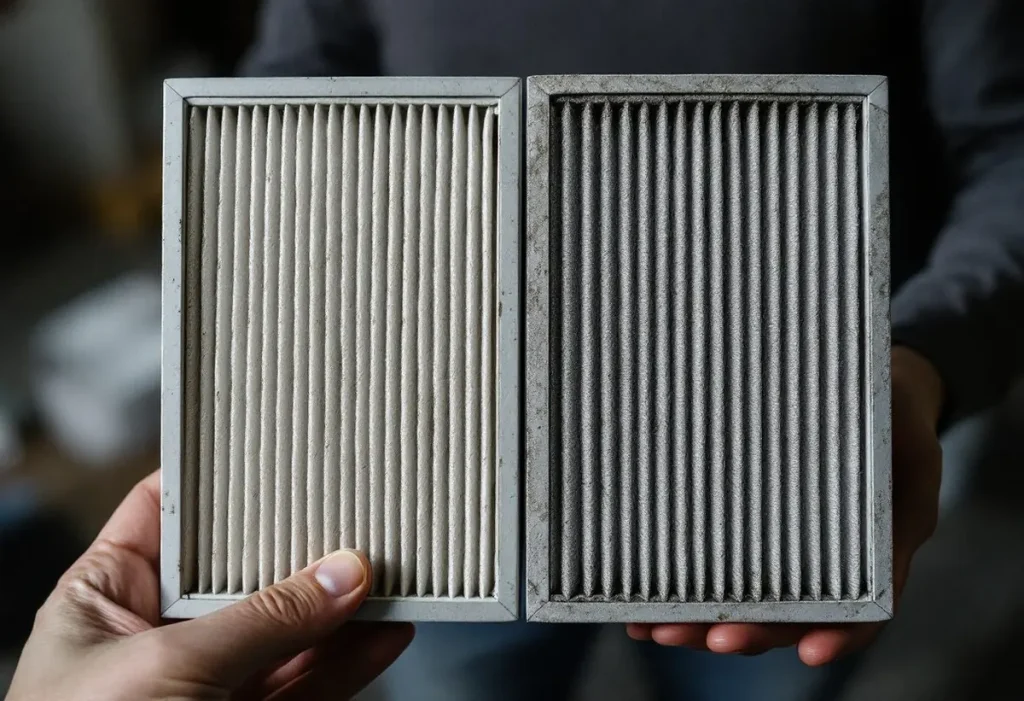
On a used filter, the dirty face should point back toward the return and the arrow at the blower. If both faces look clean after 90 days, suspect air going around the frame, which our article on why a furnace filter never gets dirty works through.
Should you flip a dirty filter that went in backwards, or replace it?
Replace it. Flipping a loaded filter blows air through the dust cake from behind, which is how industrial dust collectors clean cartridges. A University of Minnesota study of 6 pleated cartridges in a reverse flow pulse jet collector found downstream particle concentration during cleaning was at least 2 times that during filtration. In a furnace, downstream is the blower wheel and coil.
Those were compressed air pulses, not a furnace blower, so treat it as a direction of effect. Filtrete says to change a 1 inch filter “at least once every three months” anyway. With no spare tonight, our page on running without a filter sets out what a night or a week does to the coil.
What should a technician measure after weeks on a reversed filter?
Three numbers settle it: pressure drop across the new filter, total external static against the rating plate, and temperature rise against the plate range. Goodman’s S-200 procedure adds return and supply readings with clean filters in; a reading above the plate maximum (0.5 in. w.c. on the Daikin AMST) means something besides the old reversed filter is restricting the air.
For scale, a new Glasfloss MR-11 is rated at 0.24 in. w.g. at 300 FPM, and its drop rises with face velocity. Our static pressure guide explains where the test ports go.
Frequently asked questions
What happens if the HVAC filter is backwards in an air handler or heat pump?
The same as a furnace: the arrow should point toward the blower, and reversed media loses its downstream support. Daikin’s AMST air handler manual requires ducts sized for 350 to 450 CFM per ton with static not over 0.5 in. w.c., and a filter that bows or clogs eats into that limit before the coil does.
What happens if an air filter is backwards for a month?
Usually nothing you can hear, but the media has carried the push without its grid for 30 days. At Glasfloss’s 1.00 in. w.g. change point a 16x25x1 sees about 13.7 pounds of push. Replace it with a new filter rather than flipping it, so the caked dust is not blown toward the blower.
Does a backwards MERV 13 filter still filter like a MERV 13?
Nobody has published that test. Glasfloss rates its MR-13 at MERV 13 when tested to ANSI/ASHRAE 52.2, which EPA’s technical summary calls the most widely used US test method for duct filters. A rating measured one way says nothing certain about the other, and MR-13 media is built as an engineered gradient, so assume the rating no longer applies.
How we researched this
Research date: November 9, 2026. We read the 10 documents listed under Sources (the Filtrete page as an archived copy, since the live page blocked our fetch) and four of the top search results for this query. We excluded AI generated product manuals on manuals.plus, contractor and affiliate blogs for any number, and commercial pocket filter data that do not match a 1 inch residential filter. No document measured a residential filter installed in reverse, so we give none.
Sources
- US Environmental Protection Agency. “Residential Air Cleaners: A Technical Summary, 3rd Edition.” https://www.epa.gov/sites/default/files/2018-07/documents/residential_air_cleaners_-_a_technical_summary_3rd_edition.pdf. Accessed November 2026.
- 3M Filtrete. “How to Install an Air Filter” (archived copy). https://web.archive.org/web/2025id_/https://www.filtrete.com/3M/en_US/filtrete/about-us/how-to-install-an-air-filter/. Accessed November 2026.
- Glasfloss Industries. “Z-Line Series MR-11 MERV 11 Pleated Filters,” Product Bulletin 6 MR11. https://www.glasfloss.com/wp-content/uploads/2026/02/06f-MR11-Bro.pdf. Accessed November 2026.
- Glasfloss Industries. “Z-Line Series MR-13 MERV 13 Pleated Filters,” Product Bulletin 6 MR13. https://www.glasfloss.com/wp-content/uploads/2026/02/06h-MR13-Bro.pdf. Accessed November 2026.
- Glasfloss Industries. “Z-Line Series ZL MERV 10 Pleated Filters,” Product Bulletin 6ZLINEZL. https://www.glasfloss.com/wp-content/uploads/2025/10/06baBro0326ZL.pdf. Accessed November 2026.
- 3M Innovative Properties Co. “Framed pleated air filter with upstream bridging filaments,” US9174159B2. https://patents.google.com/patent/US9174159B2/en. Accessed November 2026.
- Spitler and Wilkins. “Preparation for fiberglass air filtration media,” US20180044230A1. https://patents.google.com/patent/US20180044230A1/en. Accessed November 2026.
- Goodman Manufacturing. “GMS95 Installation Instructions and Service Manual.” https://s3.amazonaws.com/s3.supplyhouse.com/product_files/Goodman-GMS951155DXA-Install-Instructions.pdf. Accessed November 2026.
- Daikin Comfort Technologies. “AMST Air Handlers Installation and Operating Instructions, IO-4011B.” https://daikincomfort.com/docs/default-source/amst/im-io-4011b.pdf. Accessed November 2026.
- University of Minnesota. “Experimental study of pleated cartridge filters in a pulsejet-cleaned dust collector” (AFS 2005 abstract). https://experts.umn.edu/en/publications/experimental-study-of-pleated-cartridge-filters-in-a-pulsejet-cle/. Accessed November 2026.
Leave a Reply