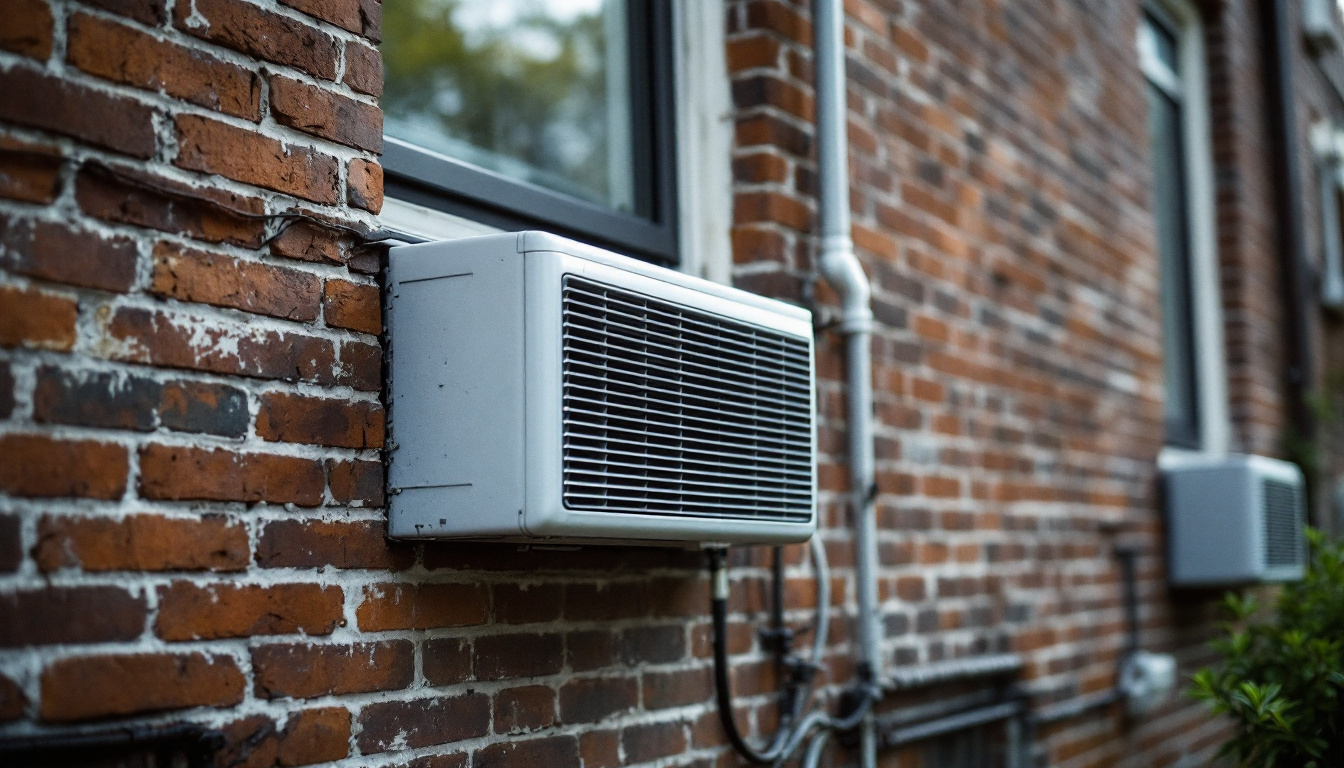
What is a wall air conditioner? A wall air conditioner is a through-the-wall room unit that sits in a sleeve in an exterior wall and vents through a rear grille. Federal rules class it as a room air conditioner “without louvered sides,” with its own efficiency minimums from May 26, 2026.
Key Takeaways
- Wall and window units share one federal category: a “window-mounted or through-the-wall-mounted encased assembly” under 10 CFR 430.2.
- A cooling-only wall unit of 8,000 to 10,900 Btu/h made from May 26, 2026 needs a CEER of 14.1, up from 9.6 (10 CFR 430.32(b)).
- DOE tests non-louvered units “inside a compatible wall sleeve” with a rear grille (Appendix F).
- PTACs are commercial equipment rated on EER; a standard-size 12,000 Btu/h PTAC needs an EER of 10.4 under 10 CFR 431.97.
- AHAM told DOE that window units in wall sleeves risk “inadequate cooling of high-pressure components” (88 FR 34298).
- DOE Energy Saver says units above 7.5 amps need a dedicated 115-volt circuit (archived copy).
A wall air conditioner cools one room from a fixed opening in the wall rather than a window sash. The real choice is among four options: a through-the-wall unit, a window unit, a PTAC or a ductless mini split. For whole-house systems, see our guide to the main types of residential cooling.
What is a wall air conditioner?
A wall air conditioner is a room air conditioner built to mount through an exterior wall. Under 10 CFR 430.2, a room air conditioner is a “window-mounted or through-the-wall-mounted encased assembly” on single-phase power, and the definition excludes packaged terminal air conditioners.
The difference from a window unit is airflow. ENERGY STAR’s Version 7.0 Draft 1 specification defines a through-the-wall unit as “A RAC without louvered sides,” and louvered sides as “Exterior side vents on a RAC enclosure to facilitate airflow over the outdoor coil.” A room unit “may include additional means for ventilating and heating.”
How does a wall air conditioner compare with window units, PTACs and mini splits?
The four differ in federal category, efficiency metric and the opening they need. Wall and window units are consumer room air conditioners rated on CEER, PTACs are commercial equipment rated on EER, and mini splits are rated on SEER2.
| Option | Federal category | Efficiency metric | Opening | Heating |
|---|---|---|---|---|
| Through-the-wall room air conditioner | Consumer room air conditioner, “without louvered sides” (10 CFR 430.32(b)) | CEER | Sleeve in an exterior wall, rear grille | Optional, reverse cycle classes |
| Window room air conditioner | Consumer room air conditioner, “with louvered sides” (10 CFR 430.32(b)) | CEER | Window sash | Optional, reverse cycle classes |
| Packaged terminal air conditioner (PTAC) | Commercial and industrial equipment (10 CFR 431.97) | EER at 95°F | Wall sleeve with separable outdoor louvers | Hot water, steam or electricity |
| Ductless mini split | Consumer central air conditioner or heat pump (10 CFR 430.32(c)) | SEER2, plus HSPF2 for heat pumps | Small conduit hole; outdoor unit up to 50 feet away | Yes, heat pump models |
For the removable end of the category, see our comparison of portable and window units.
How is a wall air conditioner installed?
A wall air conditioner slides into a sleeve set in an exterior wall, with its back facing outdoors through a rear grille. DOE’s test procedure mirrors this: “Install a non-louvered room air conditioner inside a compatible wall sleeve with the provided or manufacturer-required rear grille.”
- Confirm the manufacturer lists the unit, sleeve and grille as compatible. The federal rules we reviewed define a standard-size opening only for PTACs.
- Plan the opening. Cutting wall framing is structural work that, depending on the wall and local code, may need a header, a permit and an inspection.
- Set and seal the sleeve following the sleeve maker’s details.
- Fit the rear grille and slide in the chassis with the supplied trim.
- Position the unit for drainage. Energy Saver advises: “Ensure the unit is level for efficient drainage and operation.”
- Match the circuit to the nameplate. Energy Saver says units under 7.5 amps can share a 15- or 20-amp, 120-volt circuit not used by major appliances, larger units need a dedicated 115-volt circuit, and the largest need 240 volts.
Why shouldn’t a window unit go in a wall sleeve?
A window unit draws outdoor air through side vents, and set inside a sleeve those vents face the sleeve rather than open air.
Safety point
In the room air conditioner rulemaking, the Association of Home Appliance Manufacturers (AHAM) said consumers may put window units in wall sleeves because higher-capacity through-the-wall units are costlier, larger and heavier, which may “even lead to safety concerns due to inadequate cooling of high-pressure components.” DOE replied that it assumes consumers “install products according to manufacturer instructions.” Use a unit whose instructions approve sleeve installation.
What efficiency rules apply to a wall air conditioner?
A wall air conditioner must meet the CEER minimum for its “without louvered sides” class in 10 CFR 430.32(b), and the table for products manufactured starting May 26, 2026 raised every one of those floors.
CEER is measured in Btu per watt-hour and counts inactive and off-mode energy with cooling; the Appendix F formula assumes 750 annual operating hours in cooling mode. Our breakdown of the 2026 room air conditioner standards has every class. Common wall unit rows:
| Through-the-wall class | CEER until May 26, 2026 | CEER from May 26, 2026 |
|---|---|---|
| 8a: cooling only, 8,000 to 10,900 Btu/h | 9.6 | 14.1 |
| 8b: cooling only, 11,000 to 13,900 Btu/h | 9.5 | 13.9 |
| 12: reverse cycle, under 14,000 Btu/h | 9.3 | 13.7 |
Wall units carry lower floors than window units in most size bands: a cooling-only window unit of 8,000 to 13,900 Btu/h must reach 16.0. What a rating means on a bill depends on rates and run hours, as our look at air conditioning running costs explains.
DOE estimated the standards save 1.41 quads over units bought from 2026 to 2055, 12 percent below the no-new-standards case. ENERGY STAR calls its room air conditioner specification “currently under revision,” so check which version a label reflects.
When does a PTAC make more sense than a wall air conditioner?
A PTAC is the likelier fit where a building already has PTAC sleeves or the builder specifies the heat source. 10 CFR 431.92 defines it as “a wall sleeve and a separate un-encased combination of heating and cooling assemblies specified by the builder and intended for mounting through the wall, and that is industrial equipment.”
That places PTACs under the “Energy Efficiency Program for Certain Commercial and Industrial Equipment,” with heat by “hot water, steam, or electricity.” Our explainer on commercial and residential HVAC covers that regulatory split.
A standard-size PTAC has a wall opening of at least 16 inches high or 42 inches wide and at least 670 square inches in area. Since January 1, 2017, a standard-size PTAC of 7,000 to 15,000 Btu/h must reach an EER of 14.0 minus 0.3 times its capacity in thousands of Btu/h, rated at 95°F. At 12,000 Btu/h that is 10.4.
When is a ductless mini split the better choice?
A ductless mini split tends to fit when you want heating and cooling, several rooms served, or no large wall opening. DOE Energy Saver (archived copy) says it “typically requires only a small hole through a wall for the conduit,” with the outdoor unit up to 50 feet away.
The trade-off is price: Energy Saver says mini splits “can cost twice as much as window units of similar capacity.” Our guides to how a ductless mini split works and what a mini split installation involves cover the equipment and the job.
Federally, mini splits are central air conditioners, a definition that includes “an outdoor unit and one or more indoor units.” Split air conditioners made from January 1, 2023 need 13.4 SEER2 nationally, and split heat pumps need 14.3 SEER2 and 7.5 HSPF2.
Which wall air conditioner option fits your room?
An existing sleeve usually decides it; otherwise the opening you accept and your need for heat do. Every branch depends on manufacturer instructions and local code.
Size the room first with our room BTU sizing lookup, and see why floor area alone misleads in our piece on sizing a cooling system. An oversized unit, Energy Saver notes, “will cool the room too quickly without dehumidifying it properly.”
How we researched this
Researched September 17, 2026. We consulted 11 sources and cited 10: five eCFR sections (current to September 15, 2026), DOE’s final rule at 88 FR 34298, two ENERGY STAR documents and archived copies of two DOE Energy Saver pages (the live room air conditioner page returns a 404). The 10.4 PTAC figure is our arithmetic from the CFR formula.
Excluded: installed prices (no federal series), install guides, contractor blogs, vendor surveys, and the ENERGY STAR key criteria table, which cites Version 5.0 during a revision. Reddit was not used because the topic involves electrical and structural safety.
Frequently asked questions
Can you put a window air conditioner in a wall?
Only if the manufacturer’s instructions approve it. Window units draw outdoor air through side vents, which a sleeve can block. In the 2023 federal rulemaking, AHAM warned that window units in wall sleeves may cause safety concerns due to inadequate cooling of high-pressure components.
Is a through-the-wall air conditioner the same as a PTAC?
No. A through-the-wall unit is a consumer room air conditioner under 10 CFR 430.2, rated on CEER. A PTAC is a wall sleeve plus separate heating and cooling assemblies specified by the builder, regulated as commercial and industrial equipment under 10 CFR 431.97 and rated on EER at 95°F.
What efficiency does a wall air conditioner need in 2026?
For units manufactured starting May 26, 2026, 10 CFR 430.32(b) requires a CEER of 14.1 for a cooling-only unit without louvered sides of 8,000 to 10,900 Btu/h, and 13.9 for 11,000 to 13,900 Btu/h. Units built earlier fall under the minimums in effect since June 1, 2014.
Does a wall air conditioner need a dedicated circuit?
Larger ones usually do. DOE Energy Saver says units drawing more than 7.5 amps require a dedicated 115-volt circuit and the largest models need a 240-volt circuit. Units under 7.5 amps can share a 15- or 20-amp, 120-volt circuit. The nameplate and local electrical code decide the rest.
Can a wall air conditioner heat?
Some can. The federal definition allows a room air conditioner to include means for heating, and 10 CFR 430.32(b) has reverse cycle classes for units without louvered sides. A reverse cycle wall unit under 14,000 Btu/h manufactured from May 26, 2026 must reach a CEER of 13.7.
How long does a wall air conditioner last?
DOE estimated the average lifetime of a room air conditioner at 9.3 years in its 2023 final rule, covering window and through-the-wall units together. DOE built it from shipments, American Housing Survey and RECS data, so it is an average, not a guarantee.
Sources
- Electronic Code of Federal Regulations. “10 CFR 430.2, Definitions.” https://www.ecfr.gov/current/title-10/chapter-II/subchapter-D/part-430/subpart-A/section-430.2 Accessed September 2026.
- Electronic Code of Federal Regulations. “10 CFR 430.32, Energy and water conservation standards and their compliance dates.” https://www.ecfr.gov/current/title-10/chapter-II/subchapter-D/part-430/subpart-C/section-430.32 Accessed September 2026.
- Electronic Code of Federal Regulations. “Appendix F to Subpart B of Part 430, Uniform Test Method for Measuring the Energy Consumption of Room Air Conditioners.” https://www.ecfr.gov/current/title-10/chapter-II/subchapter-D/part-430/subpart-B/appendix-Appendix%20F%20to%20Subpart%20B%20of%20Part%20430 Accessed September 2026.
- Electronic Code of Federal Regulations. “10 CFR 431.92, Definitions concerning commercial air conditioners and heat pumps.” https://www.ecfr.gov/current/title-10/chapter-II/subchapter-D/part-431/subpart-F/section-431.92 Accessed September 2026.
- Electronic Code of Federal Regulations. “10 CFR 431.97, Energy efficiency standards and their compliance dates.” https://www.ecfr.gov/current/title-10/chapter-II/subchapter-D/part-431/subpart-F/section-431.97 Accessed September 2026.
- U.S. Department of Energy, Federal Register. “Energy Conservation Program: Energy Conservation Standards for Room Air Conditioners,” 88 FR 34298, May 26, 2023. https://www.federalregister.gov/documents/2023/05/26/2023-10287/energy-conservation-program-energy-conservation-standards-for-room-air-conditioners Accessed September 2026.
- ENERGY STAR. “Room Air Conditioner Specification Version 7.” https://www.energystar.gov/room_air_conditioner_specification_version_7_0_pd Accessed September 2026.
- ENERGY STAR. “ENERGY STAR Version 7.0 Room Air Conditioners Draft 1 Specification.” https://www.energystar.gov/sites/default/files/2024-11/ENERGY%20STAR%20Version%207.0%20Room%20Air%20Conditioners%20Draft%201%20Specification.pdf Accessed September 2026.
- U.S. Department of Energy, Energy Saver. “Room Air Conditioners” (archived copy). https://web.archive.org/web/2025/https://www.energy.gov/energysaver/room-air-conditioners Accessed September 2026.
- U.S. Department of Energy, Energy Saver. “Ductless Mini-Split Air Conditioners” (archived copy). https://web.archive.org/web/2025/https://www.energy.gov/energysaver/ductless-mini-split-air-conditioners Accessed September 2026.
Leave a Reply