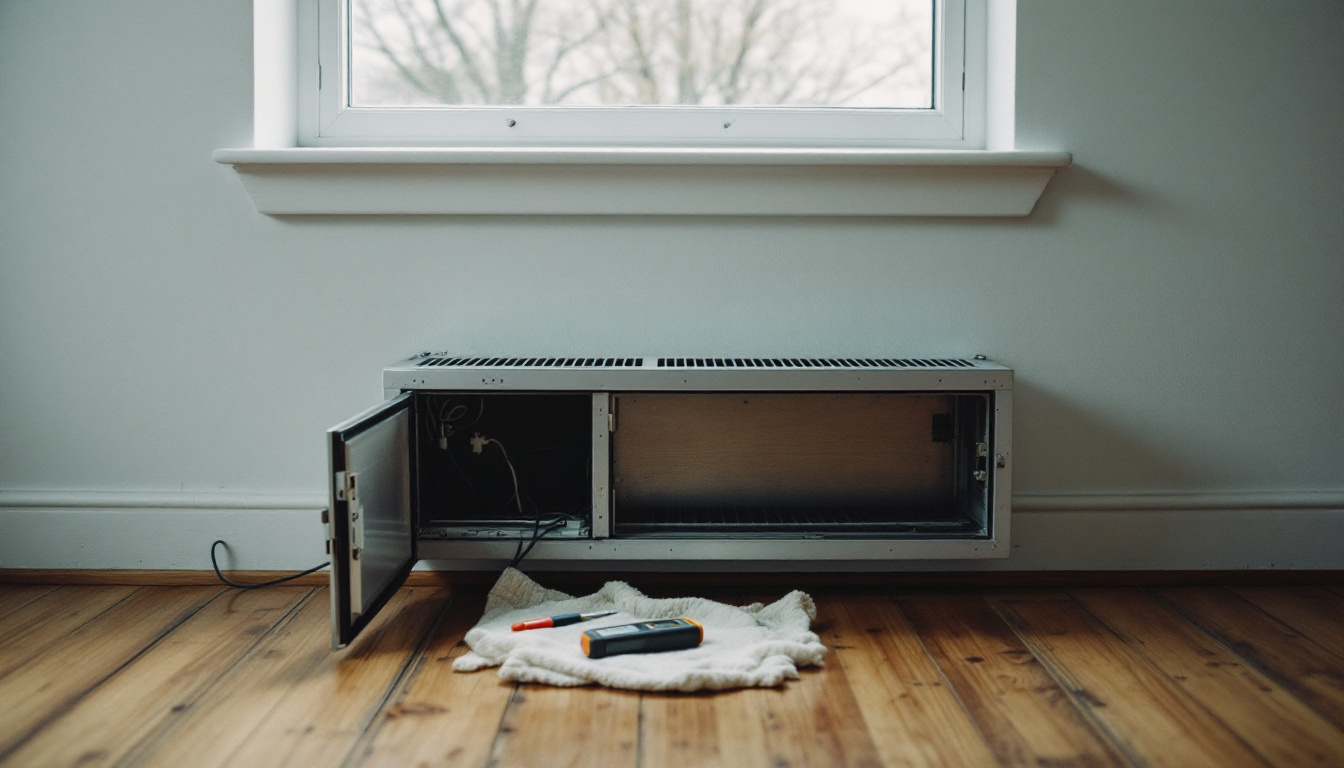
Is an electric baseboard heater worth running? Only where heat is occasional or the wiring already exists. It turns 100% of the electricity into heat, but never more, so a heat pump moving that heat uses a third of the power.
Key Takeaways
- A 240 volt electric baseboard heater produces 250 watts per linear foot, or 853 Btu per hour per foot (QMark 2500 catalogue).
- Built-in electric units were main heat in 7.65 million US homes in 2020 and secondary heat in 3.14 million more (EIA RECS Table HC6.1).
- Electric resistance has a COP of 1.0. EIA’s typical 2022 mini split, HSPF 11.1, is a seasonal COP of 3.25 and draws about 31% of the electricity.
- At 17.30 cents per kWh, the 2025 US average, a million Btu from baseboard costs $50.70 against $15.59 from that mini split (EIA Electric Power Monthly, Table 5.3).
- A 95% AFUE gas furnace also lands at $15.59, at the 2025 gas price of $15.34 per thousand cubic feet.
- One electric resistance unit heater costs $390 to $1,190 installed in 2022 dollars, against $2,030 for a 12,000 Btu mini split (EIA equipment cost report, 2023).
What is an electric baseboard heater?
An electric baseboard heater is a resistance element in a steel sheath with aluminum fins, mounted low along a wall, with no water and no boiler. Hydronic baseboard looks identical but is fed by one.
DOE calls it a zonal heater “controlled by thermostats located within each room,” with elements “encased in metal pipes.” If yours has supply and return pipes, our guide to how boiler-fed baseboard loops work covers that system.
How many watts per linear foot does an electric baseboard heater deliver?
Standard residential electric baseboard runs 250 watts per linear foot at 240 volts, which is 853 Btu per hour per foot. The 2 and 2.5 foot cabinets run 200 watts per foot; a high-density 8 foot model reaches 312.5 watts per foot.
| QMark 2500 model (240 V) | Length | Watts | Watts per foot | Amps at 240 V |
|---|---|---|---|---|
| 2542NW | 2 ft | 400 | 200 | 1.7 |
| 2543NW | 3 ft | 750 | 250 | 3.2 |
| 2546NW | 6 ft | 1,500 | 250 | 6.3 |
| 2548NW | 8 ft | 2,000 | 250 | 8.4 |
| 25408NW | 8 ft | 2,500 | 312.5 | 10.5 |
Watts per foot calculated by The HVAC Brief from the Marley QMark 2500 submittal sheet.
Why does heat loss, not floor area, set the length?
Because the heater must replace the Btu a room loses on the coldest design day, and two rooms of identical area lose different amounts. The standard is ACCA Manual J, which DOE’s Building America Solution Center calls a standard for producing equipment sizing loads.
The arithmetic is one division: feet equals heat loss in Btu per hour divided by 853. A room losing 5,000 Btu per hour needs 5.9 feet, so a 6 foot cabinet. One losing 12,000 Btu per hour needs 14.1 feet.
That second case is an insulation decision first. Our piece on insulating before sizing equipment sets out the order, and the ENERGY STAR room sizing chart is a first approximation.
Electric baseboard heater vs heat pump: where does the gap come from?
From the difference between making heat and moving it. Electric resistance converts electricity to heat at 100% and stops, a coefficient of performance of exactly 1.0. A heat pump moves heat that already exists outdoors, so its COP exceeds 1.
HSPF and HSPF2 are both Btu delivered per watt-hour, so dividing by 3.412 gives a seasonal COP. Our explainer covers why a heat pump beats 100% efficiency.
| System | Published rating | Seasonal COP | Electricity for the same heat |
|---|---|---|---|
| Electric baseboard heater | 100% efficient, 3,412 Btu per kWh | 1.00 | 100% |
| Split heat pump at the 2023 federal minimum | HSPF2 7.5 | 2.20 | 45% |
| EIA typical ducted air source heat pump, 2022 | HSPF 8.6 | 2.52 | 40% |
| EIA high efficiency split heat pump, 2023 | HSPF2 10.6 | 3.11 | 32% |
| EIA typical ductless mini split, 2022 | HSPF 11.1 | 3.25 | 31% |
Ratings from EIA, equipment cost report, 2023. COP calculated by The HVAC Brief as the rating divided by 3.412 Btu per watt-hour. HSPF2 is measured at higher static pressure, so it runs lower.
The 100% efficient trap
The commonest claim is that electric baseboard is 100% efficient, so nothing beats it. Efficiency is capped at 100% because it is a ratio of output to input. COP is not, because a heat pump’s output includes heat it never made. DOE, in an archived Energy Saver page, says heat pumps “easily cut electricity use by 50%” against electric resistance. See the SEER2 and HSPF2 minimums.
What does a million Btu of heat cost?
At the 2025 US average of 17.30 cents per kWh, one million Btu delivered by electric baseboard costs $50.70. The same heat from EIA’s typical mini split costs $15.59, and from a 95% AFUE gas furnace at the 2025 gas price of $15.34 per thousand cubic feet, $15.59 again.
HVAC Brief calculation. One million Btu equals 293.08 kWh at 3,412 Btu per kWh; gas converts at EIA’s 2026 estimate of 1,036 Btu per cubic foot. Fuel only.
Those averages move. Residential electricity reached 18.34 cents per kWh in June 2026, pushing baseboard to $53.75 per million Btu, and rates vary by state, as our June 2026 state electricity prices show. The factors are EIA constants; see what heat costs by fuel.
Why do electric baseboard heaters run on 240 volts?
Because doubling the voltage halves the current, and current limits how much baseboard one circuit carries. The same 1,500 watt, 6 foot QMark cabinet is listed at 6.3 amps on 240 volts and 12.6 amps on 120 volts.
A 20 amp circuit loaded to 16 amps carries 3,840 watts at 240 volts, about 15 feet of 250 watt baseboard, against 1,920 watts and about 7.7 feet at 120 volts. Section 424.3(B) of the National Electrical Code treats fixed electric space heating as a continuous load. Confirm with your inspector, since adoption varies.
The control is the other half. DOE notes that line-voltage thermostats built into the heater “often don’t sense the room temperature accurately,” and recommends a remote thermostat on an interior wall; our guide to what thermostats can and cannot do explains why. DOE puts the saving from zoning unused rooms at more than 20%.
Which homes still run on built-in electric units?
Older apartments and the Pacific states. Of the 7.65 million US homes whose main heat was a built-in electric unit in 2020, 4.19 million were apartments in buildings of five units or more, 54.8% of the total. Only 1.75 million were single-family detached.
The Pacific division held 1.69 million of them, 9.1% of its 18.51 million housing units and the highest share of any census division. Homes built between 1970 and 1979 carry the most at 1.64 million, 8.9% of that cohort. See also how American homes are heated.
Mini split or more baseboard?
Per unit of capacity they are closer than the sticker prices suggest. EIA puts one electric resistance unit heater of 5,100 Btu per hour at $390 to $1,190 installed in 2022 dollars, or $76 to $233 per thousand Btu per hour. A 12,000 Btu per hour mini split at $2,030 is $169, inside that range.
The separation is in running cost. EIA gives the mini split $100 a year in maintenance and calls baseboard maintenance negligible, against a gap of $35.12 per million Btu. DOE’s archived guidance calls minisplits “highly effective for homes without ductwork, offering an efficient alternative to baseboard heating”; see how a ductless mini split works.
A defensible order:
- Get a room-by-room load calculation. Both sizes depend on it.
- Price the envelope first. A lower load shrinks whichever equipment you buy.
- Check the panel. Baseboard reuses 240 volt circuits; a mini split may need a new one.
- Use your own utility rate, and remember only the mini split cools.
- Get the install right. Our walkthrough of what a mini split job involves lists the failure points.
Where baseboard wins is the case DOE names: an addition where extending the existing system is impractical, or a room heated a few days a year. At $390 installed and no maintenance, one unit in a spare room is hard to beat on capital cost.
How we researched this
Research date: September 17 and 18, 2026. Every figure was read at the source document.
Cited: EIA RECS 2020 Tables HC6.1, HC6.3, HC6.7, HC6.8; the RECS 2024 index; EIA Electric Power Monthly Table 5.3; the EIA gas price series; EIA conversion calculators; EIA equipment cost report, 2023, Appendix B, in 2022 dollars; two DOE Energy Saver pages, read as archived copies because the live pages 404; and the Marley QMark 2500 submittal sheet.
Excluded: contractor cost estimators and retailer sizing calculators, which publish prices with no sample basis or dollar year. No Reddit: this is 240 volt branch-circuit work, and our rule keeps forum material out of electrical safety topics.
Calculated by us and labelled: watts per foot; Btu per hour per foot; seasonal COP as the rating divided by 3.412; cost per million Btu; cost per thousand Btu per hour of capacity; circuit capacity. No payback period, because no national series reports delivered heat per home.
Limitations: RECS 2020 is the most recent published equipment count, and the RECS 2024 space heating tables are not due until spring 2027. National Electrical Code text is not free, so 424.3(B) is cited by number. Fuel costs exclude fixed customer charges.
Frequently asked questions
How many feet of electric baseboard do I need for a room?
Divide the room’s design heat loss in Btu per hour by 853, the output of one foot of 250 watt baseboard at 240 volts. A room losing 5,000 Btu per hour needs 5.9 feet, so a 6 foot heater. Floor area will not answer it.
Is electric baseboard heat expensive to run?
Yes. At the 2025 US average of 17.30 cents per kWh reported by EIA, delivering one million Btu costs $50.70 by our calculation, against $15.59 from a mini split rated HSPF 11.1 and $15.59 from a 95% AFUE gas furnace.
Why is electric baseboard wired for 240 volts instead of 120?
Because it halves the current. The QMark 2500 catalogue lists the same 1,500 watt, 6 foot cabinet at 6.3 amps on 240 volts and 12.6 amps on 120 volts. That is why a 20 amp circuit carries about 15 feet at 240 volts and half that at 120.
Is electric baseboard the same as hydronic baseboard?
No. Electric baseboard has a resistance element inside the fin tube and needs only a circuit. Hydronic baseboard circulates hot water from a boiler. EIA counts them apart: built-in electric units heated 7.65 million homes in 2020, steam and hot water systems 9.29 million.
Do electric baseboard heaters have a federal efficiency standard?
No. EIA’s 2023 equipment cost report states there are currently no federal efficiency requirements for electric resistance unit heaters. There is nothing to regulate: every unit converts 100% of its electricity to heat. Controls, build quality and placement differentiate models.
How long does an electric baseboard heater last?
EIA assigns electric resistance unit heaters an average life of 15 to 30 years, reasoning that heating elements eventually burn out the way electric furnace elements do. Annual maintenance is listed as negligible, against $100 a year for a mini split.
Sources
- EIA. “RECS 2020 Table HC6.1.” https://www.eia.gov/consumption/residential/data/2020/hc/pdf/HC%206.1.pdf. Accessed September 2026.
- EIA. “RECS 2020 Table HC6.8.” https://www.eia.gov/consumption/residential/data/2020/hc/pdf/HC%206.8.pdf. Accessed September 2026.
- EIA. “RECS 2020 Table HC6.3.” https://www.eia.gov/consumption/residential/data/2020/hc/pdf/HC%206.3.pdf. Accessed September 2026.
- EIA. “RECS 2020 Table HC6.7.” https://www.eia.gov/consumption/residential/data/2020/hc/pdf/HC%206.7.pdf. Accessed September 2026.
- EIA. “Electric Power Monthly, Table 5.3.” https://www.eia.gov/electricity/monthly/epm_table_grapher.php?t=epmt_5_3. Accessed September 2026.
- EIA. “Residential gas price, annual.” https://www.eia.gov/dnav/ng/hist/n3010us3a.htm. Accessed September 2026.
- EIA. “Energy conversion calculators.” https://www.eia.gov/energyexplained/units-and-calculators/energy-conversion-calculators.php. Accessed September 2026.
- EIA. “Equipment Costs, Appendix B.” https://www.eia.gov/analysis/studies/buildings/equipcosts/pdf/appendix-b.pdf. Accessed September 2026.
- EIA. “RECS 2024 tables.” https://www.eia.gov/consumption/residential/data/2024/. Accessed September 2026.
- DOE Energy Saver. “Electric Resistance Heating” (archived). https://web.archive.org/web/2025id_/https://www.energy.gov/energysaver/electric-resistance-heating. Accessed September 2026.
- DOE Energy Saver. “Heat Pump Systems” (archived). https://web.archive.org/web/2025id_/https://www.energy.gov/energysaver/heat-pump-systems. Accessed September 2026.
- Marley Engineered Products. “QMark 2500 submittal sheet.” https://www.marleymep.com/wp-content/uploads/MEP_2500-Baseboard-Q_Submittal_2023-12-web.pdf. Accessed September 2026.
- DOE Building America. “ACCA Manual J.” https://basc.pnnl.gov/library/acca-manual-j-residential-load-calculation. Accessed September 2026.
Leave a Reply