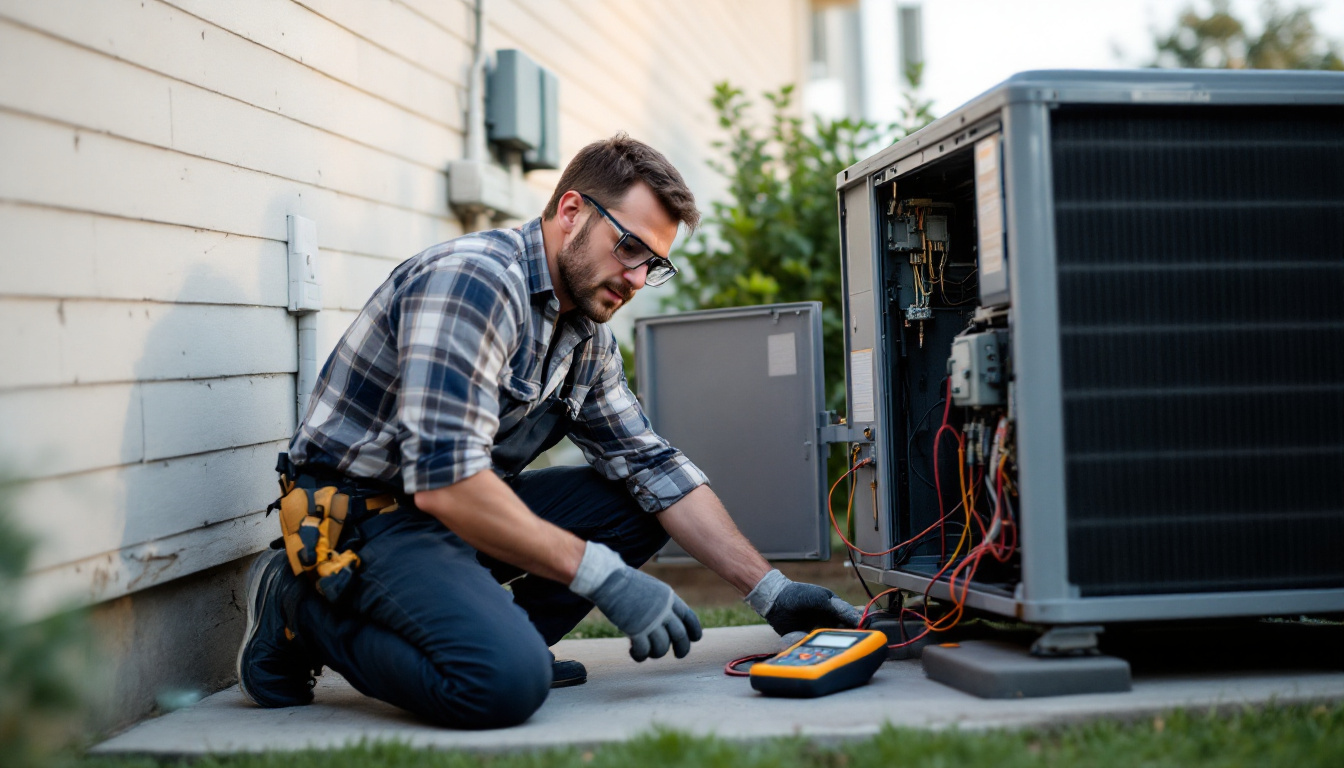
What is an HVAC contactor? It is the electrically operated switch inside your outdoor unit: a 24 volt coil pulls heavy contacts closed so line voltage reaches the compressor and condenser fan motor.
Key Takeaways
- The 1992 DOE Fundamentals Handbook defines a magnetic contactor as “a device operated by an electromagnet”.
- DOE’s Building America Solution Center puts most residential thermostat control circuits at 24 VAC.
- A thermostat set to off is not a disconnect. OSHA 1910.333(b)(2)(ii)(B) bars control devices as “the sole means for deenergizing circuits or equipment”.
- OSHA’s exemption for live work stops at “less than 50 volts to ground” (1910.333(a)(1)).
- The DOE Electrical Safety Handbook cites research that 70 milliamperes through the heart for 5 seconds can fibrillate it.
- BLS counted 130 US workplace deaths from exposure to electricity in 2024, down from 142 in 2023.
What does an HVAC contactor actually do?
It is a remote controlled power switch. The 24 volt control circuit energizes a coil, the coil pulls an iron armature across, and the armature closes heavy contacts that connect line voltage to the compressor and condenser fan motor. Cut the 24 volts and a spring opens them again.
The 1992 DOE Fundamentals Handbook on Electrical Science defines a magnetic contactor as “an electromagnet and a movable iron armature on which movable and stationary contacts are mounted,” and notes that with no coil current “the armature is held away by a spring.”
Two circuits meet at one part: the thin pair that carries the call for cooling, and the line voltage feed running the machinery inside the outdoor cabinet. Nor is it a niche part: EIA’s 2020 survey found 88 percent of US households used air conditioning, two thirds on central AC or a central heat pump.
Single pole or double pole: which HVAC contactor leaves a leg live?
A pole is one set of contacts switching one conductor. A double pole contactor opens both ungrounded legs feeding the compressor. A single pole contactor opens only one, so the second leg stays connected back to the disconnect and stays energized even when the coil drops out and the unit goes silent.
Both designs stop the compressor, because breaking one leg of a two leg supply stops current. Neither makes the cabinet safe. On a single pole unit a terminal inches from your hand sits at line potential while the machine is quiet.
This is why OSHA does not accept a control device as a shutdown. Paragraph 1910.333(b)(2)(ii)(B) requires equipment to be “disconnected from all electric energy sources” and says control circuit devices “may not be used as the sole means for deenergizing circuits or equipment.” A thermostat is a control circuit device. So is the contactor. That is what sets this part apart from most of what fails on an air conditioner.
How does an HVAC contactor fail?
Four ways. The contacts pit and burn from arcing, the contacts weld shut, the coil opens or burns out, or something physical jams the armature. Each produces a different complaint, so describe the symptom precisely.
Arcing causes the first two. Every time the contacts open under load, a small arc erodes metal from the faces. Pitted faces raise resistance, resistance makes heat, heat makes more pitting. A system that cycles more often burns that budget faster, which is why DOE lists electric control failure as a standard air conditioner problem and warns that “your compressor and fan controls could be worn out from having your system turn off and on too frequently.” A burned contactor is often the symptom of something that made the system run badly rather than fail outright.
The fourth mode is biology. The coil is a warm, humming, enclosed space, and some ants colonize exactly that. University of Florida’s entomology extension records that the tawny crazy ant, Nylanderia fulva, “has caused electrical damage to phone lines, air conditioning units and computers,” and reports it from 27 counties of Florida and 27 of Texas.
What symptoms does each contactor fault produce?
Five patterns cover most of it. Note which parts still work, because a 24 volt fault and a line voltage fault look identical from the hallway. If the blower runs and the outdoor unit does nothing, the contactor is a prime suspect, and the same split sorts complaints about warm air or water on the floor.
| Failure mode | What the homeowner notices | What the technician measures |
|---|---|---|
| Pitted or burned contacts | Hums, sometimes starts, cooling comes and goes | Voltage drop across closed contacts, compressor running |
| Welded contacts, stuck closed | Runs with the thermostat off and the blower stopped | Contacts closed with the coil dead; load terminals live |
| Open or burned coil | Never starts, blower normal, no click outside | 24 volts at the coil, no pull in; coil continuity open |
| Chattering coil, weak control voltage | Buzzing or rapid clicking, short cycling, breaker trips | Control voltage under load; transformer output |
| Insects, corrosion or debris | Will not seat or release; grinding or rattling noise | Visual inspection, disconnect open, capacitor discharged |
Treat the welded case as urgent: that compressor runs until somebody opens the breaker.
How does a technician test an HVAC contactor?
Dead checks first, then live measurements. OSHA 1910.334(c)(1) limits testing to qualified persons, and 1910.334(c)(3) requires that test instruments be rated for the circuits they connect to, which is the point of meter category ratings.
- Open the outdoor disconnect, then lock and tag it, as 1910.333(b)(2)(iii)(A) requires for each disconnecting means.
- Release stored energy. Paragraph 1910.333(b)(2)(ii)(C) requires capacitors to be discharged, and treats one being handled as energized.
- Verify dead. Paragraph 1910.333(b)(2)(iv)(B) requires a qualified person to test the circuit elements and confirm they are deenergized.
- Inspect the contact faces and armature; check the coil for continuity, scorching or a melted bobbin.
- Restore power and read coil voltage on a call for cooling. Roughly 24 volts with no pull in points at the contactor; no voltage points upstream.
- Read the voltage drop across each closed pole with the compressor running. A drop means resistance where there should be none.
Step five separates a control fault from a contactor fault. If the 24 volts never arrives the contactor is innocent, and the fault is in the low voltage chain that also causes trouble during a thermostat swap with no common wire.
Why is replacing a contactor a licensed job?
Because the part sits where line voltage waits. OSHA allows live parts to stay energized during work only where they “operate at less than 50 volts to ground.” Load terminals are nowhere near that, the disconnect may still be closed, and the run capacitor inches away can hold a charge after power is cut.
The myth worth correcting
“The thermostat is off, so the outdoor unit is dead” is wrong twice over. The thermostat only removes the 24 volt signal to the coil, and OSHA rules out control devices as a means of deenergizing equipment. On a single pole contactor, one line terminal stays live whenever the disconnect is closed.
Licensing exists for the lockout sequence, not because the part is complicated.
Where does the contactor sit in the sequence of operations?
Third in a six link chain. The thermostat calls, the board and transformer deliver 24 volts, the coil pulls in and the contacts close, line voltage reaches the motors, and the capacitor works once those motors are energized. Knowing the order lets a technician skip four wrong parts.
Capacitor and contactor get confused because they sit side by side and both stop the unit. The contactor decides whether the motors get power; the capacitor shapes how they behave once power arrives. A humming unit that will not spin is usually the capacitor. A silent one with a working blower is usually the contactor or its 24 volt supply.
On a heat pump the fault list is longer because reversing valves and defrost controls join the chain, and on a gas furnace the ignition and safety circuit has to prove itself first.
The part is cheap, so why did the contactor fail?
A contactor is one of the cheapest components in the outdoor unit, so the swap is a small line on the invoice and the diagnosis is the valuable part. Ask what changed the duty cycle: an oversized system, a restricted filter, a low charge or a failing capacitor all add make and break events to the same contacts. No federal price series covers contactor replacement, which is why we publish what is actually measured about repair costs, and why bad cycling shows up in your electricity bill first.
How we researched this
Research conducted September 2026. Every figure and quoted phrase comes from one of the nine sources listed below, each opened for this article: two OSHA standards, three DOE publications, BLS, EIA and one University of Florida IFAS Extension publication.
Reddit was skipped entirely: this is an electrical safety topic, and anonymous accounts of what somebody jumped across a contactor are neither verifiable nor safe to restate. No manufacturer literature, contractor blog or lead generation site was used for any number. All installed prices were excluded, because no federal or national lab series publishes one. Contact ratings and service life vary by model, so we describe mechanisms rather than assign figures.
Frequently asked questions
Can I replace an HVAC contactor myself?
Treat it as licensed work. OSHA 1910.334(c)(1) limits testing on electric circuits to qualified persons, and 1910.333(b)(2) sets a lockout sequence that includes discharging capacitors and verifying the circuit is dead with rated test equipment.
Why does my outdoor unit keep running with the thermostat off?
That is the classic welded contactor. The contacts fused shut, so line voltage reaches the compressor whether or not the coil is energized. Open the outdoor disconnect or the breaker and book a technician: a compressor running with no indoor airflow risks damage beyond the contactor.
Is a contactor the same thing as a relay?
Same principle, different duty. The DOE Fundamentals Handbook describes a magnetic contactor as a device operated by an electromagnet whose coil pulls an armature to close the contacts. A contactor is a relay built for motor loads, so contacts and coil are sized for compressor current.
Can ants really destroy a contactor?
Yes. University of Florida IFAS Extension records that the tawny crazy ant has caused electrical damage to air conditioning units, and reports it from 27 counties of Florida and 27 of Texas. Ants jamming or bridging contacts is a recognized failure, not folklore.
Should the capacitor be replaced at the same time?
Not automatically. They are separate parts with separate tests: the capacitor against its rated microfarad value, the contactor against coil voltage and voltage drop across the closed contacts. Ask for the measured capacitor reading rather than a blanket swap.
What voltage should I measure at the contactor coil?
You should not be measuring it. For context, the DOE Building America Solution Center puts most residential control circuits at 24 VAC, so a technician looks for roughly that at the coil during a call for cooling, standing next to live line voltage terminals.
Sources
- U.S. Department of Energy. “Electrical Science, Volume 4 (DOE-HDBK-1011/4-92).” https://www.energy.gov/sites/default/files/2026-04/DOE-HDBK-1011-92_VOL4.pdf. Accessed September 2026.
- OSHA. “29 CFR 1910.333, Selection and use of work practices.” https://www.osha.gov/laws-regs/regulations/standardnumber/1910/1910.333. Accessed September 2026.
- OSHA. “29 CFR 1910.334, Use of equipment.” https://www.osha.gov/laws-regs/regulations/standardnumber/1910/1910.334. Accessed September 2026.
- U.S. Department of Energy. “Electrical Safety (DOE-HDBK-1092-2013).” https://www.energy.gov/sites/default/files/2026-04/DOE-HDBK-1092-2013.pdf. Accessed September 2026.
- U.S. Bureau of Labor Statistics. “Fatal occupational injuries by event, 2023-24.” https://www.bls.gov/news.release/cfoi.t02.htm. Accessed September 2026.
- DOE Building America Solution Center. “Determine if a Smart Thermostat is Right for You.” https://basc.pnnl.gov/diy-guides/determine-if-smart-thermostat-right-you. Accessed September 2026.
- U.S. Department of Energy. “Home Cooling 101.” https://www.energy.gov/sites/prod/files/HomeCooling101-final.pdf. Accessed September 2026.
- U.S. Energy Information Administration. “Nearly 90% of U.S. households used air conditioning in 2020.” https://www.eia.gov/todayinenergy/detail.php?id=52558. Accessed September 2026.
- University of Florida IFAS Extension. “Tawny Crazy Ant (EENY-610).” https://edis.ifas.ufl.edu/in1071. Accessed September 2026.
Leave a Reply