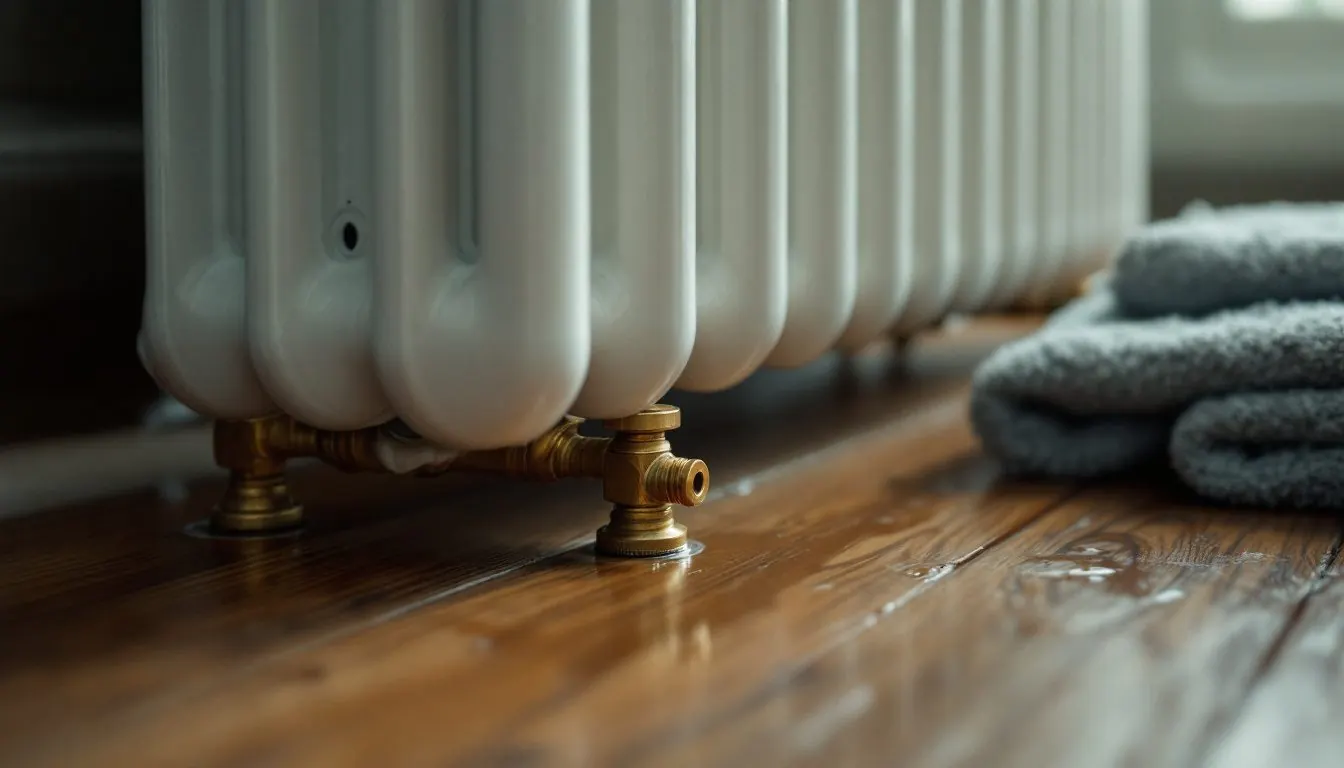
A radiator valve leaking water almost always leaks at one of 4 points: the packing nut under the handle, the union nut joining valve to radiator, the spud thread into the radiator, or the pipe thread below. Stem leaks usually stop with a small packing nut adjustment; the other 3 need the radiator isolated or drained first.
Where is the radiator valve leaking: top, pin, bottom nut or the pipe?
Dry every joint, run the heat for 10 minutes, then hold a dry tissue against each joint in turn; the first one that darkens is the leak. Water runs down the valve, so a drip at the bottom nut often starts at the packing nut 3 inches higher.
| Where the water shows | What is leaking | First fix | Isolate or drain first? |
|---|---|---|---|
| A: top, under the handle or spindle | Stem packing on a multi-turn valve | Snug the packing nut; repack with graphite string if that fails | To repack, yes (hot water); steam: boiler off and cool |
| A on a TRV: around the pin | Gland seal (Danfoss code 013G0290 on RA-N and RA2000 bodies) | New gland, 10 mm wrench, max 10 Nm | No: replaceable in operation at 30°C (86°F) flow |
| B: bottom nut between the valve and the radiator | Union seat between valve body and spud | Clean the faces, realign, torque | Yes on hot water; on steam, boiler off and cool |
| C: where the spud enters the radiator | Spud thread in the radiator bushing | Spud wrench out, reseal or replace | Yes: the radiator must be empty |
| D: pipe thread or solder joint below the valve | Supply pipe connection | Reseal or resolder | Yes, below that point |
| Crust on the casting itself | Cracked or corroded brass | Replace the valve | Yes |
Compiled by The HVAC Brief from Danfoss instructions 013R9131 and 013R9055, the Danfoss torque instruction and the Emerson Hancock valve manual.
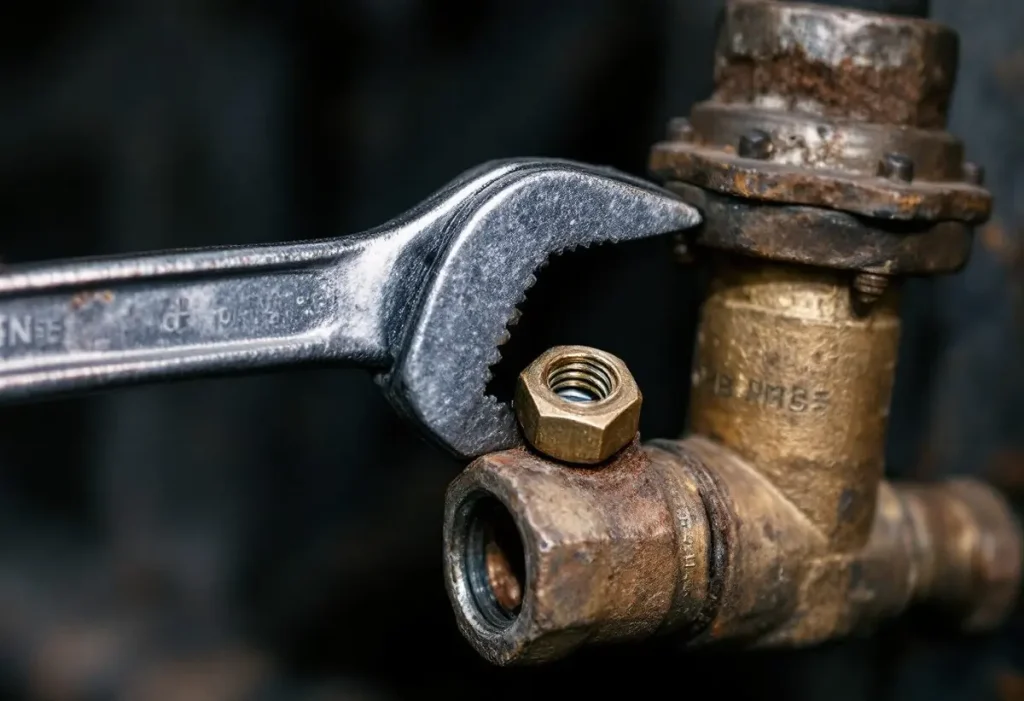
Leaking from the spindle or top: will tightening the packing nut stop it?
Usually, on an older multi-turn valve: open it fully, turn the packing nut clockwise a fraction of a turn, work the handle, and stop when the weep stops.
Emerson’s Hancock manual for industrial globe valves describes the same routine: tighten the gland a little, cycle the handwheel 1/2 turn each way, and back the nut off 1/4 turn if the stem binds. The aim is “to tighten the packing a minimum amount to prevent leakage.”
If the nut has run out of thread, the packing is used up. Repacking means removing the nut, winding graphite packing string around the stem in the direction the nut tightens, and refitting it. Hancock is blunt: “Do not repack valve while valve is in service.” On hot water, that means both radiator valves closed and pressure released at the bleed screw; on steam, the boiler off and the radiator cold. A stem that hisses rather than drips belongs to the steam radiator hissing diagnosis.
Leaking from the pin on a thermostatic valve: can the gland be swapped without draining?
On Danfoss RA-N, RA-IN, RA-FN and RA2000 bodies, yes: instruction 013R9131 says the 013G0290 gland seal “can be replaced during operation,” with the flow temperature lowered to 30°C (86°F) and a leak check after.
Pull the head off, unscrew the old gland around the pin with a 10 mm wrench, and fit the new one to no more than 10 Nm, which we calculated as 7.4 lbf·ft: hand tight plus a nudge. Danfoss guide 013R9055 recommends replacing the gland “after several years” and warns that mineral oils must not touch the EPDM parts, so skip penetrating oil on a sticky pin. A pin that is stuck rather than wet is covered in our thermostatic radiator valve not working guide.
Leaking from the bottom nut: why does the union between valve and spud weep?
The bottom nut is a union, and the nut does not seal: the matching faces of the spud and valve body do. It weeps when those 2 faces are dirty, scratched or pulled together out of line, so cranking the nut harder often just distorts it.
With the radiator isolated or drained, loosen the union, clean both faces with a nylon pad, check that the spud lines up without forcing the radiator sideways, and retighten to the maker’s torque (Danfoss figures below). If the leak is at point C, the spud has to come out with a spud wrench, the tool Danfoss guide 013R9055 specifies; its RA2000 hot water kit ships with its own tailpieces and union nuts, so replace valve and spud as a pair.
| Danfoss connection size | Tailpiece/union torque (Nm) | Same torque in lbf·ft |
|---|---|---|
| DN10 (3/8 in) | 40 to 60 | 30 to 44 |
| DN15 (1/2 in) | 60 to 90 | 44 to 66 |
| DN20 (3/4 in) | 80 to 120 | 59 to 89 |
| Gland seal (any size) | 10 max | 7.4 max |
HVAC Brief calculation: Danfoss Nm values × 0.7376 = lbf·ft, rounded. Applies to the Danfoss valve families listed in its instruction; other makers publish their own figures.
The DN15 union minimum is 6 times the gland maximum: a wrench sized for the union will strip a gland, and a gland-sized nudge will not seal a union.
Why does the radiator valve leak when switched off or only half open?
Many multi-turn valves seal best at the stops. Industrial globe valves use a backseat: fully open, the stem seats against the bonnet, which is why the Emerson Hancock manual (section 2.3) says a valve whose packing leak cannot be stopped “should be firmly backseated.”
On one-pipe steam, a half-open valve is a fault in itself. The U.S. DOE Building America steam guide says radiator valves “should always be completely open or completely closed,” and Peerless’s one-pipe guide adds: “Do not throttle the valve. This will restrict condensate flow and cause hammer in the radiator.” Open it fully before judging a steam valve leak; our radiator heating repair guide covers the cold radiator that sends people to the valve in the first place.
Steam or hot water: which one can you work on with just the heat turned off?
Steam, usually; hot water, no. DOE puts one-pipe steam at ½ to 1½ psig while running, and “as the radiators cool, the air vents open and allow air to re-enter the system,” so a cold steam radiator is at room pressure.
A hot water loop stays pressurized with the burner off: Burnham’s ES2 manual fills it “until the pressure gauge reads 12 psi.” If the leak dropped the gauge, read our boiler pressure guide before refilling; on steam, a leaking valve shows up as frequent adding water to the steam boiler.
To isolate a hot water radiator, close the supply valve (Danfoss recommends its RA2000 TRV on the supply side), then the lockshield on the other end, counting its turns so the balance can be restored. Open the bleed screw over a cup: if the dribble stops within 2 minutes, both valves hold; if not, one is passing and the system must be drained below that radiator.
Radiator valve leaking after removing the radiator: how do you make it safe?
With the radiator gone, the valve outlet is an open pipe end held shut only by the valve seat, and on a 12 psi hot water loop an old seat that passes even slightly will drip indefinitely.
Close the valve, cap or plug the outlet, and check it after the next 2 heating cycles. If it will not shut off, close the boiler fill valve, drain below the valve and cap the pipe. On steam, never fire the boiler until the open valve is capped, or it will vent steam into the room.
Is a cracked or green, crusted valve body a replace-not-repair job?
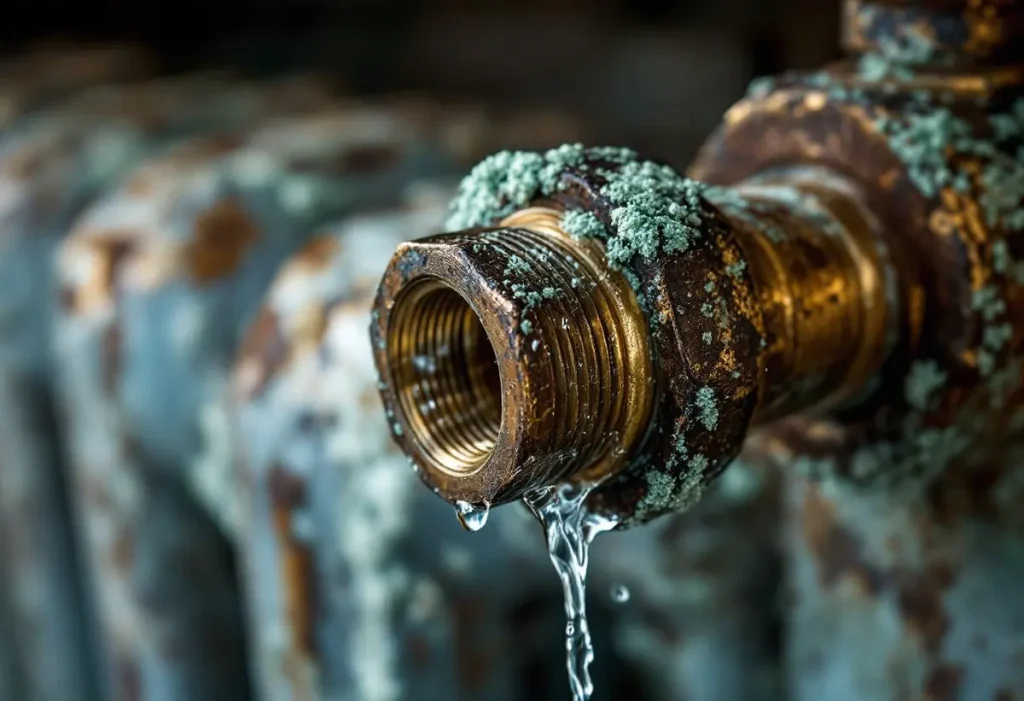
Yes. Crust on the casting itself, away from the 4 joints, means water is seeping through the metal, and no nut adjustment fixes a casting.
Danfoss guide 013R9055 names one cause: brass exposed to water treatment agents above its limits, such as chloride above 20 mg/l, or a pH above 9.5, can be damaged “allowing the heating fluid to escape, possibly scalding any bystanders.” Green deposits at a joint are more often dried residue from a weep at that joint. Water pooling under the boiler instead is covered in our boiler leaking water locator.
Stop and call when the leak is hot or spraying, or the casting is cracked. The technician will isolate or drain the zone, check fill pressure against the boiler manual (12 psi on a Burnham ES2), replace valve and spud as a pair, and leak test before refilling.
Frequently asked questions
Why is water coming out of my radiator valve?
Water escapes at a seal: worn stem packing or a TRV gland at the top, a dirty or misaligned union at the bottom nut, or a failed spud or pipe thread. On hot water it leaks even with the heat off, because the system stays at a fill pressure such as the 12 psi Burnham specifies for its ES2 boiler.
Is a radiator valve leaking green a sign it needs replacing?
Not always. Green crust at a joint is usually dried residue from a slow weep there, and retightening or resealing that joint fixes it. Crust on the casting itself means the brass is failing; Danfoss warns that brass attacked by aggressive water, such as a pH above 9.5, can let heating fluid escape. Replace that valve.
How much does it cost to replace a radiator valve?
No federal or national lab source publishes an installed price, so we do not quote one. The labor driver is draining: a Danfoss gland seal (013G0290) can be swapped in operation in minutes, while a union, spud or body leak on hot water needs the system isolated or drained and refilled to fill pressure, such as 12 psi on a Burnham ES2.
What to do if a radiator valve is leaking right now?
Put a container and towel under it, open the valve fully (on many valves that backseats the stem), and snug the packing nut a fraction of a turn if the leak is at the top. If water is coming from the bottom nut on a hot water system, close the supply valve and lockshield and open the bleed screw to relieve pressure at that radiator until it can be resealed.
How we researched this
We read Danfoss instructions 013R9131 (gland seal) and 013R9055 (RA2000), the Danfoss tailpiece torque instruction and RA2000 hot water instruction, the U.S. DOE Building America steam measure guideline (2013), the Peerless one-pipe steam guide, the Burnham ES2 manual and Emerson’s Hancock valve manual (industrial globe valves, cited for principle only). Contractor blogs, forums and video were excluded for every number, and we give no “1/8 turn” packing figure because no maker document we opened states one. Torque conversions are our calculation. Research date: November 21, 2026.
Sources
- Danfoss. “Instruction 013R9131: Gland Seal 013G0290, RA-N, RA-IN, RA-FN” (copy hosted by Hornbach). https://media.hornbach.ch/hb/installationmanual/as.178544542.pdf. Accessed November 2026.
- Danfoss. “Installation Guide 013R9055: RA 2000 Valves, Thermostatic control valves for hot water and 2-pipe low pressure steam systems” (copy hosted by The Granite Group). https://s3.amazonaws.com/thegranitegroup/thegranitegroup/content/121178_DANFOSINST00013.pdf. Accessed November 2026.
- Danfoss. “Mounting Danfoss Radiator Valves” (tailpiece/union nut torque instruction). https://assets.danfoss.com/documents/latest/163310/AB372026762399en-010101.pdf. Accessed November 2026.
- Danfoss. “Installation RA2000 Thermostatic Radiator Valve: Instructions For 2-Pipe Hot Water Applications.” https://assets.danfoss.com/documents/47250/AN000086406172en-010201.pdf. Accessed November 2026.
- Emerson. “Hancock Forged Steel Gate, Globe and Check Valves: Installation, Operation and Maintenance.” https://www.emerson.com/is/content/emerson/en/final-control/flow-controls/documents/manual-forged-steel-gate-globe-and-check-valves-iom-hancock-en.pdf. Accessed November 2026.
- U.S. Department of Energy, Building America. “Measure Guideline: Steam System Balancing and Tuning for Multifamily Residential Buildings” (Choi, Ludwig and Brand, 2013). https://www1.eere.energy.gov/buildings/publications/pdfs/building_america/measure_guide_steam_system_balancing.pdf. Accessed November 2026.
- Peerless Boilers. “One-Pipe Steam Systems: Piping and Troubleshooting” (training guide CHOS396). https://www.peerlessboilers.com/wp-content/uploads/2018/01/OnePipeSteam.pdf. Accessed November 2026.
- Burnham (U.S. Boiler Company). “ES2 Installation, Operating and Service Instructions.” https://res.cloudinary.com/dzhpkjoqj/US%20Boiler%20%2D%20Burnham/ES2_IO_Manual_ht4xvg.pdf. Accessed November 2026.
Leave a Reply