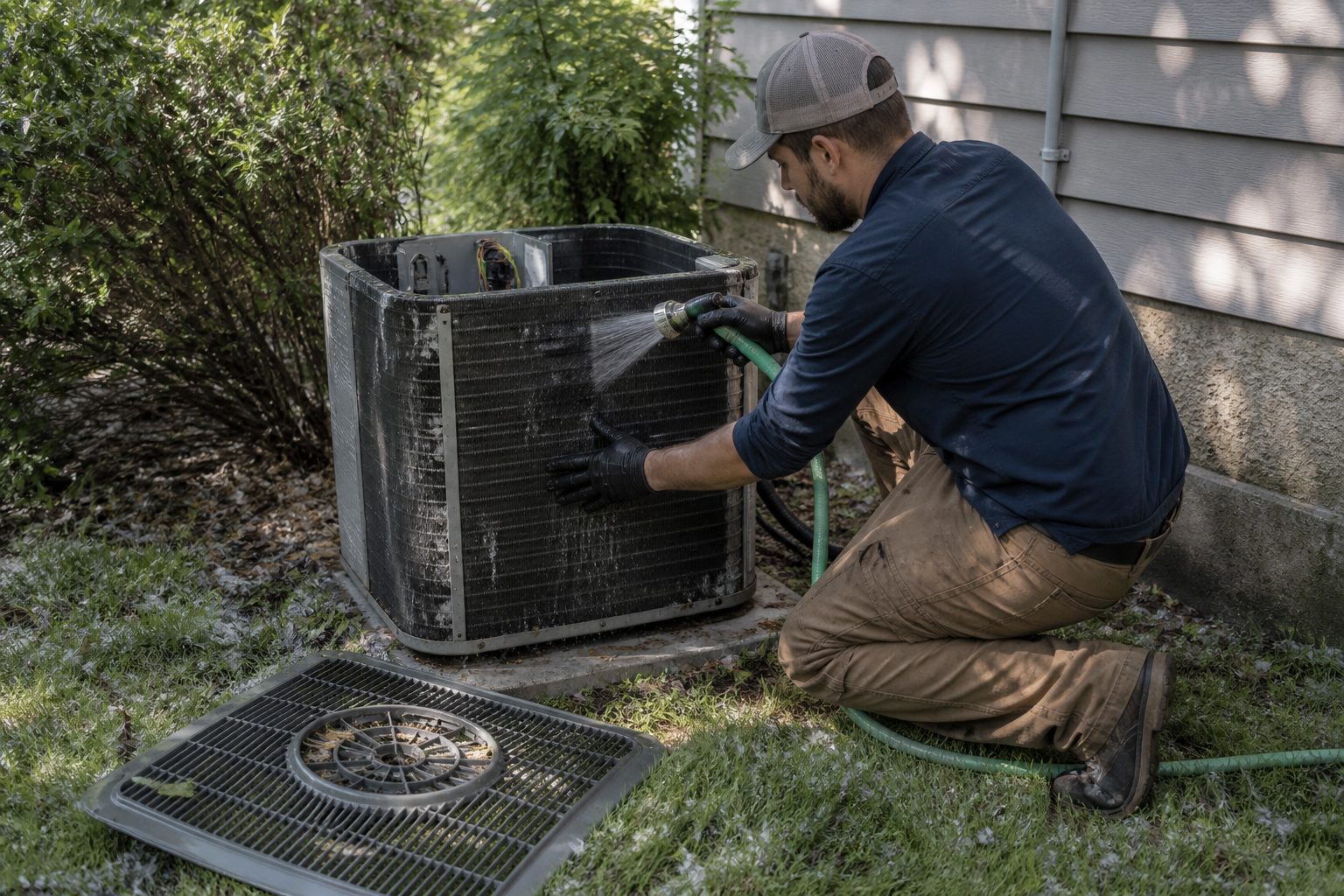
What does AC coil cleaning involve? Two different jobs. The outdoor condenser coil is a garden-hose rinse an owner can do with the power off. The indoor evaporator coil sits wet inside a sealed cabinet above a live blower, and it is a technician’s job.
Key Takeaways
- Lawrence Berkeley National Laboratory modeled a typical evaporator coil doubling its clean pressure drop in about 7.5 years, against a 15 to 30 year life.
- At that level LBNL puts airflow loss at 5% to 10% and efficiency and capacity loss at 2% to 4%, below most marketing claims.
- ENERGY STAR lists cleaning both coils as a contractor task and says airflow problems cut efficiency by up to 15 percent.
- DOE tells owners to trim foliage back at least two feet from the outdoor unit.
- A MERV 12 filter multiplied modeled fouling time by about seven versus MERV 2. EPA bars coil disinfectant use unless HVAC use is on the label.
Why does AC coil cleaning mean two different jobs?
Because a split system has two coils doing opposite work in opposite places. The outdoor condenser coil rejects heat to outside air and gets dirty from the outside in. The indoor evaporator coil absorbs heat from house air, runs wet, and collects what the filter misses.
The outdoor coil is a wall of aluminum fins wrapped around the cabinet. Cottonwood seed, grass clippings and dryer lint mat onto the outside face, which is why the debris is visible and why a rinse reaches it. Our explainer on what the outdoor unit does covers the rest of that cabinet.
The evaporator coil is the opposite problem. It sits in the air handler or furnace plenum condensing water whenever the compressor runs, so dirt sticks. A coil that failed rather than fouled is a separate decision, covered in our piece on replacing an evaporator coil.
What does a dirty coil actually cost in capacity and efficiency?
Less than the sales pitch claims, until it is badly fouled. The best public measurement is a Lawrence Berkeley National Laboratory paper from the 2002 ACEEE Summer Study, which modeled particle deposition on evaporator coils.
Once fouling has doubled the clean coil pressure drop, LBNL reports pressure drop at the fouled flow up about 40%, airflow down 5% to 10%, and efficiency and capacity down 2% to 4%. The authors call that “a relatively modest decrease in performance.” It holds only if airflow was correct to begin with, and LBNL notes low airflow is common in real houses, measured against the 400 cfm per ton rule.
Ignore it longer and the curve steepens. LBNL projects that after twice the fouling time, pressure drop has risen fourfold, giving airflow reductions of 10% to 20% and degradation of 5% to 15%. ENERGY STAR states that “Airflow problems can reduce your system’s efficiency by up to 15 percent.”
How do you do outdoor AC coil cleaning safely?
Kill the power first, then rinse from the inside out with a garden hose at ordinary pressure. The fins are roughly foil thickness, and the two ways owners wreck a condenser are too much pressure and water where the wiring is.
- Switch off at the thermostat, open the outdoor disconnect beside the unit, and pull the fuse block or throw the breaker. Confirm the fan does not spin.
- Clear the space. DOE says “Outdoor condenser coils can become very dirty, especially in dusty environments or if there is foliage nearby,” and tells owners to trim foliage back at least two feet.
- Brush or vacuum the loose mat of lint and clippings off the fins first, because wet debris turns to paste.
- Remove the top grille if the fasteners allow, so the hose reaches the inside of the coil, supporting the fan rather than letting it hang on its wiring.
- Rinse from inside the cabinet outward, top to bottom, so water pushes dirt back out the way it came in. Trane’s guidance is not to “use the jet setting or a power washer as the force of the water can bend or damage the fins.”
Pressure washing is the one mistake you cannot undo
Bent fins do not spring back. DOE notes that “The aluminum fins can bend and block airflow, reducing the efficiency of your system,” and straightening them is a fin comb job. High pressure also drives debris deeper into the coil, the failure mode LBNL flags when it says “it is unclear whether coil cleaning always removes deposited material, rather than just pushing it deeper into the coil.”
Why is indoor evaporator coil cleaning a technician job?
Because access means opening a cabinet sealed at installation, and the coil usually sits above or beside a blower on a live circuit. Panels are screwed and taped, the drain pan is in the way, and refrigerant lines are brazed on.
DOE stops short of assigning it to owners. Its guidance says maintenance from a qualified HVAC contractor “should include inspecting the coil and clean it as necessary to maintain proper airflow and heat absorption.” ENERGY STAR files it under a contractor check-up, alongside measuring airflow across the coil, as our breakdown of a real tune-up sets out.
A coil condensing water all summer also grows biological material, not just dust, which LBNL flagged separately from the energy penalty, and is why the drain and pan matter.
| Part | What dirt does to it | Who cleans it | Source |
|---|---|---|---|
| Outdoor condenser coil | Blocks the air carrying heat away, so head pressure and compressor power rise | Owner rinse, power off | DOE Energy Saver |
| Indoor evaporator coil | Raises pressure drop, cuts airflow, reduces heat absorption | Qualified HVAC contractor | DOE and ENERGY STAR |
| Coil fins, either coil | Bend flat and block airflow, which washing does not fix | Contractor, fin comb | DOE Energy Saver |
| Air filter | Passes particles to the coil once loaded; bypass lets them around it | Owner, monthly | ENERGY STAR and LBNL 2002 |
Which coil cleaning chemicals are allowed on an AC coil?
Plain water handles most outdoor coil dirt. Where chemistry is used, the split is between mild alkaline foaming cleaners for the wet indoor coil and stronger acidic brightening products for packed outdoor coils.
The federal line is narrower than most labels imply. If a coil cleaner also claims to kill mold, bacteria or viruses, EPA regulates it as a pesticide, and states that directions for use of registered sanitizers and disinfectants “do not include use on or in HVAC&R components or surfaces unless such HVAC&R use is specifically included on the label.” A disinfectant registered for hard surfaces is not automatically legal in an air handler, and no federal test data compares brands.
How often does AC coil cleaning actually need doing?
Once a year for the outdoor coil, tied to the spring visit, and on inspection indoors. ENERGY STAR’s position is to keep the system at peak performance “by having a contractor do annual pre-season check-ups,” and its cooling list includes cleaning both coils.
LBNL’s modeled fouling time of about 7.5 years is a reality check against a yearly indoor coil cleaning upsell. It is also why the paper argues for inspection with airflow measurement rather than blind cleaning, noting that “Coil cleaning is not a routine part of maintenance in residential systems.”
The filter decides how fast the evaporator coil fouls
Filter choice moved modeled fouling time more than any other variable. A MERV 12 filter in place of a MERV 2 increased fouling time by a factor of about seven on average in the LBNL simulation, and bypass around a loose filter partly cancelled that gain.
DOE describes the mechanism plainly: “When airflow is obstructed, dirt can bypass the filter and accumulate on the evaporator coil, reducing its heat-absorbing capacity.” ENERGY STAR’s owner task is to “Inspect, clean, or change air filters once a month.” Higher MERV is not automatically right once pressure drop is counted, as we show in MERV ratings and airflow and in our overview of filter types.
Signs the dirt is the problem, not the charge or the airflow
A fouled coil gives a slow seasonal decline in cooling with normal airflow at the registers, the opposite of a refrigerant or duct fault. Three patterns separate them.
- Dirty outdoor coil: long cycles on the hottest afternoons, unusually hot air off the top of the condenser, and a matted fin face. It still cools on mild days.
- Dirty indoor coil or loaded filter: weak airflow at the registers, a decline that tracks filter neglect, and a coil that can ice over, the pattern behind an AC that freezes up.
- Charge or leak problem: performance falls with no visible dirt, often with frost on the line at the indoor coil. That is a gauges-and-license question, as our primer on refrigerant explains.
If air moves but is not cold, our sort for a system running without cooling is faster. If airflow is weak house-wide, the ducts are the likelier suspect, and static pressure settles it in ductwork and airflow.
How we researched this
Research date: September 2026. Cited: the LBNL paper “Dirty Air Conditioners: Energy Implications of Coil Fouling” (Siegel, Walker and Sherman, ACEEE Summer Study, 2002), the ENERGY STAR maintenance checklist, the DOE Energy Saver air conditioner maintenance page (an archived copy, because the live URL now redirects to a 404), and EPA guidance on disinfectants in HVAC systems. NIST Technical Note 1848 was read for context but is not cited for a figure.
Excluded: contractor blog claims that dirty coils cost 30% or more, because no federal or national-lab source supports a penalty that size. Excluded: coil cleaner brand efficacy claims and coil cleaning prices, because no federal data covers either. An ARTI filtration report on OSTI could not be retrieved, so nothing from it is cited. Reddit was not mined, because the procedure involves electrical disconnection. The hose pressure and fin guidance is Trane manufacturer guidance.
Frequently asked questions
Can I clean the outdoor AC coil myself?
Yes, with the power off at the outdoor disconnect and an ordinary garden hose. DOE already assigns owners the job of keeping the area around the condenser clean and trimming foliage back at least two feet. Call a contractor if fins are bent.
Should I clean the indoor evaporator coil myself?
Generally no. DOE assigns evaporator coil inspection and cleaning to a qualified HVAC contractor. Access means opening a sealed cabinet, working around the drain pan and brazed refrigerant lines, and reaching over a blower on a live circuit.
How much efficiency does a dirty coil really cost?
Once fouling has doubled the clean coil pressure drop, LBNL’s 2002 analysis puts efficiency and capacity loss at 2% to 4%, with airflow down 5% to 10%. Left twice as long, projected degradation rises to 5% to 15%. Low-airflow systems lose more.
Can I pressure wash an AC coil?
No. Trane’s residential guidance says not to “use the jet setting or a power washer as the force of the water can bend or damage the fins.” DOE notes bent aluminum fins block airflow and reduce efficiency. Straightening them is a fin comb job.
How often should AC coil cleaning be done?
ENERGY STAR ties coil cleaning to an annual pre-season check-up, cooling checked in spring. The outdoor coil may need a rinse twice a season in a cottonwood-heavy yard. Clean the indoor coil on inspection: LBNL modeled about 7.5 years to significant fouling.
Will cleaning a coil make an old system cool like new?
Rarely. LBNL cautions that “it is unclear whether coil cleaning always removes deposited material, rather than just pushing it deeper into the coil.” If cooling is well below what the system once delivered, measure airflow and charge.
Sources
- Siegel, J., Walker, I., and Sherman, M. “Dirty Air Conditioners: Energy Implications of Coil Fouling.” Lawrence Berkeley National Laboratory, ACEEE Summer Study, 2002. https://www.aceee.org/files/proceedings/2002/data/papers/SS02_Panel1_Paper23.pdf. Accessed September 2026.
- ENERGY STAR. “Maintenance Checklist.” https://www.energystar.gov/saveathome/heating-cooling/maintenance-checklist. Accessed September 2026.
- US Department of Energy. “Air Conditioner Maintenance,” Energy Saver, archived copy. https://web.archive.org/web/2025id_/https://www.energy.gov/energysaver/maintaining-your-air-conditioner. Accessed September 2026.
- US Environmental Protection Agency. “Use of Disinfectants and Sanitizers in Heating, Ventilation, Air Conditioning, and Refrigeration Systems.” https://www.epa.gov/pesticide-labels/use-disinfectants-and-sanitizers-heating-ventilation-air-conditioning-and. Accessed September 2026.
- Trane. “How to Clean Condenser Coils.” https://www.trane.com/residential/en/resources/troubleshooting/air-conditioners/how-to-clean-condenser-coils/. Accessed September 2026.
Leave a Reply