Why does my AC keep tripping the breaker? When an AC keeps tripping breaker after reset, the device is working: it sensed more current than it will safely pass on a 240 volt circuit. It is rarely a bad breaker, and resetting it again is the one genuinely dangerous response.
Key Takeaways
- OSHA at 29 CFR 1910.334(b)(2): “the repetitive manual reclosing of circuit breakers or reenergizing circuits through replaced fuses is prohibited.”
- USFA estimated 23,700 residential building electrical malfunction fires in 2023, with 305 deaths and $1,501,600,000 in property loss.
- Electrical failure was a contributing factor in 88 percent of residential building electrical fires, 2014 to 2016 (USFA).
- An AC breaker is already sized above running current: NEC 440.22(A), as restated by inspectors, caps it at 175 percent of rated load amps.
- Timing is the diagnosis: an instant trip, a trip 2 seconds after start, and a trip 10 minutes in are three different faults.
What is happening when your AC keeps tripping the breaker?
A breaker is a current sensor with a switch attached. It opens on an overload, meaning current above its rating held too long, or on a short circuit or ground fault, a spike within a fraction of a cycle. Both mean the conductor is carrying heat it was not sized for.
OSHA at 29 CFR 1910.303(b)(5) requires protective devices and circuit ratings to be “selected and coordinated to permit the circuit protective devices used to clear a fault to do so without extensive damage.” Your breaker is the last line in that chain, and it just fired.
The CPSC’s Guide to Home Wiring Hazards calls breakers “safety devices located on your electrical panel to prevent overloading and fires,” and treats one appliance that repeatedly trips as evidence of a defect that could cause fire or shock. If the system is dead instead, start with a system that will not switch on.
Why is the AC on a double pole 240 volt breaker?
A central compressor runs across both hot legs of a residential service, so it needs a breaker that opens both at once. That is a double pole breaker, shown in the CPSC guide alongside single pole and ground fault types.
Its rating comes off the nameplate, which OSHA requires to carry “voltage, current, wattage, or other ratings as necessary” under 1910.303(e)(1). An outdoor unit lists minimum circuit ampacity, a maximum fuse or breaker size, rated load amps, and locked rotor amps, the current drawn at the instant of start before the rotor turns.
An International Association of Electrical Inspectors explainer gives the arithmetic: minimum ampacity is rated load amps times 1.25 plus other loads, and the maximum breaker figure is based on 175 percent of rated load amps under NEC 440.22(A). We link that restatement because the code text is not freely readable. For running figures, see what an air conditioner actually draws.
Is the AC tripping the breaker on startup or after it runs?
This question splits the fault list in half. A trip inside the first two or three seconds is a starting problem, because that is the only window in which the compressor pulls locked rotor current. A trip five to twenty minutes in is a heat problem, because that is how long pressures and windings take to climb.
Starting trips trace to three things. A weak start or run capacitor cannot deliver the phase shift the motor needs, so the compressor stays in locked rotor instead of accelerating out. A contactor with pitted contacts arcs instead of making cleanly. A seized compressor never leaves locked rotor.
Running trips are about rejected heat. A fouled condenser raises head pressure, so compressor amp draw rises with it. DOE guidance notes that outdoor coils “can become very dirty, especially in dusty environments or if there is foliage nearby” (archived copy). See cleaning an AC coil and what the condenser does.
Indoor airflow does the same from the other side. NIST’s Technical Note 1848 measured a heat pump in heating mode at 47 degrees Fahrenheit with airflow cut 50 percent: COP fell by over 30 percent and total power rose by more than 20 percent. More power at fixed voltage is more amps. A restricted filter or undersized duct is the usual cause, which is why the airflow target per ton matters here. If the coil ices instead, read why an AC freezes up.
| When it trips | Most likely fault | Confirming measurement |
|---|---|---|
| Instantly, every reset | Dead short or ground fault in compressor windings, whip or disconnect | Insulation resistance to ground, winding to winding resistance |
| 1 to 3 seconds after start | Failed capacitor, pitted contactor, locked compressor | Capacitance in microfarads, inrush amps against nameplate locked rotor amps |
| 5 to 20 minutes into a cycle | Fouled condenser coil, low indoor airflow, failing fan motor | Running amps against rated load amps, temperature split, static pressure |
Which faults trip the breaker instantly, every time?
A breaker that opens the instant the handle closes, with nothing calling, is reporting a dead short or a ground fault. Thermal overload takes seconds to minutes. Magnetic trip on a short circuit takes a fraction of a cycle, so the handle will not stay up.
On an air conditioner the usual location is the compressor. Its windings sit inside the shell in refrigerant and oil, and failed insulation can short winding to winding or winding to shell. USFA found short circuit arc from defective or worn insulation was a contributing factor in 11 percent of residential building electrical fires, 2014 to 2016. A shorted compressor is a replacement decision, not a repair.
Wiring is the other candidate: a whip chafed on a sharp edge, rodent damage, or water standing in the disconnect. A technician disconnects the compressor leads at the contactor and retests. If the breaker then holds, the fault is in the compressor.
Can a loose lug at the disconnect cause the AC to keep tripping the breaker?
Yes, and it is the fault most often missed because it hides in a box nobody opens. Every outdoor unit is fed through a disconnect within sight of the equipment, and its screw terminations carry full compressor current. A lug never torqued correctly, or corroded in coastal air, adds resistance where current is highest.
Resistance under load makes heat, and heat makes the joint worse. A CPSC staff review lists “Arc heating at a series arcing fault,” with a “loose electrical connection” as an example, among the heat sources that decompose conductor insulation. DOE guidance puts “inspect electric terminals, clean and tighten connections” on the service checklist.
The tell is physical: discolored insulation, a hot plastic smell, a lug that turns under a screwdriver, or a breaker warmer than its neighbors. None of it shows up at the thermostat.
Why an oversized breaker is a fire risk, not a fix
The conductor is the part you cannot upgrade from the panel. It has a fixed ampacity, and the scheme assumes the device ahead of it opens before the insulation cooks. Fit a bigger breaker and the conductor sits unprotected between the two ratings.
The U.S. Fire Administration counted 23,700 such fires in 2023. Risk runs higher in “homes more than 40 years old that have older wiring, electrical systems, and devices.”
The one thing not to do
The IAEI explainer is explicit that the panel device “protects the conductors from a short circuit or a ground fault,” while “the conductors are protected from overload by the running overcurrent device” inside the equipment. Exceed the nameplate maximum and nothing watches for a slow overload. The CPSC guide says it plainly: “Do not put in a higher ampere fuse or circuit breaker.”
How dangerous is it to keep resetting the breaker?
Dangerous enough that federal rules prohibit it. OSHA at 29 CFR 1910.334(b)(2) states a circuit “may not be manually reenergized until it has been determined that the equipment and circuit can be safely energized,” and that repetitive manual reclosing is prohibited.
Each reclose pushes fault current back through a compromised conductor or winding, adding arc energy to insulation that is already failing. USFA data show where that leads: an unspecified short circuit arc contributed to 23 percent of residential building electrical fires, and wire or cable insulation was the item first ignited in 31 percent. A breaker that will not hold means stop.
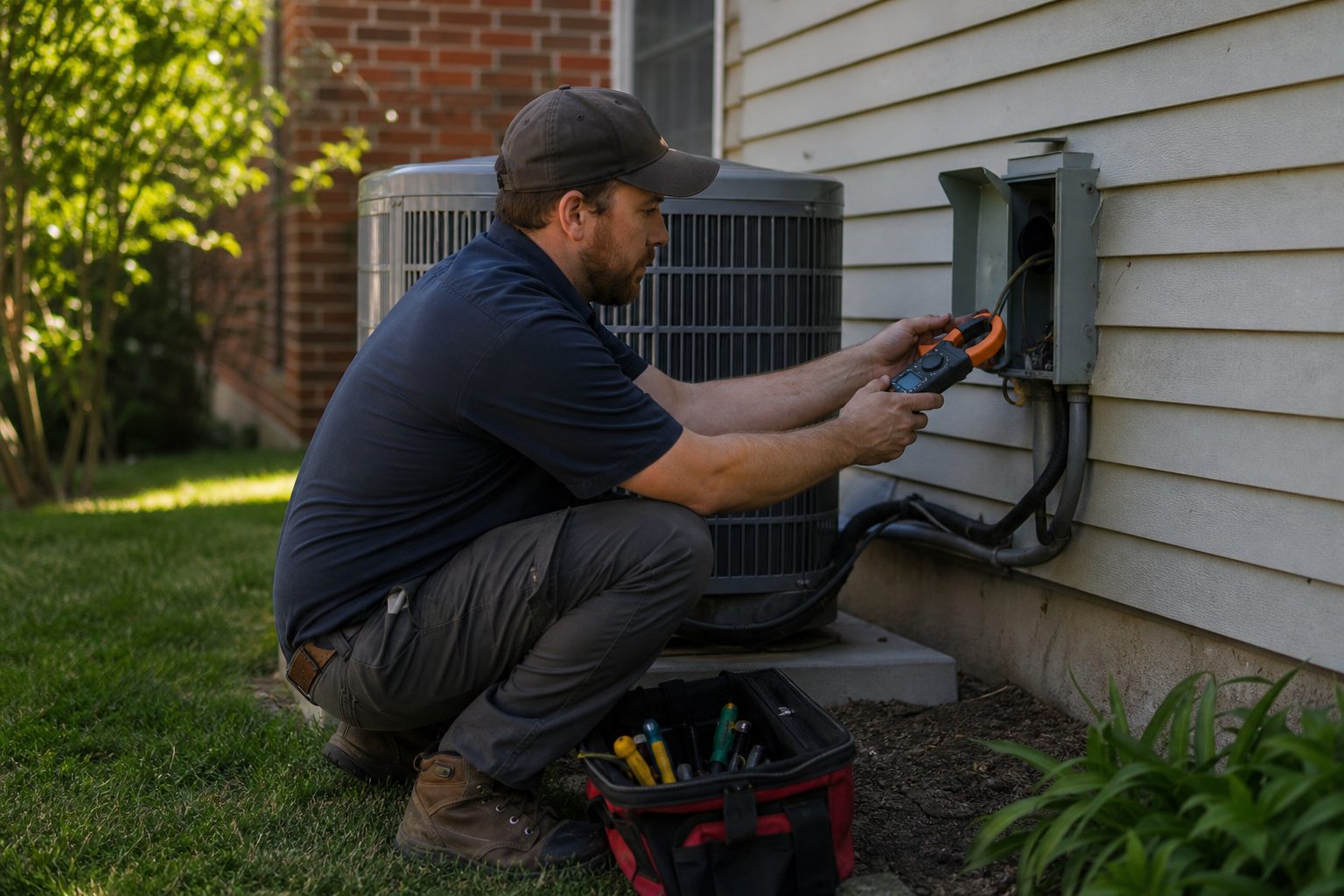
What a technician measures when an AC keeps tripping the breaker
Diagnosis is five readings against nameplate values, not a parts swap.
- Running amps on each leg, against nameplate rated load amps at the observed outdoor temperature.
- Inrush amps at start, against nameplate locked rotor amps, separating a starting fault from a running one.
- Insulation resistance from each winding to the shell with a megohmmeter, which finds a ground fault before it becomes a fire.
- Voltage drop across the contactor under load, and at the disconnect lugs.
A fan motor pulling above its own nameplate rating points at the motor, and the pattern in how a blower motor fails transfers to the outdoor fan. If the readings condemn the compressor, read why no reliable national repair figure exists.
How we researched this
Research date: September 2026. Numbers come from OSHA text, USFA NFIRS estimates, CPSC staff publications, NIST Technical Note 1848, and an archived DOE page. An IAEI article serves only as a readable restatement of NEC Article 440.
Excluded: the NEC text, which is not freely readable; contractor blogs and cost aggregators, which publish no sampling method; and installed prices, since no federal series covers this repair. Reddit was skipped entirely, because anonymous accounts are not an acceptable basis for advice about live 240 volt circuits. Limitations: NFIRS reporting is voluntary for many departments, and USFA totals cover all residential electrical fires rather than AC circuits. Your nameplate governs.
Frequently asked questions
Can I reset the breaker once to check?
Once is how most people find out. A second reset is where it turns serious: OSHA at 29 CFR 1910.334(b)(2) prohibits repetitive reclosing, because each one sends fault current back through whatever failed.
Why does it only trip on the hottest days?
Heat raises compressor current draw and lowers the breakdown strength of aging winding insulation at once. A compressor that measures fine at breakfast can pull past its rated load amps at 100 degrees Fahrenheit.
Could a dirty condenser coil really trip a breaker?
Yes, by raising head pressure until the compressor draws past its rating. DOE guidance warns that outdoor coils become very dirty near foliage, and says to trim vegetation back at least two feet.
Should I just install a bigger breaker?
No. The nameplate maximum is a ceiling, and the CPSC guide says do not put in a higher ampere fuse or circuit breaker. An oversized device leaves the conductor unprotected.
What if a GFCI or AFCI breaker is tripping instead?
The reset rule holds, but the fault list narrows. CPSC publication 5133 notes that typical fuses and breakers “do not respond to early arcing and sparking conditions in home wiring,” a different failure from overload.
How much can a homeowner safely check?
Visual items only: filter condition, debris and vegetation around the outdoor unit, scorching or a hot plastic smell. Anything behind a cover, or needing a meter on live terminals, belongs to a licensed electrician or HVAC technician.
Sources
- OSHA. “1910.334 Use of equipment.” https://www.osha.gov/laws-regs/regulations/standardnumber/1910/1910.334. Accessed September 2026.
- OSHA. “1910.303 General.” https://www.osha.gov/laws-regs/regulations/standardnumber/1910/1910.303. Accessed September 2026.
- USFA. “Residential building electrical malfunction fire trends.” https://www.usfa.fema.gov/statistics/residential-fires/electrical.html. Accessed September 2026.
- USFA. “Residential Building Electrical Fires (2014-2016), TFRS Vol. 19 Issue 8.” https://www.usfa.fema.gov/downloads/pdf/statistics/v19i8.pdf. Accessed September 2026.
- CPSC. “Guide to Home Wiring Hazards,” Publication 518. https://www.cpsc.gov/s3fs-public/518.pdf. Accessed September 2026.
- CPSC. “Technology for Detecting Conditions That Could Lead to Residential Electrical Fires.” https://www.cpsc.gov/s3fs-public/technolopt1_0.pdf. Accessed September 2026.
- CPSC. “Preventing Home Fires: Arc Fault Circuit Interrupters,” Publication 5133. https://www.cpsc.gov/s3fs-public/5133.pdf. Accessed September 2026.
- NIST. “Sensitivity Analysis of Installation Faults on Heat Pump Performance,” TN 1848. https://nvlpubs.nist.gov/nistpubs/TechnicalNotes/NIST.TN.1848.pdf. Accessed September 2026.
- DOE Energy Saver. “Maintaining Your Air Conditioner” (archived copy). https://web.archive.org/web/2025id_/https://www.energy.gov/energysaver/maintaining-your-air-conditioner. Accessed September 2026.
- IAEI. “Air-Conditioning Equipment Installations.” https://iaeimagazine.org/2017/julyaugust-2017/air-conditioning-equipment-installations/. Accessed September 2026.
Leave a Reply