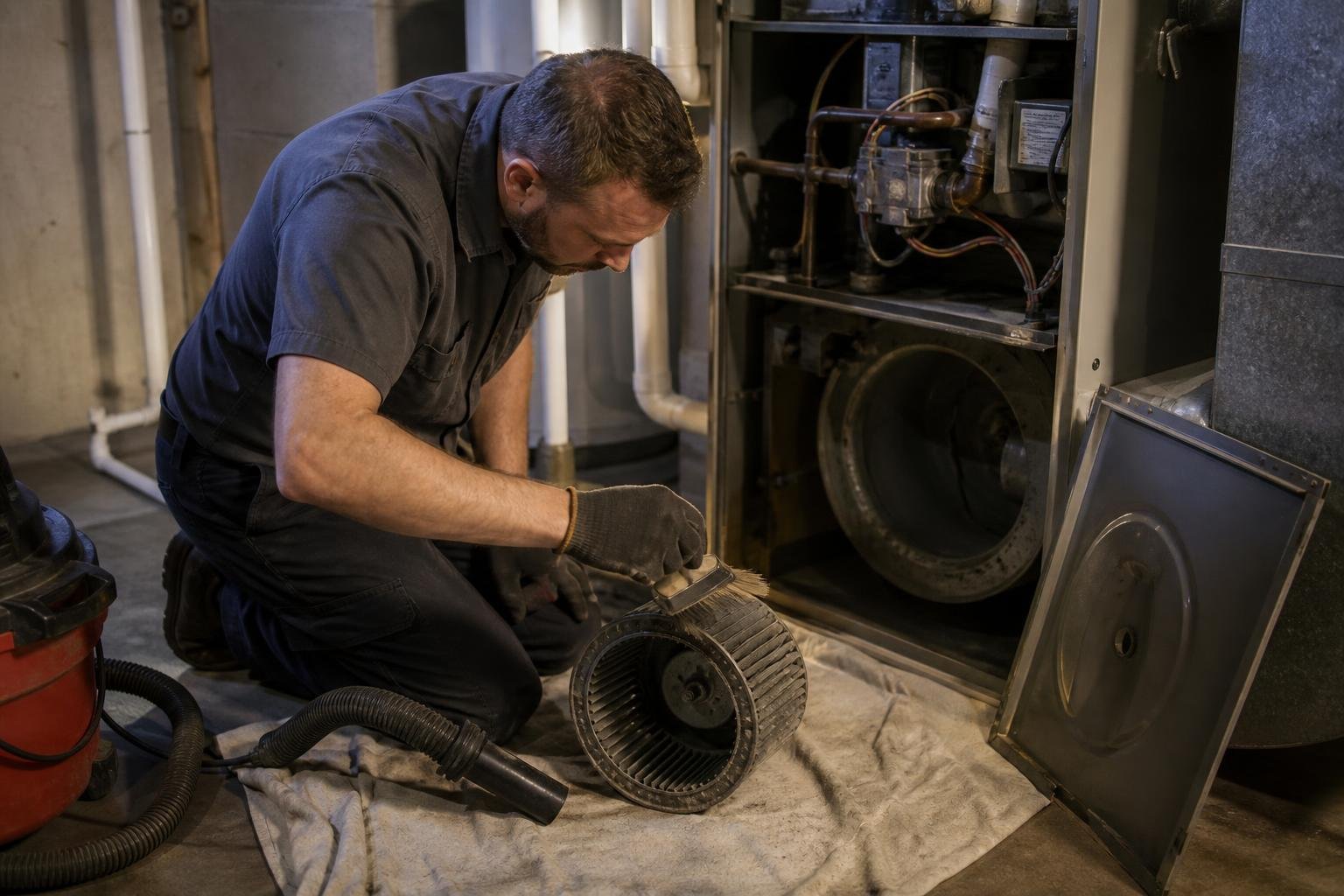
What does furnace cleaning involve? Furnace cleaning is two jobs. With the power and gas off, an owner can change the filter, clear the return grilles, vacuum the reachable blower compartment and check a condensing furnace’s drain. The blower wheel, flame sensor, burners and heat exchanger belong to a technician.
Key Takeaways
- DOE lists “clean and oil the blower” and “remove dirt, soot, or corrosion” among forced air furnace tasks that “should be provided by a heating system professional” (DOE Energy Saver, archived copy).
- ENERGY STAR says airflow problems can reduce a system’s efficiency by up to 15 percent, and lists cleaning blower components as the contractor’s fix (ENERGY STAR).
- Lawrence Berkeley National Laboratory recorded a 30% airflow reduction for PSC blowers in two test furnaces at 0.8 in. water of resistance (LBNL 61467, 2006).
- CPSC estimates furnaces, including boilers, were linked to an average of 23 non-fire carbon monoxide deaths a year in 2020 to 2022 (CPSC, May 2026).
- Goodman and Bosch manuals both reserve flame sensor cleaning for a qualified servicer; Bosch puts the signal after cleaning at 1 to 6 microamps (Bosch BGH96 manual).
- No federal agency publishes a price for furnace cleaning. This page quotes none.
What does furnace cleaning actually cover?
Furnace cleaning means removing dust, lint and combustion deposits from the appliance itself: the air side (filter, blower, cabinet) and the fire side (burners, flame sensor, heat exchanger passages, vent). The fire side is where dirt turns into a carbon monoxide question.
This page covers the cabinet and what is inside it. The ducts are a separate trade, covered in our look at what EPA says about duct cleaning.
The yearly task list sits in our owner and technician furnace checklist, and the paid visit is broken down in what a real tune-up includes. Neither is repeated here.
What part of furnace cleaning can an owner do safely?
The owner’s share of furnace cleaning is the air side you can reach without tools beyond a vacuum: the filter, the return grilles, the floor of the blower compartment and, on a condensing furnace, the drain. Rheem’s manual says the blower compartment “should be cleaned monthly during the heating and cooling seasons” because dirt and lint load the motor (Rheem installation instructions).
- Shut it down first. Turn the thermostat off, switch off the furnace service switch, and close the gas valve before any panel comes off. Rheem’s flue cleaning procedure opens the same way: gas off, power off, thermostat down.
- Change the filter. ENERGY STAR says to inspect, clean or change it once a month. Sizes and ratings are covered in our furnace filter guide.
- Clear the returns and the area. Vacuum the return grilles and keep storage, lint and boxes away from the cabinet and its air openings.
- Vacuum the blower compartment. Use a soft brush on the cabinet floor and the reachable surfaces. Do not unbolt the blower or bend the wheel’s blades.
- Check the condensate drain. On a condensing furnace, look for leaks and cracks in the trap and hoses. Bosch’s manual says the trap must stay filled with water.
- Close up in reverse. Seat the blower door fully, then restore gas and power.
Safety point
The blower door is part of the combustion safety system. CPSC’s carbon monoxide report lists “filter doors/covers that were removed or not sealed” among the furnace conditions found in fatal incidents. Never run the furnace with that door off or loose.
A clogged drain is the common condensing furnace fault an owner can spot. If the furnace pumps its water uphill, our condensate pump explainer covers that part.
What does a technician clean inside the furnace?
The technician’s share is everything that has to come apart or be measured: the blower wheel, the flame sensor, the burners, the heat exchanger and the combustion test that proves the job. DOE’s Energy Saver list for forced air systems includes “clean and oil the blower,” “remove dirt, soot, or corrosion” and “test for carbon monoxide (CO) and remedy if found.”
- Blower wheel. The squirrel cage wheel is unbolted, slid out and cleaned blade by blade, because packed dust a vacuum cannot reach cuts airflow. Motor types are covered in our blower motor guide.
- Flame sensor. Goodman says a “nearly invisible coating” can insulate the sensor until the furnace “will not sense flame and will lock out”; the fix is steel wool by a qualified servicer (Goodman installation instructions).
- Burners. Bosch states that “only a qualified contractor, installer or service agency can clean the burners.”
- Heat exchanger. Goodman asks for a yearly check “for corrosion and/or buildup within the heat exchanger passageways.” A leaking one mixes combustion gases with house air, DOE notes.
- Combustion test. After the fire side is disturbed, the job ends with measurement, not a look. DOE lists the carbon monoxide test, and the DOE Building America Solution Center calls for a combustion safety test by a BPI or RESNET certified rater on Category I furnaces after installation.
The lockout pattern a dirty sensor causes is traced in our ignition sequence explainer, and burner appearance is read in our flame color guide. CPSC reports that vents in fatal cases were sometimes “blocked by soot caused by inefficient combustion,” which may stem from “leaky or clogged burners.”
What does a dirty blower wheel do to airflow and temperature rise?
A blower wheel packed with dust moves less air, and with the same gas input, less air leaves the furnace hotter. Goodman’s manual spells out the chain: insufficient air “can cause excessive temperature rise. This can cause limit switch tripping and heat exchanger failure.” Rheem adds that a rise outside the rating plate range “could result in premature heat exchanger failure.”
No federal or national lab study we found measures a dirty blower wheel directly. The closest evidence is how furnace blowers respond to added resistance. A 2006 LBNL study for DOE recorded a 30% reduction in airflow for PSC blowers in two test furnaces at 0.8 in. water, a typical operating pressure, and restrictive cabinets alone cut airflow by about 10%.
The same report cites a Wisconsin field study of 31 houses with furnaces under three years old. Measured resistance averaged 0.5 in. water, against the 0.20 or 0.23 in. used in federal test procedures. Filters add resistance too, which our piece on filter ratings and airflow covers.
Bosch’s published blower table shows the result on one furnace. On high speed, its size 60B model moves 1,430 CFM at 0.1 in. water, 1,280 CFM at 0.5 in. and 1,065 CFM at 1.0 in. Second-stage temperature rise climbs from 37°F to 40.7°F to 49.1°F across the same points. A clogged wheel also lowers airflow, so the direction is the same, though no study we found measures how far.
How often does each part need furnace cleaning?
The owner’s parts run monthly in season; the technician’s parts run once a year, at the start of the heating season. Goodman says the furnace “should be inspected by a qualified installer, or service agency at least once per year,” and Rheem wants the flue passages, vent and burners “inspected and cleaned (if required) by a qualified serviceman annually.”
| Component | Who cleans it | How often | Symptom when dirty |
|---|---|---|---|
| Air filter | Owner | Check monthly (ENERGY STAR) | Higher energy costs, equipment damage |
| Return grilles and furnace area | Owner | When dust or lint shows | Restricted return air |
| Blower compartment floor | Owner | Monthly in heating and cooling seasons (Rheem) | Motor runs hotter, shorter life |
| Condensate trap and drain | Owner checks; technician cleans | Each annual inspection (Bosch) | Leaks, water damage; condensate is acidic, pH ≤3 |
| Blower wheel | Technician | When inspection finds buildup | Weak airflow, high temperature rise, limit trips |
| Flame sensor | Technician | When coated or oxidized (Goodman) | Burners light, then lock out |
| Burners | Technician | Inspected yearly, cleaned if required (Rheem) | Yellow flame, soot |
| Heat exchanger and flue passages | Technician | Start of each heating season (Goodman) | Corrosion, buildup, combustion gas leaks |
ENERGY STAR puts the cost of neglect on the air side plainly: airflow problems can cut efficiency by up to 15%. On the fire side, DOE suggests every home have a working carbon monoxide alarm; our guide to where CO alarms go covers placement. Owners who want the yearly visit scheduled can read how an HVAC maintenance plan is structured.
What does furnace cleaning cost?
Federal sources give no price for furnace cleaning. We found no BLS, DOE, EIA or national lab series that prices a furnace cleaning or a heating service visit, so this page quotes no dollar figure. Vendor price surveys are not data under our sourcing rules.
What can be said is what the price should buy: a visit billed as cleaning should name the blower wheel, flame sensor, burners and heat exchanger, and end with combustion readings. Vacuuming the cabinet floor is the owner’s job.
How we researched this
Research date: October 5, 2026. We consulted 10 sources and cite 8: DOE Energy Saver (archived copy, the live page now returns a 404), ENERGY STAR, the DOE Building America Solution Center, CPSC’s 2022 carbon monoxide estimates, LBNL report 61467, and installation manuals from Goodman, Rheem and Bosch. Manufacturer guidance is attributed by name, never stated as fact. Reddit was skipped entirely because this is a combustion and carbon monoxide safety topic. Excluded: contractor blogs, vendor price surveys (no federal price series exists), and a widely repeated “Texas A&M” blower wheel figure for which we found no primary document.
Frequently asked questions
Can I clean my furnace myself?
Partly. With the power and gas off, an owner can change the filter, vacuum the returns and the reachable blower compartment, and check a condensing furnace’s drain. DOE lists cleaning the blower and removing soot as professional tasks.
How often should a furnace be cleaned?
The owner’s parts monthly in season and the technician’s parts yearly. Rheem asks for the blower compartment to be cleaned monthly during heating and cooling seasons, and Goodman wants a qualified inspection at least once per year.
Should I clean the flame sensor myself?
The manuals say no. Goodman and Bosch both reserve flame sensor cleaning for a qualified servicer, and Bosch says the flame signal should read 1 to 6 microamps afterwards, which takes a meter to confirm.
Can a dirty furnace cause carbon monoxide?
It can contribute. CPSC’s 2022 report describes vents blocked by soot from inefficient combustion, possibly from clogged burners, plus compromised heat exchangers and unsealed filter doors, among conditions found in fatal incidents.
Does furnace cleaning include the ducts?
No. Furnace cleaning covers the appliance. Duct cleaning is a separate service, and the DOE Energy Saver list of professional furnace tasks covers the blower, combustion chamber and flame, not cleaning the duct runs.
Why does my furnace overheat and shut off?
Low airflow is a common cause. Goodman says insufficient air can cause excessive temperature rise, limit switch tripping and heat exchanger failure. A clogged filter or a dirty blower wheel both reduce airflow.
Sources
- US Department of Energy. “Furnaces and Boilers,” Energy Saver, archived copy. https://web.archive.org/web/2025id_/https://www.energy.gov/energysaver/furnaces-and-boilers. Accessed October 2026.
- ENERGY STAR. “Maintenance Checklist.” https://www.energystar.gov/saveathome/heating-cooling/maintenance-checklist. Accessed October 2026.
- Walker, I. S. “Residential Furnace Blower Performance,” LBNL 61467. Lawrence Berkeley National Laboratory, 2006. https://eta-publications.lbl.gov/sites/default/files/lbnl-61467.pdf. Accessed October 2026.
- US Consumer Product Safety Commission. “Non-Fire Carbon Monoxide Deaths Associated with the Use of Consumer Products, 2022 Annual Estimates.” https://www.cpsc.gov/s3fs-public/Non-Fire-Carbon-Monoxide-Deaths-Associated-with-the-Use-of-Consumer-Products-2022-Annual-Estimates.pdf. Accessed October 2026.
- DOE Building America Solution Center (PNNL). “Combustion Furnaces.” https://basc.pnnl.gov/resource-guides/combustion-furnaces. Accessed October 2026.
- Goodman. “Installation Instructions for *M9S80 and *C9S80* Gas Furnace.” https://documents.alpinehomeair.com/product/goodmangm9s8gc9s8installationmanual.pdf. Accessed October 2026.
- Rheem. “Residential Gas Furnaces Installation Instructions,” 708291b. https://files.rheem.com/LiteratureArchive/708291b.pdf. Accessed October 2026.
- Bosch Thermotechnology. “Bosch 96% AFUE Gas Furnace BGH96 Installation, Operation and Maintenance Manual.” https://www.hvacdiscounters.com/customer/docs/skudocs/bosbgh96-iom.pdf. Accessed October 2026.
Leave a Reply