
If your electric water heater breaker keeps tripping, note when it trips. An instant trip on reset points to a grounded heating element or a shorted wire. A trip partway through heating points to a partly grounded element, a loose terminal or a breaker below 125% of the heater rating. A trip right after a refill points to a dry-fired element.
Does the breaker trip the instant you reset it, or after the tank has been heating?
Timing sorts the causes before you open a cover. Bradford White’s service manual says an element “with a short circuit to ground will in most cases cause the circuit breaker in the service panel to open,” so a breaker that will not stay on at all usually means a grounded element. A breaker that holds, then lets go, is reporting heat or a smaller leak.
| When it trips | Likely cause | Test | Condemning reading |
|---|---|---|---|
| Instantly, every reset | Element shorted to tank | Ohms, each terminal to flange, wires lifted | Any reading |
| Instantly, both elements test clean | Shorted cable, wet junction box, failed breaker | Electrician lifts heater leads, recloses breaker | Trips with no heater attached |
| Partway through heating | Partly grounded element | Clamp amps on element wires, thermostat satisfied | Any amps |
| Long recoveries, hot smell | Loose or burned terminal | Look for brown insulation, pitted screws | Melted terminal block |
| Long recoveries, nothing burned | Circuit under 125% of rating | Rating plate vs breaker and wire gauge | 4,500 W on 20 A (94%) |
| After a drain, flush or element swap | Dry-fired element | Ohms across terminals, then to tank | Open, or any reading to tank |
| Since a new heater or elements | Higher wattage or simultaneous wiring | Plate wattage vs circuit size | Amps above circuit sizing |
How do you test a water heater element for a short to the tank?
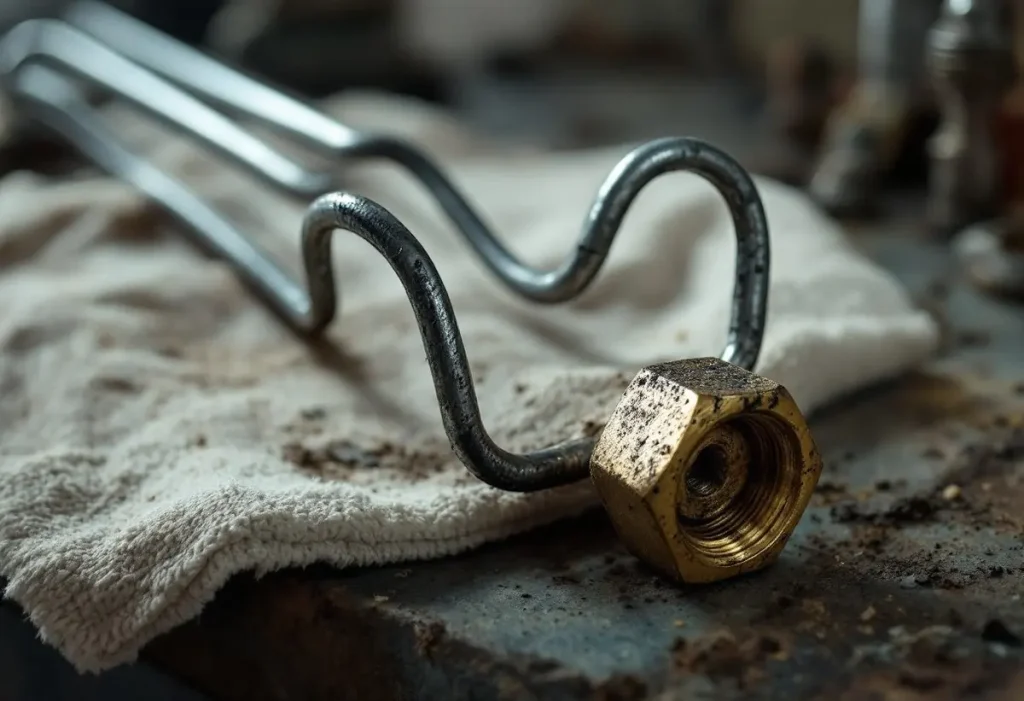
Breaker off, wires lifted, one ohmmeter probe on an element screw terminal and the other on the flange, then the second terminal. Bradford White: “There should be no reading on the ohm meter. Any reading indicates a grounded element and the element must be replaced.” Test the upper and lower elements, since only one is usually powered at a time.
Across the two terminals, Bradford White expects 12.8 ohms (±6%) for a 240 volt, 4,500 watt element; State allows readings to vary by up to 7.5% by meter. Our water heater element testing guide has the full ohms table and replacement steps. For a trip, the ground test matters more: an element can read normal ohms and still leak to the tank.
Why does the breaker hold for a while, then trip partway through heating?
Because the fault appears only when one element is powered, or only once a connection heats up. Rheem’s thermostat bulletin says that in non-simultaneous mode “only one of the heating elements, either the upper OR the lower, may heat at a time,” so a grounded lower element stays quiet until the upper thermostat hands power down. The State handbook’s check: clamp each element wire with the thermostat satisfied; any amperage means the element is grounded. Bradford White adds that some grounded elements draw too little to open the breaker, and run constantly until the ECO stops them.
A loose screw at an element, thermostat or junction box makes heat at the joint. Bradford White lists “Loose wire connections” among slow-recovery causes, and Rheem’s checklist asks for “Electrical connections tight and unit properly grounded.” Each Square D QO pole has a “thermal-magnetic trip element calibrated for 40°C ambient temperature,” per Schneider Electric’s catalog, so heat from a burned lug can push a breaker near its rating over. Brown insulation or a melted terminal block means replacing the wire end and the part.
Did the trips start after a flush, a refill or a new element?
Then suspect a dry-fired element. Bradford White says an element without water fails “within seconds,” and tells installers to “be sure the tank is full of water prior to energizing the water heater.” A burned-out element alone costs you hot water; it trips the breaker only if it is also grounded, which the ground test catches. Before the breaker goes back on after a flush, run a hot tap until water flows steadily, as in our water heater flushing steps. If trouble began after an outage instead, see no hot water after a power outage.
A new heater or new elements can simply draw more. The State handbook warns that a higher wattage element may overload “the water heater wiring or supply wiring or fusing,” and that with both elements running together “amperage draw doubles.” By our arithmetic, two 4,500 watt elements draw 37.5 amps at 240 volts, beyond any 30 A circuit.
What breaker and wire size does an electric water heater need?
At least 125% of the heater’s rating, for breaker and wire. IRC 2021 section E3702.10, which carries NEC 422.13, says the conductors and overcurrent device for storage water heaters of 120 gallons or less “shall be sized not less than 125 percent of the water heater rating.” For a 4,500 watt, 240 volt tank: 18.75 A times 1.25 is 23.4 A, and Rheem’s sizing table answers with a 25 A breaker on 10 AWG copper.
| Watts at 240 V | Amps | 125% floor | 150% ceiling | Rheem breaker | Rheem wire | Good ohms |
|---|---|---|---|---|---|---|
| 3,000 | 12.5 | 15.6 | 18.8 | 20 A | 12 AWG | 18.0 to 20.4 |
| 4,000 | 16.7 | 20.8 | 25.0 | 25 A | 10 AWG | 13.5 to 15.3 |
| 4,500 | 18.75 | 23.4 | 28.1 | 25 A | 10 AWG | 12.0 to 13.6 |
| 5,000 | 20.8 | 26.0 | 31.2 | 30 A | 10 AWG | 10.8 to 12.2 |
| 5,500 | 22.9 | 28.6 | 34.4 | 30 A | 10 AWG | 9.8 to 11.1 |
| 6,000 | 25.0 | 31.2 | 37.5 | 35 A | 8 AWG | 9.0 to 10.2 |
A 30 A breaker on a 4,500 watt tank is also allowed in many jurisdictions: IRC E4101.4.1 lets an unmarked appliance over 13.3 amperes be protected at up to 150 percent (28.1 A by our math), with the next higher standard rating permitted. The wire is the real limit. IRC Table E3705.5.3 caps 12 AWG copper at 20 A and 10 AWG at 30 A, so a tank on 12 AWG and a 20 A breaker is undersized twice and runs at 94% of the breaker rating. A bigger breaker on that wire lets the cable overheat instead, the trap our AC breaker tripping guide covers. Other conversions are in our HVAC watts and amps explainer.
The breaker tripped and won’t reset: is it the breaker or the heater?
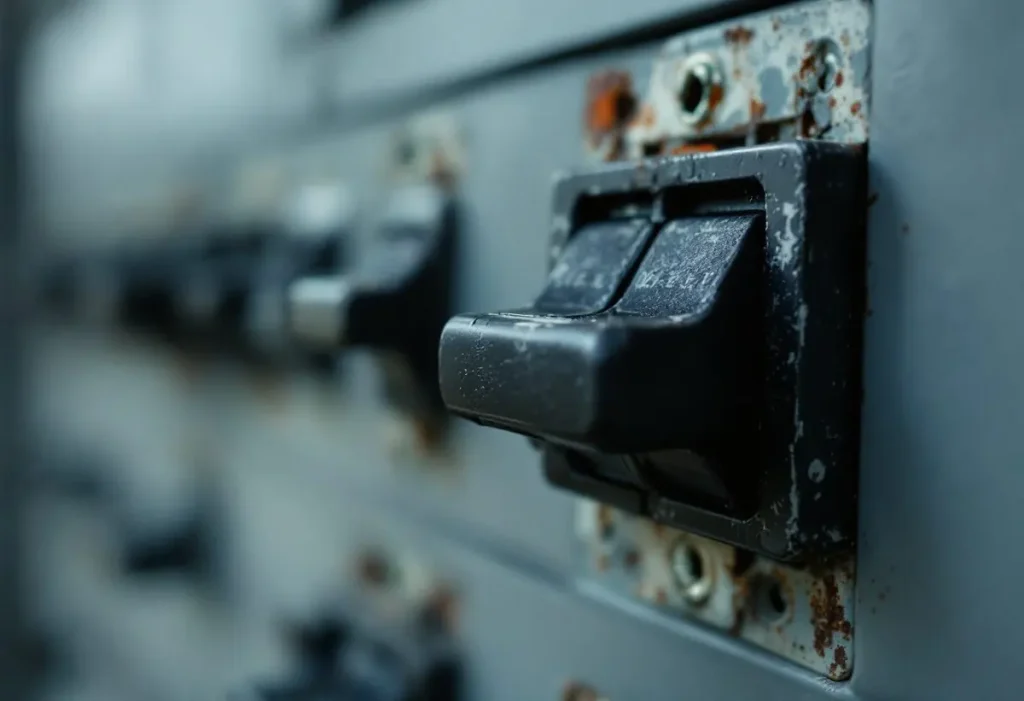
First reset it properly. Schneider’s QO catalog says a tripped handle “assumes a center position” and resets “by pushing the handle to OFF and then to ON”; the CPSC wiring guide gives the same OFF then ON order. Because the breaker is double pole, an overcurrent on either pole makes all poles “open simultaneously,” per the catalog, killing both 120 volt legs.
If the handle snaps back the moment it reaches ON, stop and run the ground test on both elements. If both pass, the fault is the cable, junction box or breaker, and an electrician separates them by lifting the heater leads and closing the breaker on an empty circuit. That is 240 volt line work: a sensible stop line for most owners.
Red reset button or panel breaker: which one actually tripped?
The red button on the upper thermostat is the ECO high limit, the “internal breaker” many searchers mean; Rheem’s bulletin says it trips when “Excessive heat from the inner tank wall” inverts its bimetal plate, while the panel breaker opens on current. Rheem adds that frequent ECO trips are “an indication of additional problems,” and Bradford White names the usual one: “Repeated actuation of the ECO is usually the result of a grounded element.” State lists a “thermostat stuck in call for heat” as the other cause.
So a tank that pops its red button needs the same ground test. If the elements pass and the water is only lukewarm, move to our water heater not heating checklist.
Frequently asked questions
Why does my hot water heater keep tripping the reset button?
The reset button is the ECO high limit, which trips on overheated water, not current. Bradford White’s service manual says repeated ECO actuation “is usually the result of a grounded element,” which can leak too little current to open the breaker yet keep heating. The State handbook adds a thermostat stuck calling for heat. Test both elements to the tank first.
What size breaker for a 4500 watt water heater?
Rheem’s branch circuit table lists a 25 A breaker on 10 AWG copper for a 4,500 watt heater at 240 volts. The heater draws 18.75 A, and IRC E3702.10 requires at least 125 percent, or 23.4 A. A 30 A breaker is also permitted under the 150 percent rule in IRC E4101.4.1 when the wire is 10 AWG copper.
Electric water heater breaker trips occasionally: what does that mean?
An occasional trip late in long heating runs points to heat, not a hard short: a loose or scorched terminal, or a circuit sized under 125 percent of the rating. A partly grounded element also fits; the State handbook’s test is a clamp meter on each element wire with the thermostat satisfied, where any amps means a grounded element.
Is it safe to keep resetting a water heater breaker?
Not more than once. Bradford White says a grounded element will in most cases open the breaker, and closing a breaker repeatedly onto that fault strains the cable and breaker. Reset once by pushing the handle fully to OFF and then ON, as Schneider’s QO catalog describes. If it trips again, leave it off and test both elements to the tank.
How we researched this
We read Bradford White service manual 238-54711-00, the State residential electric service handbook (STC082), Rheem manual AP23124-1 and its thermostat bulletin, IRC 2021 Chapters 37 and 41 on UpCodes, Schneider Electric’s QO catalog 0730CT9801 and CPSC publication 518. Amps, the 125% and 150% limits and ohms windows are our calculations (script kept with this article). Contractor blogs and forums were excluded as sources for numbers. Local codes and inspectors decide what applies at a given address. Researched November 20, 2026.
Sources
- Bradford White. “Service Manual: Light Duty Electric Water Heaters (238-54711-00A).” https://docs.bradfordwhite.com/Service_Manual/238-54711-00_Current.pdf. Accessed November 2026.
- State Water Heaters. “Residential Electric Water Heater Service Handbook.” https://assets.statewaterheaters.com/damroot/Original/10008/320990-000.pdf. Accessed November 2026.
- Rheem. “Use and Care Manual, Electric Residential Water Heaters (AP23124-1).” https://media.rheem.com/blobazrheem/wp-content/uploads/sites/36/2024/04/Residential-Electric-Side-Connect-Blanketed-Lowboy-UC-Manual-AP23124-1.pdf. Accessed November 2026.
- Rheem. “Technical Service Bulletin: How An Electric Thermostat Works.” https://res.cloudinary.com/dzhpkjoqj/TradeService/RheemManufacturing_00377_1-3_OTHER1.pdf. Accessed November 2026.
- International Code Council, via UpCodes. “IRC 2021 Chapter 37, Branch Circuit and Feeder Requirements.” https://up.codes/viewer/utah/irc-2021/chapter/37/branch-circuit-and-feeder-requirements. Accessed November 2026.
- International Code Council, via UpCodes. “IRC 2021 Chapter 41, Appliance Installation.” https://up.codes/viewer/utah/irc-2021/chapter/41/appliance-installation. Accessed November 2026.
- Schneider Electric. “QO and QOB Circuit Breakers Catalog (0730CT9801).” https://download.schneider-electric.com/files?p_Doc_Ref=0730CT9801&p_enDocType=Catalog. Accessed November 2026.
- U.S. Consumer Product Safety Commission. “Home Wiring Hazards (Publication 518).” https://www.cpsc.gov/s3fs-public/518.pdf. Accessed November 2026.
Leave a Reply