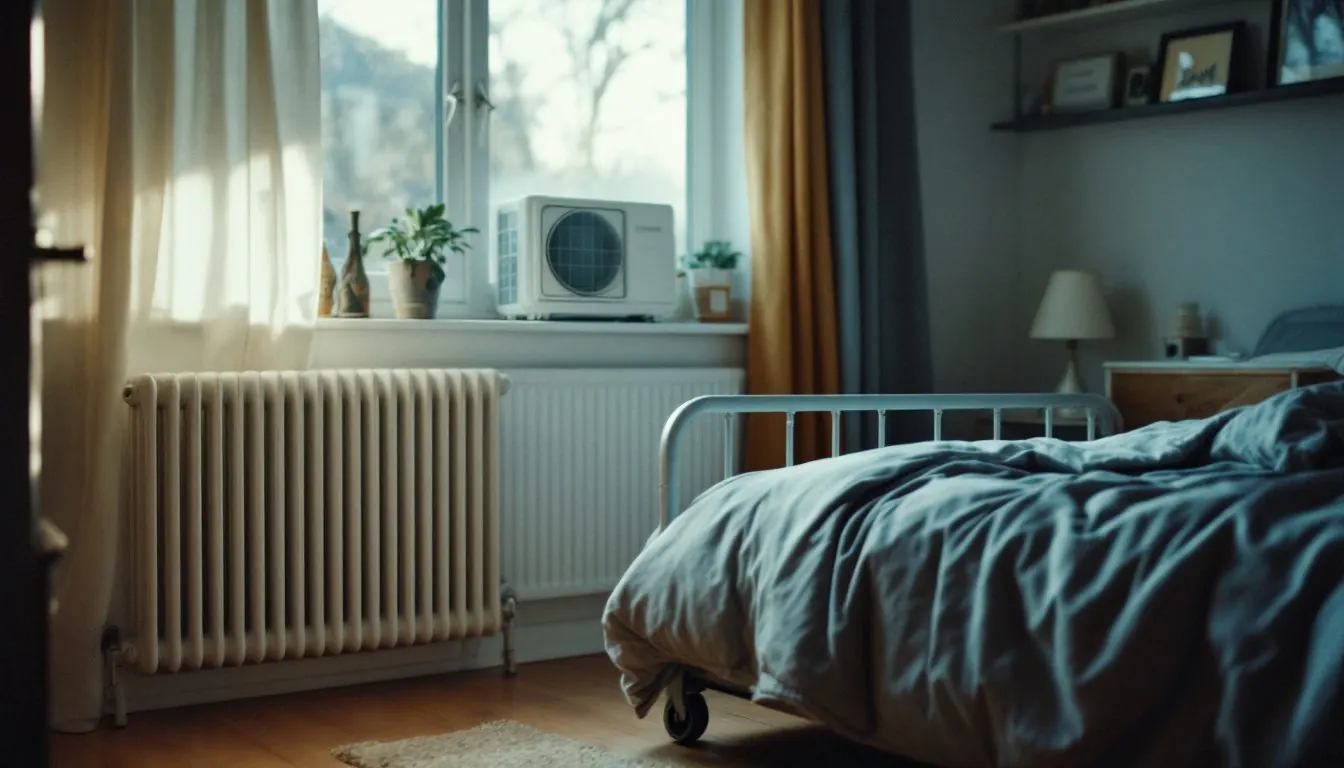
To heat a room without central heating for the least money, use a window heat pump or mini split (about 20 cents an hour for 9,000 Btu/h at 17°F) or, in a small tight room, one 1,500 W plug-in heater (27 cents for 5,118 Btu/h). To heat only yourself, a 150 W electric blanket costs about 3 cents an hour.
Which option heats a room without central heating for the least per hour?
A heat pump: 9,000 Btu/h for 12 to 24 cents an hour. Every plug-in heater pays 5.32 cents per 1,000 Btu. Prices use the US average of 18.16 cents per kWh for August 2026, the latest month in EIA Electric Power Monthly Table 5.6.A, and EIA’s conversion of 1 kWh to 3,412 Btu.
| Option | Heat delivered | Power drawn | Cost per hour | Cost per 1,000 Btu |
|---|---|---|---|---|
| Electric blanket, 100 to 150 W | 341 to 512 Btu/h | 0.10 to 0.15 kW | 1.8 to 2.7 cents | 5.32 cents |
| Any 1,500 W plug-in heater | 5,118 Btu/h | 1.5 kW | 27.2 cents | 5.32 cents |
| Gradient window heat pump, 47°F outside (COP 4.04) | 9,000 Btu/h | 0.65 kW | 11.9 cents | 1.32 cents |
| Gradient window heat pump, 17°F outside (COP 2.37) | 9,000 Btu/h | 1.11 kW | 20.2 cents | 2.25 cents |
| Midea window heat pump, 5°F outside (COP 2.0) | 9,000 Btu/h | 1.32 kW | 24.0 cents | 2.66 cents |
| Mini split, federal minimum 7.5 HSPF2 (season) | Sized per room | Varies | Varies | 2.42 cents |
| Vent-free gas room heater | Up to 40,000 Btu/h input | Gas, not electricity | Not costed | Not costed |
Ceramic, oil filled, infrared and quartz heaters share one row: at 1,500 W each turns 1.5 kWh into 5,118 Btu. Only where the heat lands differs; an infrared heater warms the person in front of it. Monthly bills by state are in our space heater cost and fire data page; rates run from 12.72 cents per kWh in Nevada to 47.18 cents in Hawaii.
How big a room can one 1,500 watt heater keep at 70°F?
A tight 12 by 12 foot room with one outside wall needs about 1,477 Btu/h at 0°F, so even 600 W holds it; a drafty corner room with single glass needs 5,780 Btu/h, more than a 1,500 W heater makes. Glass and air leakage decide it, not floor area.
| Input | Room A: tight, one outside wall | Room B: drafty corner room |
|---|---|---|
| Outside wall, net of glass, at R-13 | 81 sq ft: 6.2 Btu/h per °F | 162 sq ft: 12.5 Btu/h per °F |
| Glass | 15 sq ft at U-0.30: 4.5 Btu/h per °F | 30 sq ft at U-1.3: 39.0 Btu/h per °F |
| Air leakage (assumed) | 0.5 air changes an hour: 10.4 Btu/h per °F | 1.5 air changes an hour: 31.1 Btu/h per °F |
| Total UA | 21.1 Btu/h per °F | 82.6 Btu/h per °F |
| Heat needed, 20°F outside | 1,055 Btu/h | 4,128 Btu/h |
| Heat needed, 0°F outside | 1,477 Btu/h | 5,780 Btu/h |
| Coldest day one 1,500 W heater holds 70°F | On paper, minus 173°F | About 8°F |
R-13 is the 2009 IECC wood-frame wall minimum for zones 1 to 4 in the PNNL code table, taken as U = 1/13. U-1.3 is what the Whole Building Design Guide gives for “a typical aluminum frame single glazed window.” Air leakage uses 0.018 Btu per cubic foot per °F (0.075 lb per cubic foot × 0.24 Btu per lb per °F); the air change rates are our assumptions. Room B: 5,118 ÷ 82.6 = 62°F of lift, so the heater loses ground below about 8°F.
Is a window heat pump or mini split worth it for a single room?
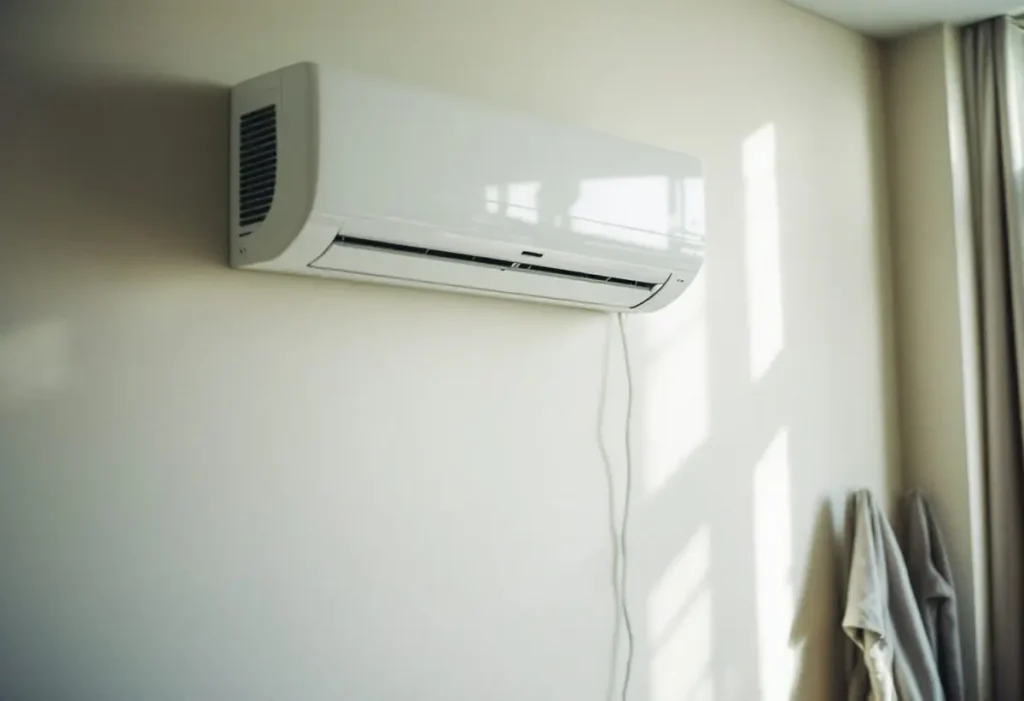
Yes, if the room is used daily through winter: a cold-climate window heat pump makes 9,000 Btu/h at 17°F for about 20 cents an hour, 1.76 times the heat of a 1,500 W heater for less money. The Gradient All-Weather 120V spec sheet lists COP 4.04 at 47°F, 2.37 at 17°F and 1.80 at minus 7°F (5,400 Btu/h), on a 120 V, 15 A outlet. Midea’s PWHP sheet claims 9,000 Btu/h at 5°F at COP 2.0 and states “No auxiliary resistance electric heater.”
These are maker claims, not federal ratings. Gradient lists 140 lbs and needs a window at least 26 inches wide; field results are in our window heat pump guide. A mini split is the permanent version: split heat pumps made since January 1, 2023 must reach 7.5 HSPF2 under 10 CFR 430.32(c)(5), about 2.2 Btu of heat per Btu of electricity over a season (7.5 ÷ 3.412), or 2.42 cents per 1,000 Btu at the August rate. Federal installed prices are on our mini split cost page.

What is the cheapest way to heat just yourself instead of the room?
Heat the person: a 150 W electric blanket costs 2.7 cents an hour, a tenth of a 1,500 W heater, because it puts 512 Btu/h against your body, not into the air. Australian tester CHOICE writes that most electric blankets have a wattage of around 100 to 150 watts. Recalls and who should skip one are in our electric blanket guide.
For a desk or chair, DOE’s portable heater page (archived copy) favors radiant heaters, which “are a more efficient choice when you will be in a room for only a few hours and can stay within the line of sight of the heater.” Sealing leaks cuts Room B’s 31.1 Btu/h per °F air term; start with how to stop drafts from windows.
Can a vent-free gas or kerosene heater heat the room instead?
Only within code limits, and never as the only heat. The 2021 IRC (Seattle reprint, Section G2445) says unvented room heaters “shall not be used as the sole source of comfort heating in a dwelling unit,” caps input at 40,000 Btu/h, limits all unvented appliances in a room to 20 Btu/h per cubic foot, and under G2406.2 allows one wall-mounted unit of 10,000 Btu/h or less in a bedroom. In our 1,152 cubic foot room that caps unvented input at 23,040 Btu/h; the local inspector decides.
DOE says unvented combustion heaters “are not recommended for use inside your home because of the risk of carbon monoxide poisoning,” and “Most states have banned unvented kerosene heaters for use in the home. California, and some other cities and counties, have banned the use of unvented natural gas heaters in the home.” The moisture math and state rules are on our ventless gas heater page.
How do you heat a room without electricity or power?
With a vented wood stove or fireplace insert, and nothing unvented indoors; a pellet stove does not count. DOE’s wood and pellet heating page (archived copy) says pellet stoves (8,000 to 90,000 Btu/h) use about 100 kWh a month for fans, controls and feeders, and “Unless the stove has a back-up power supply, the loss of electric power results in no heat and possibly some smoke in the house.” Certification and sizing are in our wood and pellet stove guide.
Generators belong outside: CPSC’s January 23, 2026 winter safety release (archived copy) estimates “about 750 people died from CO poisoning associated with generators alone” from 2012 to 2022. Two top-ranked guides today suggest candles for warmth; the same CPSC release says to use flashlights or lanterns instead of candles in an outage. The outage plan is in how to keep a house warm during a power outage.
Which safety rules apply no matter which heater you pick?
CPSC’s 2026 release sets three rules for portable heaters: keep them “at least three feet away from drapes, furniture, bedding and other combustible materials,” plug electric units “directly into a wall outlet” and never into an extension cord or power strip, and “Turn off heaters when sleeping.” It counts an average of 1,600 fires, 70 deaths and 150 injuries a year from portable heaters, 2020 to 2022.
Agencies conflict here: DOE’s archived page says that if a cord is necessary, use “the shortest possible heavy-duty cord of 14-gauge wire or larger.” CPSC says never, and a 1,500 W heater draws 12.5 A at 120 V (1,500 ÷ 120), near a 15 A circuit’s limit, so we follow CPSC and the manual. The bedroom case is in is it safe to sleep with a space heater on.
Frequently asked questions
What is the cheapest way to heat a house without central heating?
Per Btu, a heat pump. At 18.16 cents per kWh, a mini split at the federal minimum of 7.5 HSPF2 delivers heat for about 2.42 cents per 1,000 Btu over a season, against 5.32 cents for any resistance heater, so mini split zones or window heat pumps beat a row of plug-in heaters.
How do you heat a room without drying it out?
Heaters remove no water; warmer air simply shows a lower relative humidity. EPA advises keeping indoor humidity below 60 percent, ideally between 30 and 50 percent, so check a $10 to $50 hygrometer before adding moisture. Electric heat adds no water; a vent-free gas heater adds water vapor with its exhaust.
How do you heat a room without vents?
Use equipment that needs no ductwork: a ductless mini split head, a window heat pump such as the Gradient All-Weather 120V on a 120 V outlet, or a plug-in heater. DOE calls ductless heat pumps “ideal for zone heating.” A 9,000 Btu/h heat pump covers our drafty Room B even at 0°F.
What is the quickest way to heat up a room?
For the person, a radiant heater, which DOE says heats “objects and people within their line of sight” with no wait for the air. For the room, the biggest output: a 9,000 Btu/h heat pump adds heat 1.76 times as fast as a 1,500 W heater at 5,118 Btu/h.
How we researched this
In November 2026 we read the documents listed under Sources, from EIA Table 5.6.A (August 2026, latest posted) to the Gradient and Midea spec sheets and the 2021 IRC. Costs and heat loss are our arithmetic. We excluded installed prices, fuel-burning running costs (no national burn-rate data for room heaters) and Reddit, Quora, Facebook and YouTube. The heat loss model is simplified, not a Manual J.
Sources
- U.S. Energy Information Administration. “Electric Power Monthly, Table 5.6.A.” https://www.eia.gov/electricity/monthly/epm_table_grapher.php?t=epmt_5_6_a. Accessed November 2026.
- U.S. Energy Information Administration. “Units and calculators explained.” https://www.eia.gov/energyexplained/units-and-calculators/. Accessed November 2026.
- U.S. Department of Energy, Energy Saver. “Portable Heaters” (archived copy). https://web.archive.org/web/2025id_/https://www.energy.gov/energysaver/portable-heaters. Accessed November 2026.
- U.S. Department of Energy, Energy Saver. “Wood and Pellet Heating” (archived copy). https://web.archive.org/web/2025id_/https://www.energy.gov/energysaver/wood-and-pellet-heating. Accessed November 2026.
- U.S. Consumer Product Safety Commission. “Keep Warm and Safe This Winter,” January 23, 2026 (archived copy). https://web.archive.org/web/2026id_/https://www.cpsc.gov/Newsroom/News-Releases/2026/Keep-Warm-and-Safe-This-Winter-Tips-for-Using-Generators-Furnaces-and-Space-Heaters. Accessed November 2026.
- Gradient. “All-Weather 120V Window Heat Pump” spec sheet, hosted by Efficiency Vermont. https://www.efficiencyvermont.com/Media/Default/docs/products/gradient-product-specifications.pdf. Accessed November 2026.
- Midea America. “Technical Product Sheet: Packaged Window Heat Pump” (June 2024). https://midea.com/content/dam/midea-aem/us/air-conditioners/pwhp/mah09h1agr/PWHP-Product-Specs-20240612-v2-0.pdf. Accessed November 2026.
- Electronic Code of Federal Regulations. “10 CFR 430.32.” https://www.ecfr.gov/current/title-10/chapter-II/subchapter-D/part-430/subpart-C/section-430.32. Accessed November 2026.
- City of Seattle. “2021 Seattle Residential Code, Chapter 24: Fuel Gas.” https://seattle.gov/documents/Departments/SDCI/Codes/SeattleResidentialCode/2021SRCChapter24.pdf. Accessed November 2026.
- PNNL Building America Solution Center. “2009 to 2021 IECC and IRC Minimum Insulation Requirements.” https://basc.pnnl.gov/information/2009-2021-iecc-and-irc-minimum-insulation-requirements-new-homes. Accessed November 2026.
- Whole Building Design Guide. “Windows and Glazing.” https://legacy.wbdg.org/resources/windows-and-glazing. Accessed November 2026.
- U.S. Department of Energy, Energy Saver. “Heat Pump Systems” (archived copy). https://web.archive.org/web/2025id_/https://www.energy.gov/energysaver/heat-pump-systems. Accessed November 2026.
- U.S. Environmental Protection Agency. “A Brief Guide to Mold, Moisture and Your Home.” https://www.epa.gov/mold/brief-guide-mold-moisture-and-your-home. Accessed November 2026.
- CHOICE. “How to buy the best electric blanket.” https://www.choice.com.au/home-and-living/bedroom/electric-blankets/buying-guides/electric-blankets. Accessed November 2026.
Leave a Reply