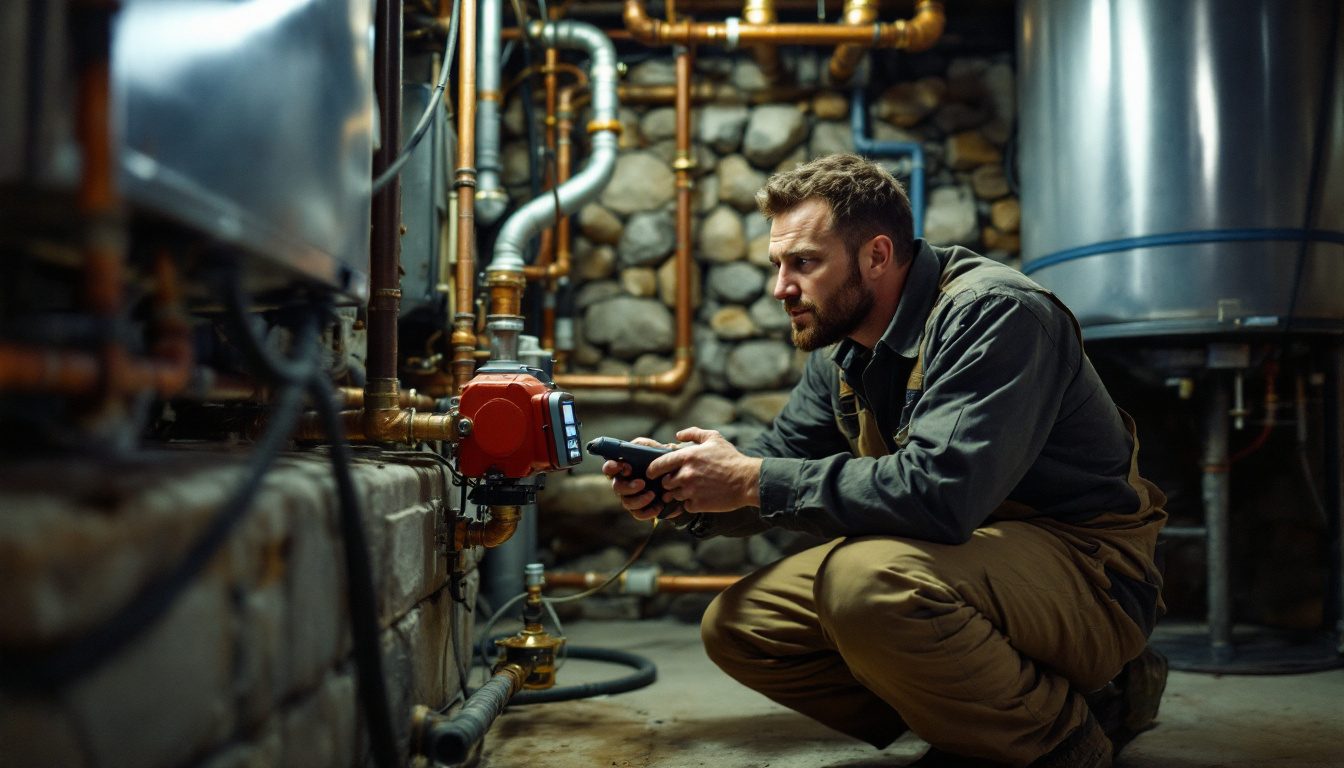
How does an oil heating system work? An oil heating system pumps heating oil from a tank to a burner, sprays it through a nozzle as a mist, lights it and sends the heat through a furnace’s ducts or a boiler’s pipes. About 4.93 million US homes heated mainly this way in 2020.
Key Takeaways
- 4.93 million US homes heated mainly with fuel oil or kerosene in 2020; 4.07 million were in the Northeast (EIA RECS 2020, Table HC6.7).
- Federal floors: 83% AFUE for indoor oil furnaces, 86% for oil hot water boilers (10 CFR 430.32).
- Heating oil (ASTM D396) and diesel (ASTM D975) are both No. 2 distillates (EIA Glossary).
- New York requires at least 10% biodiesel in heating oil since July 1, 2025, and 20% from 2030 (NY ECL 19-0327).
- A common burner control gives the flame 15 seconds to light before it locks out (R.W. Beckett AF/AFG manual).
What is an oil heating system?
An oil heating system is central heating that burns liquid fuel, usually No. 2 heating oil, in a pressure-atomizing burner mounted on a furnace or boiler. EIA defines No. 2 fuel oil as a distillate meeting ASTM D396, “used in atomizing type burners for domestic heating.”
The parts are a tank, a filtered fuel line, the burner and the appliance; our guide to oil tank sizes, gauges and leak rules covers the tank. For how oil compares with gas, propane and heat pumps, see our overview of home heating system types.
How does oil heat work, step by step?
Oil heat works by spraying fuel as a mist, lighting it and proving the flame electronically. A primary control runs the sequence; these steps follow the Beckett 7505 control in the R.W. Beckett AF/AFG burner manual.
- Call for heat. The thermostat closes; the control runs a 3 to 10 seconds safe start check.
- Valve-on delay. The motor spins the fan and fuel pump and the igniter turns on for 15 seconds, oil valve still shut.
- Trial for ignition. The valve opens and the pump forces oil through the nozzle as a cone of mist. Nozzles are calibrated at 100 psig; a 1.00 gph nozzle at 140 psig flows 1.18 gph.
- Flame proving. A cad cell must see flame within the 15 second lockout time or the control locks out. Normal reading with flame: 0 to 1600 ohms.
- Run. The igniter stays on 10 more seconds; hot gases cross the heat exchanger and a blower or circulator moves the heat.
- Flame loss. The control waits 60 seconds and retries; three flame losses in a row cause lockout.
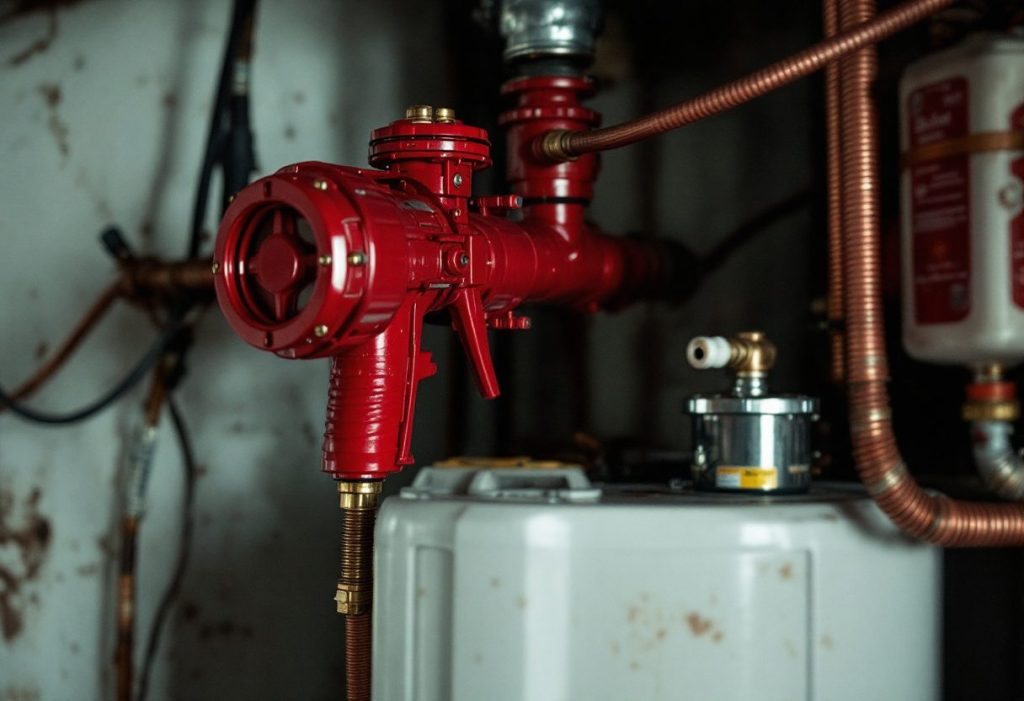
Oil furnace or oil boiler: which kind of oil heating system do you have?
Most oil homes have a furnace. EIA’s 2020 survey counted 3.10 million oil or kerosene homes with a warm-air furnace, 1.62 million with a steam or hot water boiler and 0.21 million with other equipment: roughly 63% furnaces and 33% boilers by our arithmetic on RECS Table HC6.7.
The burner is the same; the heat exchanger differs. A furnace heats air for ducts; a boiler heats water, as our hydronic heating explainer describes, or makes steam, covered in our steam heat guide.
How efficient must a new oil heating system be?
A new indoor oil furnace must reach at least 83% AFUE and a new oil hot water boiler at least 86%, under 10 CFR 430.32. AFUE is the share of fuel energy that becomes heat over a year; DOE’s Energy Saver guide (archived copy) puts older furnaces and boilers at 56% to 70%.
| Equipment | Federal minimum AFUE | Applies to units made |
|---|---|---|
| Indoor oil furnace | 83% | On or after May 1, 2013 |
| Outdoor (weatherized) oil furnace | 78% | On or after January 1, 1992 |
| Mobile home oil furnace | 75% | On or after September 1, 1990 |
| Oil hot water boiler | 86% | On and after January 15, 2021 |
| Oil steam boiler | 85% | On and after January 15, 2021 |
| Indoor gas furnace (for comparison) | 80%, rising to 95% | 95% from December 18, 2028 |
The 95% floor from 2028 covers gas furnaces only, as our report on the 95% AFUE gas furnace rule explains. ENERGY STAR asks 87% AFUE of oil furnaces and 87% or greater of oil boilers. Carrier’s oil furnace page cites that 87% without a link; we confirmed it at the source.
Fuel price drives the bill; see our cost per million Btu by fuel and the heating oil price tracker.
Heating oil vs kerosene vs diesel: what is the difference?
Heating oil and diesel are near twins; kerosene is lighter. The EIA Glossary defines No. 2 distillate as usable “as either a diesel fuel or a fuel oil,” so specification, sulfur and tax rules separate them.
| Fuel | Standard | Typical use | Cold weather |
|---|---|---|---|
| No. 2 heating oil | ASTM D396 | Atomizing burners in home furnaces and boilers | Begins to congeal at 20°F and colder |
| No. 1 oil and kerosene (1-K, 2-K) | ASTM D396 (No. 1); ASTM D3699 (kerosene) | Outdoor tanks in very cold places; space heaters and stoves | No. 1 keeps flowing to about minus 60°F |
| No. 2 diesel | ASTM D975 | High-speed diesel engines in trucks and cars | Same No. 2 grade; UAF says it congeals at 20°F and colder |
Cold is why kerosene-type fuel exists in heating. The University of Alaska Fairbanks Cooperative Extension Service says No. 2 oil begins to congeal at 20°F and colder and advises buying only No. 1 oil for an outdoor tank that cannot be kept warm.
Heating oil vs diesel is mostly rules. EIA lists 138,500 Btu per gallon for heating oil and 137,381 Btu for diesel. Federal rules cap diesel at 15 ppm sulfur (40 CFR 1090.305); per the EIA heating oil explainer, New York required 15 ppm heating oil first, in 2012, then Delaware and New Jersey in 2016 and New England on July 1, 2018. IRS Publication 510 treats home heating as a nontaxable use; tax-free fuel is dyed with Solvent Red 164 (26 CFR 48.4082-1).
Before substituting fuels, check the burner label: the Beckett manual rates ASTM D396 No. 1 or No. 2 oil and B6 to B20 blends, not D975 diesel.
What is bioheat, and which states require it?
Bioheat is heating oil blended with biodiesel: B5 is 5%, B20 is 20%. EIA says supplier blends are “generally 5% biofuel by volume,” but two states set higher floors in statute.
- New York (Environmental Conservation Law 19-0327): B5 in Nassau, Suffolk and Westchester counties from July 1, 2018; at least five percent statewide from July 1, 2022; at least ten percent from July 1, 2025; at least twenty percent from July 1, 2030.
- Connecticut (General Statutes 16a-21b): not less than ten per cent by July 1, 2025, fifteen per cent by 2030, twenty per cent by 2034 and fifty per cent by July 1, 2035, with a waiver for short supply or consumer hardship.
The Beckett AF/AFG manual lists B6 to B20, below Connecticut’s 2035 B50 level, so ask your technician whether your burner is listed for the blend delivered.

Who still uses an oil heating system, and where?
An oil heating system is now a regional technology. EIA’s 2020 survey counted 4.93 million oil or kerosene homes, about 4.0% of 123.53 million US homes; 4.07 million were in the Northeast, including 2.12 million in the Middle Atlantic and 1.94 million in New England, against 0.28 million in the Midwest.
That is one in three New England homes. EIA’s October 2026 winter outlook counts 4.13 million oil-heated households this winter, down from 5.05 million in 2021. Our heating oil usage estimates turn those homes into gallons, and our guide to cash heating oil covers how they buy it.
What service does an oil heating system need each year?
An oil heating system needs a professional service every year. Beckett’s manual says a qualified technician “must service this burner annually,” including:
- Replace the oil supply line filter.
- Check pump pressure and the pump’s cutoff.
- Check electrode tip settings and the ignition system; clean the cad cell if needed.
- Check the primary control’s safety lockout timing.
- Inspect the vent and chimney for soot, and clean the flue passages.
- Set draft, then tune the flame with smoke and CO2 or O2 readings.
The manual also asks owners to check the tank level weekly and keep it full in summer to limit condensation. Our boiler service checklist covers the water side of an oil boiler.
Safety: stop pressing reset
Repeated resets can pump unburned oil into a hot chamber. Beckett’s control limits retries to prevent “excessive accumulation of oil in the appliance firing chamber,” and after three lockouts in a row enters a restricted lockout that a qualified service technician must clear. DOE notes a leaking furnace heat exchanger can cause carbon monoxide poisoning, so keep a CO alarm placed as our CO detector placement guide describes.
How we researched this
Researched October 8, 2026. We opened 26 documents (3 failed to load) and cite the 14 entries below: eCFR rules, EIA tables, ENERGY STAR, IRS guidance, two state statutes, a University of Alaska Fairbanks bulletin and one manufacturer manual (R.W. Beckett, Tier 2, burner operation only). Excluded: dealer claims of 30-year system life (no primary source), installed prices (no federal series), Reddit (combustion safety) and a Massachusetts blend mandate we could not confirm in statute.
Frequently asked questions
Is oil heat being phased out in the US?
Not by federal rule. New indoor oil furnaces remain legal at 83% AFUE or better under 10 CFR 430.32, and the 2028 95% rule covers gas furnaces only. The pressure is on the fuel: New York requires 20% biodiesel from 2030 and Connecticut 50% by July 1, 2035. Where a gas main runs past the house, the alternative is to leave oil entirely; our guide to converting oil heat to gas walks through the utility steps, chimney liner and tank.
Can you burn kerosene in an oil furnace?
Check the burner label first. The Beckett AF/AFG manual rates its burner for ASTM D396 No. 1 or No. 2 heating oil, and EIA says kerosene-type stove oils resemble No. 1 fuel oil. The University of Alaska Fairbanks extension service advises No. 1 oil for unheated outdoor tanks.
Is heating oil the same as diesel?
Close, not identical. EIA says No. 2 distillate can be either diesel or fuel oil, but diesel follows ASTM D975 and heating oil ASTM D396. Federal rules cap diesel at 15 ppm sulfur, the limit New York, New Jersey, Delaware and New England also set for heating oil.
How long does an oil burner take to light?
On the Beckett 7505 control, a call for heat starts a 3 to 10 seconds safe start check and a 15 second valve-on delay. The oil valve then opens and the cad cell must see flame within 15 seconds: about 40 seconds at most to run or lock out, by our arithmetic.
How efficient is an oil furnace?
A new indoor oil furnace must reach at least 83% AFUE under federal rules in force since May 1, 2013, and ENERGY STAR asks 87%. DOE’s Energy Saver guide puts older fossil fuel furnaces and boilers at 56% to 70%.
How often should an oil heating system be serviced?
Once a year. The R.W. Beckett manual says a qualified technician must service its burner annually: new oil line filter, pump pressure, ignition and lockout timing checks, flue cleaning and combustion tuning with test instruments. DOE notes a leaking heat exchanger can cause carbon monoxide poisoning.
Sources
- eCFR. “10 CFR 430.32, Energy and water conservation standards and their compliance dates.” https://www.ecfr.gov/current/title-10/chapter-II/subchapter-D/part-430/subpart-C/section-430.32. Accessed October 2026.
- U.S. EIA. “Residential Energy Consumption Survey 2020, Table HC6.7.” https://www.eia.gov/consumption/residential/data/2020/hc/xls/HC%206.7.xlsx. Accessed October 2026.
- U.S. Energy Information Administration. “Winter Fuels Outlook, October 2026 Short-Term Energy Outlook.” https://www.eia.gov/outlooks/steo/report/perspectives/2026/10-winterfuels/article.php. Accessed October 2026.
- U.S. EIA. “Heating oil explained.” https://www.eia.gov/energyexplained/heating-oil/. Accessed October 2026.
- U.S. EIA. “Glossary” (entries N and K). https://www.eia.gov/tools/glossary/index.php?id=N. Accessed October 2026.
- U.S. EIA. “British thermal units (Btu).” https://www.eia.gov/energyexplained/units-and-calculators/british-thermal-units.php. Accessed October 2026.
- New York State Senate. “Environmental Conservation Law 19-0327, Bioheating fuel requirements.” https://www.nysenate.gov/legislation/laws/ENV/19-0327. Accessed October 2026.
- Connecticut General Assembly. “General Statutes 16a-21b.” https://www.cga.ct.gov/current/pub/chap_296.htm. Accessed October 2026.
- R.W. Beckett Corporation. “AF/AFG Oil Burner Manual” (hosted by Weil-McLain). https://www.weil-mclain.com/wp-content/uploads/RW-Beckett-AFG-Burner-Manual-for-Ultra-Oil-VBL-0321.pdf. Accessed October 2026.
- University of Alaska Fairbanks Cooperative Extension Service. “Keeping Your House Operating During a Cold Alaska Winter.” https://uaf.edu/ces/publications/database/energy/files/pdfs/EEM-04955-Keep-House-Operating-Cold.pdf. Accessed October 2026.
- ENERGY STAR. “Boilers” and “Furnaces Key Product Criteria.” https://www.energystar.gov/products/boilers. Accessed October 2026.
- eCFR. “40 CFR 1090.305, ULSD standards” and “26 CFR 48.4082-1.” https://www.ecfr.gov/current/title-40/chapter-I/subchapter-U/part-1090/subpart-D/section-1090.305. Accessed October 2026.
- Internal Revenue Service. “Publication 510, Excise Taxes.” https://www.irs.gov/publications/p510. Accessed October 2026.
- U.S. Department of Energy. “Furnaces and Boilers,” Energy Saver (archived copy). https://web.archive.org/web/2025id_/https://www.energy.gov/energysaver/furnaces-and-boilers. Accessed October 2026.
Leave a Reply