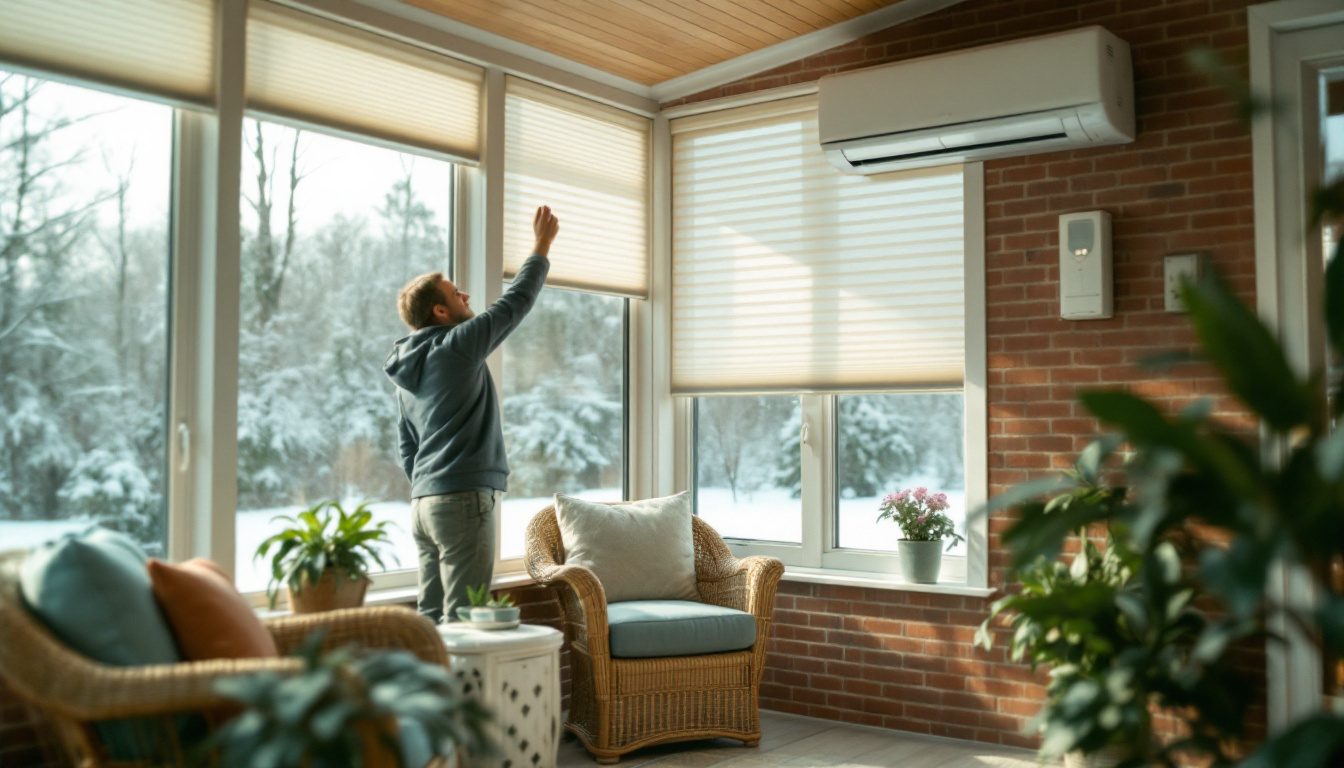
How do you handle sunroom heating and cooling? Treat the room as its own zone. In our worked example a glass room loses 3.4 times the heat of an ordinary room the same size, so most homes do best with a dedicated ductless mini split sized from a load calculation, plus exterior shading for summer sun.
Key Takeaways
- ENERGY STAR Northern-zone windows need U-0.22 or lower (ENERGY STAR criteria); a zone 5A code wall is U-0.057.
- Fairfax County, Virginia, allows sunroom windows up to U-0.45, against U-0.30 for an addition (2021 Virginia Residential Code).
- About 76% of sunlight on standard double-pane windows becomes heat, per DOE Energy Saver (archived copy).
- The ENERGY STAR AC chart adds 10 percent for a very sunny room; in our example the glass alone uses that up.
- At 18.31 cents per kWh (EIA, July 2026), 10,000 Btu of resistance heat costs $0.54; a minimum-efficiency heat pump, $0.24.
- Portable heaters were involved in about 1,600 fires a year in 2020 to 2022 (CPSC).
Why is sunroom heating and cooling harder than for other rooms?
Sunroom heating and cooling is harder because glass moves heat several times faster than an insulated wall, in both directions: out in winter, in on sunny afternoons. Many energy codes define a sunroom as a one-story attached structure whose glazing exceeds 40 percent of its exterior wall and roof area.
U-factor rates heat flow in Btu/h per square foot per °F; lower is better. The Michigan adoption of the IECC lists U-0.057 for a frame wall in climate zone 5A, U-0.030 for a ceiling and U-0.32 for windows. Sunroom glass at Fairfax County’s sunroom maximum of U-0.45 conducts 7.9 times as much heat per square foot.
The second label number, solar heat gain coefficient (SHGC), is the share of sunlight that gets through as heat. ENERGY STAR caps it at 0.23 in the South-Central and Southern zones.
How much more heat does a glass room lose than a normal room?
A glass room can need more than three times the heat of an ordinary room the same size. We compared a 12 by 16 foot zone 5A code room with a sunroom on the same footprint, using Q = U x A x temperature difference.
Assumptions: 320 sq ft of exterior wall. The ordinary room is 15% window at U-0.32; the sunroom is 80% glass, 50% of walls plus roof. Both share a solid roof at U-0.030. Floor and air leakage are left out, and the winter case is 70°F inside, 0°F outside.
| Surface (UA, Btu/h per °F) | Ordinary room | Sunroom, U-0.45 glass | Sunroom, U-0.22 glass |
|---|---|---|---|
| Opaque wall at U-0.057 | 272 sq ft = 15.5 | 64 sq ft = 3.6 | 64 sq ft = 3.6 |
| Windows or glass | 48 sq ft = 15.4 | 256 sq ft = 115.2 | 256 sq ft = 56.3 |
| Ceiling at U-0.030 | 192 sq ft = 5.8 | 5.8 | 5.8 |
| Heat loss at a 70°F difference | 2,560 Btu/h | 8,720 Btu/h | 4,600 Btu/h |
The code-minimum sunroom loses 3.4 times as much heat, and glass is 92% of its loss. ENERGY STAR Northern glass cuts it to 4,600 Btu/h.
Solar gain follows Q = SHGC x glass area x sunlight. Assume 100 Btu/h of sun per square foot on the 16 foot wall (illustrative). At SHGC 0.40 the ordinary room admits 768 Btu/h; the sunroom admits 4,096, or 2,355 with SHGC 0.23 glass.
How do you size a sunroom mini split?
Size a sunroom mini split from a load calculation that counts the glass, its orientation and its SHGC, not from floor area.
The ENERGY STAR chart gives a 150 to 250 sq ft room 6,000 Btu/h, plus 10 percent if very sunny: 6,600 Btu/h for our example, plus 600 per occupant beyond two. Our room BTU sizing guide explains it. Yet at 95°F outside and 75°F inside, our sunroom envelope alone needs about 6,590 Btu/h, or about 10,680 if the sunlight doubles. The ordinary room needs about 1,500.
Winter can set the size instead: 8,720 Btu/h at 0°F, when heat pump output is lowest, so check capacity at your design temperature using cold climate heat pump ratings. Do not round up: DOE warns that oversized units cause short cycling and poor humidity control (DOE Energy Saver, archived copy). Ask for an ACCA Manual J in writing, with the glass values it used.
What does the energy code say about sunroom heating and cooling?
Energy codes ease insulation and window rules for a sunroom only if it is thermally isolated: closed off from the house and conditioned separately. Otherwise, IECC-based codes treat it as a standard addition held to full house requirements.
Fairfax County restates the 2021 Virginia Residential Code: Category I to III sunrooms are unconditioned. A Category IV sunroom earns reduced requirements only with a separate, independently controlled system and closeable doors and windows to the house. Fairfax then allows sunroom windows at U-0.45. Michigan’s version requires R-24 ceilings in zones 5 to 7 and R-13 walls; Montgomery County, Maryland, lists the provision as IECC R402.2.12.
Code point: extending house ducts can change what you built
South Bend, Indiana, requires a sunroom to be conditioned “as separate zones for heating and cooling or conditioned by separate equipment.” An addition that misses any condition “is considered a standard room addition.” Depending on local code, an unzoned duct run can cost the sunroom its reduced rules; ask the building department first and see how zoning dampers and separate thermostats work.
Which sunroom heating and cooling option costs least to run?
A ductless heat pump is the cheapest way to run sunroom heating and cooling from one machine. At the July 2026 EIA average of 18.31 cents per kWh, it delivers 10,000 Btu of heat for about $0.24 at the federal minimum, against $0.54 for electric resistance.
The floors come from 10 CFR 430.32: HSPF2 7.5 and SEER2 14.3 for split heat pumps, and CEER 13.7 for a small window unit built from May 26, 2026. CEER and SEER2 use different tests.
| Option | Heats | Cools | Cost per 10,000 Btu | Sunroom fit |
|---|---|---|---|---|
| Ductless mini split | Yes | Yes | Heat $0.24; cool $0.13 | Own zone and thermostat |
| Extending house ducts | Yes | Yes | Depends on house system | Adds load; may forfeit sunroom status |
| Electric baseboard | Yes | No | $0.54 | Hardwired, costly to run |
| Space heater (1,500 W) | Yes | No | $0.54 | 5,118 Btu/h; occasional use only |
| Window air conditioner | No | Yes | About $0.13 | Needs an operable sash |
| Ceiling fan | No | Feels cooler | Motor only | Set cooling about 4°F higher |
| Awnings, shades, film | Some | Cuts solar gain | None | Shrinks every other load |
At 0°F our sunroom costs about $0.47 an hour on resistance heat and about $0.21 on a minimum heat pump (more in the coldest hours); the ordinary room, $0.14. Compare your rate with our state electricity prices.
DOE notes a mini split needs only a three-inch hole, with the outdoor unit up to 50 feet away. Our mini split cost review covers the thin federal price data.
How to heat a sunroom without wasting money
Cut the glass loss first, then add a dedicated heat source sized to what remains.
- Close it off. Keep a closeable door between the sunroom and the house.
- Cover the glass at night. DOE says tight cellular shades can reduce window heat loss by 40% or more.
- Get a load number. Use a Manual J with the real glass values.
- Match the heater to use. A ductless mini split suits daily winter use; baseboard heaters need no outdoor unit but run at $0.54 per 10,000 Btu.
- Keep space heaters for short sessions. A 1,500 W unit delivers 5,118 Btu/h, well short of our 8,720 Btu/h design load.
For portable heaters, the CPSC says keep them three feet from combustibles, plug them into a wall outlet, never an extension cord, and turn them off when sleeping. It counts an average of 70 deaths and 150 injuries a year (2020 to 2022). See our space heater fire data; the same sizing logic applies to heating and cooling a garage.
How to cool a sunroom: shade first, then air conditioning
To cool a sunroom, block the sun before it hits the glass, then size air conditioning for the rest.
DOE’s window attachment guidance (archived copy) says awnings can cut summer solar gain by up to 65% on south windows and 77% on west windows; tight cellular shades, up to 60%. Film suits fixed glass, but DOE warns most manufacturers void warranties if film goes on an insulated glazing unit.
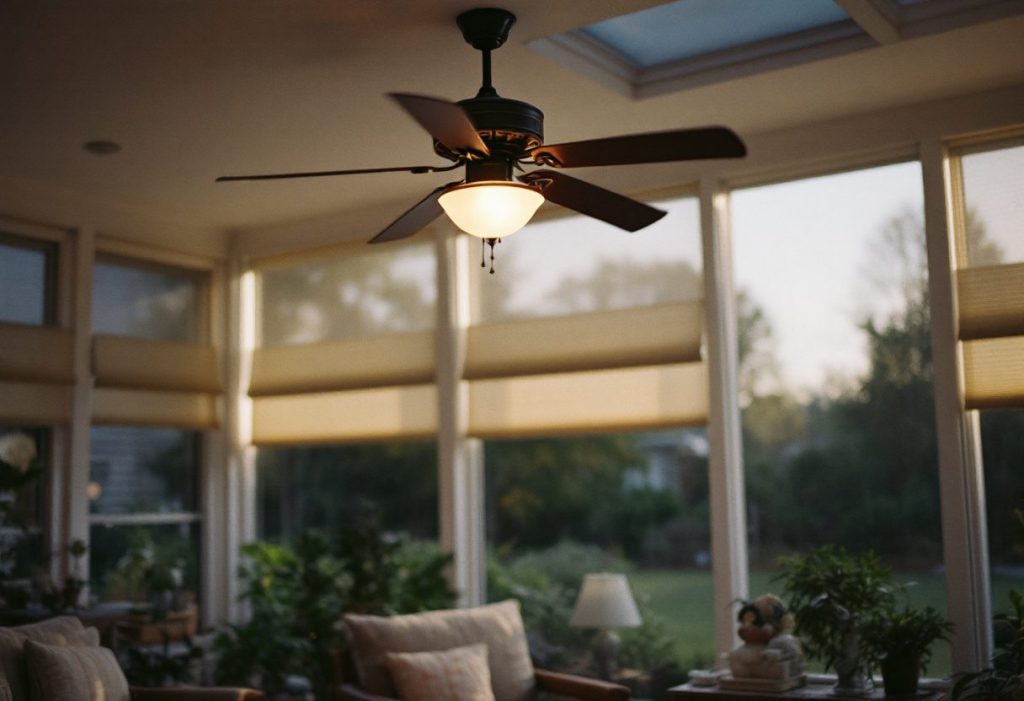
A ceiling fan lets you raise the thermostat about 4°F without reducing comfort (DOE, archived copy) if it spins the right summer direction. In winter the same south glass helps, which is the idea behind passive solar heating.
For the remaining load, window units need an operable sash and single-hose portables pull hot air back in, as our portable versus window AC review explains; a mini split avoids both.
How we researched this
Research date: October 8, 2026. We consulted 19 sources, including three top-ranking competitor pages, and cite 12. Code text comes from state, county and city restatements, because codes.iccsafe.org blocks automated reading.
Costs use EIA’s July 2026 price and federal minimums. Excluded: vendor price surveys (no federal series covers installed sunroom HVAC) and the unsourced BTU-per-square-foot rules on ranking pages. Reddit was not used because the topic includes heater fire safety. The 100 Btu/h per sq ft sunlight figure is a stated assumption, not a measurement.
Frequently asked questions
What is the best way to heat and cool a sunroom?
For year-round use, a ductless mini split heat pump usually fits best. It heats and cools as its own zone and, at the federal HSPF2 7.5 minimum, delivers 10,000 Btu of heat for about $0.24 at July 2026 prices, against $0.54 for resistance heat.
How many BTU do I need for a sunroom?
More than floor-area charts say. ENERGY STAR gives a 150 to 250 sq ft room 6,000 Btu/h, plus 10 percent if very sunny. Our 192 sq ft sunroom needed about 6,590 Btu/h of cooling for the envelope alone and 8,720 Btu/h of heat at 0°F.
Can I extend my home’s ductwork into a sunroom?
Sometimes. Your system was sized without the glass, and codes such as South Bend’s treat a sunroom without separate zones or separate equipment as a standard room addition held to full insulation rules. DOE adds that attic ducts can lose more than 30% of space-conditioning energy.
Is a three-season sunroom supposed to be heated?
No. Under the 2021 Virginia Residential Code, as Fairfax County restates it, Category I to III sunrooms are unconditioned. Only a Category IV sunroom, with its own controlled heating or cooling and closeable doors to the house, gets reduced rules. Adding heat may trigger new code requirements in many jurisdictions.
Is it safe to use a space heater in a sunroom?
For short sessions, if you follow CPSC advice: keep it at least three feet from drapes and furniture, plug it directly into a wall outlet, and turn it off when sleeping. CPSC estimates portable heaters were involved in about 1,600 fires a year from 2020 to 2022.
How do I keep a sunroom cool without air conditioning?
Shade the glass from outside first. DOE says awnings can cut summer solar heat gain by up to 65% on south-facing windows and 77% on west-facing ones. A ceiling fan then lets you set the thermostat about 4°F higher, per DOE.
Sources
- ENERGY STAR. “ENERGY STAR Certification Criteria for Residential Windows.” https://www.energystar.gov/sites/default/files/asset/document/ES_Windows_Table_Oct2023.pdf. Accessed October 2026.
- ENERGY STAR. “Room Air Conditioners: Sizing.” https://www.energystar.gov/products/room_air_conditioners. Accessed October 2026.
- Michigan Administrative Code. “R 408.30547d, Building thermal envelope.” https://www.law.cornell.edu/regulations/michigan/Mich-Admin-Code-R-408-30547d. Accessed October 2026.
- Fairfax County Land Development Services. “Energy Conservation.” https://www.fairfaxcounty.gov/landdevelopment/energy-conservation. Accessed October 2026.
- City of South Bend. “Energy Code Compliance: Sun Room.” https://southbendin.gov/wp-content/uploads/2026/01/ENERGY-COMPLIANCE-SUN-ROOM.pdf. Accessed October 2026.
- Montgomery County, Maryland, DPS. “2021 IECC Selection Form.” https://www.montgomerycountymd.gov/DPS/Resources/Files/RCI/2021%20IECC%20Selection%20Form%20for%20ADD-ALT.pdf. Accessed October 2026.
- U.S. Energy Information Administration. “Electric Power Monthly, Table 5.6.A.” https://www.eia.gov/electricity/monthly/epm_table_grapher.php?t=epmt_5_6_a. Accessed October 2026.
- eCFR. “10 CFR 430.32, Energy and water conservation standards.” https://www.ecfr.gov/current/title-10/chapter-II/subchapter-D/part-430/subpart-C/section-430.32. Accessed October 2026.
- U.S. Consumer Product Safety Commission. “Keep Warm and Safe This Winter.” https://www.cpsc.gov/Newsroom/News-Releases/2026/Keep-Warm-and-Safe-This-Winter-Tips-for-Using-Generators-Furnaces-and-Space-Heaters. Accessed October 2026.
- U.S. DOE Energy Saver. “Energy Efficient Window Attachments.” Archived copy. https://web.archive.org/web/2025id_/https://www.energy.gov/energysaver/energy-efficient-window-attachments. Accessed October 2026.
- U.S. DOE Energy Saver. “Fans for Cooling.” Archived copy. https://web.archive.org/web/2025id_/https://www.energy.gov/energysaver/fans-cooling. Accessed October 2026.
- U.S. DOE Energy Saver. “Ductless, Mini-Split Heat Pumps.” Archived copy. https://web.archive.org/web/2025id_/https://www.energy.gov/energysaver/ductless-mini-split-heat-pumps. Accessed October 2026.
Leave a Reply