Is heat tape for water pipes safe? Yes, if it is UL, CSA or FM certified, plugged into ground-fault protection, never overlapped unless the maker allows it, and insulated only the way its instructions say. Installed wrong, it burns: the CPSC once tied heat tapes to about 3,300 home fires a year.
Key Takeaways
- CPSC estimated 3,300 residential heat tape fires a year, with 20 deaths and 160 injuries, in release 90-162 (1990).
- Its 1996 estimate was 1,500 fires a year, and it urged replacing uncertified tapes more than 3 years old (CPSC 96-062).
- Self-regulating Raychem Frostex cable puts out 3 watts per foot at 50°F, and more as the pipe cools (Chemelex).
- Constant wattage EasyHeat AHB cable runs at 7 watts per foot whenever its thermostat closes at 38°F (distributor spec).
- At 17.30 cents per kWh (EIA, 2025), 20 feet of 7 W/ft cable running 30 days nonstop costs about $17.44.
- NEC Section 427.22 requires ground-fault protection on pipeline heat trace, as EC&M restates it.
What is heat tape for water pipes, and how does it work?
Heat tape for water pipes is an electric cable that lies against a pipe and warms it just enough to stop the water freezing. Most residential kits plug into a 120 volt outlet and switch on through a built-in thermostat or a self-regulating core.
It belongs on the pipes the American Red Cross says freeze most often: supply lines in unheated basements, crawl spaces, attics, garages and cabinets, and pipes against poorly insulated exterior walls. How a crawl space is vented or sealed decides how cold its pipes get.
Is heat tape safe? What the CPSC fire data shows
Heat tape is safe when it is certified, matched to the pipe and installed to its instructions; the federal fire record comes from tapes that were not. CPSC estimated about 3,300 residential fires a year in 1990 and 1,500 a year in 1996.
The 1990 estimate, built from US Fire Administration and NFPA data, also counted 20 deaths and 160 injuries a year (CPSC release 90-162). These are the newest CPSC heat tape estimates we could find, so treat them as a historical baseline. Our heating fire statistics by equipment type cover other heating equipment.
The 1996 release followed a Philadelphia Zoo fire that killed 23 primates. CPSC’s advice: replace uncertified tapes more than 3 years old with ones certified by UL, CSA or FMRC.
We also searched all 10,039 records in CPSC’s recall database, June 1973 to October 1, 2026. None was a heat tape or pipe heating cable recall, so the risk lies in installation and age, not in a recall list.
Self-regulating vs constant wattage heat tape for water pipes: which should you buy?
Self-regulating cable is the safer pick for most homes, because its output falls as the pipe warms. Constant wattage cable puts out the same heat per foot whenever it is on, so its spacing, overlap and insulation rules are stricter.
Chemelex’s Frostex data sheet puts it plainly: “As the environment becomes colder, cable resistance decreases to generate greater heat.” The products below are examples, not endorsements.
| Cable type (example) | How output is controlled | Rated output | Plastic pipe | Insulation over it |
|---|---|---|---|---|
| Self-regulating (Raychem Frostex) | Polymer core adjusts output along its length | 3 W/ft at 50°F, 120 V | Yes; more runs needed | Designed for insulated pipe; run straight, not spiraled |
| Constant wattage, built-in thermostat (EasyHeat AHB) | On at 38°F or below, off at 45°F and above | 7 W/ft, 120 V | Yes, up to 1-1/2 in. | Per the instructions in the box |
| Constant wattage, no thermostat (EasyHeat HB) | Separate thermostat or a watched pilot light | 7 W/ft, 120 V | No; metal only | Never |
The HB installation instructions say the cable is for “metal water pipes only” and must never be energized above 50°F.
How to install heat tape on water pipes, step by step
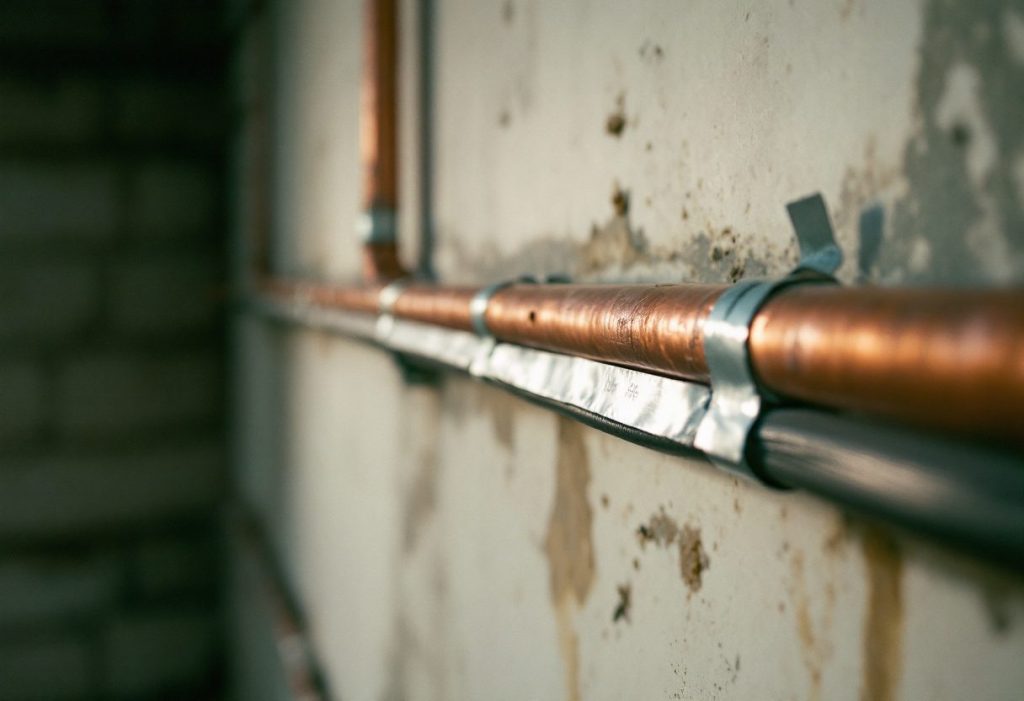
To install heat tape on water pipes, lay a certified cable directly on the bare pipe, keep it from crossing itself, tape it down, insulate only as allowed and plug it into ground-fault protection. This order follows CPSC and EasyHeat HB guidance.
- Buy the right cable. Look for a UL, CSA or FM mark, sized to the pipe’s diameter and length, as CPSC advises.
- Prepare the pipe. Remove old tape, file sharp edges, clear combustibles and fix leaks.
- Lay it on bare pipe. Never on top of pipe insulation. Run it straight or spiral it only as the instructions show.
- Never wrap it over itself unless the instructions permit it. HB cable needs a 1/2 inch minimum gap between spiral turns.
- Tape it down with electrical tape, about every six inches for HB cable, never metal binding.
- Insulate only if allowed. CPSC says use non-flammable fiberglass, not foam or vinyl, and keep the end cap sealed and off the ground.
- Plug in and inspect. Use a grounded GFCI outlet, and check the cable each year for charring, cuts or bare wire.
Safety correction
Sliding a foam sleeve on first and wrapping tape over it is backwards. CPSC says tape goes on the bare pipe, and its 1989 release 89-088 warned that “Over-insulation can cause a fire.”
Can you put heat tape on PVC or PEX plastic pipe?
You can put heat tape on PVC or PEX only if its label says it is rated for plastic pipe. EasyHeat’s HB sheet says “Do not use on plastic pipes,” while its AHB line is listed for metal and plastic pipe up to 1-1/2 inches.
Plastic spreads heat poorly, so it needs more cable. In the Frostex sizing table, a 3/4 inch pipe under 1/2 inch of insulation needs one run at 0°F if metal but two runs if plastic.
Sometimes the better fix is warmth, not cable: keeping an attached garage above freezing, as in our garage heating and cooling guide, or adding the insulation our home insulation data shows many houses lack.
Does heat tape need a GFCI outlet, and can you use an extension cord?
Yes, heat tape needs ground-fault protection. CPSC’s 1996 guidance says to plug heat tapes into a GFCI-protected outlet using the 3-prong plug, and EasyHeat warns that fault current from a damaged cable “may not be large enough” to trip a conventional circuit breaker.
EC&M’s 2025 code quiz restates NEC Section 427.22 as requiring ground-fault protection of equipment on pipeline heat trace. Chemelex builds a 27 mA ground-fault plug into each Frostex kit. Adopted NEC editions vary, so check with your local inspector.
Extension cords are a gray area: popular guides say never, while EasyHeat’s HB sheet allows only a properly sized, grounded, certified outdoor cord. A GFCI outlet within reach is safer, the same logic as our space heater safety advice. A GFCI that keeps tripping is a warning, like a breaker that keeps tripping.
How much does heat tape cost to run?
Heat tape costs about $0.87 per foot per month if a 7 W/ft cable runs nonstop for 30 days at the 2025 US average residential price of 17.30 cents per kWh. Self-regulating cable at its 3 W/ft rating costs well under half that.
The method: watts per foot times feet times hours, divided by 1,000, gives kWh; multiply by your price. Ours is from EIA’s Electric Power Monthly Table 5.3; swap in your local rate from our electricity prices by state.
| Cable and length | Watts drawn | kWh per 30 days, nonstop | Cost at 17.30 cents/kWh |
|---|---|---|---|
| 7 W/ft constant wattage, 10 ft | 70 W | 50.4 | $8.72 |
| 7 W/ft constant wattage, 20 ft | 140 W | 100.8 | $17.44 |
| 7 W/ft constant wattage, 50 ft | 350 W | 252.0 | $43.60 |
| 3 W/ft self-regulating at 50°F, 20 ft | 60 W | 43.2 | $7.47 |
Those are ceilings for constant wattage cable, since the AHB thermostat shuts off at 45°F, and floors for self-regulating cable in hard cold. Unplugging at season’s end, as the HB sheet advises once air stays above 50°F, ends the cost.
Cheaper protection comes first. The Red Cross advises keeping the house at 55°F or warmer when you travel in cold weather; our winter thermostat settings guide covers the tradeoff. A home energy audit finds the air leaks that chill pipe runs.
How we researched this
Research date: October 8, 2026. We read four CPSC heat tape releases (1989 to 1996), cited three, and queried all 10,039 records in CPSC’s recall web service ourselves. Ratings come from the Chemelex Frostex data sheet and EasyHeat documents; products are examples, not recommendations. Costs use EIA’s 2025 residential average.
Excluded: contractor and lead-generation pages, law firm pages repeating unsourced fire counts, and vendor price surveys; no federal series publishes installed heat tape prices. NFPA 70 is not openly readable, so NEC 427.22 is attributed to EC&M. Reddit was skipped for this electrical fire safety topic.
Frequently asked questions
Does heat tape go under or over pipe insulation?
Under. CPSC says to apply heat tape directly on the pipe, never on top of the insulation covering it. Insulation then goes over the tape only if the manufacturer allows it, and CPSC recommends non-flammable fiberglass rather than foam or vinyl. Some cables, such as EasyHeat HB, must never be insulated at all.
Should heat tape be left plugged in all winter?
A thermostat or self-regulating cable can stay plugged in through the cold season, since it only heats hard when needed. EasyHeat’s AHB thermostat turns off at 45°F and above. EasyHeat recommends disconnecting HB cable at the end of the season, once air temperatures stay above 50°F.
How long does heat tape last?
No federal source sets a lifespan, but CPSC urged owners to replace uncertified heat tapes more than 3 years old with certified ones. It also says to inspect heat tapes each year and replace any showing discolored surfaces, especially at the plug, charring, cuts, breaks in the insulation or bare wires.
Can you cut heat tape to length?
Not constant wattage cable. EasyHeat’s HB sheet says never to alter the cable, because if it is made shorter it will overheat, and once cut it cannot be repaired. Self-regulating systems such as Frostex use a separate plug kit and end seal on each circuit, so follow that kit’s instructions exactly.
Can water pipe heat tape be used on gutters or a roof?
No. CPSC’s 1996 guidance says not to use heat tapes designed for water pipes on gutters, driveways or fuel lines. Roof and gutter de-icing cable is a separate product class with its own listing. Buy the cable that names your exact use on its label.
How do you thaw a frozen pipe safely?
Keep the faucet open and warm the pipe with an electric heating pad, a hair dryer, a space heater kept clear of flammables, or hot wet towels, the American Red Cross advises. Never use a blowtorch, kerosene or propane heater, or any open flame. Call a licensed plumber if you cannot reach or thaw it.
Sources
- US Consumer Product Safety Commission. “Mobile Homes: Have Heat Tapes, Cables Checked For Fire Hazards” (release 90-162, October 18, 1990). https://www.cpsc.gov/Newsroom/News-Releases/1991/Mobile-Homes-Have-Heat-Tapes-Cables-Checked-For-Fire-Hazards. Accessed October 2026.
- US Consumer Product Safety Commission. “CPSC Re-Issues Heat Tape Guidelines In Wake Of Zoo Fire” (release 96-062, January 22, 1996). https://www.cpsc.gov/Newsroom/News-Releases/1996/CPSC-Re-Issues-Heat-Tape-Guidelines-In-Wake-Of-Zoo-Fire. Accessed October 2026.
- US Consumer Product Safety Commission. “Check Heat Tapes, Cables For Possible Fire Hazards” (release 89-088, October 6, 1989). https://www.cpsc.gov/Newsroom/News-Releases/1990/Check-Heat-Tapes-Cables-For-Possible-Fire-Hazards. Accessed October 2026.
- US Consumer Product Safety Commission. “Recalls REST web service” (SaferProducts.gov, queried October 8, 2026). https://www.saferproducts.gov/RestWebServices/Recall?format=json. Accessed October 2026.
- US Energy Information Administration. “Electric Power Monthly, Table 5.3: Average Price of Electricity to Ultimate Customers.” https://www.eia.gov/electricity/monthly/epm_table_grapher.php?t=epmt_5_3. Accessed October 2026.
- American Red Cross. “Frozen Pipes.” https://www.redcross.org/get-help/how-to-prepare-for-emergencies/types-of-emergencies/winter-storm/frozen-pipes.html. Accessed October 2026.
- Chemelex (Raychem). “Frostex Residential Pipe Freeze Protection System” data sheet H57419. https://cdn.chemelex.com/Product%20Documents/Data%20Sheets/RAYCHEM-DS-H57419-FrostexPipeFreezeProtection-EN.pdf. Accessed October 2026.
- EasyHeat. “HB Heating Cable Installation Instructions” (11001-001 Rev. 8). https://morelectricheating.com/media/assets/product/documents/EasyHeat_HB_Heating_Cable_Installation_Instructions.pdf. Accessed October 2026.
- Morelectric Heating. “AHB013 EasyHeat 3ft Pipe Heating Cable” (EasyHeat AHB specification). https://morelectricheating.com/easy10074-easy-heat-ahb013-easyheat-3ft-pipe-heating-cable. Accessed October 2026.
- Morelectric Heating. “New Product Introduction: EasyHeat HB/HB2 Series” (7 W/ft rating). https://blog.morelectricheating.com/heating-cable/new-product-introduction-easyheat-hb-hb2-series-120240v-freeze-protection-cable-heating-cables-pre-assembled-ready-to-install-no-thermostat-no-plug-7-watts-per-foot/. Accessed October 2026.
- EC&M. “Code Quiz: Ground-Fault Protection Requirements for Electric Heat Trace Cable” (John Lupacchino, August 21, 2025). https://ecmweb.com/national-electrical-code/quizzes/article/55311141/code-quiz-ground-fault-protection-requirements-for-electric-heat-trace-cable. Accessed October 2026.
Leave a Reply