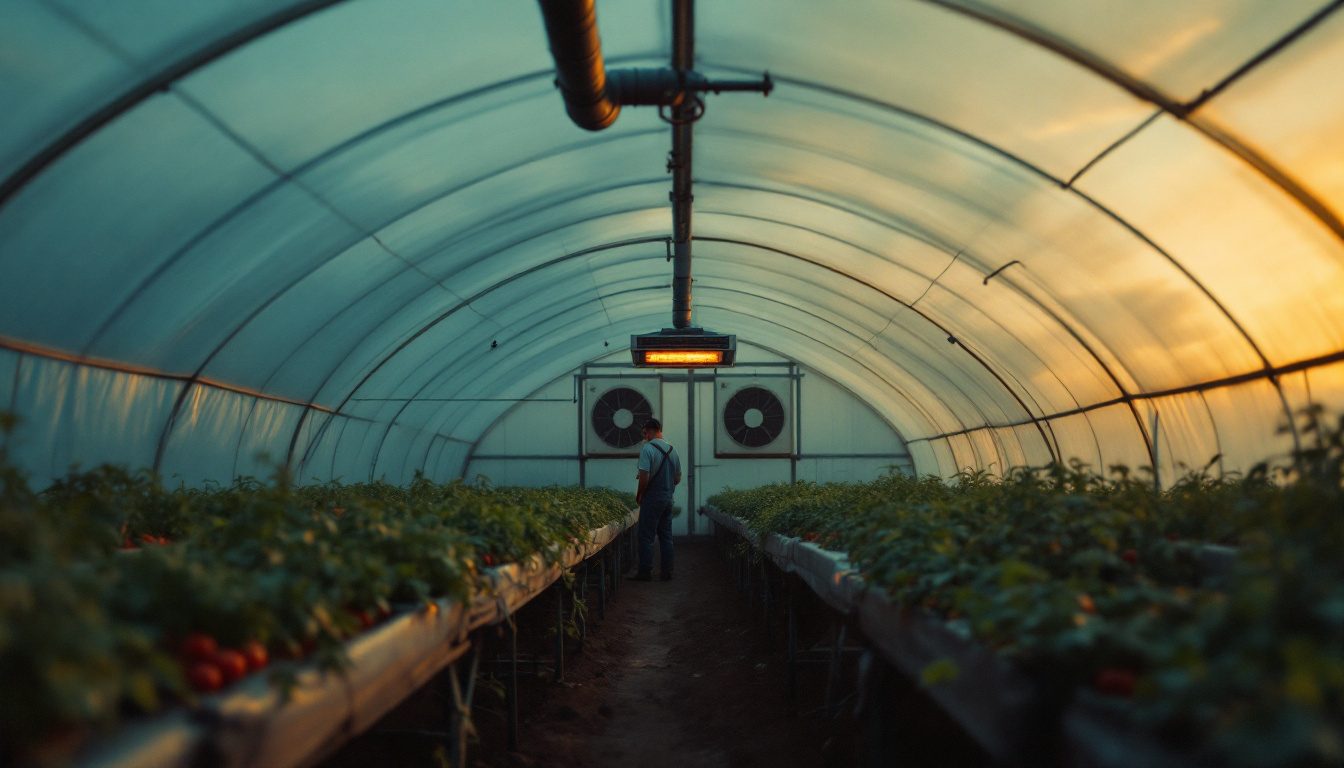
How much greenhouse ventilation does a greenhouse need? About one air change per minute in summer and two to three air changes per hour in winter, per UF/IFAS Extension. Size the heater separately: glazing area times U-value times the inside to outside temperature difference.
Key Takeaways
- Summer: one air change per minute; winter: two to three air changes per hour (UF/IFAS AE030).
- Fans: floor area times 8 feet, or 9,216 cfm for a 24 by 48 foot house, with inlets 1.25 times the fan area (UMass Extension).
- U-values: single glazing 1.1 to 1.2, double poly 0.7, twin-wall polycarbonate 0.53 to 0.63 (UW Extension).
- Vented unit heaters run 65% to 93% seasonal efficiency by type (UW Extension A3907-02).
- Heater ethylene injures plants at 0.01 ppm (UMass Extension).
What does greenhouse ventilation have to do?
Greenhouse ventilation swaps inside air for outside air to do four jobs, per UF/IFAS publication AE030: cap solar heat, hold winter humidity down, keep airflow even and keep gas levels acceptable. Heating is the other half of the system, because every cubic foot exhausted in January must be reheated.
UF/IFAS notes that humidity over 90% promotes rapid fungal disease. The forces are the same wind and stack effects that ventilate a house, but a glazed box in sun gains heat far faster.
How much greenhouse ventilation does a greenhouse need by season?
It depends on the season. UF/IFAS sets a summer minimum of one air change per minute and a winter rate of two to three air changes per hour, with controls staging fans through spring and fall.
UF/IFAS found no benefit above four air changes per hour, and the winter minimum also clears gases leaking from direct-fired heaters.
| Season or use | Ventilation rate | Source |
|---|---|---|
| Summer, house in use | one air change per minute (volume to 8 feet) | UF/IFAS; UMass |
| Spring only, empty in summer | 3/4 air change per minute | UMass |
| Winter fan capacity | 1/4 air change per minute | UMass |
| Winter humidity control | two to three air changes per hour; no gain above four | UF/IFAS |
| Fan-jet tube, winter mixing | About 0.5 cfm per square foot of floor | UMass |
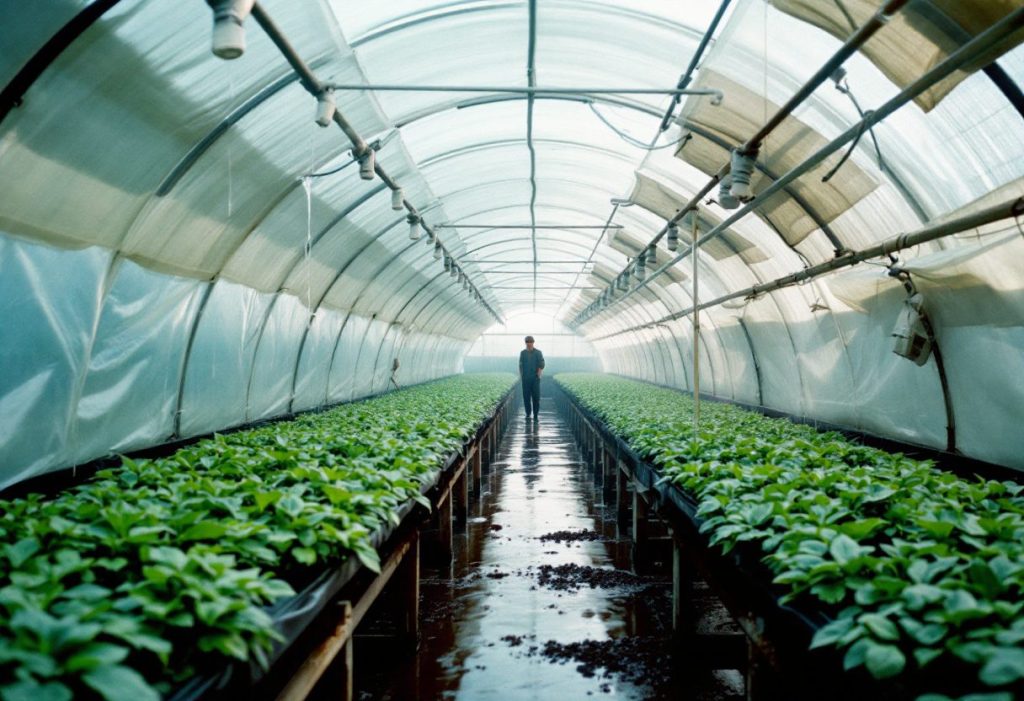
How do you size a greenhouse ventilation fan and its inlet?
Size the greenhouse ventilation fan to move the house volume, measured to 8 feet high, once a minute, then add intake louvers of at least 1.25 times the fan area. That is the UMass Extension method by UConn engineer John Bartok, equal to the 8 cfm per square foot of floor UConn uses.
Worked example, 24 by 48 foot hoop house:
- Floor area: 24 x 48 = 1,152 square feet.
- Fan capacity: 1,152 x 8 feet = 9,216 cfm.
- Rating: AMCA-tested fans delivering that total at 1/8 inch static pressure (UF/IFAS); UF’s fan guide AE020 puts most greenhouse resistance at 0.10 to 0.15 inch. Use two fans for staging.
- Intake: two 36 inch fans have about 14.1 square feet of opening, so louvers need at least 17.7 square feet.
- Winter: 1/4 air change per minute is 2,304 cfm.
UMass layout rules: draw under 150 feet, never exhaust into the prevailing wind (a 10 percent or more loss), fan bottom about 3 feet above the floor. The intake logic matches an attic fan and its soffit inlet.
Buy fans with a Ventilating Efficiency Ratio of 15 or higher cfm per watt. UMass estimates fan ventilation at 0.5 to 1 kWh per square foot per year; check motor draw with our guide to watts and amps.
Natural vents, fans or evaporative pads: which greenhouse ventilation system fits?
Vents cost least to run, fans are most dependable, and only evaporative pads cool below outdoor air; UF/IFAS says ventilation alone never does.
UMass cites the American Society of Agricultural Engineers: equal sidewall and ridge vent areas, each 15 to 20% of floor area. A 2 to 3 mph breeze supplies 80% or more of natural airflow.
UConn Extension sizes 4 inch cellulose pads at 250 cfm per square foot of pad face and aspen at 150, and reports cooling of 10 to 20°F below outside air in dry weather. Like a residential swamp cooler, it weakens as humidity rises.
| System | Sizing rule | 24 x 48 ft example | Main limit |
|---|---|---|---|
| Ridge plus sidewall vents | Each 15 to 20% of floor (ASAE) | 173 to 230 sq ft each | Needs wind; screens cut airflow |
| Exhaust fans plus louvers | Volume to 8 ft per minute | 9,216 cfm; 17.7 sq ft inlet | Power use and outages |
| Fan and 4 inch cellulose pad | Fan cfm / 250 per sq ft of pad | About 37 sq ft of pad | Weak in humid weather |
UConn keeps pads 2 to 8 feet high, so a 2 by 18.5 foot strip works here. Water runs 1/3 gpm per foot of aspen pad and 1/2 gpm for 4 inch cellulose, about 9.3 gpm here, with 3/4 gallon of sump per square foot. Houses under 100 feet pad to fan need more airflow, per UConn.
Correction: the eXtension Farm Energy page and UMass print pad water as “113” gpm per linear foot, a garbled 1/3; that would put an 18.5 foot pad over 2,000 gpm.
How do you size greenhouse heating systems?
Greenhouse heating systems are sized from peak heat loss: Q = U x SA x (inside setpoint minus design outdoor low), in Btu per hour, per University of Arizona engineer Gene Giacomelli’s CEAC heating lecture. SA is the glazed surface; U is the covering’s heat transfer coefficient.
| Glazing | U-value | Light transmission |
|---|---|---|
| Glass, single | 1.1 | 88 to 93% |
| Polyethylene film, single | 1.2 | 87% |
| Polyethylene film, double | 0.7 | 78% |
| Polyethylene, double with IR inner layer | 0.5 | 78% |
| Polycarbonate, twin-wall 6 to 10 mm | 0.53 to 0.63 | 78 to 82% |
Source: UW Extension A3907-01, Table 1. Conduction only, Btu/ft2 °F hr.
For sizing, Giacomelli folds in air leakage: 1.2 for single glass or poly, 0.8 for double poly, 0.6 for double-wall plastic. UW Extension puts leakage at 0.5 to 1.0 air changes per hour in new double poly houses.
Example, 60°F setpoint and a 0°F design night:
- Surface: UW Extension puts freestanding houses at 1.7 to 1.8 times floor area; 1,152 x 1.8 = about 2,074 square feet.
- Double poly: 0.8 x 2,074 x 60 = 99,552 Btu per hour.
- Single glazing: 1.2 x 2,074 x 60 = 149,328 Btu per hour.
- Twin-wall polycarbonate: 0.6 x 2,074 x 60 = 74,664 Btu per hour.
At EIA’s 3,412 Btu per kWh, the double poly case needs about 29.2 kW of electric heat, roughly 122 amps at 240 volts. A room BTU chart badly undersizes glazing; compare fuels with our cost of heat by fuel data.
UW Extension reports that about 80% of greenhouse heating happens at night, and that thermal curtains cut night loss through covered surfaces by about 50%.
Which greenhouse heater type should you choose?
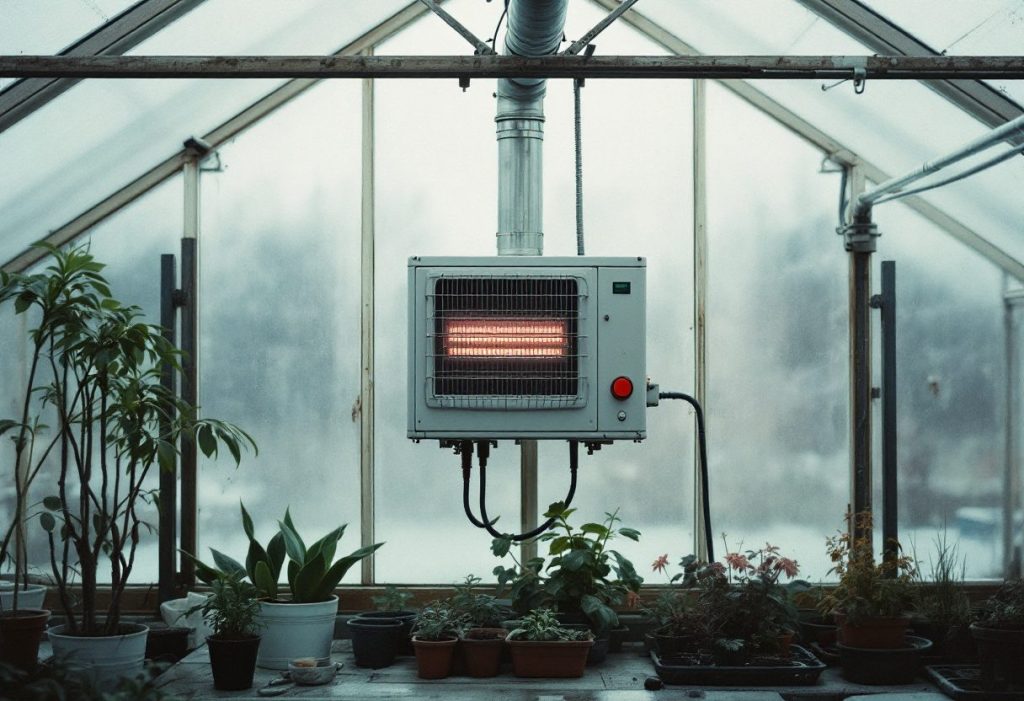
A vented unit heater with outdoor combustion air is the safe default. UW Extension A3907-02 recommends several smaller heaters so one failure never leaves the crop unheated.
| Heater type | Thermal efficiency | Seasonal efficiency | Combustion air and venting |
|---|---|---|---|
| Gravity-vented unit heater | 80% | 65% | Uses greenhouse air; flue loses heated air |
| Power-vented unit heater | 80% | 78% | Blower exhaust, runs only when firing |
| Separated-combustion unit heater | 80% | 80% | Ducted outdoor air; suits tight, humid houses |
| High-efficiency condensing unit heater | Over 90% | About 93% | Separate intake; needs a condensate drain |
| Unvented heater | Not applicable | About 80% | All flue gas stays in the greenhouse |
Source: UW Extension A3907-02.
Unvented units are not near 100%: combustion water cuts net energy by 8%, leaving them near 80%. Tanks and regulators work as in a home propane system.
UW Extension reports that hydronic floor heat with plants on the floor saves 20 to 30%, the principle behind radiant floor heating, though unit heaters still cover the coldest nights.
Why are unvented heaters a risk to plants and people?
Because an unvented heater puts every combustion product into a closed glazed box. UW Extension lists ethylene, sulfur dioxide, nitrous oxide and carbon monoxide, harmful to plants and people; a faulty vented heater can back draft the same gases.
UMass Extension reports plant injury from ethylene at 0.01 ppm and sulfur dioxide at 0.5 ppm, with tomatoes and white petunias marked in one hour. UW Extension adds that ethylene damage may surface 1 or 2 weeks later.
Each gallon of LP gas burned adds about 1.5 pounds of water; UMass estimates 22 gallons overnight in an unvented 30 by 100 foot house.
Safety: combustion air and carbon monoxide
- Combustion air: UMass calls for 1 square inch of free inlet per 1,000 Btu per hour; UW Extension uses one per 2,000 to 2,500. For 99,552 Btu per hour, that is 40 to 100 square inches; follow the manufacturer.
- Never let exhaust fans starve a heater; UW Extension warns of flue gas back drafts.
- Portable kerosene or LP heaters are emergency only; UW Extension says unvented portables do not suit enclosed structures.
- Service burners often, and fit a carbon monoxide alarm where people work.
A yellow, lazy flame signals incomplete burning, as in a furnace; see our carbon monoxide alarm placement guide. UMass suggests tomato or white petunia indicator plants near heaters.
How we researched this
Research date: October 8, 2026. We consulted 14 sources and cite 10: US land-grant extension services (UF/IFAS, UMass, UConn, UW Madison, University of Arizona) and EIA. Worked examples are our arithmetic on their figures. UMass pages were read via archived copies and checked against the eXtension version.
Excluded: retailer fan calculators (marketing, not engineering data), the NSW DPI page (Australian, blocked) and two Rutgers PDFs that returned errors. No installed prices: no federal series covers greenhouse equipment. Reddit was skipped because the topic involves combustion and carbon monoxide.
Frequently asked questions
How many CFM do I need for my greenhouse?
Multiply floor area by 8 feet for one air change per minute, the same 8 cfm per square foot UConn Extension uses. A 10 by 12 foot hobby house needs about 960 cfm; a 24 by 48 foot house needs 9,216 cfm, rated at 1/8 inch static pressure.
How big should greenhouse vents be?
UMass Extension cites the American Society of Agricultural Engineers: equal ridge and sidewall vent areas, each 15 to 20% of floor area. Powered fans need intake louvers of at least 1.25 times the fan area, or the fans cannot deliver their rated airflow.
Does a greenhouse need ventilation in winter?
Yes. UF/IFAS recommends two to three air changes per hour, at least two, to keep humidity below the 90% fungal threshold and clear combustion gases from direct-fired heaters. Going past four air changes per hour adds heating cost with no benefit.
Is a propane heater safe in a greenhouse?
A vented propane unit heater with outdoor combustion air is the standard choice. Unvented units release ethylene, which injures plants at 0.01 ppm per UMass, plus about 1.5 pounds of water per gallon burned. UW Extension limits unvented portables to emergency use.
What size heater do I need for a greenhouse?
Use Q = U x surface area x temperature difference. A 24 by 48 foot double poly house with about 2,074 square feet of surface, U of 0.8 and a 60°F difference needs 99,552 Btu per hour; in single glass, about 149,328.
Can exhaust fans cool a greenhouse below the outside temperature?
No. UF/IFAS states that ventilation alone never brings inside air below outside air on a sunny day; it only limits the rise. Evaporative pads can: UConn Extension reports fan and pad systems cooling 10 to 20°F below outside air in dry weather.
Sources
- UF/IFAS Extension. “Greenhouse Ventilation,” AE030. https://edis.ifas.ufl.edu/publication/AE030. Accessed October 2026.
- UF/IFAS Extension. “Fans for Greenhouses,” AE020. https://edis.ifas.ufl.edu/publication/AE020. Accessed October 2026.
- UMass Extension. “Ventilation for Greenhouses.” https://www.umass.edu/agriculture-food-environment/greenhouse-floriculture/fact-sheets/ventilation-for-greenhouses. Archived copy. Accessed October 2026.
- UMass Extension. “Problems With Using Unvented Greenhouse Heaters.” https://www.umass.edu/agriculture-food-environment/greenhouse-floriculture/fact-sheets/problems-with-using-unvented-greenhouse-heaters. Archived copy. Accessed October 2026.
- UConn Extension IPM. “Fan and Pad Evaporative Cooling Systems.” https://ipm.cahnr.uconn.edu/fan-and-pad-evaporative-cooling-systems. Accessed October 2026.
- eXtension Farm Energy. “Greenhouse Ventilation.” https://farm-energy.extension.org/greenhouse-ventilation/. Accessed October 2026.
- University of Wisconsin Extension. “Reducing Greenhouse Energy Consumption: An Overview,” A3907-01. https://fyi.extension.wisc.edu/energy/files/2018/07/reducing_greenhouse_energy_consumption_-_an_overview.pdf. Accessed October 2026.
- University of Wisconsin Extension. “Greenhouse Unit Heaters: Types, Placement and Efficiency,” A3907-02. https://fyi.extension.wisc.edu/energy/files/2018/07/greenhouse_unit_heaters_-_types_placement__efficiency.pdf. Accessed October 2026.
- University of Arizona CEAC. “Lecture 8: Heating Systems.” https://ceac.arizona.edu/sites/default/files/giacomelli%20heating.pdf. Accessed October 2026.
- U.S. Energy Information Administration. “British Thermal Units (Btu).” https://www.eia.gov/energyexplained/units-and-calculators/british-thermal-units.php. Accessed October 2026.
Leave a Reply