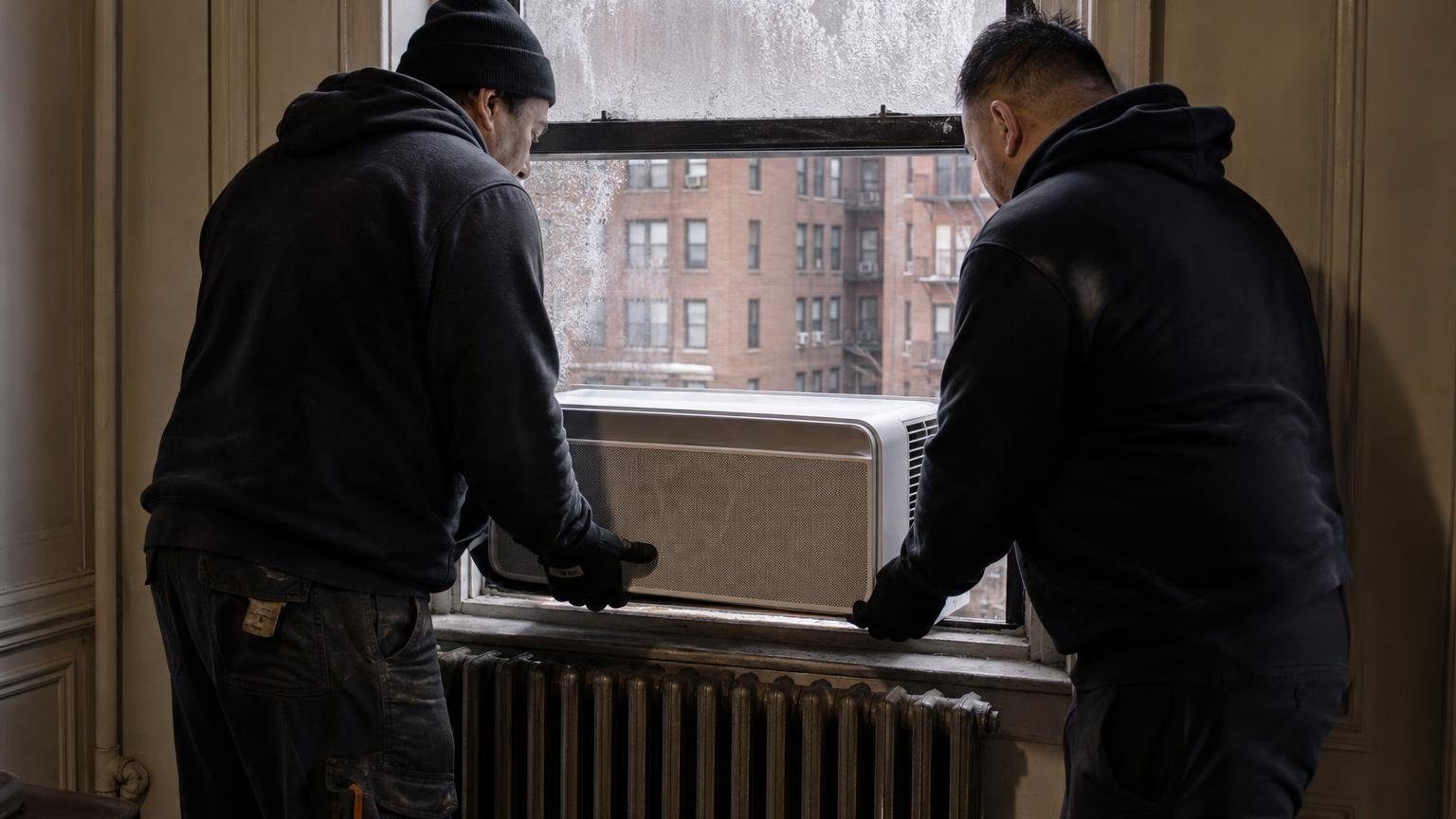
What is a window heat pump? A window heat pump is a window air conditioner that also runs its refrigeration cycle in reverse to heat the room. Cold climate models from Midea and Gradient claim 9,000 Btu/h of heat at 17°F from a standard 120 V plug.
Key Takeaways
- Two classes share the name: mild weather units such as the Midea MAW08HV1CWT, which Midea says heats between 40°F and 110°F, and cold climate packaged units.
- Gradient’s spec sheet claims 7,200 Btu/h at 5°F; Midea’s claims 9,000 Btu/h at 5°F.
- New York’s Clean Heat for All pilot put 72 units in 24 NYCHA apartments; NYSERDA’s M&V report found 81% of occupants satisfied.
- The federal rating, CEER, comes from a cooling-only test at 95°F under 10 CFR 430 Appendix F. Heating figures are maker claims.
- The highest single unit draw measured in the pilot was 1.79 kW, close to the 1,800 W a 120 V, 15 A circuit carries.
- At the EIA’s July 2026 U.S. residential price of 18.31 cents per kWh, a unit making 9,000 Btu/h at COP 2.0 costs about 24 cents an hour.
What is a window heat pump?
It is a self-contained heat pump that sits in a window opening and plugs into a wall outlet. The compressor, both coils and the refrigerant charge are sealed in one cabinet at the factory, so no refrigerant lines are run and no wall is cut.
In heating mode a reversing valve swaps the roles of the two coils, so the indoor coil releases heat pulled from outdoor air. See our explainer on how a heat pump moves heat instead of making it.
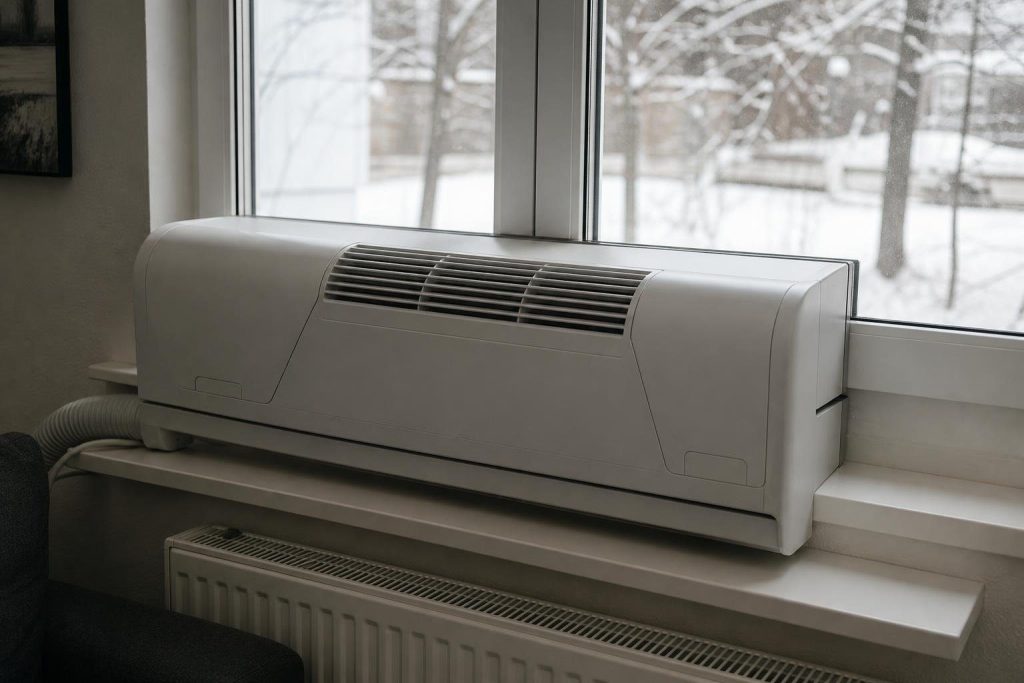
Cold climate versions straddle the sill in a saddle shape, which NYSERDA’s evaluators say minimizes “window blockage.”
Window heat pump vs window AC: what is the difference?
A window AC moves heat one way; a window heat pump moves it both ways. But the label covers two products, and only one is built for winter. Midea markets its MAW08HV1CWT for “supplemental heat for spring and fall” between 40°F and 110°F, while cold climate packaged units claim heat far below freezing.
| Type | Example | Heating | Maker’s stated heating range |
|---|---|---|---|
| Cooling-only window AC | Most window units | None | Not applicable |
| Mild weather heat pump window AC | Midea MAW08HV1CWT | Heat pump, shoulder season | 40°F to 110°F |
| Cold climate packaged window heat pump | Midea PWHP (MAH09H1AGR) | Heat pump, no resistance heater | Down to minus 13°F (spec sheet) |
| Cold climate packaged window heat pump | Gradient All-Weather 120V | Heat pump, variable speed | Minus 13°F to 115°F |
Manufacturer claims, read October 2026.
The cold climate units are heavy: Gradient lists 140 lbs and Midea 130 lbs. Our window AC installation guide covers brackets and sill load, and our portable vs window comparison explains why hose units deliver less.
Do window heat pumps work in winter and in cold climates?
The cold climate class does, on paper and in one mild New York winter. Gradient’s output falls from 9,000 Btu/h at 17°F to 5,400 Btu/h at minus 7°F; Midea claims a flat 9,000 Btu/h down to 5°F.
| Outdoor temperature | Midea PWHP (June 2024 sheet) | Gradient All-Weather 120V |
|---|---|---|
| 95°F (cooling) | 9,010 Btu/h, 11.81 EER | 9,300 Btu/h, 13.6 EER |
| 47°F | 9,000 Btu/h, COP 4.0 | 9,000 Btu/h, COP 4.04 |
| 17°F | 9,000 Btu/h, COP 2.42 | 9,000 Btu/h, COP 2.37 |
| 5°F | 9,000 Btu/h, COP 2.0 | 7,200 Btu/h, COP 2.06 |
| Minus 7°F | Not published | 5,400 Btu/h, COP 1.80 |
| Minus 13°F | 5,050 Btu/h, COP 1.41 | Lowest stated operating point |
Midea America Technical Product Sheet, 2024; Gradient product specifications. Maker claims.
Midea’s web page claims operation to minus 22°F and CEER 17.6; its June 2024 sheet says minus 13°F and CEER 16. We use the dated sheet.
Even Midea’s claimed COP of 1.41 at minus 13°F beats a resistance heater’s 1.0. Our cold climate heat pump explainer covers the ENERGY STAR 5°F test that split systems face; ENERGY STAR’s room air conditioner criteria have no equivalent.
What did New York’s window heat pump pilot find?
Warm apartments, no wiring upgrades and mostly happy tenants, in a mild winter. The Clean Heat for All Challenge, run by NYCHA, NYSERDA and the New York Power Authority, asked for a unit on a 120 V, 15 A circuit delivering 9,000 Btu/h at COP 1.85 at 17°F.
Midea and Gradient each installed 36 units in 12 apartments at Woodside Houses in Queens. In August 2022 the NYPA board awarded the two makers a combined $70 million to commercialize and pilot 30,000 units, according to NYSERDA’s December 2025 Gradient case study.
The caveats: the 2023 to 2024 winter “was relatively mild,” Taitem Engineering wrote. Gradient swapped its prototypes after eight and a half months to address “condensate backup and corrosion,” and large-scale NYCHA deployment “has been slowed,” per the case study.
How is a window heat pump rated?
Federally, as a room air conditioner rated on cooling only. Under 10 CFR 430.32(b), a heat pump window unit falls in a “with reverse cycle” class, and its minimum is a combined energy efficiency ratio, CEER.
For reverse cycle units with louvered sides under 20,000 Btu/h, the CEER floor rose from 9.8 to 14.4 for products made from May 26, 2026. Our report on the 2026 room AC efficiency rule lists every class.
Correction: CEER says nothing about heating
The DOE test in Appendix F measures cooling capacity and power at 80°F indoors and 95°F outdoors. It has no heating test. Heating COPs, Gradient’s “HEER” of 9.4 and Midea’s HSPF2 of 10.12 are maker figures outside the federal room AC procedure.
ENERGY STAR’s Version 5.0 room AC criteria are also cooling only. When we read them in October 2026 they listed 13.2 CEER for louvered reverse cycle units under 20,000 Btu/h, below the new 14.4 federal floor.
Can a window heat pump run on a 120 V outlet?
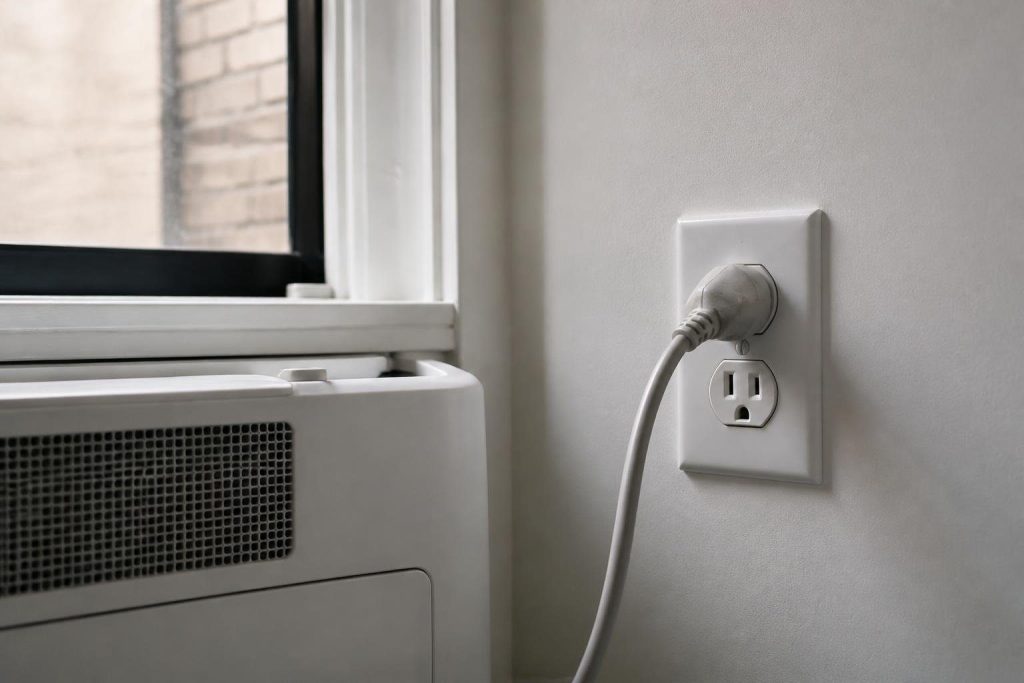
Yes. Gradient specifies 120 V on a 15 A circuit and Midea a “standard 15A-120VAC outlet.” That circuit carries at most 1,800 W, and only a heat pump fits 9,000 Btu/h of heat inside it.
- Convert heat to electric power: 9,000 Btu/h divided by 3.412 Btu per watt-hour is 2,638 W of output.
- Divide by COP. At Midea’s claimed COP of 2.0 at 5°F, input is about 1,319 W.
- Compare with resistance heat at COP 1.0: the full 2,638 W, beyond what the circuit can carry.
The highest single unit heating draw Taitem measured was 1.79 kW for Midea and 1.31 kW for Gradient; the report says Midea’s peak “approached the limit of a 15A circuit,” yet no breakers tripped. Two units at those draws would exceed 1,800 W, so plan on one unit per circuit. See our guide to HVAC watts and amps.
How much does a window heat pump cost to run?
About 12 to 24 cents an hour at full output, at the national average price. The EIA’s Electric Power Monthly put U.S. residential electricity at 18.31 cents per kWh in July 2026 and New York at 29.90 cents.
| Case (maker claim) | Input power | Per hour, U.S. 18.31¢ | Per hour, New York 29.90¢ |
|---|---|---|---|
| Midea, 9,000 Btu/h at 47°F, COP 4.0 | 659 W | 12.1¢ | 19.7¢ |
| Midea, 9,000 Btu/h at 5°F, COP 2.0 | 1,319 W | 24.1¢ | 39.4¢ |
| Gradient, 7,200 Btu/h at 5°F, COP 2.06 | 1,024 W | 18.8¢ | 30.6¢ |
| Resistance heat, 9,000 Btu/h, COP 1.0 | 2,638 W | 48.3¢ | 78.9¢ |
Our arithmetic: Btu/h divided by 3.412 and by COP, times the EIA price. Real units cycle and modulate.
In the NYCHA pilot, three-unit apartments averaged 1,465 kWh (Midea building) and 1,804 kWh (Gradient building) of heating electricity, with wide spread between homes. Local rates are in our state electricity price table, and a plug-in resistance heater’s cost is in our space heater cost guide.
Which window heat pump fits which home?
Match the product class to the coldest weather you need heat in.
- If you need heat only above about 40°F, a mild weather heat pump window AC such as the Midea MAW08HV1CWT fits its stated range.
- If the window unit must heat through a northern winter, look only at cold climate packaged models with published capacity at 17°F and 5°F, such as the Midea PWHP and Gradient All-Weather 120V.
- If you are heating a whole home, compare against a ductless system.
Our ductless mini split explainer and mini split cost data set out that route.
The federal 25C credit no longer applies to 2026 installs, as our report on the expired heat pump tax credit explains, so any help now comes from state or utility programs.
Frequently asked questions
Is there such a thing as a window heat pump?
Yes. 10 CFR 430.32(b) sets separate CEER minimums for room air conditioners “with reverse cycle,” meaning heat pumps. Cold climate models from Midea and Gradient came out of New York’s Clean Heat for All Challenge, which piloted 72 units in NYCHA apartments.
Do window heat pumps work in cold climates?
The cold climate models claim to. Gradient’s sheet lists 7,200 Btu/h at 5°F and operation down to minus 13°F; Midea’s lists 5,050 Btu/h at minus 13°F. NYSERDA’s field report found good comfort but warned the 2023 to 2024 test winter was mild, so very cold performance needs more study.
How much does a window heat pump cost?
We do not publish a purchase price: no federal or national lab source tracks one. For scale, NYPA awarded Midea and Gradient a combined $70 million in August 2022 to commercialize and pilot 30,000 units, per NYSERDA. Running cost is about 24 cents an hour at 1,319 W and 18.31 cents per kWh.
Is a window heat pump cheaper to run than a space heater?
Per unit of heat, yes, whenever its COP is above 1.0, because a resistance heater turns 1 watt into 1 watt of heat. Midea claims COP 2.0 at 5°F, so the same heat should take half the electricity, by the maker’s figures.
Window heat pump vs mini split: which is better?
They solve different problems. A window heat pump heats one room from one plug with no refrigerant lines; Taitem logged 45 to 70 minutes of two-person crew time for installation in the NYCHA pilot. A ductless mini split needs a contractor but can serve several rooms.
Do window heat pumps need a 220 V outlet?
The cold climate models do not. Gradient specifies 120 V on a 15 A circuit and Midea a standard 15A-120VAC outlet. That circuit tops out at 1,800 W; the highest single unit heating draw in the NYCHA pilot was 1.79 kW. Check the nameplate voltage before buying any other model.
How we researched this
Research date: October 11, 2026. We read 10 CFR 430.32(b), 430.2 and Appendix F via the eCFR API, two NYSERDA pilot reports, ENERGY STAR criteria, EIA data and maker spec sheets: 14 sources consulted, 10 cited.
Product capacity, COP and temperature figures are manufacturer claims. We excluded retailer prices and vendor savings percentages (no federal series) and the Wirecutter review (could not be opened). Reddit was skipped because the topic involves household circuits.
Sources
- Midea America. “Technical Product Sheet: Packaged Window Heat Pump (2024).” https://midea.com/content/dam/midea-aem/us/air-conditioners/pwhp/mah09h1agr/PWHP-Product-Specs-20240612-v2-0.pdf. Accessed October 2026.
- Gradient. “All-Weather 120V Window Heat Pump product specifications (Efficiency Vermont copy).” https://www.efficiencyvermont.com/Media/Default/docs/products/gradient-product-specifications.pdf. Accessed October 2026.
- Midea America. “Packaged Window Heat Pump.” https://www.mideacomfort.us/packaged.html. Accessed October 2026.
- Midea. “Window Air Conditioner, Multi-Season, MAW08HV1CWT.” https://www.midea.com/us/store/cooling-and-heating/window-air-conditioners/midea-window-air-conditioner-multi-season-low-noise.maw08hv1cwt. Accessed October 2026.
- NYSERDA. “Clean Heat for All Pilot: Taitem Measurement and Verification, Report 25-21.” https://www.nyserda.ny.gov/-/media/Project/Nyserda/Files/Programs/Room-Heat-Pump-Program/25-21-Clean-Heat-for-All-%2DTaitem-Measurement-and-Verification.pdf. Accessed October 2026.
- NYSERDA. “NYSERDA Case Study: Gradient Window Heat Pumps, December 2025.” https://www.nyserda.ny.gov/-/media/Project/Nyserda/Files/Publications/PPSER/Program-Evaluation/Gradient-Window-Heat-Pumps.pdf. Accessed October 2026.
- eCFR. “10 CFR 430.32, Energy and water conservation standards.” https://www.ecfr.gov/current/title-10/chapter-II/subchapter-D/part-430/subpart-C/section-430.32. Accessed October 2026.
- eCFR. “10 CFR Part 430, Subpart B, Appendix F: Uniform Test Method for Room Air Conditioners.” https://www.ecfr.gov/current/title-10/chapter-II/subchapter-D/part-430/subpart-B/appendix-Appendix%20F%20to%20Subpart%20B%20of%20Part%20430. Accessed October 2026.
- ENERGY STAR. “Room Air Conditioners Key Product Criteria.” https://www.energystar.gov/products/room_air_conditioners/key_product_criteria. Accessed October 2026.
- U.S. Energy Information Administration. “Electric Power Monthly, Table 5.6.A.” https://www.eia.gov/electricity/monthly/epm_table_grapher.php?t=epmt_5_6_a. Accessed October 2026.
Leave a Reply