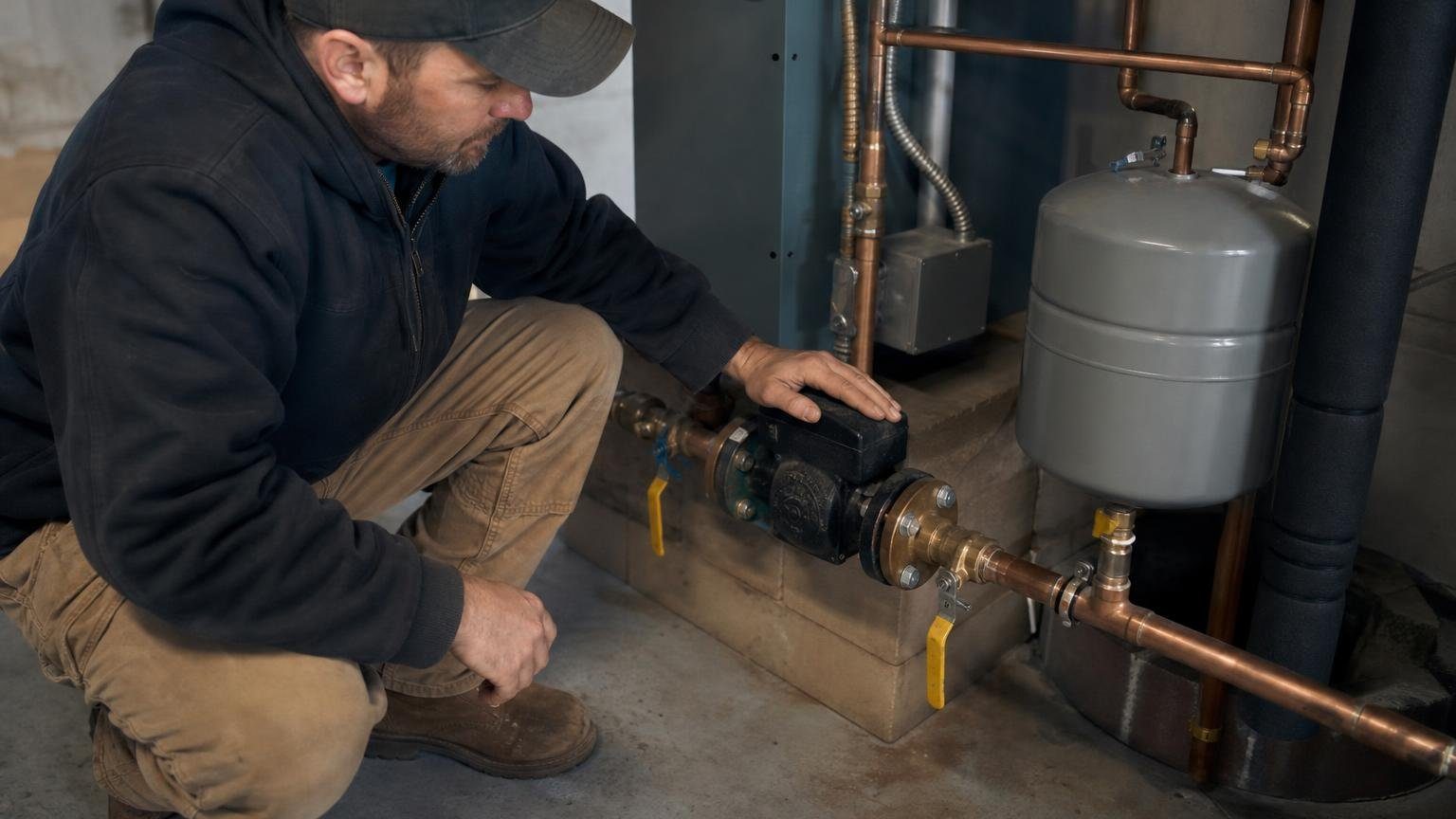
What is a circulator pump? A circulator pump is the small electric pump that pushes hot water from a boiler through baseboard, radiators or radiant tubing and back again. In a filled, closed loop it only has to overcome pipe friction, which is why a small 1/25 hp wet rotor pump can keep a whole loop flowing.
Key Takeaways
- DOE’s final rule of May 20, 2024 sets the first federal circulator standard: pumps manufactured starting May 22, 2028 must rate a CEI of 1.00 or lower under 10 CFR 431.465(i).
- DOE ties that level approximately to single-speed ECMs, measured against a PSC motor baseline.
- DOE puts the average circulator pump lifetime at 10.5 years.
- Sizing: GPM = Btu/h ÷ (500 × ΔT), with 20ºF the “traditional” design ΔT per Caleffi idronics 16.
- Maker data: Grundfos UPS15-58, 60 to 87 W by speed; Taco 007e ECM, 44 W max; Grundfos ALPHA2, 5-45 W.
- In a filled loop the pump only replaces friction loss; Caleffi says it is not responsible for “lifting” the water.
What is a circulator pump?
A circulator pump is a low-head pump that keeps water moving around a closed heating loop. Federal rules (10 CFR 431.462) recognize wet rotor, dry rotor two-piece and dry rotor three-piece types, and define the wet rotor kind, CP1 in the trade, as a single stage, close-coupled pump.
System water surrounds a wet rotor and lubricates its bushings. Caleffi credits Taco with the first North American wet rotor circulator in 1958; by 1980 wet rotors dominated new residential systems. Our hot water heating system explainer covers the whole loop.
DOE found two main jobs, hydronic heating and domestic hot water recirculation, and counted 73.7% of circulator buyers as residential.
How does a boiler circulator pump work?
A boiler circulator pump spins an impeller in a volute, adding just enough pressure, measured in feet of head, to push water against pipe friction. Because the loop is full, rising water is balanced by falling water, so Caleffi says a small circulator can keep flow going even when the top of the loop is several stories up.
Caleffi advises connecting the expansion tank near the circulator inlet so the pump will “pump away” from the point of no pressure change, raising loop pressure. Grundfos and Caleffi both require a horizontal motor shaft.
The pump starts when the boiler control, a relay or a zone valve end switch closes on a call for heat. Caleffi notes homes of the 1960s to early 1980s typically had one to three zones run by zone circulators or zone valves, a pattern many boiler and baseboard homes keep.
Fixed-speed vs ECM circulator pump: what changes?
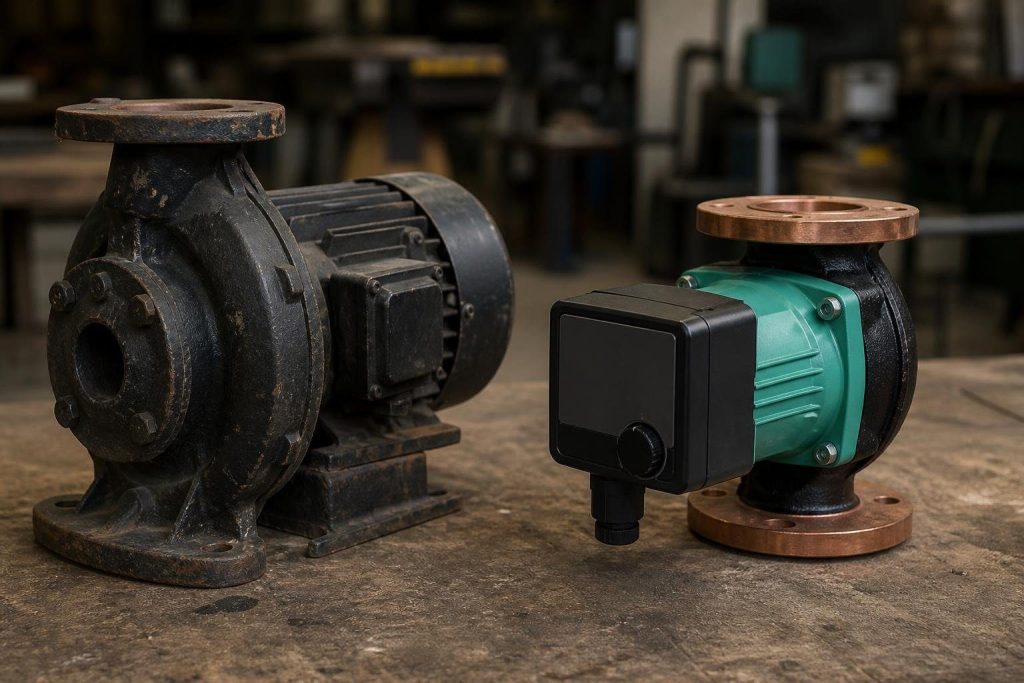
A fixed-speed circulator runs a permanent split capacitor (PSC) induction motor at one or a few set speeds. An ECM circulator uses a permanent magnet, electronically commutated motor that draws less power and can vary speed. Caleffi cites simulations predicting electrical savings of 60% or more for ECM variable-speed pumps versus PSC wet rotors of equal peak duty.
The table uses each maker’s published figures, not independent tests. Our single-speed vs variable-speed guide covers the same idea for blowers.
| Model (maker document) | Motor | Max flow | Max head | Power draw |
|---|---|---|---|---|
| Taco 007-F5 (submittal 101-029) | Fixed speed, 1/25 hp, 3,250 rpm | 23 gpm | 10 feet | 0.71 A at 115 V |
| Grundfos UPS15-58 FC (UP data booklet) | Capacitor run, 3 speeds | 17 gpm | 19.5 ft | 60 / 80 / 87 W |
| Taco 007e (submittal 101-177) | ECM, permanent magnet | 16 gpm | 10 feet | 44 W max |
| Grundfos ALPHA2 15-55 (2024 leaflet) | ECM, AUTOADAPT | 21 gpm | 19 ft | 5-45 W |
Taco calls the 007e’s performance “equivalent to the legendary 007,” and its submittal sheet lists 44 W against 87 W for the UPS15-58 on speed 3. Grundfos claims the ALPHA2 cuts consumption by up to 85% in AUTOADAPT mode, a maker claim. The 007 sheet lists amps, not watts, so we leave it unconverted.
How do you size a hydronic circulator pump?
To size a hydronic circulator pump, find the flow the load needs, find the head that flow creates in your piping, then pick a pump whose curve crosses that point. Caleffi’s water formula is q = 500 × f × ΔT (500 rounds 8.33 × 60), so GPM = Btu/h ÷ (500 × ΔT).
Caleffi’s check: 50,000 Btu/h at 4 gpm gives a 25ºF drop. Radiant floors use a 10º to 15ºF drop, which raises flow; see our radiant floor heating guide. The loads below are worked examples.
| Design load | Design ΔT | Flow (Btu/h ÷ 500 × ΔT) | Velocity in 3/4 in copper (0.62 × gpm) |
|---|---|---|---|
| 40,000 Btu/h baseboard | 20ºF | 4.0 gpm | 2.5 ft/s |
| 60,000 Btu/h baseboard | 20ºF | 6.0 gpm | 3.7 ft/s |
| 80,000 Btu/h baseboard | 20ºF | 8.0 gpm | 5.0 ft/s, over the 4 ft/s limit |
| 30,000 Btu/h radiant floor | 10ºF | 6.0 gpm | 3.7 ft/s |
| 30,000 Btu/h radiant floor | 15ºF | 4.0 gpm | 2.5 ft/s |
Caleffi keeps average velocity under 4 feet per second to limit pipe noise, and calls 2 feet per second enough to carry air along. At 0.62 ft/s per gpm, 3/4 in copper tops out near 6.5 gpm.
Head is the friction of pipe, fittings and boiler at design flow; where that curve crosses the pump curve is the operating point. Caleffi advises an operating point in the middle third of the pump curve, and warns that too much flow brings noise, component damage and wasted electricity.
What does the DOE circulator pump standard require?
The DOE circulator pump standard requires covered circulators manufactured starting May 22, 2028 to rate a circulator energy index (CEI) of 1.00 or lower, tested in their least consumptive control mode. It is codified at 10 CFR 431.465(i) in the October 2026 eCFR, and the Federal Register shows no later delay.
It covers clean water circulators of all three types, excluding submersible and header pumps. DOE published the final rule May 20, 2024 (89 FR 44464), effective August 5, 2024, choosing a level that “is set to correspond approximately to single-speed ECMs.” DOE’s baseline was a PSC pump, and it expected the level would likely require ECMs, though some variable speed induction pumps remain.
What the rule does not do. It keys on manufacture date. Nothing in 431.465(i) requires replacing a working PSC circulator.
How do you know if a circulator pump is bad?
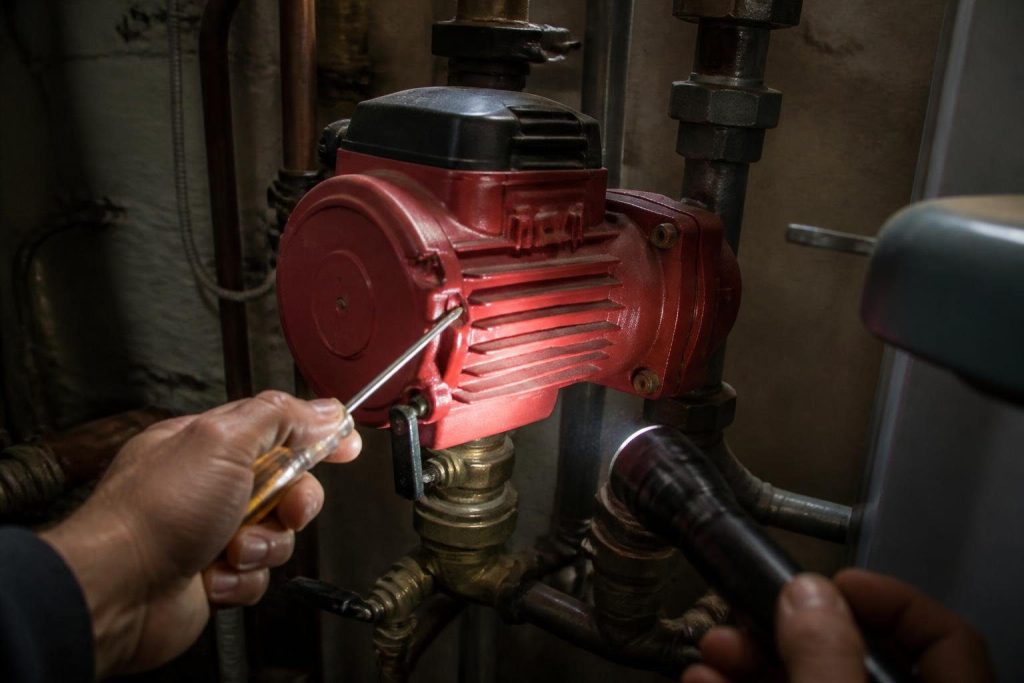
A circulator pump is likely bad if it has power on a call for heat but moves no water, hums without turning, or rattles with system pressure in range. Check in order, since control, air and pressure faults mimic a dead pump. Kill power at the service switch first; Grundfos says electrical work belongs to a qualified person.
- Not turning on. Confirm a call for heat and voltage at the pump. A relay or end switch that never closes idles a good pump; see our boiler not working checklist.
- Hums but does not spin. The rotor may be stuck after summer. The Grundfos UP instructions say: cut power, close the isolation valves, remove the indicator plug, turn the shaft with a flat screwdriver, reopen the valves and wait 2 to 3 minutes before restarting.
- Runs, but rooms stay cold or pipes gurgle. Suspect air. Grundfos says to vent at the system’s high points, never through the pump.
- Rattling or gravel noise. Possible cavitation, which Caleffi ties to low inlet pressure. Grundfos lists a minimum inlet pressure of 4.0 psi at 190ºF and 15.6 psi at 230ºF, so check boiler pressure first.
- Very hot motor. A warm casing is normal because the wet rotor motor sheds heat through its surface; Caleffi says never insulate it. Hot plus no flow may mean a locked rotor.
- Runs all the time. Usually a stuck relay or end switch, not the pump.
How long does a circulator pump last?
DOE estimates the average circulator pump lifetime at 10.5 years. Caleffi notes some late-1970s wet rotors were still running with zero maintenance almost four decades on. Dry running, a vertical shaft or an insulated motor shortens life.
We quote no replacement price: no federal or national-lab source publishes residential installed costs. For fit, Grundfos’s cross-reference lists the UPS 15-58 FC and ALPHA2 15-55 as replacements for the Taco 007-F5 (6 1/2 in port-to-port versus 6 3/8 in). If the boiler is aging too, read our boiler replacement guide, and have the pump checked at annual boiler service.
How we researched this
We read DOE’s final rule (89 FR 44464), pulled 10 CFR 431.462 and 431.465 from the eCFR versioner API (October 1, 2026) and searched the Federal Register for later delays; none exist. Pump data come from Taco submittals 101-029 and 101-177 and Grundfos’s UP booklet, ALPHA2 leaflet and UP instructions; sizing and installation rules from Caleffi idronics 16. We consulted 18 documents and cited 9.
Excluded: retailer and contractor price pages (no federal price series exists), UK pump guides, and Reddit, which we skip on a boiler safety topic. Maker efficiency claims are labeled. Research date: October 11, 2026.
Frequently asked questions
What is the purpose of a circulator pump?
It moves heated water from the boiler through baseboard, radiators or radiant tubing and back. DOE names two main uses: hydronic heating and domestic hot water recirculation. In a filled loop it only replaces friction loss; Caleffi says it is not responsible for lifting the water.
How long does a circulator pump last?
DOE estimates the average circulator pump lifetime at 10.5 years in its 2024 final rule. Caleffi describes late-1970s wet rotor units still running almost four decades later. Dry running, a vertical motor shaft and an insulated motor all shorten life.
How much does it cost to replace a boiler circulator pump?
We publish no number: no federal or national-lab source reports installed costs for residential circulator replacement, and contractor quotes are not data. On fit, Grundfos lists the UPS 15-58 FC and ALPHA2 15-55 among its replacements for the Taco 007-F5.
Can a circulator pump run without water?
No. Grundfos instructions say never let the pump run dry or start it before the system is filled. Caleffi explains that a wet rotor circulator needs system water both to lubricate its bushings and to carry heat away from the motor.
Do I have to switch to an ECM circulator pump?
Not for an existing system. Under 10 CFR 431.465(i), circulators manufactured starting May 22, 2028 must rate a CEI of 1.00 or lower, a level DOE ties approximately to single-speed ECMs. The rule does not require replacing a working pump.
Does a circulator pump have a check valve?
Only some versions. Grundfos sells the UPS15-58 as the FC without a check valve and the FRC with a removable one, and its 2024 ALPHA2 leaflet says that pump has an integrated check valve. Confirm which version a replacement includes before ordering.
Sources
- U.S. Department of Energy, Federal Register. “Energy Conservation Program: Energy Conservation Standards for Circulator Pumps, 89 FR 44464 (May 20, 2024).” https://www.federalregister.gov/documents/2024/05/20/2024-07873/energy-conservation-program-energy-conservation-standards-for-circulator-pumps. Accessed October 2026.
- Electronic Code of Federal Regulations. “10 CFR 431.465, Pumps energy conservation standards and their compliance dates.” https://www.ecfr.gov/current/title-10/chapter-II/subchapter-D/part-431/subpart-Y/section-431.465. Accessed October 2026.
- Electronic Code of Federal Regulations. “10 CFR 431.462, Definitions.” https://www.ecfr.gov/current/title-10/chapter-II/subchapter-D/part-431/subpart-Y/section-431.462. Accessed October 2026.
- Caleffi. “idronics 16: Circulation in Hydronic Systems.” https://www.caleffi.com/sites/default/files/media/file/idronics_16_na.pdf. Accessed October 2026.
- Taco. “Submittal Data Information 101-029, Model 007 Cartridge Circulators (retailer-hosted copy).” https://images.homedepot-static.com/catalog/pdfImages/5d/5da08932-5b59-42c7-ba0c-a0bcd5d5d1a8.pdf. Accessed October 2026.
- Taco. “Submittal Data Information 101-177, 007e ECM High-Efficiency Circulator (distributor-hosted copy).” https://www.firstsupply.com/UserFiles/Documents/inRiver/Original/200867_TAC007e_Submittal.pdf. Accessed October 2026.
- Grundfos. “UP Series Circulator Pumps 60 Hz Data Booklet.” https://api.grundfos.com/literature/Grundfosliterature-5235400.pdf. Accessed October 2026.
- Grundfos. “Grundfos ALPHA2 leaflet.” https://api.grundfos.com/literature/Grundfosliterature-6511597.pdf. Accessed October 2026.
- Grundfos. “UP Series Circulators Installation and Operating Instructions (distributor-hosted copy).” https://res.cloudinary.com/dzhpkjoqj/Grundfos/UP-I-O.pdf. Accessed October 2026.
Leave a Reply