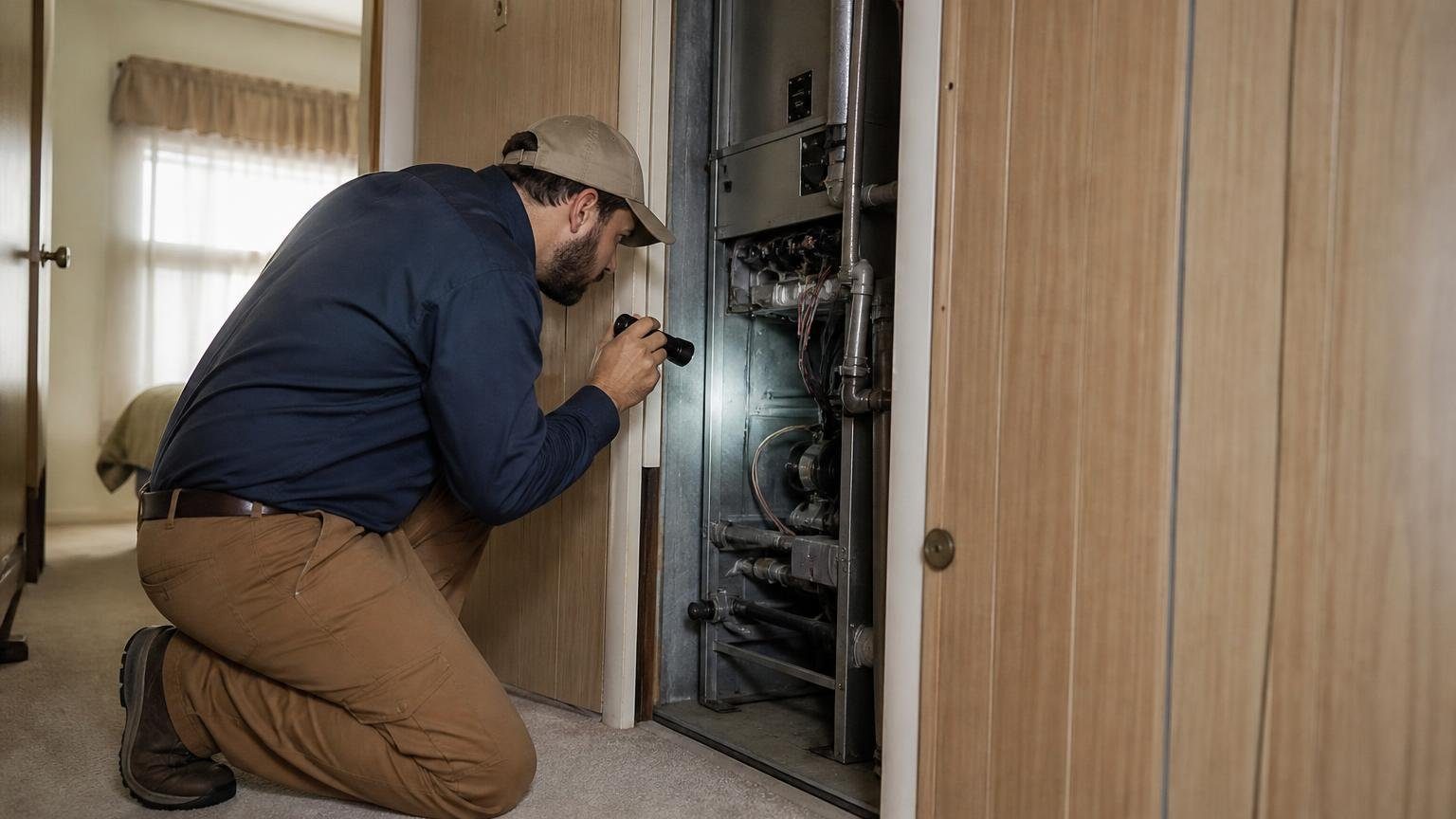
What is a mobile home furnace? A mobile home furnace is a direct vent furnace listed for manufactured homes: it takes combustion air from outdoors, vents outdoors, and usually blows down into a floor duct. A standard site-built furnace is not a drop-in swap under the federal HUD Code.
Key Takeaways
- 24 CFR 3280.709(d) requires complete separation of combustion from indoor air: a direct vent unit or a sealed enclosure.
- DOE defines a mobile home furnace as “a direct vent furnace that is designed for use only in mobile homes” (10 CFR 430.2).
- Mobile home gas furnaces made on or after December 18, 2028 must reach 95.0% AFUE, up from 80.0% today, per 10 CFR 430.32(e).
- Of 6.83 million US mobile homes in EIA’s 2020 RECS, 3.60 million heat mainly with a central furnace: 1.50 million gas and 1.34 million electric.
- DOE puts the average life of a gas furnace, mobile home models included, at 21.5 years (2023 final rule).
- Return ducts need 2 square inches per 1,000 Btu/h of input under 24 CFR 3280.715(b)(3).
What is a mobile home furnace?
A mobile home furnace is a forced-air furnace built and listed for a HUD Code manufactured home. Three traits set it apart: sealed combustion, a narrow closet cabinet, and, in most homes, downflow delivery into a supply duct that runs under the floor.
Gas models draw combustion air and discharge flue gas through a listed roof jack, so no room air feeds the flame. The HUD Code allows only a venting system “consisting entirely of listed components, including roof jack” (24 CFR 3280.710), which is why the vent pipe rules for a site-built furnace do not carry over. Intertherm, whose older manuals name Nordyne as the “manufacturer of Intertherm and Miller products,” says many manufactured homes use downflow “because ducts are below the unit.”
Can you put a regular furnace in a mobile home?
Not as a straight swap. Under 24 CFR 3280.709(d), a fuel-burning furnace must keep its combustion system completely separate from indoor air, and 3280.709(a) requires installation by the terms of its listing. A furnace that draws combustion air from the room around it fails that test in an interior closet.
The code allows a direct vent appliance or an enclosure with “no door, removable access panel, or other opening” into the home. Section 3280.703 names UL 307B for gas heating appliances built for manufactured homes, and ANSI Z21.47 for gas central furnaces other than direct vent. Fit matters too: Johnson Controls (JCI) told DOE that an upflow unit in a downflow home means reworking ducts and structure.
| Feature | Mobile home furnace | Standard indoor furnace |
|---|---|---|
| Combustion air | Outdoors, sealed (DOE: “direct vent”) | Room air or direct vent, by model |
| Typical airflow | Downflow into floor duct | Upflow common (per JCI comment to DOE) |
| Standard named in 3280.703 | UL 307B gas, UL 307A oil, UL 1096 electric | ANSI Z21.47 gas, only in a sealed enclosure |
| Federal gas AFUE floor today | 80.0% | 80.0% |
| Gas AFUE floor from Dec 18, 2028 | 95.0% | 95.0% |
| Oil AFUE floor | 75.0% (since 1990) | 83.0% (since 2013) |
Correction
A mobile home furnace is not just a smaller furnace. The federal gas efficiency floors are identical; the difference is listing, sealed combustion and fit. Nordyne’s manual for its MG, MM, MS and MB series warns that parts outside the appliance’s certification may, “in many states, make installations illegal.” Check state rules before any furnace replacement decision.
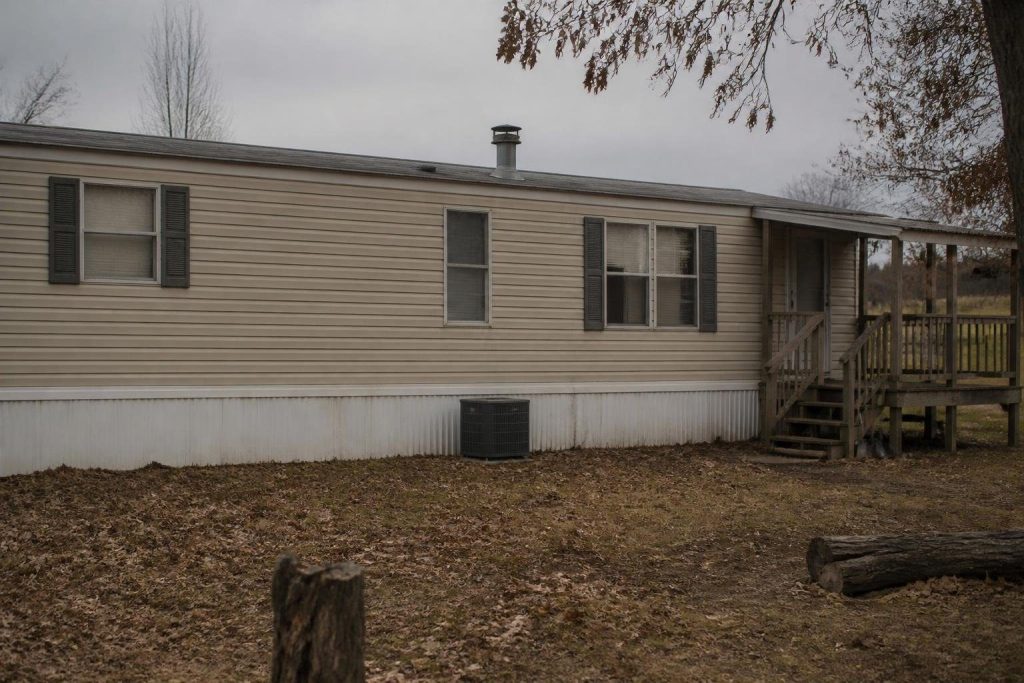
Which mobile home furnace types heat US manufactured homes?
Electric heat leads. EIA’s 2020 Residential Energy Consumption Survey counted 6.83 million mobile homes, and electricity was the main heating fuel in 3.87 million. Heat pumps, gas furnaces and electric furnaces each serve roughly 1.3 to 1.6 million. Census’s 2024 American Community Survey counts 6,635,819 occupied mobile homes (7,939,191 with vacant units).
An electric furnace needs no vent or gas line, while a propane system serves homes beyond gas mains. Maker catalogs show the range on offer; these are manufacturer figures, not independent tests.
| Maker and model | Fuel | AFUE (maker) | Input, Btu/h (maker) |
|---|---|---|---|
| Intertherm MG1E | Gas | Up to 80% | 56,000 to 90,000 |
| Intertherm MG2S, two stage | Gas | Up to 96% | 45,000 to 72,000 |
| Intertherm E7ED, downflow | Electric | 100% | 34,000 to 78,000 |
| Intertherm M5SB | Oil | Up to 83% | 66,000 to 86,000 |
| Thermo Pride CMA4 / GMA2 | Gas or propane | 95% / 80% | Not stated on category page |
Model data: Intertherm furnaces catalog and Thermo Pride’s category page, October 2026.
What efficiency must a mobile home furnace meet, and does the 2028 rule apply?
Today a new mobile home gas furnace must reach 80.0% AFUE. From December 18, 2028 the floor rises to 95.0%, and the regulation names mobile home gas furnaces explicitly, so the 2028 rule does apply. Both limits come from 10 CFR 430.32(e), which the HUD Code adopts in 24 CFR 3280.707(a)(2).
The rule applies by manufacture date. In the December 2023 final rule, DOE estimated mobile home models at about 3 percent of covered gas furnace shipments. It pointed to compact condensing models from Burnham Holdings (Thermo Pride) and Madison Industries (Nortek). DOE also projected that 15.3% of mobile home gas furnace buyers would face a net cost at the 95% level.
The date could still move. On February 19, 2026, three gas and propane trade groups petitioned DOE to amend the compliance dates (comments closed May 27, 2026). The eCFR text dated October 1, 2026 still reads December 18, 2028; our 2028 furnace standard explainer tracks changes. Mobile home oil furnaces keep a 75.0% floor.
How do you size and replace a mobile home furnace?
Size a replacement from a heat-load calculation, then match the old unit’s fuel, airflow direction and cabinet. Intertherm’s own FAQ says to start with square footage and climate, then “have a licensed dealer perform Manual J calculations.”
- Read the data plate. HUD requires it near the main electrical panel, listing each major factory-installed appliance by maker and model (24 CFR 3280.5). A serial number decoder dates it.
- Read the heating certificate. It states the lowest outdoor temperature at which the installed heating equipment keeps the home at 70°F (3280.510). A smaller replacement lowers that margin.
- Keep the fuel, or convert by the book. A fuel-burning appliance may change fuel only under its listing and the maker’s instructions (3280.707(c)).
- Match airflow and cabinet. Confirm downflow base, coil box and closet clearances against the new unit’s listing.
- Check the return air. The return path needs 2 square inches per 1,000 Btu/h of input. A 72,000 Btu/h furnace therefore needs at least 144 square inches.
- Check ducts and static pressure. With a labeled furnace running, casing static pressure may not exceed 90 percent of the label value, and exposed crossover ducts need R-8 insulation (3280.715).
- Pull the permit. Depending on state and local code, a state agency or local inspector signs off.
Mobile home furnace not working? Check these first
Check the safe items first: thermostat mode, breaker, gas or propane supply, filter and furnace door. Under 3280.709(e)(1), a furnace sharing an enclosure with another fuel-burning appliance (unless both are direct vent) may run its blower only with the fan compartment door closed, so a loose panel can stop the blower. A clogged return chokes airflow too; see our filter sizing and MERV guide.
A sealed-combustion unit also depends on a clear roof jack. If the intake or flue is blocked, the draft inducer and pressure switch will usually stop ignition.
Smell gas, or hear a CO alarm? Leave the home and call the gas utility or 911 from outside. A January 2021 HUD rule (86 FR 2519) added 3280.211, which requires carbon monoxide alarms outside each sleeping area in homes with a fuel-burning appliance. Older homes may lack them, so follow our CO alarm placement rules.
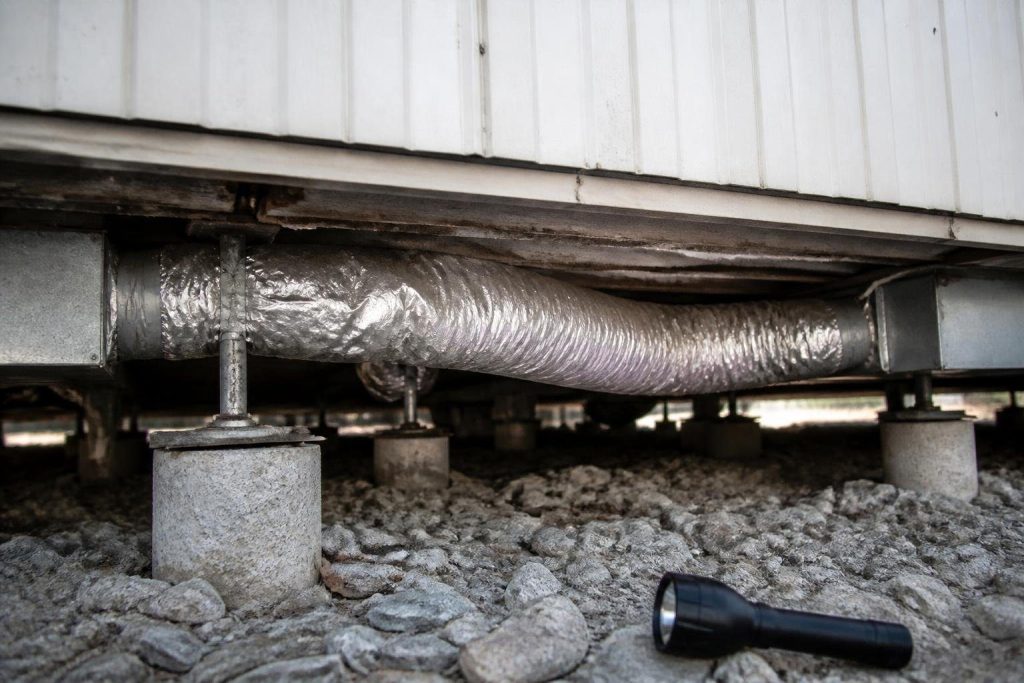
How long does a mobile home furnace last, and what does DOE say it costs?
DOE’s 2023 furnace rule estimates an average lifetime of 21.5 years for gas furnaces, mobile home models included: 22.5 years in northern states and 20.2 years elsewhere. EIA’s 2020 survey found 1.01 million mobile homes whose main heating equipment was 20 or more years old.
On price, the only federal figure we found is DOE’s modeled average installed cost of $2,583 in 2022 dollars for a 95% AFUE mobile home gas furnace (Table V.6). It averages product, markups and labor across DOE’s sample of mobile home households from EIA’s 2020 survey; it is not a quote. We skip vendor price ranges because no federal series backs them. Our federal furnace cost breakdown shows how to compare bids.
How we researched this
We read the text of eight 24 CFR 3280 sections and 10 CFR 430.2 and 430.32 through the eCFR versioner (October 1, 2026). DOE figures come from the December 2023 final rule (88 FR 87502) and the April 2026 petition notice. Housing counts come from EIA RECS 2020 and Census ACS 2024. Model data are maker claims.
Excluded: vendor and contractor price ranges (no federal series), Reddit (combustion and CO topic), and Census Manufactured Housing Survey tables, which list shipments and prices but no heating data. We consulted 15 sources and cite 11. Research date: October 11, 2026.
Frequently asked questions
How much does it cost to replace a furnace in a mobile home?
DOE modeled an average installed cost of $2,583 in 2022 dollars for a 95% AFUE mobile home gas furnace in its 2023 final rule. It is a federal average, not a local quote. Get written bids naming the model, its manufactured home listing and the permit.
What kind of furnace do I need for a mobile home?
You need a furnace listed for manufactured homes that keeps combustion separate from indoor air, as 24 CFR 3280.709(d) requires. Most are direct vent downflow units. Match fuel, airflow and cabinet, and size it with a Manual J calculation, as Intertherm advises.
How long does the average mobile home furnace last?
DOE estimates an average lifetime of 21.5 years for gas furnaces, mobile home models included, with 22.5 years in northern states and 20.2 years elsewhere. EIA’s 2020 survey counted 1.01 million mobile homes whose main heating equipment was 20 or more years old.
Are mobile home furnaces different from regular home furnaces?
Yes. DOE defines a mobile home furnace as a direct vent furnace designed for use only in mobile homes, and the HUD Code requires sealed combustion. The federal gas efficiency floor is the same for both: 80.0% today and 95.0% for units made from December 18, 2028.
Can I replace a mobile home gas furnace with an electric furnace?
Often, yes. Intertherm’s FAQ says it works if your electrical service and wiring can support the new unit. Electric furnaces were the main heat in 1.34 million mobile homes in EIA’s 2020 survey, and they need no flue or gas line.
Does the 95% AFUE rule apply to mobile home furnaces?
Yes, for gas. 10 CFR 430.32(e) sets 95.0% AFUE for mobile home gas furnaces manufactured on and after December 18, 2028. A February 19, 2026 industry petition seeks new compliance dates, but the October 1, 2026 eCFR text is unchanged.
Sources
- eCFR. “24 CFR Part 3280, Manufactured Home Construction and Safety Standards.” https://www.ecfr.gov/current/title-24/subtitle-B/chapter-XX/part-3280. Accessed October 2026.
- eCFR. “10 CFR 430.2, Definitions.” https://www.ecfr.gov/current/title-10/chapter-II/subchapter-D/part-430/subpart-A/section-430.2. Accessed October 2026.
- eCFR. “10 CFR 430.32, Energy and water conservation standards.” https://www.ecfr.gov/current/title-10/chapter-II/subchapter-D/part-430/subpart-C/section-430.32. Accessed October 2026.
- Federal Register. “Energy Conservation Standards for Consumer Furnaces,” 88 FR 87502. https://www.federalregister.gov/documents/2023/12/18/2023-25514/energy-conservation-program-energy-conservation-standards-for-consumer-furnaces. Accessed October 2026.
- Federal Register. “Notification of Petition for Rulemaking,” 91 FR 22477. https://www.federalregister.gov/documents/2026/04/27/2026-08145/energy-conservation-program-notification-of-petition-for-rulemaking. Accessed October 2026.
- US Energy Information Administration. “2020 RECS Table HC6.1.” https://www.eia.gov/consumption/residential/data/2020/hc/xls/HC%206.1.xlsx. Accessed October 2026.
- US Census Bureau. “ACS 2024 1-Year, Table B25032, Tenure by Units in Structure.” https://data.census.gov/table/ACSDT1Y2024.B25032. Accessed October 2026.
- US Census Bureau. “ACS 2024 1-Year, Table B25024, Units in Structure.” https://data.census.gov/table/ACSDT1Y2024.B25024. Accessed October 2026.
- Intertherm. “Furnaces.” https://www.intertherm.net/furnaces/. Accessed October 2026.
- Thermo Pride. “Mobile Home.” https://thermopride.com/product-category/mobile-home/. Accessed October 2026.
- Nordyne. “Series MG, MM, MS and MB Installation Instructions/Owners Manual” (scanned copy, InspectApedia). https://inspectapedia.com/heat/Amrstrong-Series-MG-MM-MS-MB-Manual.pdf. Accessed October 2026.
Leave a Reply