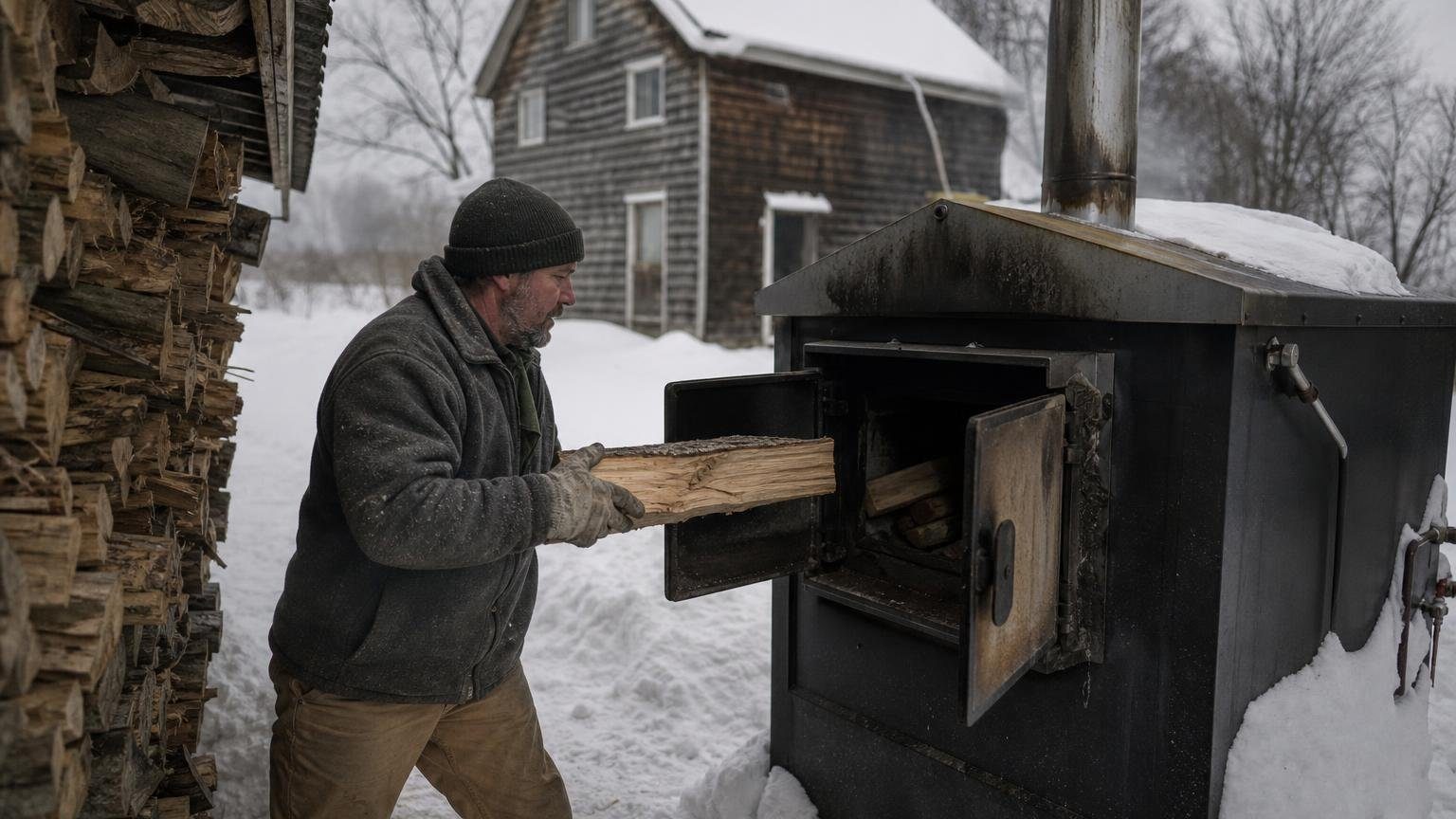
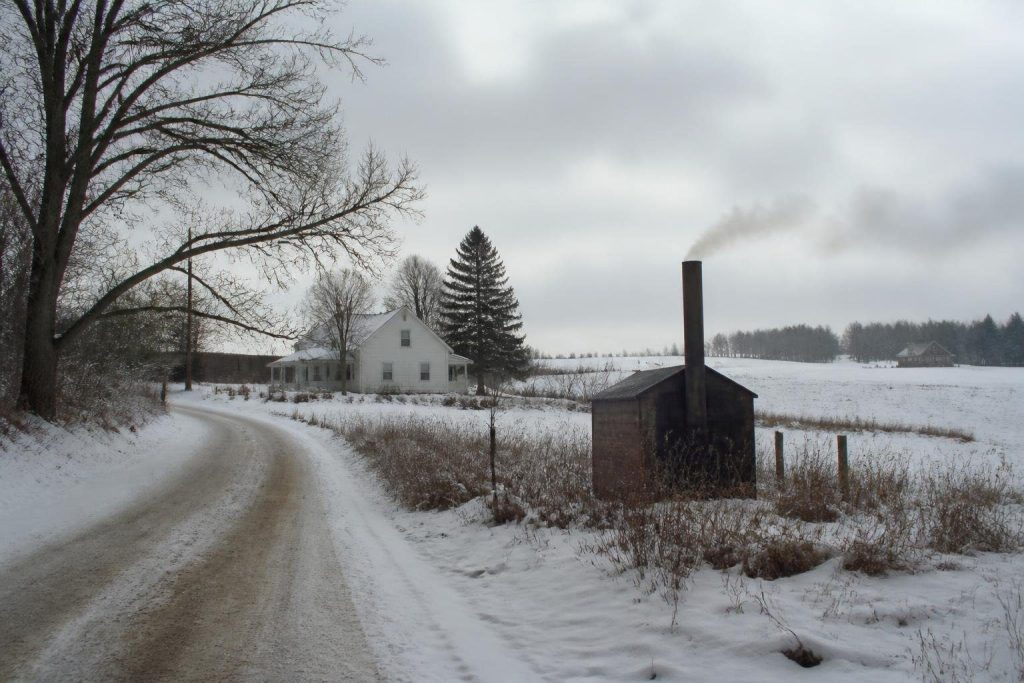
What is an outdoor wood boiler? An outdoor wood boiler is a wood-fired water heater housed in a shed outside the home that pipes hot water underground to the house’s heating system. Since May 15, 2020, new units must meet EPA’s Step 2 smoke limit, and many states add setbacks and stack heights.
Key Takeaways
- EPA’s Step 2 limit for new units is 0.10 lb of particulate per million Btu of heat output, or 0.15 on the cord wood option, under 40 CFR 60.5474.
- No federal rule bans running one. New York requires new residential units to sit 100 feet from the property line with an 18 foot stack, under 6 NYCRR 247.5.
- Massachusetts bars operation May 16 to September 30 unless the unit is certified ( 310 CMR 7.26).
- At EIA’s October 5, 2026 heating oil price of $6.042 a gallon, wood burned at 50% efficiency matches oil at about $507 a cord (EIA weekly prices, our arithmetic).
- The federal credit for biomass boilers covered improvements made through December 31, 2025, per the IRS.
How does an outdoor wood boiler work?
An outdoor wood boiler burns wood in a firebox wrapped in a water jacket, then pumps that water through insulated underground pipe to the house. EPA describes hydronic heaters as heating water or a water and antifreeze mix piped to homes, barns, greenhouses and garages (EPA Burn Wise).
- A water thermostat opens the combustion air when the water cools and closes it at setpoint, so the fire idles between calls.
- A circulator moves the hot water out through the buried supply line and back through the return.
- Inside, a heat exchanger feeds the existing system: a coil in a furnace plenum, a plate exchanger on a hot water heating loop, or tubing in a radiant floor.
- Units can be pressurized or unpressurized. A closed, pressurized loop needs an expansion tank as the water heats.
“Outdoor wood furnace” is a sales name for the same appliance; the federal rule’s “forced-air furnace” is a separate class that heats air for ducts.
What does the EPA require of an outdoor wood boiler?
Since May 15, 2020, a new residential outdoor wood boiler may be made or sold at retail in the US only if certified to EPA’s Step 2 limit: 0.10 lb of particulate per million Btu of heat output on crib wood, or 0.15 on the cord wood option, under 40 CFR part 60 subpart QQQQ.
| Stage | Applies from | Particulate limit | Section |
|---|---|---|---|
| Step 1 hydronic heater | May 15, 2015 | 0.32 lb/mmBtu weighted average, and 18.0 g/hr at any single burn rate | 60.5474(b)(1) |
| Step 2 hydronic heater, crib wood | May 15, 2020 | 0.10 lb/mmBtu at every burn rate | 60.5474(b)(2) |
| Step 2 hydronic heater, cord wood option | May 15, 2020 | 0.15 lb/mmBtu at every burn rate | 60.5474(b)(3) |
| Forced-air furnace, 2020 | May 15, 2020 | 0.15 lb/mmBtu, cord wood test | 60.5474(b)(6) |
Step 2 is a tougher test, not only a lower number. Step 1 allowed a weighted average across burn rates; Step 2 applies “per individual burn rate,” so a dirty low fire cannot hide in a clean average.
A compliant unit’s permanent label reads “Certified to comply with the 2020 particulate emission standards” (60.5478). Owners must run it per the owner’s manual and never burn unseasoned wood, defined as 20 percent moisture or more (60.5474). The rule covers units made on or after May 15, 2015, so older installed boilers fall outside it. EPA warns that most units “qualified” under its old voluntary program are not “certified” under the standard (EPA). Indoor stoves follow a separate rule; see our wood stove certification explainer.
Are outdoor wood boilers banned? The state and local rules
No federal rule bans owning or running an outdoor wood boiler, but uncertified new units cannot be sold at retail. EPA notes that many local agencies ban or restrict hydronic heaters, set distances to neighbors and set minimum stack heights.
| Jurisdiction | Setback | Stack | Other limits |
|---|---|---|---|
| New York, 6 NYCRR Part 247 (new residential units) | 100 feet from the nearest property line | 18 feet above ground; DEC may require more | DEC certified models only; smoke that sets off neighbors’ smoke detectors is banned |
| Massachusetts, 310 CMR 7.26 (residential size) | 50 feet from any property line and 75 feet from any home it does not serve | 2 feet above roof peaks within 150 feet, when that close to a home | No operation May 16 to September 30 unless certified or 500 feet from homes |
| Wisconsin, DHS guidance for local ordinances | 300 to 500 feet from the nearest neighboring building | 15 feet or higher than roofs of nearby buildings | Local health departments act under Wis. Stat. ch. 254 |
Under 6 NYCRR 247.5 and 247.6, New York units over 250,000 Btu/h need 200 feet to the property line and 1,000 feet to a school. Massachusetts defines residential size as 350,000 Btu/hr or less (MassDEP, archived copy). Wisconsin’s numbers are recommendations to towns, not state law (Wisconsin DHS).
We did not verify other states; ask the state air agency and town first. In many jurisdictions the indoor piping needs the permits of any boiler installation.
What does an outdoor wood boiler cost to run?
Running cost comes down to your price per cord and real efficiency. EIA puts a cord at 20 million Btu. At EIA’s October 5, 2026 US averages, oil in an 86% boiler delivers heat for $50.73 per million Btu and propane in an 84% boiler for $33.82; wood wins on fuel below the break-evens.
| Wood boiler efficiency (assumed) | Heat delivered per cord | Cord price that matches oil | Cord price that matches propane | Cords per 100 million Btu delivered |
|---|---|---|---|---|
| 50% | 10.0 million Btu | $507 | $338 | 10.0 |
| 65% | 13.0 million Btu | $659 | $440 | 7.7 |
| 77% (Forest Service assumption) | 15.4 million Btu | $781 | $521 | 6.5 |
Oil uses 138,500 Btu a gallon and the 86% federal minimum boiler efficiency; propane, billed as in any propane heating system, uses 91,452 Btu and 84% (EIA heat contents). No federal series tracks cordwood prices, so we publish break-evens instead. Pump electricity, labor and equipment are excluded.
The Forest Service’s Fuel Value Calculator puts an average home at 50 to 150 million Btu a season (2004 edition). Compare fuels in our cost of heat by fuel table and our heating oil price series.
How efficient is an outdoor wood boiler?
There is no trustworthy single number. Subpart QQQQ limits smoke and sets no efficiency floor, and rated efficiencies have a poor record: in late 2010 EPA found its Method 28 efficiencies did not represent actual efficiencies and removed them from its website, per a 2011 Brookhaven National Laboratory review for NYSERDA (Report 11-17).
The Forest Service calculator assumes 77% for seasoned firewood but was built with commercial boilers in mind. The expired federal credit required 75% thermal efficiency.
Two habits help. Burn wood under 20% moisture, the federal line for seasoned wood. Keep return water warm: Brookhaven flagged condensing below 130°F, which corrodes heaters not designed for it. Central Boiler says its Classic Edge Titanium HDX uses “up to 60% less wood,” a maker claim with no stated baseline.
What are the downsides of an outdoor wood boiler?
Smoke is the big one. EPA’s archived guidance says older units, with smoldering fires and short stacks “usually no more than six to ten feet tall,” release heavy smoke close to the ground (EPA, 2017 snapshot). Its fine particles can trigger heart attacks and strokes in people already at risk (EPA).
- Neighbors. New York’s required sale notice warns that even a compliant unit can be ordered removed at the owner’s expense if it unreasonably interferes with others (247.9).
- Labor. Every cord is cut, split, dried and hand loaded.
- Old units. EPA says Phase 2 units were up to 90 percent cleaner than unqualified ones.
Correction: the 30% credit is gone
Wisconsin DHS’s outdoor wood boiler page, updated February 24, 2026, still says 30% federal tax credits run from 2023 to 2032. The IRS says the Energy Efficient Home Improvement Credit covers improvements made through December 31, 2025, so a 2026 install does not qualify.
Is an outdoor wood boiler worth it?
It can be, with cheap cordwood, room for the setbacks and a big oil or propane bill to replace. It rarely is on a small lot, with wood bought near break-even, or where the town restricts them. Check in this order:
- Confirm state and town setback, stack and season rules.
- Buy only an EPA certified model with a 2020 label.
- Price your cordwood against the break-even table above.
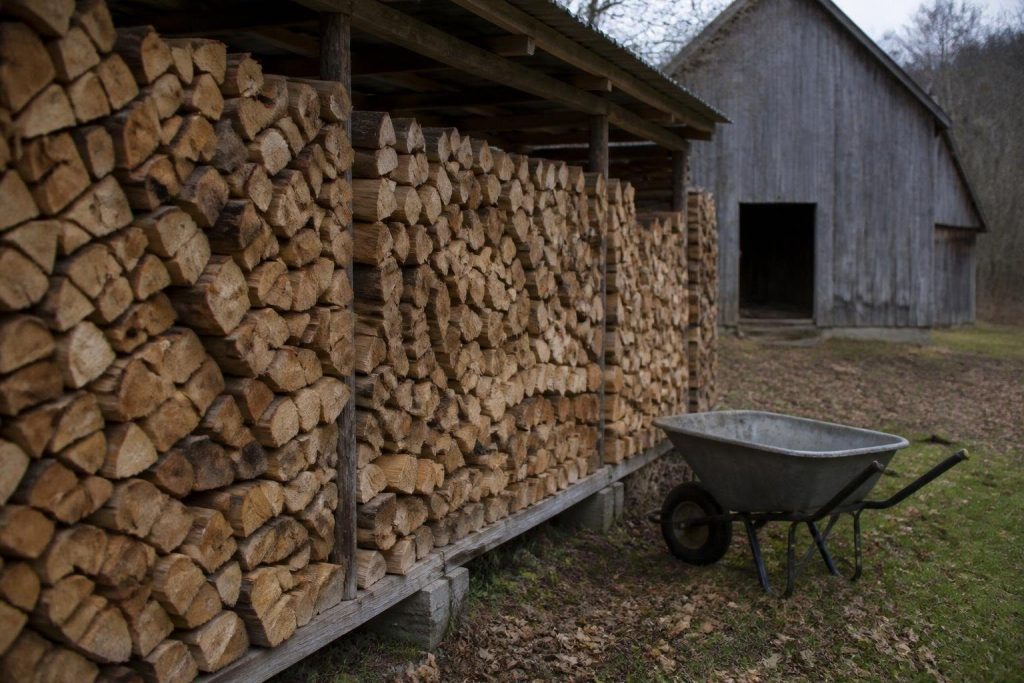
- Plan covered storage so wood stays under 20% moisture.
- Weigh it against other home heating system types that need no daily loading.
How we researched this
Researched October 11, 2026. We read the eCFR text of 40 CFR 60.5472 to 60.5478 and 10 CFR 430.32, New York Part 247 and the Massachusetts 310 CMR 7.26 text dated October 22, 2008 (archived copy). Break-even prices are our arithmetic. We consulted 21 documents and cite 14.
Excluded: Reddit and forums (a combustion topic); dealer installed prices (no federal series); and EPA’s certified wood heater database, which returned an error on October 11, 2026, so we publish no model count.
Frequently asked questions
What is the average cost of an outdoor wood boiler?
No federal or national lab series publishes installed prices, so we quote no dealer figures. Running cost is measurable: at EIA’s October 5, 2026 prices, a cord burned at 50% efficiency matches oil at about $507 and propane at about $338.
What is the best outdoor wood boiler?
No federal body or national lab ranks them. Start with models whose permanent label says they meet the 2020 particulate standards: 0.10 lb per million Btu on crib wood or 0.15 on cord wood. Treat brand efficiency claims as maker claims.
Are outdoor wood boilers legal in NYS?
Yes, within limits. Under 6 NYCRR Part 247, a new unit must be a DEC certified model at least 100 feet from the nearest property line, with a permanent stack at least 18 feet above ground. Smoke that sets off a neighbor’s smoke detector is prohibited.
Can you burn trash in an outdoor wood boiler?
No. 40 CFR 60.5474(f) prohibits garbage, yard waste, plastics, rubber, plywood, particleboard, treated lumber, construction debris and unseasoned wood, plus anything not listed in the owner’s manual. New York and Massachusetts keep similar banned fuel lists, and both ban garbage outright.
How many cords of wood does an outdoor wood boiler use?
At 20 million Btu per cord (EIA), 100 million Btu of delivered heat takes 6.5 cords at 77% efficiency and 10.0 cords at 50%. The Forest Service puts an average home at 50 to 150 million Btu a season, or roughly 3 to 15 cords.
Is there a tax credit for an outdoor wood boiler in 2026?
Not federally. The IRS says the Energy Efficient Home Improvement Credit, which allowed up to $2,000 a year for biomass boilers of at least 75% thermal efficiency, covers improvements made through December 31, 2025. Any state programs vary, so check locally.
Sources
- eCFR. “40 CFR Part 60 Subpart QQQQ.” https://www.ecfr.gov/current/title-40/part-60/subpart-QQQQ. Accessed October 2026.
- eCFR. “10 CFR 430.32.” https://www.ecfr.gov/current/title-10/chapter-II/subchapter-D/part-430/subpart-C/section-430.32. Accessed October 2026.
- US EPA. “Choosing the Right Hydronic Heater.” https://www.epa.gov/burnwise/choosing-right-hydronic-heater. Accessed October 2026.
- US EPA. “Choosing the Right Hydronic Heater” (January 2017 snapshot). https://19january2017snapshot.epa.gov/burnwise/choosing-right-hydronic-heater_.html. Accessed October 2026.
- US EPA. “Wood Smoke and Your Health.” https://www.epa.gov/burnwise/wood-smoke-and-your-health. Accessed October 2026.
- New York DEC. “6 NYCRR Part 247, Outdoor Wood Boilers” (Cornell LII). https://www.law.cornell.edu/regulations/new-york/6-NYCRR-247.5. Accessed October 2026.
- MassDEP. “310 CMR 7.26(50) to (54)” (archived copy). https://www.mass.gov/doc/310-cmr-72650-54-massdep-wood-fired-boiler-regulation/download. Accessed October 2026.
- Wisconsin DHS. “Air: Outdoor Wood Boilers.” https://www.dhs.wisconsin.gov/air/woodboiler.htm. Accessed October 2026.
- US EIA. “Units and calculators explained.” https://www.eia.gov/energyexplained/units-and-calculators/. Accessed October 2026.
- US EIA. “Weekly heating oil and propane prices.” https://www.eia.gov/dnav/pet/hist/LeafHandler.ashx?n=PET&s=W_EPD2F_PRS_NUS_DPG&f=W. Accessed October 2026.
- IRS. “Energy Efficient Home Improvement Credit.” https://www.irs.gov/credits-deductions/energy-efficient-home-improvement-credit. Accessed October 2026.
- USDA Forest Service, Forest Products Laboratory. “Fuel Value Calculator” (archived copy). https://www.fpl.fs.fed.us/documnts/techline/fuel-value-calculator.pdf. Accessed October 2026.
- NYSERDA and Brookhaven National Laboratory. “Review of EPA Method 28 Outdoor Wood Hydronic Heater Test Results.” https://www.nyserda.ny.gov/-/media/Project/Nyserda/Files/Publications/Research/Biomass-Solar-Wind/Outdoor-Wood-Hydronic-Heater-Test-Results.pdf. Accessed October 2026.
- Central Boiler. Home page (maker claims). https://centralboiler.com/. Accessed October 2026.
Leave a Reply