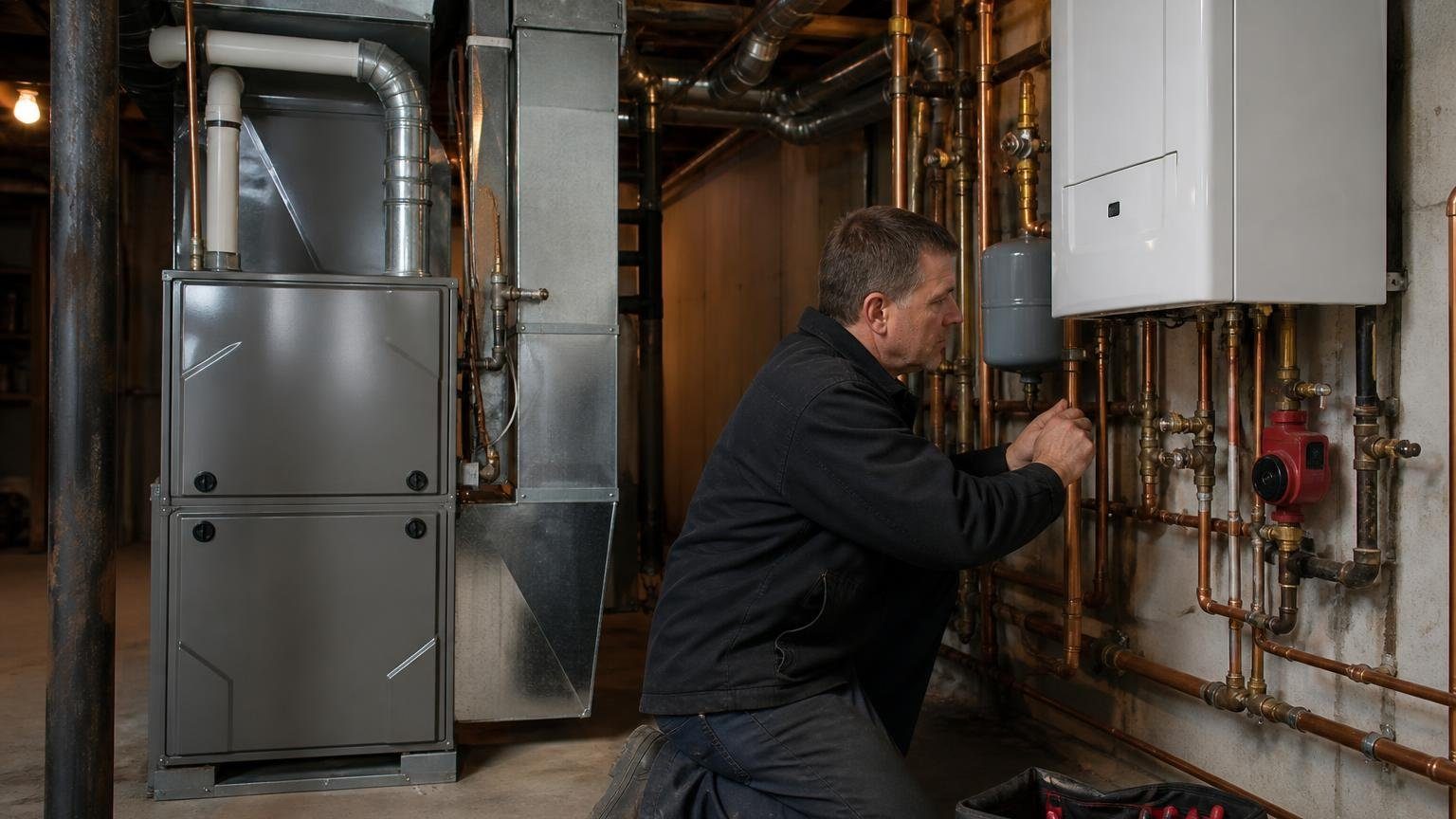
Boiler vs furnace: which is better? A furnace heats air and pushes it through ducts; a boiler heats water and pipes it to radiators or floors. Furnaces cost less to install and share ducts with central air. Boilers avoid duct losses and last longer in DOE analyses, 26.6 years against 21.5.
Key Takeaways
- Furnaces were the main heat in 74.42 million US homes in 2020; boilers (steam or hot water) in 9.29 million, about 8 to 1 (EIA RECS 2020).
- The federal AFUE floor is 84% for a new gas hot water boiler and 80% for a gas furnace, rising to 95% for gas furnaces made from December 18, 2028 (10 CFR 430.32(e)).
- EIA models a 95% AFUE gas boiler at $5,940 installed and a 95% AFUE gas furnace at $4,150, in 2022 dollars (EIA equipment cost study).
- At equal 95% AFUE, gas heat costs the same $14.55 per million Btu in either box at EIA’s winter 2026 to 2027 forecast price (EIA STEO, October 2026).
- AFUE ignores duct losses, which DOE says can reach 35% of furnace output with ducts in an attic or garage (DOE Energy Saver, archived copy).
- DOE’s rulemakings put average life at 26.6 years for a gas hot water boiler and 21.5 years for a gas furnace (DOE, 2016 boiler rule).
What is the difference between a boiler and a furnace?
The difference between a boiler and a furnace is the heat carrier. DOE puts it plainly: furnaces heat air and send it through ducts, while boilers heat water and supply either hot water or steam (DOE Energy Saver). Most residential boilers make hot water, not steam; EIA notes steam boilers “make up a small percentage of the market” (EIA).
Both burn the same fuels and carry an AFUE rating. The carrier decides the rest: ducts or pipes, and whether air conditioning can ride along. For the pipe side in detail, see our explainer on how a hydronic water loop works.
| Factor | Gas furnace | Gas hot water boiler |
|---|---|---|
| Heat carrier | Air, through ducts | Water, through pipes to baseboard, radiators, floors or a coil |
| Federal AFUE floor | 80%; 95% from Dec 18, 2028 | 84% since Jan 15, 2021 |
| US homes, 2020 | 74.42 million | 9.29 million (steam or hot water, all fuels) |
| EIA modelled installed cost, 95% AFUE | $4,150 (80,000 Btu/h, 2022$) | $5,940 (100,000 Btu/h, 2022$) |
| DOE average lifetime | 21.5 years | 26.6 years |
| Central air | Shares the ducts | Needs separate cooling |
Boiler vs furnace efficiency: what do the federal minimums say?
Boiler vs furnace efficiency depends on the model, not the category. Under 10 CFR 430.32(e), a gas hot water boiler made since January 15, 2021 must reach 84% AFUE, an oil hot water boiler 86%, a gas steam boiler 82% and an oil steam boiler 85% (eCFR). A non-weatherized gas furnace must reach 80% today, and an oil furnace 83%.
The furnace floor jumps to 95% for gas units made on and after December 18, 2028, which our report on the 2028 condensing furnace rule covers. At the top end the two overlap: DOE gives 90% to 98.5% AFUE for condensing furnaces and boilers, and EIA lists 96.4% as the most efficient gas boiler.
Oil narrows the boiler options. EIA reports that no condensing oil-fired boilers exist in the US market, because sulfur in the fuel fouls the heat exchanger (EIA). US gas hot water boiler sales split about 60/40 between condensing and non-condensing; our boiler replacement guide covers that choice.
Correction: “boilers are more efficient.” Several ranking pages list boiler minimums of 82% for gas hot water and 84% for oil hot water. Those are the 2012 to 2021 levels in 10 CFR 430.32(e)(2)(ii); every class rose 2 to 3 points in 2021. From December 2028, the minimum new gas furnace (95%) will out-rate the minimum new gas boiler (84%). Where boilers do gain is distribution: AFUE ignores duct losses.
Do homes still use boilers? How many US homes have each
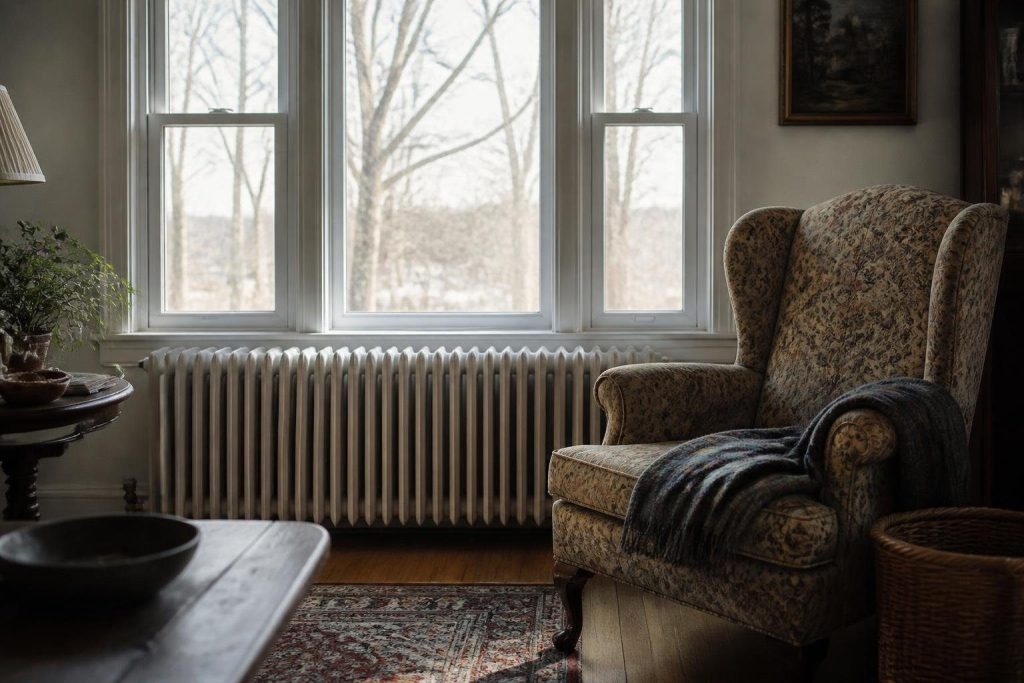
Yes, but far fewer than furnaces. In 2020, 9.29 million of 123.53 million US homes used a steam or hot water system as main heat, about 7.5%, against 74.42 million on a central furnace, about 60.2% (EIA RECS 2020, HC6.1).
Boilers skew away from detached houses. Only 4.31 million boiler homes were single-family detached, so about 54% were apartments, attached or mobile homes. Gas fires 6.51 million boiler homes and oil or kerosene 1.62 million. Our guide to every home heating type ranks the rest.
Boiler vs furnace cost: what do they cost to install and to run?
A boiler costs more to install; at the same AFUE and fuel, it costs about the same per unit of heat. EIA models a typical 95% AFUE gas hot water boiler (100,000 Btu/h) at $5,940 installed and a 95% AFUE gas furnace (80,000 Btu/h, northern states) at $4,150, both in 2022 dollars (EIA equipment cost study). That is $1,790, or 43%, more for the boiler.
These are modelled averages, not quotes, and capacities differ. EIA puts an 86% oil boiler (140,000 Btu/h) at $5,510 and annual maintenance at $160 for the condensing gas boiler against $130 for the furnace. Our furnace cost breakdown splits equipment from labor.
Running cost turns on fuel and AFUE. We divided EIA’s October 2026 forecast residential prices, averaged October 2026 to March 2027 ($14.32 per thousand cubic feet of gas, $5.43 a gallon of heating oil), by EIA’s Btu content (1,036 Btu per cubic foot, 138,500 Btu per gallon) and by AFUE (EIA STEO; EIA Btu factors).
| Equipment at its AFUE | Fuel cost per million Btu of heat |
|---|---|
| Gas furnace, 80% | $17.27 |
| Gas boiler, 84% | $16.45 |
| Gas furnace or gas boiler, 95% | $14.55 |
| Oil boiler, 86% | $45.55 |
| Oil furnace, 83% | $47.20 |
The fuel matters more than the box: oil heat costs about 3.1 times gas. These rates exclude duct or pipe losses, and monthly cost is your heat load times the rate. To weigh a heat pump instead, see our heat pump vs gas furnace state comparison.
What lasts longer, a furnace or a boiler?
A boiler, on DOE’s numbers. DOE’s 2016 boiler rule estimates average lifetimes of 26.6 years for gas hot water boilers, 24.7 for oil hot water and 23.6 for gas steam (81 FR 2320). DOE’s 2023 furnace rule puts the gas furnace at 21.5 years nationally, 22.5 in the North (88 FR 87502).
That 5.1 year gap has a caveat. Lochinvar, Burnham, Energy Kinetics and Crown Boiler told DOE that sources put condensing boiler life at 15 years or less; DOE found too little data to separate them and kept one lifetime. Our equipment age analysis shows how old installed systems run.
Is a boiler or a furnace better for your house?
For most houses the existing distribution decides it: ducts favor a furnace, radiators or baseboard favor a boiler, because switching means building new distribution. DOE lists the furnace’s main advantage as pairing with central air, and its main drawback as ducts prone to leaks (DOE Energy Saver, archived copy).
The downsides of a boiler are real but manageable. DOE says air in hot water radiators reduces efficiency, so they need bleeding each season, and zoned rooms should stay above 50°F to keep pipes from freezing. A boiler cannot cool, though hot water “can heat air via a coil” in an air handler. One plus: a combi boiler also makes domestic hot water.
Can you replace a boiler with a furnace?
Yes, but it means adding a duct system, so treat it as a new installation. No federal series publishes duct installation cost; our ductwork cost review shows what data exists. A typical sequence:
- Get a room-by-room heat load calculation (ACCA Manual J) so ducts and furnace are sized to the house, not to the old boiler.
- Plan duct routes inside conditioned space where possible; DOE says losses can reach 35% of furnace output with ducts in an attic or garage.
- Price the ductwork as its own line, separate from the furnace.
- Check venting. DOE’s 2023 furnace rule priced PVC flue venting, condensate removal and orphaned water heaters for condensing installs.
- Replace domestic hot water if the old boiler made it, then drain and cap or remove the old piping.
Want central air but like the radiators? Keep the boiler and add cooling instead; our guide to adding central air to a house without ducts compares the routes, and a fan coil unit can run on boiler water.
How we researched this
Research date: October 13, 2026. Cited: 10 CFR 430.32(e) read through the eCFR versioner API; EIA RECS 2020 Table HC6.1; EIA’s 2023 appliance cost and efficiency study; DOE’s 2016 boiler and 2023 furnace final rules; EIA’s October 2026 Short-Term Energy Outlook and Btu factors; two DOE Energy Saver pages, read as archived copies. Cost-of-heat figures are our arithmetic, shown above.
Excluded: vendor price surveys used by ranking pages (no federal sample), unsourced lifespan ranges, and the claim that boilers are inherently more efficient. Reddit was not used.
Frequently asked questions
Is it better to have a boiler or a furnace?
Neither wins everywhere. A furnace costs less to install ($4,150 against $5,940 at 95% AFUE in EIA’s 2022-dollar model) and shares ducts with central air. A boiler avoids duct losses and averages 26.6 years of life in DOE analysis, against 21.5 for a gas furnace.
Is a boiler cheaper to run than a furnace?
Only if it is more efficient or loses less heat in distribution. At equal 95% AFUE and EIA’s October 2026 forecast gas price, both deliver heat for $14.55 per million Btu. A 95% furnace beats an 84% boiler ($16.45). Leaky attic ducts, which DOE says can lose up to 35%, can reverse that.
Are boilers still common in US homes?
Not very. EIA counted 9.29 million US homes heated mainly by steam or hot water in 2020, 7.5% of homes, and says gas boilers have lost market share to furnaces and heat pumps over 30 years. About 54% of boiler homes were not single-family detached.
What are the downsides of using a boiler?
No cooling, a higher installed cost and more upkeep. EIA models annual maintenance at $160 for a condensing gas boiler against $130 for a gas furnace in 2022 dollars. DOE says air in hot water radiators cuts efficiency, and zoned rooms must stay above 50°F to protect pipes.
Can you have a boiler and central air?
Yes, with a separate cooling system. DOE notes boiler hot water can also heat air through a coil, which is how a hydronic air handler works, so a ducted house can pair a boiler with central air. In houses without ducts, ductless heat pumps are another route.
Is a steam boiler less efficient than a hot water boiler?
Yes. DOE says steam boilers run hotter and are inherently less efficient. The federal floor for a gas steam boiler made since January 15, 2021 is 82% AFUE, against 84% for a gas hot water boiler, under 10 CFR 430.32(e).
Sources
- Electronic Code of Federal Regulations. “10 CFR 430.32, Energy and water conservation standards and their compliance dates.” https://www.ecfr.gov/current/title-10/chapter-II/subchapter-D/part-430/subpart-C/section-430.32. Accessed October 2026.
- U.S. Energy Information Administration. “RECS 2020 Table HC6.1, Space heating in U.S. homes, by housing unit type.” https://www.eia.gov/consumption/residential/data/2020/hc/xls/HC%206.1.xlsx. Accessed October 2026.
- U.S. Energy Information Administration. “Updated Buildings Sector Appliance and Equipment Costs and Efficiencies.” https://www.eia.gov/analysis/studies/buildings/equipcosts/pdf/full.pdf. Accessed October 2026.
- U.S. Department of Energy. “Energy Conservation Standards for Residential Boilers,” final rule, 81 FR 2320, January 15, 2016. https://www.federalregister.gov/documents/2016/01/15/2016-00025/energy-conservation-program-energy-conservation-standards-for-residential-boilers. Accessed October 2026.
- U.S. Department of Energy. “Energy Conservation Standards for Consumer Furnaces,” final rule, 88 FR 87502, December 18, 2023. https://www.federalregister.gov/d/2023-25514. Accessed October 2026.
- U.S. Energy Information Administration. “Short-Term Energy Outlook, October 2026,” Table 2. https://www.eia.gov/outlooks/steo/xls/STEO_m.xlsx. Accessed October 2026.
- U.S. Energy Information Administration. “British thermal units (Btu).” https://www.eia.gov/energyexplained/units-and-calculators/british-thermal-units.php. Accessed October 2026.
- U.S. Department of Energy, Energy Saver. “Furnaces and Boilers” (archived copy). https://web.archive.org/web/2025id_/https://www.energy.gov/energysaver/furnaces-and-boilers. Accessed October 2026.
- U.S. Department of Energy, Energy Saver. “Heat Distribution Systems” (archived copy). https://web.archive.org/web/2025id_/https://www.energy.gov/energysaver/heat-distribution-systems. Accessed October 2026.
Leave a Reply