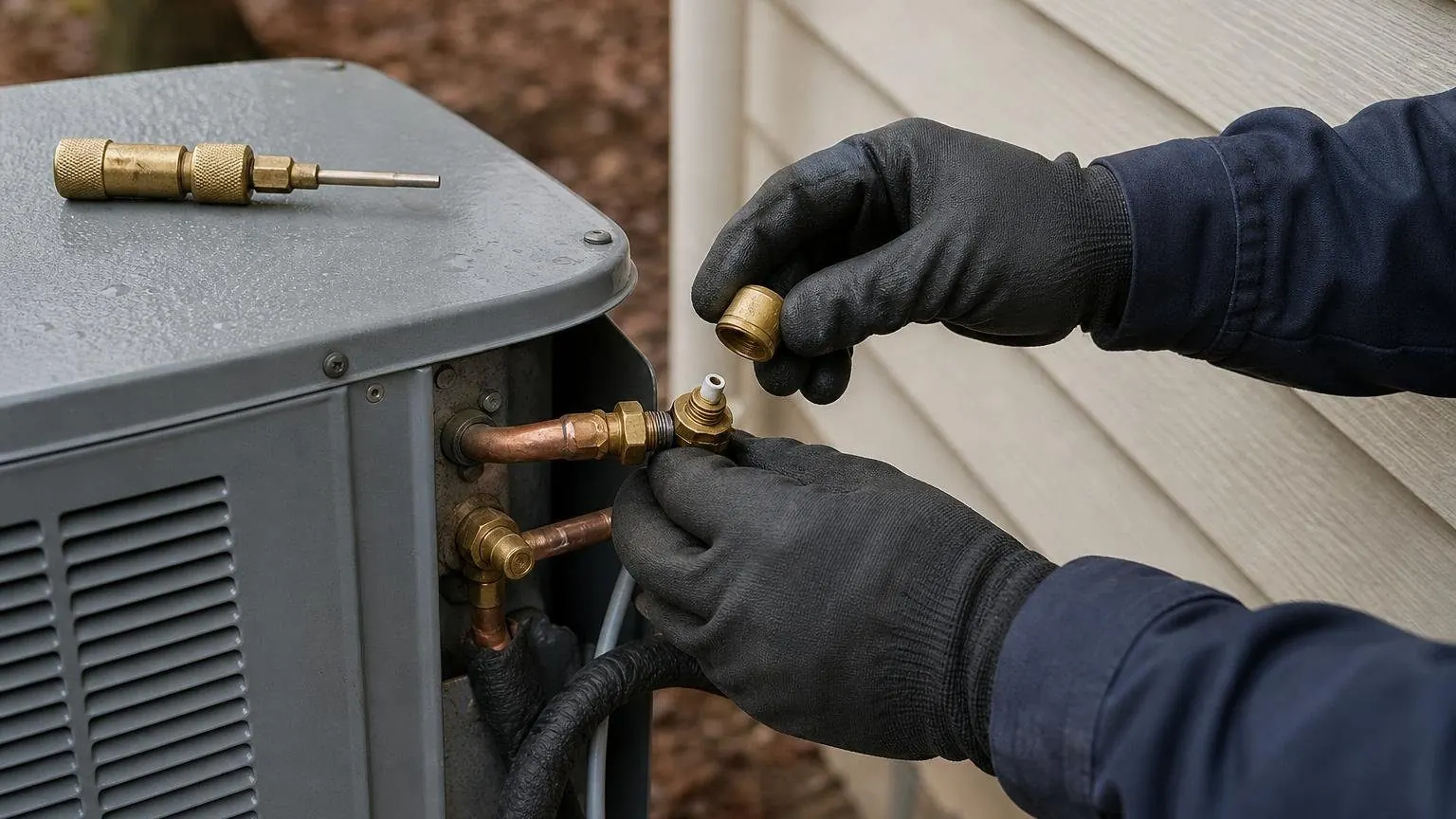
What is a Schrader valve? A Schrader valve is the spring-loaded access valve on an AC or heat pump service port: a threaded core that opens only when a gauge hose depresses its pin, sealed behind a gasketed cap. It lets a certified technician read pressure, evacuate and charge without cutting the line.
Key Takeaways
- Schrader Pacific lists 3 to 5 in-lb as the installation torque for standard cores (maker catalog); Fujitsu names overtightening as a leak cause.
- Fujitsu General calls the gasketed metal cap the valve’s “secondary seal and dirt barrier” (service guidance), so a missing cap is a leak finding.
- Standard flare ports are 1/4 in. (7/16-20 thread); some R-410A equipment uses 5/16 in. ports (1/2-20 thread), per Yellow Jacket.
- The 2024 IRC (M1411.15) and 2021 IMC (1101.9) require locking tamper-resistant caps on outdoor access ports (code text).
- EPA’s rule names “attaching or detaching hoses and gauges” as work that can breach the circuit (40 CFR 82.152).
- Schrader Pacific rates its AC standard core at 800 psig maximum working pressure, against 200 psig for a tire-type air core (catalog table).
What is a Schrader valve on an AC system?
A Schrader valve on an AC system is the access valve inside each refrigerant service port, typically one on the suction (low) side and one on the liquid or high side. It is a check valve: system pressure and a spring hold it shut until a hose fitting presses the pin.
Technicians call it a service port, access valve or access fitting. It is where a manifold gauge set connects to read pressures, where a vacuum pump pulls the system down after a repair, and where refrigerant goes in or comes out. Federal rules require every appliance other than small appliances to be sold with a “servicing aperture” for refrigerant removal (40 CFR 82.154(e)). A Schrader port is one common way to provide it.
The same valve family sits in car and bike tires. Schrader Pacific notes standard cores are defined by ISO, TRA and ARI, but the refrigerant versions use different seal compounds and pressure ratings (table below).
How does a Schrader valve core and cap seal the circuit?
A Schrader valve seals the circuit in two layers: the core is the working seal, and the gasketed cap is a backup seal and dirt shield. Schrader Pacific says its caps “serve as a redundant seal to the valve” (valve core catalog), and Fujitsu General calls the cap the “long-term secondary seal”.
The core is a cartridge check valve that threads into the port body. A soft seating washer closes against the body seat, an external PTFE (Teflon) seal stops leakage around the core threads, and a spring returns the pin when the hose comes off. The standard core thread is .210 in.-36.
Correction: Wikipedia states that in refrigeration “the valve cap is considered to be the primary seal.” The manufacturers we read say otherwise: Fujitsu General calls the cap the secondary seal, and Schrader Pacific calls it redundant. They agree on the practical point, though. Schrader Pacific’s A/C manual says “security of this cap is essential to the leak integrity of the port.” Put the gasketed cap back every time.
What size is an AC Schrader valve service port?
The standard AC Schrader valve service port is a 1/4 in. SAE flare, which is a 7/16-20 male thread. Some R-410A equipment, mini splits in particular, uses a larger 5/16 in. SAE flare port with a 1/2-20 thread; Yellow Jacket sells hoses “for use with R-410A A/C systems with 5/16″ service ports” (maker page).
A 1/4 in. hose will not thread onto a 5/16 in. port, so Yellow Jacket’s mini split kit pairs a 5/16 in. hose with a 5/16 in. female by 1/4 in. male coupler. Check the port before buying a core tool too; the RealTorque tool comes in both sizes. Newer A2L units such as R-32 and R-454B systems follow the same check: read the port, not the refrigerant label.
| Part | Size or thread | Rating or torque | Maker source |
|---|---|---|---|
| 1/4 in. SAE flare port | 7/16-20 | Takes standard 1/4 in. hoses and caps | Yellow Jacket; Schrader Pacific cap sheet |
| 5/16 in. SAE flare port (some R-410A) | 1/2-20 | Needs a 5/16 in. hose or adapter | Yellow Jacket |
| AC standard core (8080570047) | .210-36 | 800 psig max; 3 to 5 in-lb; neoprene | Schrader Pacific |
| Tire-type air core (045750035) | .210-36 | 200 psig max; 3 to 5 in-lb; nitrile | Schrader Pacific |
| AC 8mm and 10mm cores | Larger bore | 10 to 20 and 15 to 30 in-lb | Schrader Pacific |
The 8mm and 10mm cores come from Schrader Pacific’s air-conditioning table and mobile A/C manual; their torque does not apply to a standard core.
Why does a Schrader valve leak, and how is it confirmed?
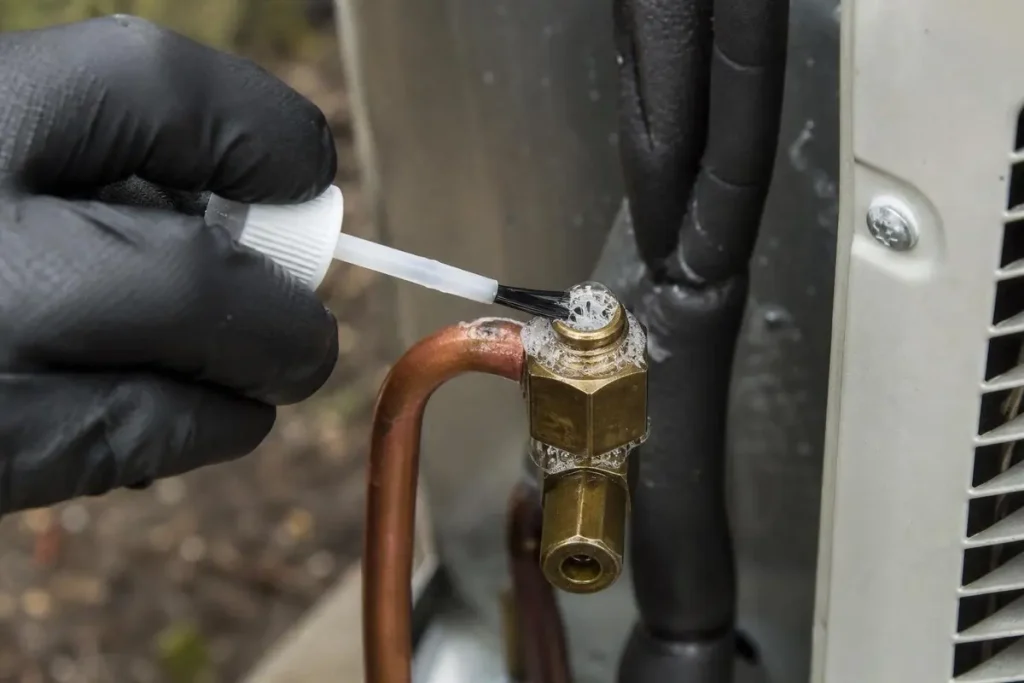
A Schrader valve leaks when the core seat is dirty or damaged, the core is overtightened, or the cap is missing. Fujitsu General lists all three: cores “can be distorted or contaminated when service tools are inserted or removed,” and “dirt under the core seat, damaged seals or overtightening the valve core can cause a slow refrigerant leak.”
That makes the service port a suspect in any slow leak, and a low charge means a leak somewhere, not a top-off. Fujitsu’s test is a leak-detection solution on the core, the port body and the cap, watching for bubbles or pressure loss. Electronic detectors and other methods are compared in our leak detection guide.
Torque the core to spec, not by feel. Schrader Pacific warns that “breakaway torque is not an accurate way to verify the installation torque,” so loosening a core tells you little about how tight it was.
How is a Schrader valve core replaced?
A Schrader valve core is replaced with a core removal tool, either after the charge is recovered or under pressure with a tool rated for it. Fujitsu General specifies “a core-removal tool specifically rated for replacement under pressure” if the system remains charged, and Yellow Jacket says its RealTorque kits can replace cores “without losing system pressure” (spec sheet).
For certified technicians, condensed from Fujitsu’s procedure and the makers’ torque data (recovery itself is covered in our refrigerant recovery guide):
- Kill power and identify the leaking port with bubble solution.
- Either recover the charge or fit a core removal tool rated for use under pressure.
- Withdraw the old core into the tool, verify the tool’s shut-off, and inspect the valve seat for debris.
- Install a new HVAC-rated core and torque a standard core to 3 to 5 in-lb.
- Refit a metal cap with an intact gasket.
- Leak-test the core, body and cap. If the circuit was opened, evacuate per the equipment instructions before recharging.
Core removal also speeds service. Yellow Jacket states that “removal of system Schrader cores can greatly increase the speed of recovery and evacuation.” Our filter drier explainer covers when the drier is replaced as well.
Do outdoor service ports need locking refrigerant caps?
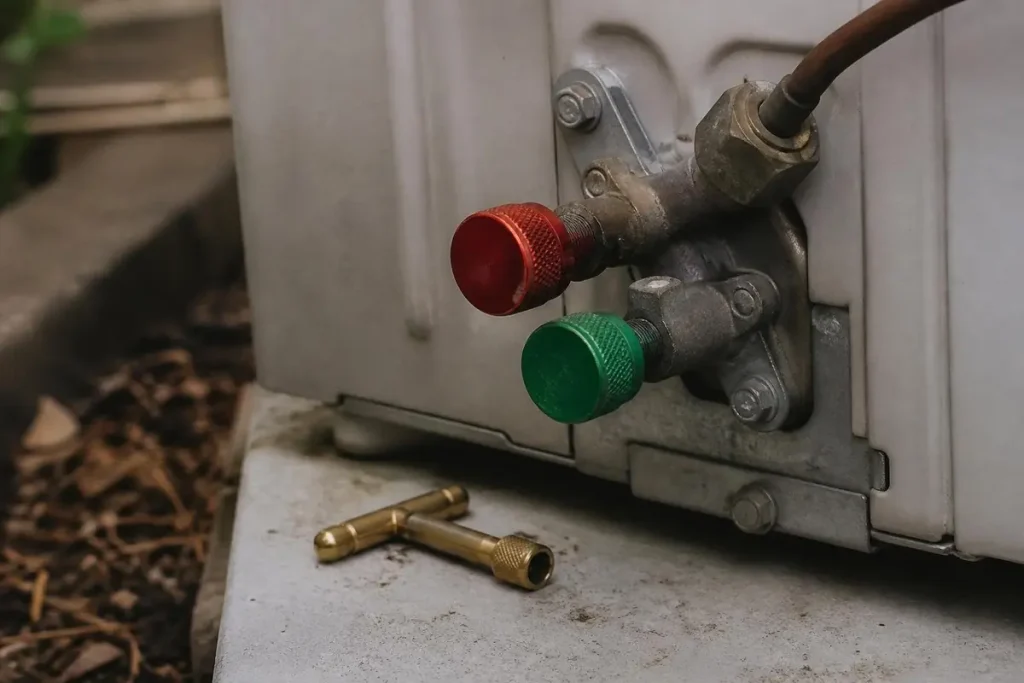
Yes, where the model codes are adopted. The 2024 International Residential Code, section M1411.15, reads: “Refrigerant circuit access ports located outdoors shall be fitted with locking-type tamper-resistant caps or shall be otherwise secured to prevent unauthorized access” (Texas adoption).
The 2021 International Mechanical Code carries the same sentence as section 1101.9, plus an exception for equipment “installed in controlled areas such as on roofs with locked access hatches or doors.” The section number moves between editions: it was M1411.8 in the 2015 and 2018 IRC and 1101.10 in the 2015 IMC. Older articles cite M1411.6; we could not open that edition’s text, so check the edition your jurisdiction adopted.
We found no EPA rule that requires locking caps. The requirement comes from building codes, so enforcement depends on local adoption and inspection. Whichever cap goes on, Schrader Pacific’s point about cap security still applies.
Who is allowed to open an AC service port?
Under federal rules, only an EPA-certified technician should open the service port on a home AC or heat pump. EPA’s definition of technician (40 CFR 82.152) lists “attaching or detaching hoses and gauges to and from the appliance” as work expected to breach the refrigerant circuit.
Residential R-410A and R-22 systems are “high-pressure appliances,” meaning refrigerant saturation pressure between 170 psia and 355 psia at 104°F. Servicing them requires Type II or Universal certification under 40 CFR 82.161; our EPA 608 explainer covers the exam types. Separately, 40 CFR 82.154 says no one servicing an appliance may knowingly vent refrigerant, which is what a careless core pull does.
How we researched this
Researched October 14, 2026. We read 40 CFR 82.152, 82.154 and 82.161 through the eCFR API, the IRC and IMC locking-cap sections as adopted in Texas on UpCodes, and maker documents from Schrader Pacific, Yellow Jacket and Fujitsu General, cited as maker data. Excluded: contractor blogs, retailer listings, an unattributed trade-press torque figure and Reddit. No prices: no federal series covers them.
Frequently asked questions
What is another name for a Schrader valve?
On HVAC equipment it is called a service port, access valve or access fitting. EPA’s rule uses the broader term “servicing aperture” and requires one on every appliance except small appliances, under 40 CFR 82.154(e). Small appliances get a process stub instead.
Is an AC Schrader valve the same as a tire valve?
Same family, different parts. Schrader Pacific rates its AC standard core at 800 psig with a neoprene seal and its tire-type air core at 200 psig with a nitrile seal. Use an HVAC-rated core in a refrigerant port, as Fujitsu General specifies.
What size is an R-410A Schrader valve?
Either the standard 1/4 in. SAE flare (7/16-20 thread) or, on some R-410A equipment such as mini splits, a 5/16 in. port with a 1/2-20 thread, per Yellow Jacket. Read the port, then match the hose. Pressures to expect are in our R-410A pressure chart.
How tight should a Schrader valve core be?
Schrader Pacific gives 3 to 5 in-lb for a standard core, and Yellow Jacket’s RealTorque tool clicks in that range. Fujitsu General warns that overtightening can itself cause a slow leak, so a torque-limiting core tool beats guessing.
Can I add refrigerant through the Schrader valve myself?
Not legally on a home split system unless you hold Type II or Universal certification under 40 CFR 82.161; connecting gauges counts as breaching the circuit. Our DIY mini split report covers how EPA treats pre-charged line sets.
Does EPA require locking caps on AC service ports?
We found no EPA rule requiring them. The requirement is in the model codes: IRC 2024 section M1411.15 and IMC 2021 section 1101.9 call for locking tamper-resistant caps on outdoor access ports, where your jurisdiction has adopted those codes.
Sources
- eCFR. “40 CFR 82.152 Definitions.” https://www.ecfr.gov/current/title-40/chapter-I/subchapter-C/part-82/subpart-F/section-82.152. Accessed October 2026.
- eCFR. “40 CFR 82.154 Prohibitions.” https://www.ecfr.gov/current/title-40/chapter-I/subchapter-C/part-82/subpart-F/section-82.154. Accessed October 2026.
- eCFR. “40 CFR 82.161 Technician certification.” https://www.ecfr.gov/current/title-40/chapter-I/subchapter-C/part-82/subpart-F/section-82.161. Accessed October 2026.
- UpCodes. “Texas IMC 2021, Chapter 11 Refrigeration, 1101.9.” https://up.codes/viewer/texas/imc-2021/chapter/11/refrigeration. Accessed October 2026.
- UpCodes. “Texas IRC 2024, Chapter 14, M1411.15.” https://up.codes/viewer/texas/irc-2024/chapter/14/heating-and-cooling-equipment-and-appliances. Accessed October 2026.
- UpCodes. “Locking Access Port Caps” (edition index). https://up.codes/s/locking-access-port-caps. Accessed October 2026.
- Schrader Pacific. “Valve Cores and Valve Core Tools.” https://schrader-pacific.com/wp-content/uploads/Valve-Core.pdf. Accessed October 2026.
- Schrader Pacific. “A/C Valve Application and Installation Manual.” https://schrader-pacific.com/wp-content/uploads/AC-Valve-Manual.pdf. Accessed October 2026.
- Schrader Pacific. “Schrader Valve Caps.” https://schrader-pacific.com/wp-content/uploads/Schrader-Valve-Caps.pdf. Accessed October 2026.
- Yellow Jacket. “PLUS II 1/4 in. Hose for 5/16 in. Flare Service Ports for R-410A.” https://yellowjacket.com/product/plus-ii-14-hose-for-flare-service-ports-for-r-410a/. Accessed October 2026.
- Yellow Jacket. “RealTorque Core Removal Tool spec sheet.” https://yellowjacket.com/wp-content/uploads/2024/10/10196-RealTorque-Product-Spec-Sheet-2024-10.pdf. Accessed October 2026.
- Yellow Jacket. “Mini-Split Tool Kit, New Product Bulletin 5.” https://yellowjacket.com/wp-content/uploads/2013/02/New-Product-Bulletin-5-Mini-Split-Tool-Kit.pdf. Accessed October 2026.
- Fujitsu General (Australia). “Leaking Schrader Valve.” https://assist.fujitsugeneral.com.au/support/solutions/articles/6000276730-leaking-schrader-valve. Accessed October 2026.
- Wikipedia. “Schrader valve” (quoted for correction only). https://en.wikipedia.org/wiki/Schrader_valve. Accessed October 2026.
Leave a Reply