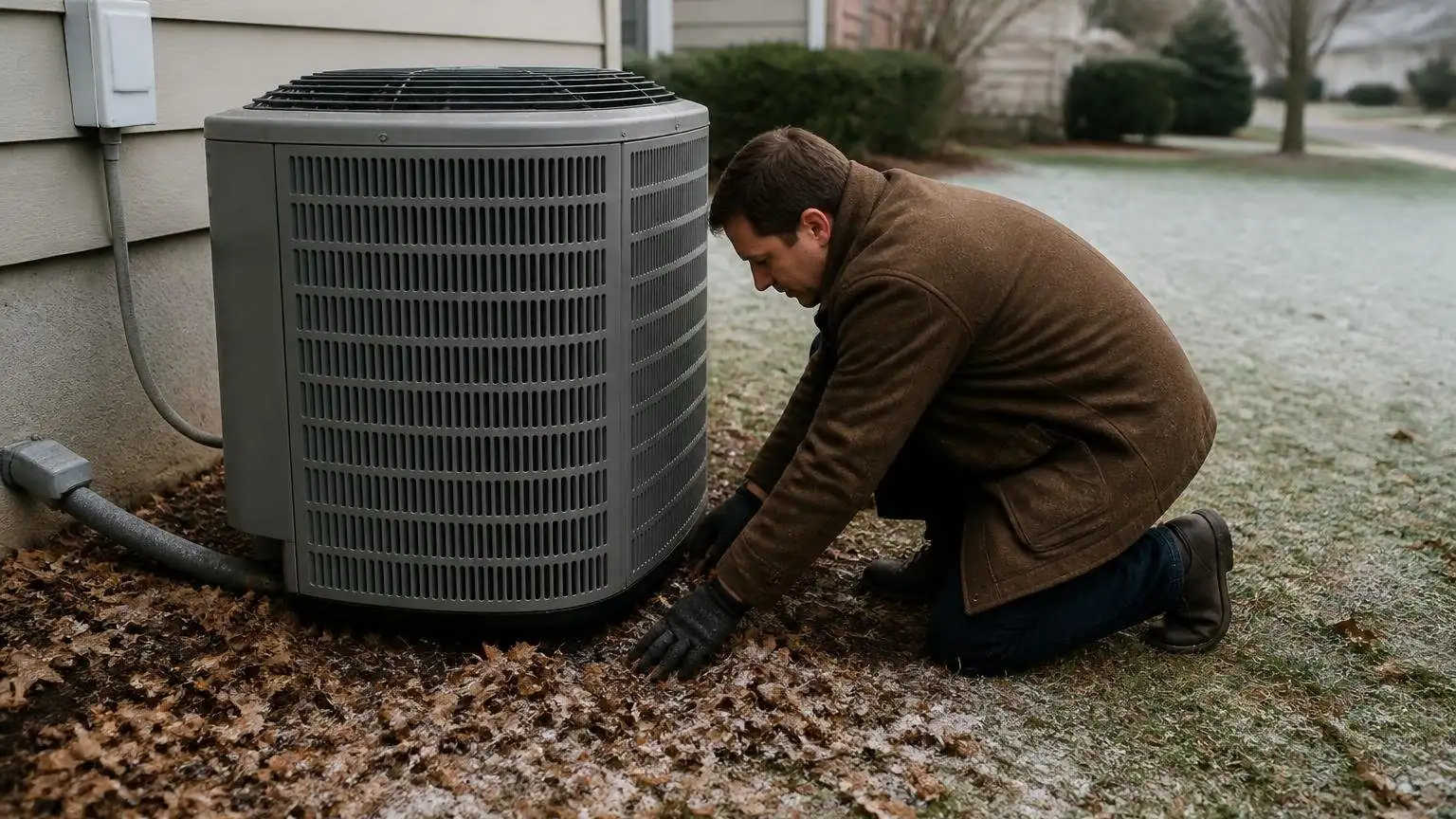
Should you cover your AC unit in winter? Usually not. A full AC unit cover traps moisture, and Goodman, Carrier, Trane and Lennox literature all advises against wrapping the outdoor unit. Never cover a heat pump that may run. Where ice or roof water falls on the unit, a top-only board with open sides is the safer fix.
Key Takeaways
- Goodman: no winter cover unless your dealer agrees, and only a breathable one (Goodman IOG-4002A).
- Carrier and Bryant’s owner’s manual: “Do not cover it,” and keep 12 inches from grass and shrubs (OG-ACR410GEN-03).
- Trane’s packaged system guide: “Never cover the unit since it is designed to operate year round” (Trane DC-UC-WEB01).
- Lennox: “The short answer is no,” though plywood on top can stop falling debris (Lennox).
- Heat pumps frost up and defrost themselves; fan and compressor pause about 30 seconds at the start (Rheem 708367).
- Shading claims are overstated: DOE cites up to 10%, while a Florida Solar Energy Center field test measured 0.1% average savings (FSEC-PF-302-96).
Should you cover your AC unit in winter?
No, not with a full wrap. Every maker document we read either says not to cover the outdoor unit or allows only breathable, dealer-approved covers. The coil needs open air on the sides and top, as our guide to what the outdoor condenser does explains.
| Maker and document | What it says about covers | Winter or heat pump note |
|---|---|---|
| Goodman, IOG-4002A install and service reference (2017) | “Do not use a condensing unit cover to ‘protect’ the outdoor unit during the winter, unless you first discuss it with your dealer.” Covers must be breathable. | Troubleshooting: confirm it is not covered on the sides or the top |
| Carrier and Bryant, OG-ACR410GEN-03 owner’s manual (2019) | “The outdoor unit needs unrestricted airflow. Do not cover it or place items on or next to it.” | Not designed to cool below 55°F without modification |
| Trane, 22-5213-WEB01 outdoor unit owner’s guide | Nothing “stacked against the sides of the unit or draped over it” | Clean snow from around the unit as soon as possible |
| Trane, DC-UC-WEB01 packaged system guide | “Never cover the unit since it is designed to operate year round.” | Packaged heat pumps and gas/electric units |
| Lennox, consumer guidance (2025) and XP25 manual | “The short answer is no.” A plywood top for falling debris is acceptable. | Keep snow below the louvered panels |
| Rheem archive, 708367 heat pump user’s information | No cover language found in this document | Coil frost in heat mode is normal; the unit will “periodically defrost” itself |
Can you cover a heat pump in winter?
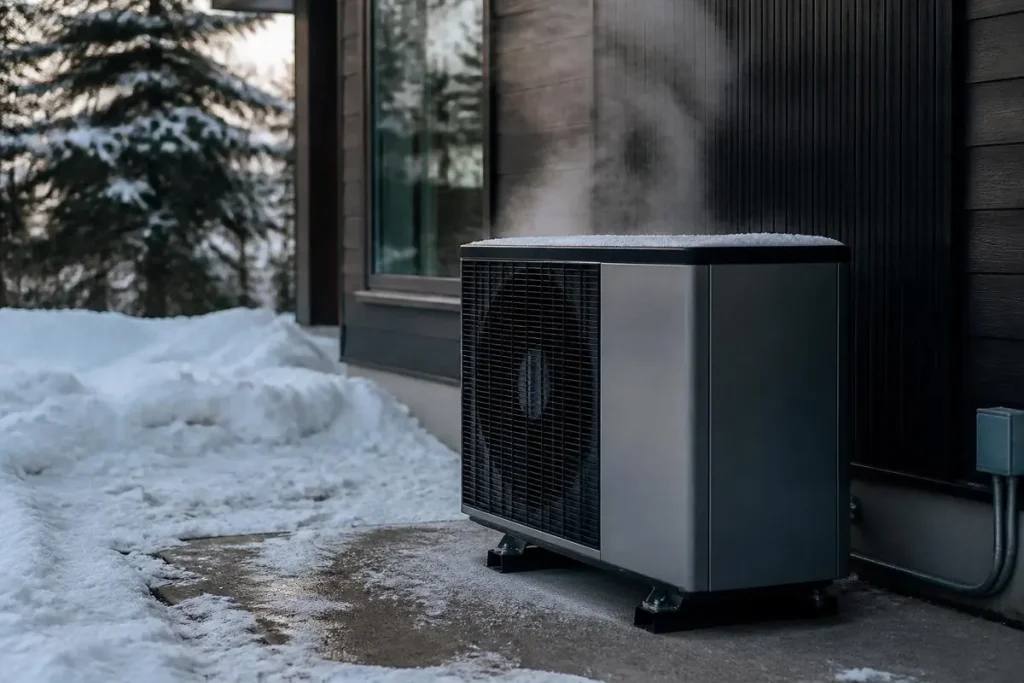
No. A heat pump’s outdoor unit is its heat source in winter, so it must breathe whenever the thermostat might call for heat. Trane’s wording is blunt: never cover the unit “since it is designed to operate year round.” Its outdoor unit owner’s guide adds that nothing should be “draped over it.”
Frost on the coil is expected, and the unit will “periodically defrost” itself, per the Rheem archive manual. At the start of defrost the outdoor fan and compressor stop; after about 30 seconds the compressor restarts and warms the coil. The full sequence is in our explainer on the heat pump defrost cycle.
A cover would trap that meltwater. Goodman heat pump bases have cutouts under the coil so defrost water can drain, and the Lennox XP25 manual asks owners to keep snow below the louvered panels. If you are unsure which you own, our comparison of a heat pump vs an air conditioner shows how to tell.
What can go wrong under a full AC unit cover?
Three things: trapped moisture, frozen or corroded parts, and the unit running while wrapped. Goodman requires breathable fabric “to avoid moisture buildup”; a vinyl wrap holds damp air against the coil and controls all winter.
Myth check: a cover keeps the coil from freezing
A ranking article claims covers keep coils from freezing. Lennox says the opposite: “Accumulated moisture can result in temperatures under the cover that are lower than the outside air” and can “possibly freeze” the coils. Lennox also lists rodents seeking shelter as a cover risk.
The third risk is operation. If a warm spell or a thermostat mistake starts the system, a wrapped unit cannot move air, and a starved coil drives up pressure and heat in the condenser fan motor and compressor.
Warranty is the last concern. Lennox says that depending on the manufacturer, covering may “void its warranty,” so check the exclusions in our guide to what an HVAC warranty covers.
When does a top-only AC unit cover make sense?
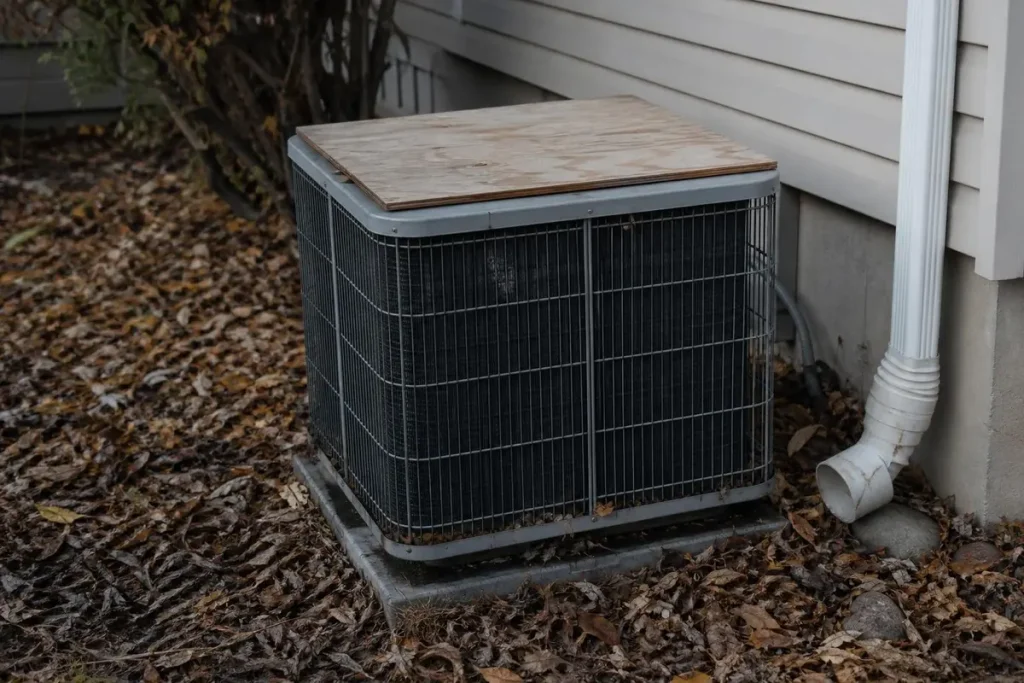
A top-only cover makes sense when something falls on the unit: icicles, roof runoff, branches or heavy leaf drop. Lennox suggests “a covering such as plywood to the top of your air conditioner to prevent falling debris and reduce ice build-up on the internal components,” with airflow left open. The same airflow rule applies to an AC cage fitted against copper thieves, which has to keep the maker clearances around the coil.
Placement is the lasting fix. Carrier’s 38EYA installation instructions tell installers to position the unit so “water, snow, or ice from roof or eaves cannot fall directly on unit.” Under an existing drip line, a top board is a stopgap; on a heat pump, use only a maker approved shield.
- Clear leaves out of the top grille first.
- Strap a rigid board or mesh top to the cabinet so wind cannot lift it.
- Leave every side open, and remove it before you run cooling.
How much clearance does an outdoor AC unit need?
It depends on the model, so the installation manual on your unit governs. The manuals we read call for 48 to 60 inches above the fan, 6 to 36 inches on the coil sides and 30 inches on the service side.
| Installation manual | Above the unit | Coil sides | Service side |
|---|---|---|---|
| Lennox XP25 heat pump (507005-01F) | 48 inches | 36 inches on one side, 12 on another, 6 on the last | 30 inches to the access panel |
| Carrier 38EYA heat pump (Form 38EYA-3SI) | 48 inches | 6 inches on one side, 12 on the rest | 30 inches at the service end |
| Goodman IOG-4002A condensing unit and heat pump | Unobstructed; 60 inches minimum under any obstruction | Not stated in the text we read | Keep minimum service clearance on the side away from the wall |
Goodman also suggests raising heat pumps above expected snow: 2.5 inches where the design temperature is 15°F or higher, 8 inches from minus 5°F to 14°F, and 12 inches below minus 5°F. Screens and fences must respect the same side numbers.
Does shading an AC unit outside save energy?
Barely, according to the only field test we found. The Department of Energy’s consumer landscaping guide says shading an air conditioner “can increase its efficiency by as much as 10%.” The Florida Solar Energy Center tested the idea on three homes in Central Florida over two summers and did not find savings of that size.
Shade cut the peak condenser inlet temperature by about 3.3°F and the daily average by 1.0°F. Efficiency shifts only about 1.2% per degree between 82°F and 100°F, FSEC notes. The computed average AC savings across the three experiments was 0.1%, within the study’s stated measurement uncertainty. The authors called any savings “quite modest (<3%)" and warned that blocking airflow "may outweigh shading considerations."
Shade from a tree several feet away is fine; a sun cover or hedge hugging the cabinet works against the coil. A clean coil matters more; see our coil cleaning guide covers that.
How do you winterize an AC unit without a cover?
Winterizing an AC unit without a cover takes a few fall checks, drawn from the manuals above. Pair it with our heating season checklist.
- Confirm whether the outdoor unit is an AC or a heat pump. If it heats, skip any cover and follow our heat pump maintenance routine.
- Remove leaves from the coil, “being careful not to damage the aluminum fins,” as the Rheem archive manual puts it.
- Trim plants back 12 inches and clear the base pan so water drains.
- Leave the power on unless your manual says otherwise. Lennox says a unit with a crankcase heater should be energized 24 hours before start-up when it is below 60°F.
- Treat the outdoor disconnect as a service switch, not a winter routine.
- After snow, follow Trane: “As soon as possible after accumulation, clean snow from the area around the outdoor unit.”
- In spring, remove any top board, check for nests, and run cooling only above 55°F outside.
How we researched this
Researched October 28, 2026. We read 26 documents and cite 10: Goodman, Carrier, Trane, Lennox and Rheem-archive manuals, Lennox’s consumer page, the FSEC shading study and the DOE landscaping guide. Manufacturer documents are Tier 2, quoted only about their own equipment; archived copies are labeled.
Excluded: retailer listings, contractor blogs, home-warranty pages and Reddit. We tested no covers. Cover prices are omitted because no federal series tracks them.
Frequently asked questions
Should I cover my heat pump in winter?
No. A heat pump heats your home from the outdoor unit, so it needs open airflow all winter. Trane’s packaged system guide says “Never cover the unit since it is designed to operate year round.” Frost on the coil is normal; keep snow below the louvered panels instead.
Can I put plywood on top of my AC unit in winter?
Yes, on a cooling-only unit. Lennox suggests plywood on top to stop falling debris and reduce ice build-up. Keep the sides open, fasten the board against wind and remove it before cooling season. Skip it on a heat pump, which discharges air out the top all winter.
Will an AC unit cover void my warranty?
It can. Lennox says that depending on the manufacturer, covering your unit “may void its warranty,” and Goodman tells owners not to use a winter cover without first discussing it with the dealer. Read your warranty exclusions, and keep any cover breathable.
Is it good to shade your AC unit outside?
Distant shade is harmless, but the payoff is small. The Florida Solar Energy Center measured 0.1% average savings, within its measurement uncertainty, across three Central Florida homes and called savings “quite modest (<3%)." Shade that crowds the coil can cost more than it saves.
Should I turn off power to my AC for the winter?
Check the manual first. Many units have a crankcase heater that protects the compressor. Lennox says such a unit should be energized 24 hours before start-up when it is below 60°F, and Carrier powers the heater with the thermostat off and the disconnect closed.
What happens if the AC runs with a cover on?
It cannot move air across the coil, so pressure and heat climb until a safety trips or a part fails. Carrier’s owner’s manual says the outdoor unit “needs unrestricted airflow,” and Goodman’s troubleshooting list asks owners to confirm it is not covered on the sides or the top.
Are decorative AC unit covers and fences safe?
Only if they keep the maker’s clearances. Lennox’s XP25 manual calls for 48 inches above the unit and 36 inches on one side, and Carrier wants 12 inches to grass and shrubs. A screen built tighter than that recirculates hot discharge air into the coil.
Sources
- Goodman Manufacturing. “Condensing Unit / Heat Pump Installation and Service Reference, P/N IOG-4002A (January 2017).” Retailer CDN copy. https://cdn.shopify.com/s/files/1/0253/0852/8730/files/Goodman_GSZ16_Installation_Manual__1.pdf Accessed October 2026.
- Carrier and Bryant (CAC/BDP). “Owner’s Manual, Split-System Air Conditioner Using R-410A Refrigerant, Catalog No. OG-ACR410GEN-03 (08/19).” https://res.cloudinary.com/ddi66icj4/image/upload/v1658097162/NH_Manual_Air_Conditioner_Carrier_R_Split_System_AC_410_A_Refrigerant_6ef95ef748.pdf Accessed October 2026.
- Carrier. “38EYA Split-System Heat Pump Installation Instructions, Form 38EYA-3SI.” Archived copy. https://archive.org/download/manualsonline-id-6371e5dc-7d07-46bd-9e20-9d37c2b8b668/6371e5dc-7d07-46bd-9e20-9d37c2b8b668.pdf Accessed October 2026.
- Trane. “Owner’s Guide, Outdoor Units: Heat Pumps, Air Conditioners, 22-5213-WEB01.” Archived copy. https://archive.org/download/manualsonline-id-0669dd0a-72b0-4432-9561-1ba4bdecfe5a/0669dd0a-72b0-4432-9561-1ba4bdecfe5a.pdf Accessed October 2026.
- Trane. “Owner’s Guide, Packaged Systems or All-in-One, DC-UC-WEB01.” Archived copy. https://archive.org/download/manualsonline-id-aaa274aa-fd10-4520-a525-bc53bc823f85/aaa274aa-fd10-4520-a525-bc53bc823f85.pdf Accessed October 2026.
- Lennox. “Should I Cover My AC Unit in Winter?” https://www.lennox.com/residential/lennox-life/consumer/should-i-cover-my-ac-unit-in-the-winter Accessed October 2026.
- Lennox Industries. “XP25 Installation Instructions, 507005-01F.” https://www.lennox.com/dA/3afe37cae1/507005-01f.pdf Accessed October 2026.
- Rheem literature archive. “Outdoor Heat Pump User’s Information/Installation Instructions, Two Stage R-410A Split System, 708367 (04/04).” https://files.rheem.com/LiteratureArchive/7083670.pdf Accessed October 2026.
- Parker, D., Barkaszi, S. and Sonne, J., Florida Solar Energy Center. “Measured Impacts of Air Conditioner Condenser Shading, FSEC-PF-302-96.” https://www.fsec.ucf.edu/en/publications/html/FSEC-PF-302-96/ Accessed October 2026.
- U.S. Department of Energy. “Landscaping for Energy-Efficient Homes” (Energy Saver guide, 2021). https://www.energy.gov/sites/default/files/2021-08/ES-Landscaping_081721.pdf Accessed October 2026.
Leave a Reply