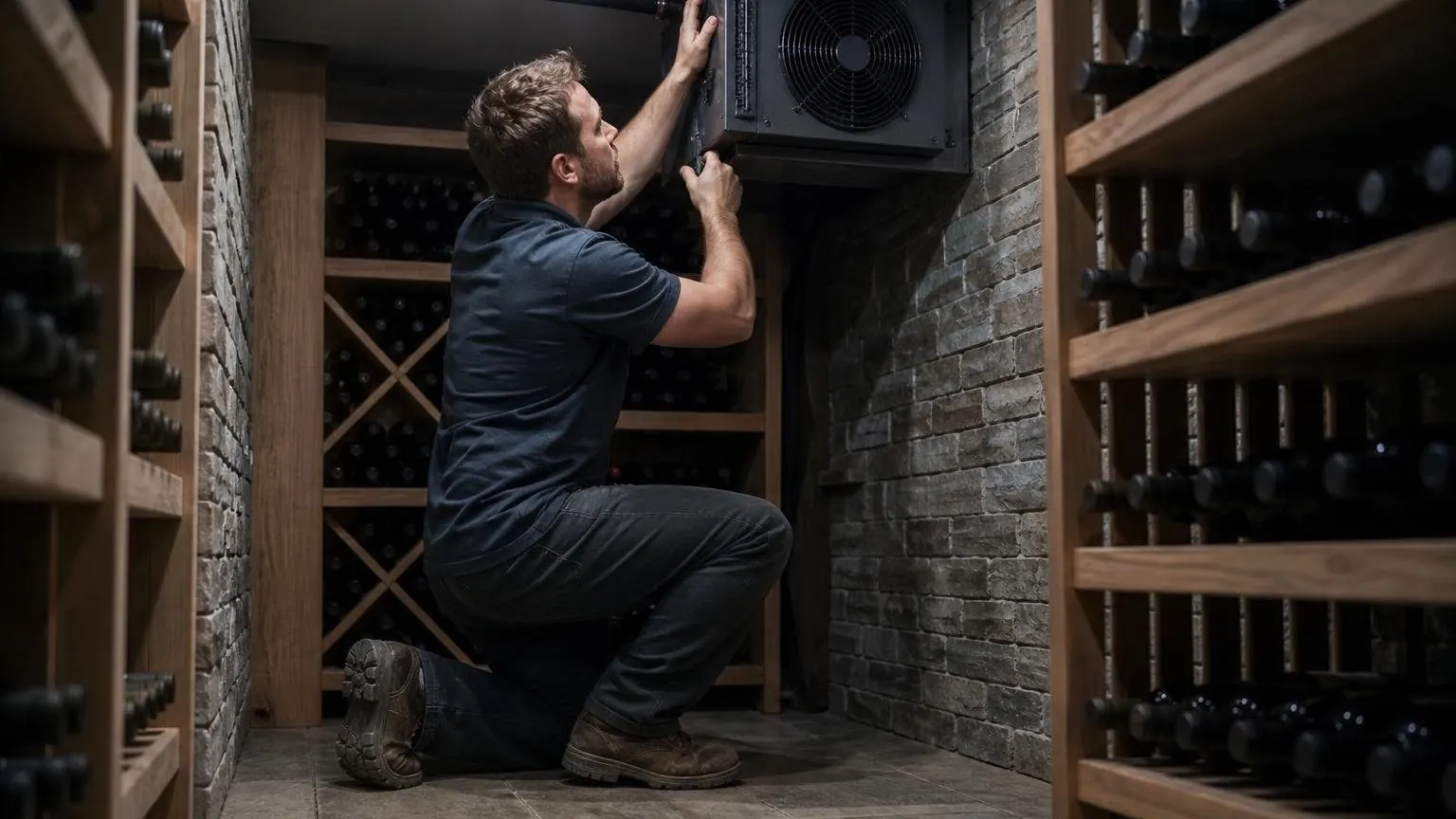
What is a wine cellar cooling unit? A wine cellar cooling unit is a refrigeration system built to hold an insulated, vapor-sealed room near 55°F without stripping out its humidity, a job comfort air conditioners are not rated for. Size it from the room’s heat load and the maker’s chart, not cubic feet alone.
Key Takeaways
- Purdue Extension puts traditional cellar storage at 50 to 60°F, around 55°F (Purdue FS-58-W).
- Mitsubishi’s MSZ-GL24NA submittal lists a 67°F minimum cooling intake air temperature and “comfort cooling only” (Mitsubishi Electric).
- CellarPro’s 2000VS table shows one 400 cubic foot cellar needing 1,717 to 2,369 BTUH (CellarPro).
- Breezaire accepts R-11 interior walls; WhisperKOOL prefers R-19 there and R-30 for ceilings (WhisperKOOL manual).
- Wine Guardian warns its air-cooled exhaust runs 25 to 35°F above entering air (Wine Guardian manual).
- DOE says wine cellar refrigeration systems fall within the federal walk-in definition (88 FR 28780).
What temperature should a wine cellar cooling unit hold?
Hold about 55°F and keep it steady. Purdue Extension enology professor Christian Butzke writes that wine is traditionally stored at 50 to 60°F, and that heat-sped aging does not match wine aged “at a traditional cellar temperature of around 13°C (55°F)” (Purdue FS-58-W).
The same guide says any temperature above 60°F accelerates maturation, above 75°F “greatly and untypically” ages most wines, and storage below 50°F may keep a wine from developing its full aroma. Its aging estimates assume a temperature held constant within 2 to 3°F.
For humidity we found no university number, and makers disagree. Breezaire targets 50% to 75% relative humidity; WhisperKOOL’s 2025 booklet lists a “45-65% humidity range” and, elsewhere, “50-70%”. Compare those with our indoor humidity targets for living spaces. A cellar that is damp rather than warm needs a properly sized dehumidifier, not a cooling unit.
Why can’t a regular air conditioner or mini split cool a wine cellar?
Because comfort equipment is not rated to run with 55°F return air. Mitsubishi’s submittal for the MSZ-GL24NA wall unit lists a minimum cooling intake air temperature of 67°F dry bulb, with a footnote that “applications should be restricted to comfort cooling only” (Mitsubishi Electric).
That rules out the usual shortcut of a ductless mini split or a ducted mini split set as low as it goes. WhisperKOOL also claims standard air conditioners “rapidly cool and remove too much humidity”; that is a maker claim, not our test.
What are the four types of wine cellar cooling units?
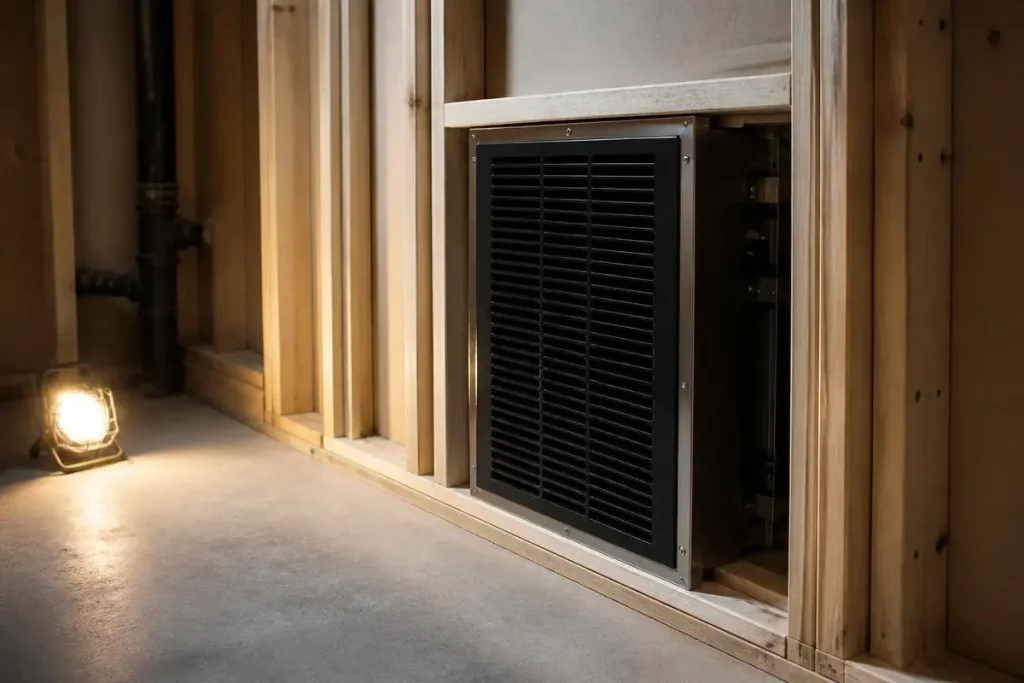
They are through-the-wall self-contained, ducted self-contained, ductless split and ducted split systems. The choice turns on where the heat can go, how much noise you accept inside the cellar, and whether a refrigeration technician must run refrigerant lines.
| Type | Maker example and rated volume | Where heat goes | Install notes |
|---|---|---|---|
| Through-the-wall self-contained | WhisperKOOL SC PRO: 300 to 1,500 cu ft; Breezaire WKL: 140 to 2,000 cu ft | Adjoining room | Breezaire: not designed for ductwork, 3 feet of clear space at the exhaust |
| Ducted self-contained | WhisperKOOL Phantom: 800 to 2,000 cu ft; Wine Guardian D025: 3,540 BTUH total at 90°F condenser air | Ducted to another space | Wine Guardian: 25 feet maximum combined supply and return duct |
| Ductless split | WhisperKOOL Platinum: 500 to 3,000 cu ft | Remote condenser | Refrigerant piping between indoor and outdoor sections |
| Ducted split | WhisperKOOL Quantum: 3,000 to 7,500 cu ft | Remote condenser | Air handler outside the cellar, ducted in |
Volumes come from WhisperKOOL’s 2025 contractor booklet, which lists BTU at 85° and cubic feet at a 55°F cellar, and Breezaire’s WKL guide. Split systems need line sets sized to the maker’s limits, covered in our refrigerant line set guide.
Noise favours ducted and split layouts. CellarPro lists its 2000VS at 55.5 decibels on low fan and 61.5 on high, falling to 56.5 when ducted. Wine Guardian’s ducted manual warns sound “may reach a magnitude of 72 db(A).” Our guide to HVAC decibel ratings explains why makers’ figures are not always comparable.
How do you size a wine cellar cooling unit?
Size it to the calculated heat load, then pick a unit whose output at your cellar temperature exceeds that load. Cubic feet is only the starting input. CellarPro’s published table for the 2000VS, a unit designed for cellars up to 400 cubic feet, shows why (CellarPro).
| 400 cu ft cellar at 55°F | 85°F outside the cellar | 95°F outside the cellar |
|---|---|---|
| R-12 surfaces | 2,146 BTUH | 2,369 BTUH |
| R-19 surfaces | 1,879 BTUH | 2,015 BTUH |
| R-30 surfaces | 1,717 BTUH | 1,800 BTUH |
The 2000VS delivers 1,713 BTUH on low fan and 1,886 BTUH on high fan at 55°F. So the same 400 cubic foot room fits the high fan with R-30 surfaces, barely fits at R-19 and 85°F, and exceeds it at R-12. Maker data, CellarPro’s own calculation.
- Measure length, width and height, and multiply for cubic feet.
- Record the R-value of every surface and any glass.
- Note the hottest temperature around the cellar.
- Run the maker’s load table or calculator with those inputs.
- Pick a unit whose output at your setpoint, not its headline cubic feet, beats that load.
Rated volumes assume ideal rooms. WhisperKOOL’s manual says glass, stone and concrete “do not offer the insulation capacity required” and that undersized units are not covered under warranty. Breezaire’s sizing guide excludes glass doors and windows entirely, and its units produce less than their stated BTUs when the space outside runs more than 25°F above the cellar.
What insulation and vapor barrier does a wine cellar need?
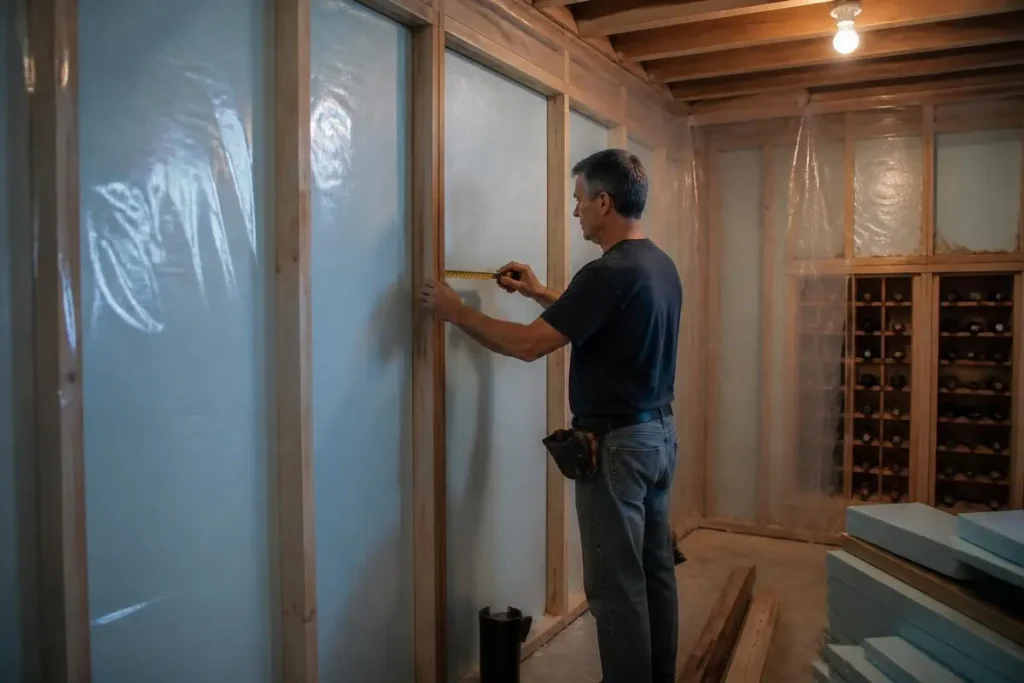
Insulate every surface and put a continuous vapor barrier on the warm side. Breezaire’s WKL guide asks for a vapor barrier “on the warm side of the insulation,” at least R-11 on interior walls, floors and doors, and R-19 on exterior walls and the ceiling (Breezaire WKL guide).
| Maker document | Setpoint range | Insulation it specifies |
|---|---|---|
| Breezaire WKL guide (2/2023) | 48°F to 63°F | R-11 interior walls, floors and doors; R-19 exterior walls and ceiling |
| WhisperKOOL SC PRO manual (2024) | Between 50°F and 70°F | R-13 minimum; R-19 preferred for interior walls; R-30 for ceilings and exterior walls |
| CellarPro 2000VS sizing table | Tables at 55°F and 60°F | Loads shown for R12, R19 and R30 |
Myth check
There is no single “R-19 walls, R-30 ceiling” rule. Among the manuals we read, only WhisperKOOL’s states that pairing; Breezaire’s minimum is lower and CellarPro publishes loads at three levels. Build to the manual for the unit you buy, since its sizing and warranty assume it.
Concrete and brick “are not insulation or moisture barriers,” Breezaire adds, and even very small cracks can let in large amounts of outside air, the guide warns. Below-grade cellars face the same moisture and radon tradeoffs covered in our basement ventilation explainer.
Where does a wine cellar cooling unit put its heat and water?
Heat goes out the condenser side into an adjoining room, a duct or a remote condenser, and condensate goes down a drain. WhisperKOOL rates its SC PRO to hold 55°F only while the condenser intake air stays at or below 85°F, and lists outside venting as not recommended (WhisperKOOL SC PRO manual).
Breezaire wants 3 feet of unobstructed exhaust space and calls closets, bathrooms, garages, attics and humid basements inappropriate exhaust locations. Wine Guardian recommends its low ambient option when the condenser sees air below 40°F (Wine Guardian manual).
For water, WhisperKOOL’s condensate evaporator is designed to evaporate 3 oz of water per working hour, yet the drain line is mandatory and skipping it voids the warranty. Where gravity drainage is impossible, a condensate pump lifts the water, and Wine Guardian sells one as an option. The SC PRO 8000 also needs a 20-amp dedicated circuit, and the unit must sit within 18 inches of the ceiling.
Do federal walk-in cooler rules cover wine cellar cooling units?
Yes, in definition, with gaps in practice. A walk-in cooler is an enclosed space refrigerated above 32°F that can be walked into, with under 3,000 square feet of storage, and the same section defines “refrigerated” as held at or below 55°F (10 CFR 431.302).
In its 2023 test procedure rule, DOE wrote that it is “aware of wine cellar (high-temperature) refrigeration systems that fall within the definition of walk-in.” It defined a high-temperature refrigeration system as one not designed to operate below 45°F. Makers had told DOE wine rooms run at 45 to 65°F, not the 35°F test condition. DOE granted test waivers to CellarPro, Air Innovations, Vinotheque and Vinotemp, plus an interim waiver to LRC Coil (88 FR 28780).
The current efficiency table has medium and low temperature classes only, such as a 5.61 AWEF minimum for indoor medium-temperature dedicated condensing systems (10 CFR 431.306). DOE found the wine cellar industry “seems to use” general-purpose condensing units, which must meet that medium-temperature standard. Our walk-in cooler explainer covers the withdrawn 2024 rule; for rooms cooled for equipment rather than wine, see server room cooling.
How we researched this
Research date: October 29, 2026. We read 10 CFR 431.302 and 431.306 through the eCFR API (October 1, 2026 version), DOE’s May 2023 walk-in test procedure rule, Purdue Extension FS-58-W, and maker documents from WhisperKOOL, Breezaire, CellarPro, Wine Guardian and Mitsubishi Electric. We consulted 17 sources and cite 10. Maker figures are labelled as maker data; we tested no units.
Excluded: retailer and vendor prices (no federal price series exists), Vinotemp’s unsourced blog BTU bands, retailer blogs and Reddit.
Frequently asked questions
How much does a wine cellar cooling unit cost?
We publish no price because no federal or national lab source tracks installed costs for these units. Cost rises with type and capacity: splits add refrigerant piping and a remote condenser, and WhisperKOOL’s SC PRO 8000 needs a 20-amp dedicated circuit.
Can I use a mini split to cool a wine cellar?
Not a standard comfort model. Mitsubishi’s MSZ-GL24NA submittal lists a 67°F minimum cooling intake air temperature, well above a 55°F cellar, and restricts the unit to comfort cooling only. Use a split rated for cellars instead.
Is a wine cellar cooling unit the same as a wine cooler?
No. A wine cooler is a self-contained cabinet. A wine cellar cooling unit conditions an insulated room, from 140 cubic feet for Breezaire’s WKL 1060 up to 7,500 cubic feet for WhisperKOOL’s largest Quantum split.
Do wine cellar cooling units add humidity?
Most do not. Breezaire states its units do not add moisture. WhisperKOOL says its SC PRO “cannot increase the humidity of the cellar,” though a fan-delay setting returns some moisture. Wine Guardian sells an optional humidifier its controller manages.
Can a wine cellar cooling unit vent outside?
Only models built for it. WhisperKOOL lists outside venting as not recommended for the SC PRO. Wine Guardian’s ducted units can exhaust hot air outdoors, with its low ambient option recommended when condenser air drops below 40°F.
How long does a new cellar take to reach temperature?
Days, not hours. Breezaire says its units cool slowly and tells owners not to change the thermostat for at least 3 days. New wood, paint and concrete also release moisture that mimics a poorly sealed room until it dries out.
Sources
- Purdue Extension. “Wine Storage Guidelines (FS-58-W).” https://www.extension.purdue.edu/extmedia/fs/fs-58-w.pdf. Accessed October 2026.
- eCFR. “10 CFR 431.302, Definitions concerning walk-in coolers and walk-in freezers.” https://www.ecfr.gov/current/title-10/chapter-II/subchapter-D/part-431/subpart-R/section-431.302. Accessed October 2026.
- eCFR. “10 CFR 431.306, Energy conservation standards and their effective dates.” https://www.ecfr.gov/current/title-10/chapter-II/subchapter-D/part-431/subpart-R/section-431.306. Accessed October 2026.
- U.S. Department of Energy. “Test Procedure for Walk-In Coolers and Walk-In Freezers, final rule, 88 FR 28780.” https://www.govinfo.gov/content/pkg/FR-2023-05-04/html/2023-08128.htm. Accessed October 2026.
- Mitsubishi Electric. “Submittal Data: MSZ-GL24NA and MUZ-GL24NA” (dealer-hosted copy). https://gotductless.com/cdn/shop/files/SUBMITTALGL24NA.pdf. Accessed October 2026.
- WhisperKOOL. “Contractor Booklet 2025.” https://www.buildersshow.com/assets/docs/ibs/logos/ExhibitorProductLit_100041_2025WhisperKOOLContractorBooklet.pdf. Accessed October 2026.
- WhisperKOOL. “SC PRO Series Owner’s Manual” (dealer-hosted copy). https://vinumdesign.com/cdn/shop/files/WK_SC_Series_OM_UV_011824-2.pdf. Accessed October 2026.
- Breezaire. “WKL Series Installation Instructions.” https://cdn.shopify.com/s/files/1/0708/6168/5021/files/WKL_Series_-_Installation_Guide.pdf. Accessed October 2026.
- CellarPro. “2000VS Sizing Table.” https://www.cellarprocoolingsystems.com/cellarpro-2000-cooling-capacity. Accessed October 2026.
- Wine Guardian. “Ducted and Ducted Vertical Wine Cellar Cooling Systems: Installation, Operation and Maintenance Manual.” https://wineguardian.com/wp-content/uploads/2013/09/Ducted-Vertical-Manual-5-18-2022.pdf. Accessed October 2026.
Leave a Reply