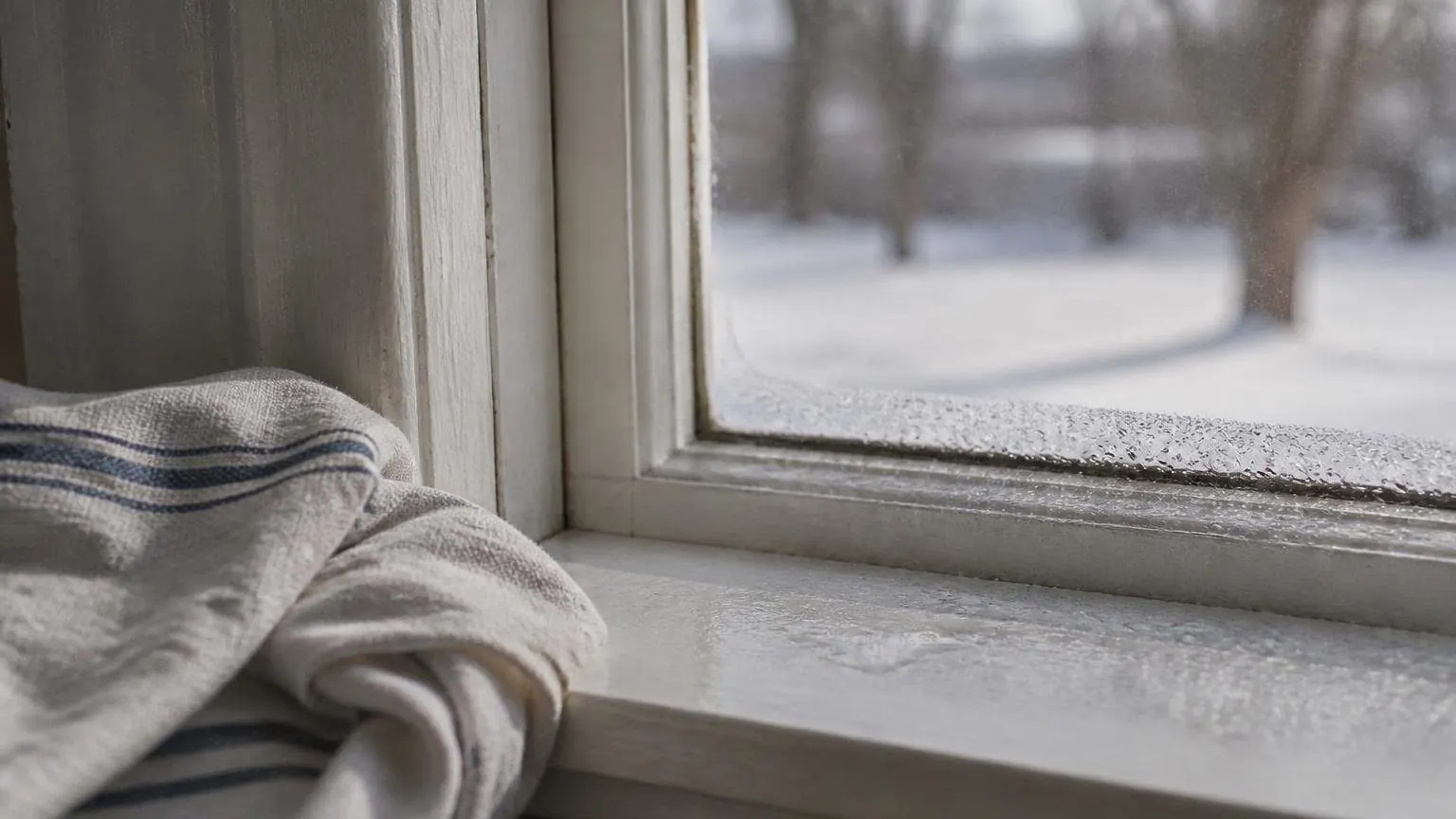
What causes window condensation? Window condensation forms when the room-side glass is colder than the dew point of the indoor air. Cold weather cools the glass, so the fix is a humidity level the glass can hold: about 41% on clear double glazing at 0°F outside, but only 21% on single glass.
Key Takeaways
- Condensation appears on inside window surfaces “whenever surface temperature falls below the dew-point temperature of the room,” per the National Research Council Canada digest CBD-4 (1960).
- Using U-factors from a DOE Building America guide, we calculate the no-fog limit at 70°F inside and 0°F outside: 21% for single glass, 41% for clear double, 63% for low-e argon double.
- The bottom edge fogs first; DOE reported in 2012 that an improved spacer warms the sightline by 6°F to 8°F at 0°F outdoors.
- EPA advises indoor humidity below 60 percent, ideally between 30 and 50 percent (EPA mold guide).
- NFRC’s Condensation Index (ANSI/NFRC 500-2020) replaces the older rating; both use a 1 to 100 scale at 0°F outside and 70°F inside (NFRC, archived copy).
- Fog between sealed panes means vapor got past the edge seal (DOE; NRC digest CBD-5), so lowering room humidity will not clear it.
What causes window condensation?
Window condensation is room vapor turning to liquid on glass below the air’s dew point. CBD-4 calls the window, usually the coldest surface in a heated room, the component that “determines the practical limit of humidity for the space in winter.”
Two numbers decide whether glass fogs: the dew point of the room air and the temperature of the inner glass. Using the National Weather Service vapor pressure formula, 70°F air at 30 percent RH has a dew point of about 37°F, at 40 percent about 45°F, and at 50 percent about 51°F. Our dew point explainer walks through that conversion, and the same relationship sits on every psychrometric chart.
Glass temperature depends on the window’s insulation. Heat reaches the glass through a thin layer of still air, and the 2021 Seattle Energy Code (section A101.3, coefficients drawn from the ASHRAE Fundamentals Handbook) assigns that interior vertical air film an R-value of 0.68 (Appendix A). A worse U-factor means a bigger drop across that film and colder glass.
How humid can a room be before window condensation starts?
At 70°F indoors and 0°F outside, our calculation gives a ceiling of 21% RH for single clear glass, 41% for clear double glass in a nonmetal frame and 63% for low-e argon double glass. The table runs that math from 40°F to -20°F for five window types in DOE’s Table 1.
| Outdoor temp | Single clear, nonmetal (U 0.88) | Double clear, metal (U 0.83) | Double clear, nonmetal (U 0.52) | Double low-e argon (U 0.28) | Triple low-e argon (U 0.19) |
|---|---|---|---|---|---|
| 40°F | 53% (52°F) | 55% (53°F) | 69% (59°F) | 82% (64°F) | 88% (66°F) |
| 30°F | 42% (46°F) | 45% (47°F) | 61% (56°F) | 77% (62°F) | 84% (65°F) |
| 20°F | 34% (40°F) | 36% (42°F) | 53% (52°F) | 72% (60°F) | 80% (64°F) |
| 10°F | 27% (34°F) | 29% (36°F) | 47% (49°F) | 67% (59°F) | 76% (62°F) |
| 0°F | 21% (28°F) | 23% (30°F) | 41% (45°F) | 63% (57°F) | 73% (61°F) |
| -10°F | 16% (22°F) | 18% (25°F) | 36% (42°F) | 58% (55°F) | 70% (60°F) |
| -20°F | 13% (16°F) | 14% (19°F) | 31% (38°F) | 55% (53°F) | 67% (58°F) |
Maximum indoor RH with no condensation, with the calculated inner glass temperature in brackets. Indoor air 70°F, still room air, no sun, no drapes. Method: glass temp = 70 minus U × (70 minus outdoor temp) × 0.68; max RH = saturation vapor pressure at the glass ÷ that at 70°F (NWS formula). Glass below 32°F frosts; treat those cells as approximate.
We checked the method against CBD-4’s own 1960 calculations. Our RH conversion matches its percentages within 1 point for all 14 surface temperatures tested, and for clear double glass at 0°F CBD-4 lists a 45°F surface and 41% (15 mph wind), the same as our column.
Correction: one humidity chart does not fit every window
The chart that circulates online, published by FGIA and footnoted to the Home Energy Resource of Minnesota, caps indoor RH at 40% from 20°F to 40°F and 30% from 0°F to 10°F, assuming 70°F indoors and naming no window type. It is too loose for single glass (34% limit at 20°F) and far too strict for low-e argon glass (63% at 0°F). Use the table instead.
Why does window condensation start at the bottom of the glass?
The bottom edge is the coldest part of most windows, so it fogs at a lower humidity than the center. CBD-4 explains that air inside a double unit is several degrees cooler at the bottom, and that window stools block room air from washing the lower glass.
The spacer that holds the panes apart adds to it. The DOE Building America guide (Carmody and Haglund, 2012) says a thermally improved spacer can raise temperature 6°F to 8°F at the sightline at 0°F outside; warm edge spacers were then in more than 90% of new windows. As a sensitivity check of our own: if the bottom of a low-e argon unit runs 6°F colder than our center figure, its limit at 0°F falls from 63% to 50%.
Frames matter too. CBD-4 notes aluminum conducts heat 800 to 1400 times better than wood, so without thermal breaks a metal-framed double window condenses at roughly single-glass humidities, as our metal-frame column shows.
Is condensation between window panes a failed seal?
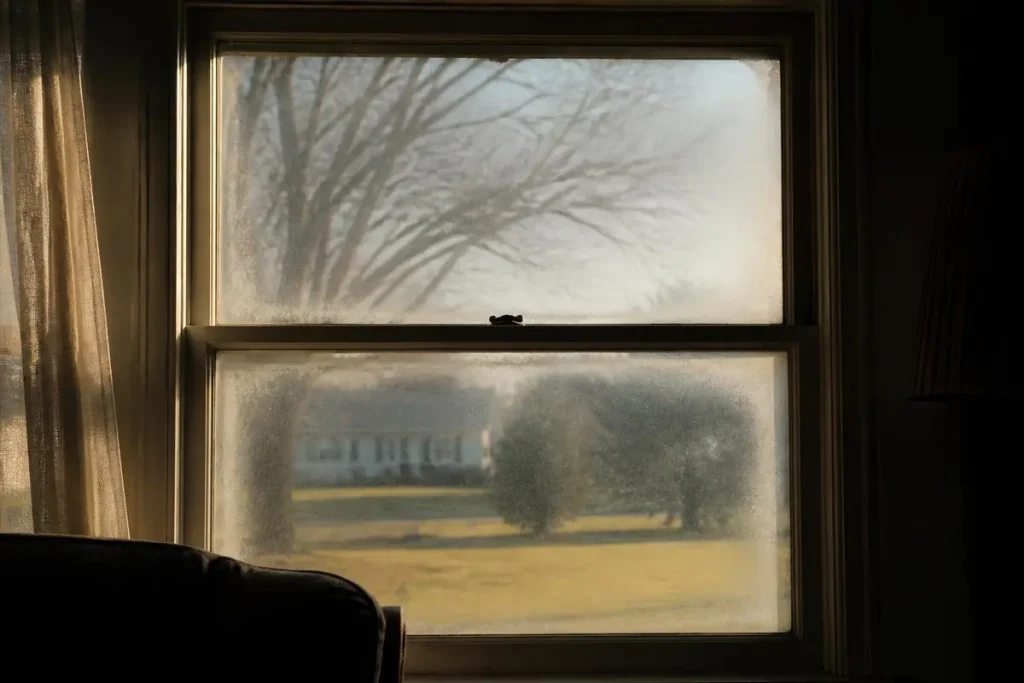
Yes. Fog inside a factory sealed unit means vapor is getting into a space designed to stay dry. The DOE guide lists the spacer’s job as a moisture barrier “that prevents passage of water or water vapor that would fog the unit,” and its desiccant absorbs residual moisture.
The NRC’s companion digest CBD-5 explains why seals fail: temperature and barometric swings flex the glass and stress the seal, which “may be broken down slowly over several years.” Room humidity cannot fix that. With a separate storm sash, CBD-5 adds that room air leaking between the sashes “has a humidifying effect.”
Why is there condensation on the outside of windows?
Outside condensation is dew, and on efficient glass it signals good insulation. Andersen, a window maker, says its low-e glass leaves the outer pane “a few degrees cooler than the interior glass surface,” and lists a clear night sky, still air and high outdoor humidity as triggers (Andersen help article). It usually evaporates during the day and needs no fix.
How do you stop window condensation? Fixes in order
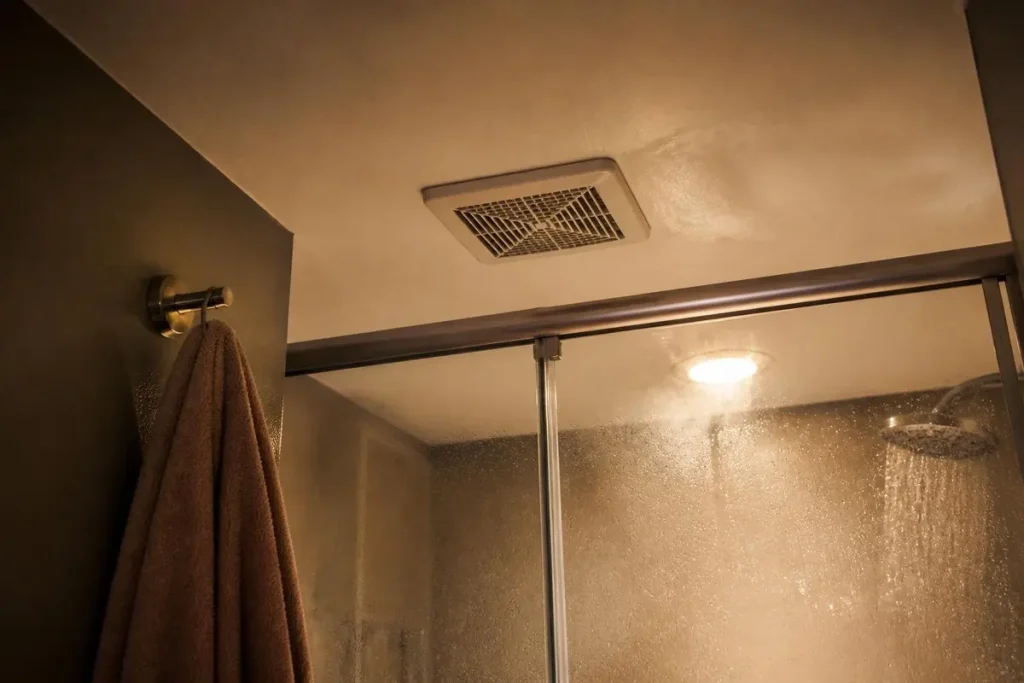
Lower the indoor dew point first, then warm the glass. EPA’s list of actions that prevent condensation starts with reducing humidity and also includes more ventilation or air movement and a higher air temperature. A hygrometer near the window tells you whether room humidity is over the limit for that glass.
- Measure. EPA says a humidity meter costs $10 to $50. Compare the reading with the table.
- Turn the humidifier down. CBD-4 found window condensation most common in buildings where “some attempt is made at humidification”; our whole house humidifier guide covers the controls, and our ideal indoor humidity page covers comfort and mold ranges.
- Exhaust moisture at the source. EPA says to run the bathroom fan when showering and exhaust fans when cooking. A correctly sized bathroom exhaust fan and a ducted range hood do that job.
- Vent appliances outdoors. EPA notes combustion appliances such as kerosene heaters “produce water vapor,” one reason a ventless gas heater raises indoor humidity.
- Move air across the glass. Open blinds and use fans, as EPA advises. CBD-4 found forced air over single glass raised its limit at 0°F outside from 12% to as much as 21%.
- Add ventilation in a tight house. If humidity stays high with fans working, balanced mechanical ventilation with an HRV or ERV helps, since CBD-5 notes outside air “has a dehumidifying effect.” EPA also lists a dehumidifier when needed.
- Upgrade the glass last. Clear double to low-e argon double raises the 0°F limit from 41% to 63%.
A blower door test from a home energy audit tells you whether the house is tight enough to need step 6.
What do window condensation ratings (CR and CI) mean?
NFRC’s ratings compare how well windows resist condensation, on a 1 to 100 scale where higher is better. The Condensation Index under ANSI/NFRC 500-2020 uses the coldest point on the frame, edge of glass or center of glass, and “CI will replace the Condensation Rating (NFRC 500-2017).”
All four industry ratings use 0°F outside and 70°F inside, and NFRC warns there is “no assurance that a selected system will not experience condensation.” Compare CI with CI only.
How we researched this
Research date: October 30, 2026. The top ranking articles we opened (This Old House, Bob Vila, Homes and Gardens) cited no primary source for a humidity limit. We consulted 16 sources and cited 9. The condensation table is our own steady-state calculation using DOE whole-window U-factors, the code-table interior air film and the NWS formula, cross-checked against CBD-4.
Limits: whole-window U-factors are applied uniformly, so edges run colder, while DOE notes center-of-glass values are usually better. Excluded: contractor and lifestyle blogs (no sourced numbers), DOE slide decks whose U-factors appear only in charts, and Reddit (no useful data). The FGIA chart appears only as FGIA’s claim.
Frequently asked questions
Is window condensation bad?
Repeated wetting is a moisture problem. EPA says condensation “can be a sign of high humidity,” that you should act quickly to dry it, and that water-damaged areas should be dried within 24 to 48 hours to prevent mold growth. CBD-4 warns that window condensation can damage surrounding construction from wetting.
Does opening a window help window condensation?
Usually, yes. EPA lists increasing ventilation or air movement by opening doors and windows, when practical, as an action that helps prevent condensation. NRC digest CBD-5 notes that outside air has a dehumidifying effect in winter. A bathroom or kitchen exhaust fan removes moisture at the source with less heat loss.
What humidity stops condensation on windows in winter?
It depends on the glass and the outdoor temperature. At 70°F indoors and 0°F outside, our calculated limits are 21% for single clear glass, 41% for clear double glass and 63% for low-e argon double glass, so single glass cannot hold EPA’s 30 to 50 percent range in deep cold.
Can condensation between window panes be fixed?
Not by changing indoor humidity. Fog between the panes of a sealed unit means the seal has let vapor in, and NRC digest CBD-5 notes such seals can break down slowly over several years. The usual repair is replacing the sealed glass unit or sash; ask the maker whether the unit is still under warranty.
Is condensation on the outside of windows a problem?
No. Window maker Andersen says exterior condensation forms when the outer glass falls below the outdoor dew point, often on clear, still nights after a warm day, and that it usually evaporates during the day. Efficient low-e glass keeps the outer pane cooler, which makes this more common on newer windows, not less.
Do curtains cause window condensation?
They can. NRC digest CBD-4 says drapes and curtains change the air temperature next to the glass and the air movement across it, and may raise or lower condensation depending on where they hang relative to the window and the heat outlet. FGIA advises opening curtains and blinds during daylight hours.
Sources
- National Research Council Canada (A. G. Wilson). “CBD-4. Condensation on Inside Window Surfaces.” 1960. https://web.mit.edu/parmstr/Public/NRCan/CanBldgDigests/cbd004_e.html. Accessed October 2026.
- National Research Council Canada (A. G. Wilson). “CBD-5. Condensation Between Panes of Double Windows.” 1960. https://web.mit.edu/parmstr/Public/NRCan/CanBldgDigests/cbd005_e.html. Accessed October 2026.
- U.S. DOE Building America (Carmody and Haglund). “Measure Guideline: Energy-Efficient Window Performance and Selection.” 2012. https://www1.eere.energy.gov/buildings/publications/pdfs/building_america/measure_guide_windows.pdf. Accessed October 2026.
- City of Seattle. “2021 Seattle Energy Code, Appendix A.” https://seattle.gov/documents/Departments/SDCI/Codes/SeattleEnergyCode/2021SECAppendixA.pdf. Accessed October 2026.
- National Weather Service, El Paso. “Vapor Pressure.” https://www.weather.gov/media/epz/wxcalc/vaporPressure.pdf. Accessed October 2026.
- U.S. EPA. “A Brief Guide to Mold, Moisture and Your Home.” https://www.epa.gov/mold/brief-guide-mold-moisture-and-your-home. Accessed October 2026.
- National Fenestration Rating Council. “Condensation Index” (archived copy). https://web.archive.org/web/2025id_/https://nfrccommunity.org/page/CI. Accessed October 2026.
- Fenestration and Glazing Industry Alliance. “Understanding Indoor Condensation.” https://fgiaonline.org/?p=314. Accessed October 2026.
- Andersen Windows. “Condensation on the Exterior of Window or Patio Door Glass.” https://helpcenter.andersenwindows.com/aw/articles/Knowledge/Condensation-on-the-Exterior-of-Window-or-Patio-Door-Glass. Accessed October 2026.
Leave a Reply