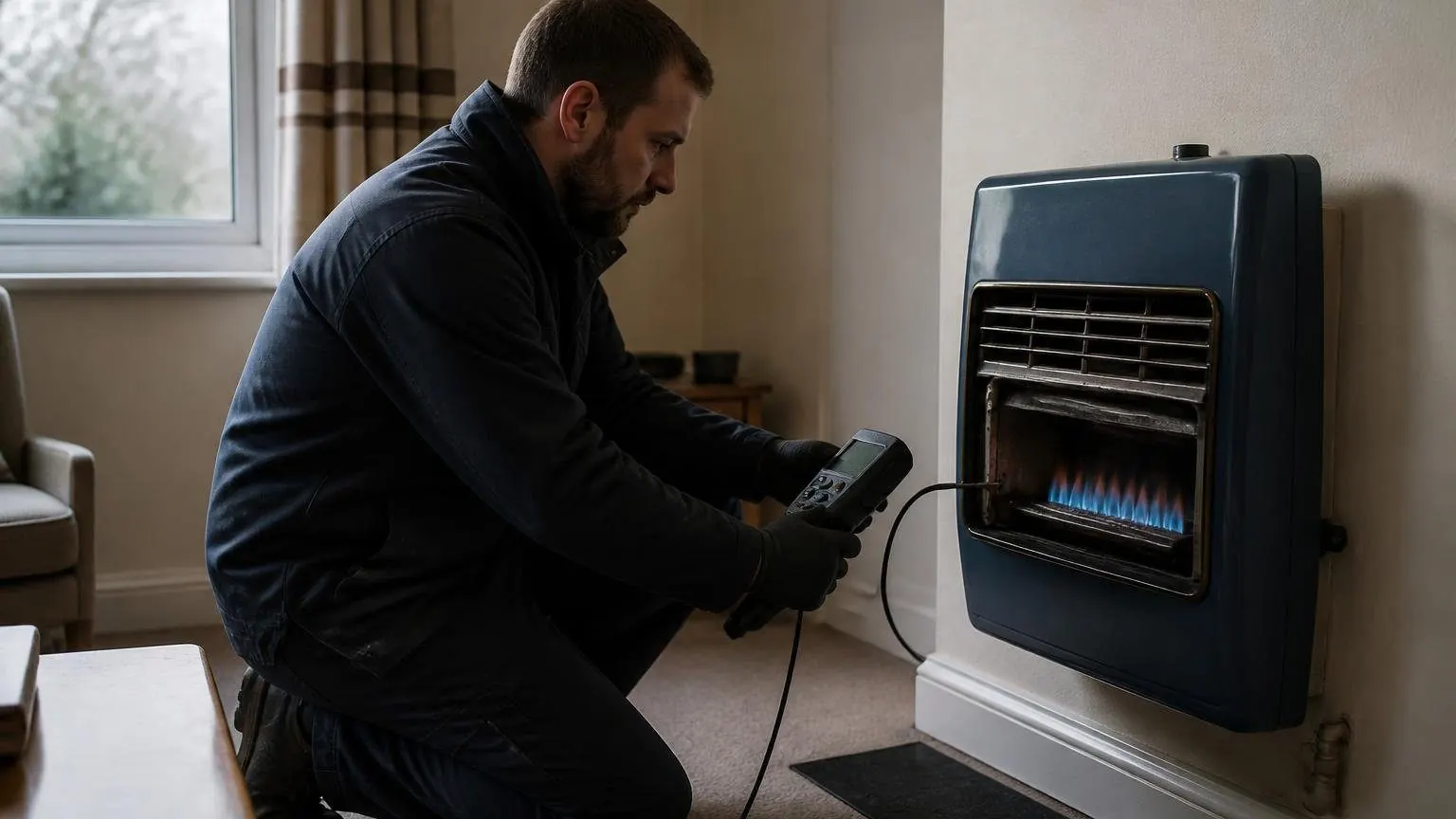
Is a ventless gas heater safe? A ventless gas heater is safe only inside tight code limits: listed to ANSI Z21.11.2, no more than 40,000 Btu/h, sized to the room, never the only heat, with a CO alarm nearby. California and Minnesota bar them from homes, and every one leaves its exhaust and water in the room.
Key Takeaways
- The 2021 IRC caps an unvented room heater at 40,000 Btu/h and bars it as a dwelling’s sole heat (IRC G2445).
- Its oxygen depletion sensor may trip as low as 18 percent oxygen, below OSHA’s 19.5 percent oxygen-deficient line.
- In a 30-home field study, nitrogen dioxide topped the WHO 1-hour guideline in 80% of homes (Indoor Air, 2010).
- CPSC ties unvented room and space heaters to an estimated 9 US CO deaths in 2022 (CPSC, May 2026).
- One therm of natural gas burned releases about 9.2 pounds of water (EIA heat content; our arithmetic).
- Minnesota rule 1346.5621 bars unvented room heaters from any dwelling (Minnesota Revisor).
What is a ventless gas heater, and what standard covers it?
A ventless gas heater is an unvented room heater: a natural gas or propane appliance with no flue, installed in the room it heats. The 2021 IRC requires listing to ANSI Z21.11.2 and installation per that listing and the maker’s instructions (IRC G2445.1).
The code defines an unvented appliance as one whose combustion products “are not conveyed by a vent or chimney directly to the outside atmosphere.” Vent-free log sets are covered in our gas fireplace venting guide; vented gas wall furnaces in our wall heater comparison.
ANSI Z21.11.2 is paywalled, so we rely on the code and a Mr. Heater manual for 20,000 and 30,000 Btu/h models certified to ANSI Z21.11.2b 2010 (Mr. Heater manual).
| Type | Combustion air | Exhaust | Bedroom use, IRC G2406.2 |
|---|---|---|---|
| Ventless | Room air | Stays in the room | One wall unit, 10,000 Btu/h or less, with ODS |
| Direct vent | Outdoors | Outdoors | Allowed per listing |
| Natural draft, Type B vent | Room air | Outdoors | Allowed if room meets volume rule |
Where does a ventless gas heater’s exhaust go, and how much water does it add?
All of it stays in the room. A natural gas ventless heater at 30,000 Btu/h releases about 2.76 pounds of water vapor an hour, or 0.33 gal, plus about 29 cubic feet of carbon dioxide, by this arithmetic:
- Methane burns as CH4 + 2 O2, yielding CO2 + 2 H2O.
- EIA puts natural gas at 1,036 Btu per cubic foot and a therm at 100,000 Btu: 96.5 cubic feet per therm.
- At 60°F and 14.73 psia a pound-mole of gas fills 378.6 cubic feet, so each cubic foot of methane yields 2 × 18.015 ÷ 378.6 = 0.095 pounds of water.
- 96.5 × 0.095 = 9.2 pounds per therm, about 1.1 gallons.
- Propane (C3H8 + 5 O2, yielding 3 CO2 + 4 H2O) gives 1.63 pounds of water per pound. At NIST’s 4.23 pounds per gallon and EIA’s 91,452 Btu per gallon, that is 7.6 pounds per therm.
Treating pipeline gas as pure methane is an approximation.
| Heater input | Water per hour, natural gas | Water per hour, propane |
|---|---|---|
| 6,000 Btu/h (bathroom cap) | 0.55 lb | 0.45 lb |
| 10,000 Btu/h (bedroom cap) | 0.92 lb | 0.76 lb |
| 30,000 Btu/h | 2.76 lb | 2.27 lb |
| 40,000 Btu/h (code maximum) | 3.67 lb | 3.02 lb |
The Mr. Heater manual says vent-free heaters “add moisture to the air” and can cause mildew where ventilation air is short, though the field study below found “moisture problems were not evident.” See our window condensation explainer and winter humidity targets.
What does a ventless gas heater’s oxygen depletion sensor actually do?
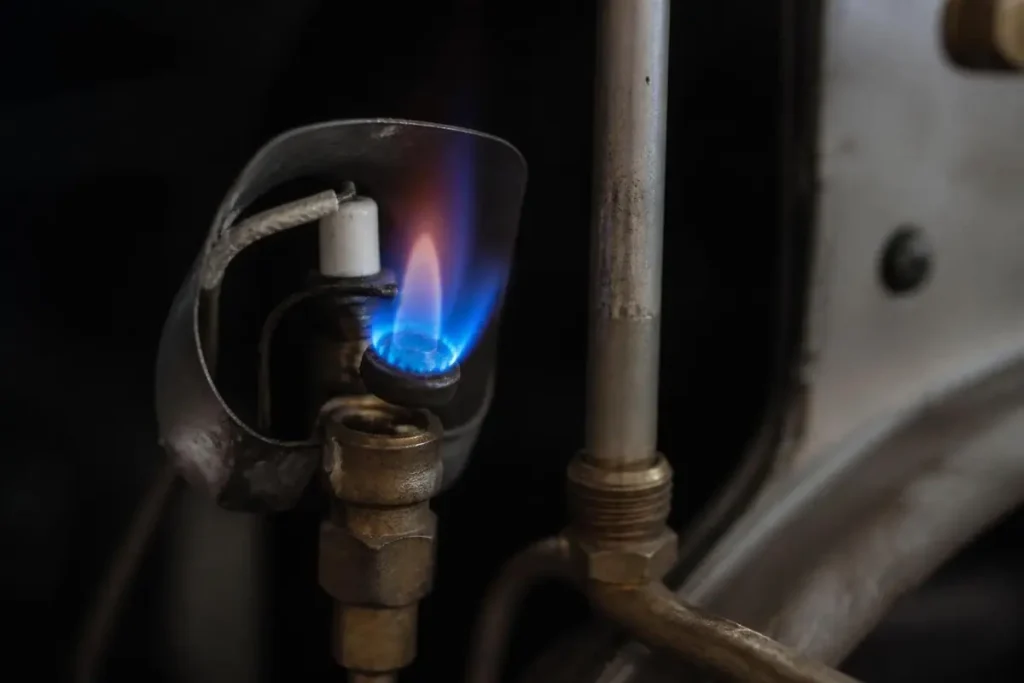
It shuts off main burner and pilot gas when room oxygen falls to the maker’s set point, which IRC G2445.6 says may be no lower than 18 percent, with no field adjustment. It does not measure carbon monoxide. OSHA calls air below 19.5 percent oxygen deficient (29 CFR 1910.146).
That floor has a CO2 cost. In a closed, well-mixed room, methane adds one molecule of CO2 per two of oxygen removed; propane adds three per five. From NASA’s 20.95 percent oxygen and 420 ppm CO2, reaching 18 percent implies roughly 15,000 ppm CO2 with natural gas and about 18,000 ppm with propane. Compare our indoor CO2 guide.
lowest oxygen set point allowed for an ODS
IRC G2445.6
OSHA oxygen-deficient threshold
29 CFR 1910.146
CO2 implied at 18% oxygen, natural gas
NASA data; our arithmetic
elevation where the ODS may shut the heater down
Mr. Heater manual
Safety point: an ODS is not a CO alarm
The Mr. Heater manual warns that a knob left between positions causes “poor combustion and higher levels of carbon monoxide.” An oxygen sensor will not catch that. Follow our CO alarm placement rules.
What do field measurements and death data show about ventless gas heaters?
Measured indoor air often fails health guidelines, while deaths are now in single digits.
Francisco, Gordon and Rose (Indoor Air, 2010) logged gases each minute for 3 to 4 days in 30 homes with unvented gas fireplaces. Nitrogen dioxide exceeded the WHO 1-hour guideline of 110 ppb in 80% of homes and Health Canada’s 250 ppb in about 43%. CO exceeded EPA’s 8-hour 9 ppm standard in 20%, ran 70 to 80% as high away from the fireplace, and nearly half the units ran at least once longer than 2 hours.
CPSC estimates 9 non-fire CO deaths tied to unvented room and space heaters in 2022: 3 natural gas, 1 LP gas, 4 unspecified gas, 1 unspecified fuel; the 2020 to 2022 average is 4 a year (CPSC Table 1). Portable LP heaters, counted separately, were tied to 30, and 2018 to 2022 data are “only partially complete.” See our CO death statistics and indoor propane heater guide.
How big a room does a ventless gas heater need under code?
At least 50 cubic feet per 1,000 Btu/h, which the IRC also states as 20 Btu/h per cubic foot. A 30,000 Btu/h heater needs 1,500 cubic feet, about 188 square feet under an 8 foot ceiling; rooms joined by doorways that cannot be closed count.
That is 300 cubic feet for a 6,000 Btu/h bathroom unit, 500 for a 10,000 Btu/h bedroom unit and 2,000 for the 40,000 Btu/h maximum. The rules, from the 2021 IRC and 2021 IFGC (Seattle reprints):
| Rule | IRC (IFGC) | Requirement |
|---|---|---|
| Listing | G2445.1 (621.1) | ANSI Z21.11.2 |
| Sole heat | G2445.2 (621.2) | Never the sole source of comfort heating in a dwelling |
| Input cap | G2445.3 (621.3) | 40,000 Btu/h |
| Room volume | G2445.5 (621.5) | All unvented appliances: 20 Btu/h per cubic foot or less |
| Oxygen sensor | G2445.6 (621.6) | Trips no lower than 18 percent oxygen |
| Bedroom | G2406.2 (303.3) | One wall unit, 10,000 Btu/h or less, with ODS |
| Bathroom | G2406.2 (303.3) | One wall unit, 6,000 Btu/h or less, with ODS |
| Factory-built fireplace | G2445.7 (621.7) | Only if the fireplace is listed under UL 127 |
| Commercial | IFGC 621.4 | Not in Group A, E or I occupancies |
Every fuel-burning appliance in the space counts. In the Mr. Heater manual’s example, an 18 by 18 by 8 foot space supports 51,800 Btu/h, so a 40,000 Btu/h water heater plus a 20,000 Btu/h heater fails. Fixes are outside air or a smaller heater; see our combustion air guide.
Are ventless gas heaters legal in your state?
It depends on the state and city. Model codes allow them; California bars their sale for dwellings, Minnesota bars installation and Massachusetts allows them only to state fire board standards. Broader fuel rules are in our state gas ban tracker.
| Jurisdiction | Rule | Status, October 2026 |
|---|---|---|
| Model codes | IRC G2445; IFGC 621 | Allowed within the limits above |
| California | HSC 19881 | No sale for dwellings, except electric heaters and gas logs for vented fireplaces |
| Minnesota | Minn. R. 1346.5621 | Not installed in any dwelling or occupancy |
| Massachusetts | M.G.L. c.148 s.25A | Only if it meets fire board standards; fine up to $100 |
| HUD-code homes | 24 CFR 3280.707(b) | Heating appliances vented to the outside |
California allows natural gas unvented logs and fireplaces only under state-adopted standards (HSC 19881), and its rental housing rule says “No unvented fuel burning heaters shall be permitted” (25 CCR 34). The Massachusetts statute covers anyone who would “install, use or maintain” a noncompliant unit (c.148 s.25A, archived copy); Worcester adds a $50 permit and bars bedroom and bathroom installs.
The HUD rule governs homes as built (24 CFR 3280.707); the Mr. Heater manual allows aftermarket manufactured home installs “where not prohibited by local codes.” Sellers list Montana as a ban state, but ARM 24.301.173 adopts the 2021 IFGC without amending Section 621.
How do you run a ventless gas heater safely?
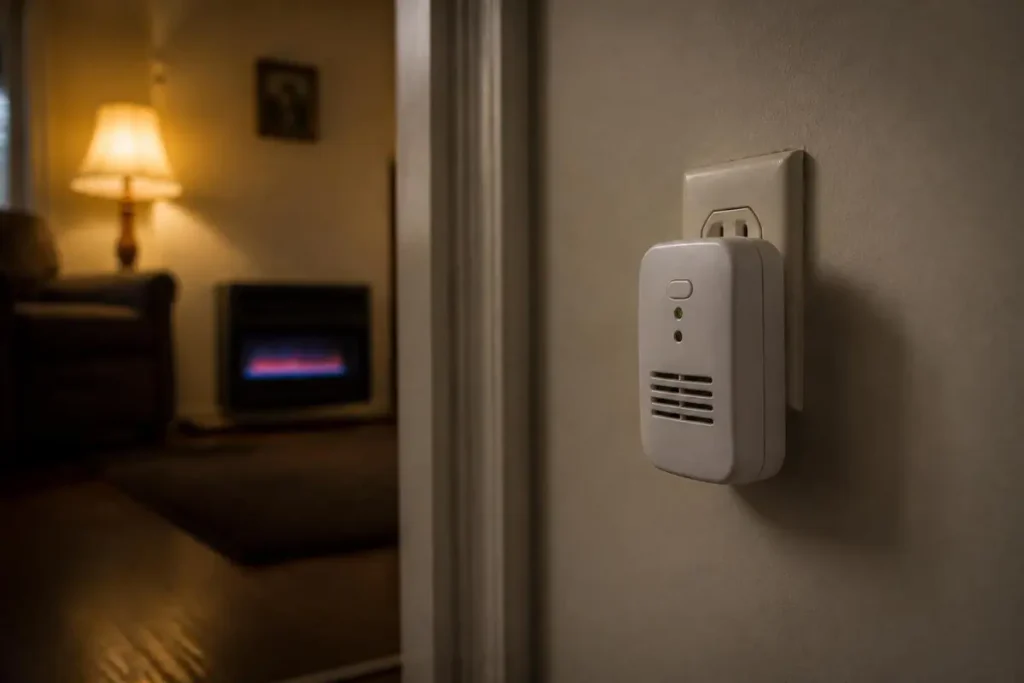
Treat it as supplemental heat, size it to the room and add CO alarms. Our space heater cost data covers electric alternatives.
- Buy one listed to ANSI Z21.11.2 for your gas; the manual says it “is not convertible.”
- Divide room volume by 50 for the most Btu/h all appliances there may total.
- Confirm local rules, and skip bedrooms and bathrooms unless it is a single wall unit within the 10,000 or 6,000 Btu/h caps.
- Keep flammables 36 inches from the front, top and sides.
- If the ODS trips, bring in outside air before relighting; repeat trips mean service.
How we researched this
Researched October 30, 2026. We opened 25 documents and cite 16: code text (Seattle reprints), CPSC estimates, a field study, state rules, two CFR sections, a permit form, a heater manual and EIA, NASA and NIST data. Excluded: Reddit (combustion safety topic), retailer efficiency claims and seller ban lists we could not match to statute text.
Frequently asked questions
Can you sleep with a ventless gas heater on?
Only a small unit belongs in a bedroom at all. The IRC allows one wall-mounted unvented heater of 10,000 Btu/h or less with an oxygen depletion sensor, and Mr. Heater bars its 20,000 and 30,000 Btu/h models from bedrooms. CO spreads through a home almost immediately.
Do you need to crack a window with a ventless gas heater?
Not if the space has 50 cubic feet per 1,000 Btu/h of all appliances and the house is not unusually tight. Smaller spaces need adjoining-room or outdoor air. If the oxygen sensor shuts the heater off, the Mr. Heater manual says to open a window or door.
Can a ventless gas heater be your only heat source?
No. IRC Section G2445.2 says unvented room heaters “shall not be used as the sole source of comfort heating in a dwelling unit.” The Mr. Heater manual likewise says not to install one as the primary heat source, except for the length of a power outage.
Do ventless gas heaters produce carbon monoxide?
Yes, in varying amounts. In a 30-home field study of unvented gas fireplaces, CO exceeded EPA’s 8-hour standard of 9 ppm in 20% of homes. CPSC ties unvented room and space heaters to 9 US CO deaths in 2022. The oxygen sensor does not detect CO.
What size room do you need for a 30,000 BTU ventless heater?
At least 1,500 cubic feet, about 188 square feet with an 8 foot ceiling. Code limits all unvented appliances in a room to 20 Btu/h per cubic foot. Open doorways to adjoining rooms count, and other gas appliances add load.
Does a ventless gas heater cause condensation?
It can. Each therm of natural gas burned releases about 9.2 pounds of water, so a 30,000 Btu/h heater adds roughly 0.33 gallons an hour. The Mr. Heater manual lists window moisture as a sign of too little ventilation air, though a 30-home field study found no evident moisture problems.
Sources
- Seattle SDCI. “2021 Seattle Residential Code, Chapter 24.” https://seattle.gov/documents/Departments/SDCI/Codes/SeattleResidentialCode/2021SRCChapter24.pdf. Accessed October 2026.
- Seattle SDCI. “2021 Seattle Fuel Gas Code, Chapter 6.” https://www.seattle.gov/documents/Departments/SDCI/Codes/FuelGasCode/2021SFGCChapter6.pdf. Accessed October 2026.
- CPSC. “Non-Fire CO Deaths, 2022 Annual Estimates.” https://www.cpsc.gov/s3fs-public/Non-Fire-Carbon-Monoxide-Deaths-Associated-with-the-Use-of-Consumer-Products-2022-Annual-Estimates.pdf. Accessed October 2026.
- Francisco, Gordon, Rose. “Measured concentrations of combustion gases from unvented gas fireplaces.” https://pubmed.ncbi.nlm.nih.gov/20590920/. Accessed October 2026.
- California Legislature (Public.Law copy). “HSC 19881.” https://california.public.law/codes/health_and_safety_code_section_19881. Accessed October 2026.
- California HCD (Cornell LII). “25 CCR 34.” https://www.law.cornell.edu/regulations/california/25-CCR-34. Accessed October 2026.
- Minnesota Revisor. “Rule 1346.5621.” https://www.revisor.mn.gov/rules/1346.5621/. Accessed October 2026.
- Massachusetts Legislature. “M.G.L. c.148 s.25A (archived copy).” https://malegislature.gov/Laws/GeneralLaws/PartI/TitleXX/Chapter148/Section25A. Accessed October 2026.
- Worcester Fire Department. “Unvented Gas Heater Permit.” https://www.worcesterma.gov/fire/document-center/unvented-heater-app.pdf. Accessed October 2026.
- Montana DLI (Cornell LII). “ARM 24.301.173.” https://www.law.cornell.edu/regulations/montana/Mont-Admin-r-24.301.173. Accessed October 2026.
- eCFR. “24 CFR 3280.707.” https://www.ecfr.gov/current/title-24/part-3280/section-3280.707. Accessed October 2026.
- eCFR. “29 CFR 1910.146.” https://www.ecfr.gov/current/title-29/part-1910/section-1910.146. Accessed October 2026.
- Mr. Heater. “Vent Free Room Heaters Manual (Home Depot copy).” https://images.homedepot-static.com/catalog/pdfImages/63/6348b47a-6364-4029-b8c2-5d14d6afe0cb.pdf. Accessed October 2026.
- EIA. “British thermal units (Btu).” https://www.eia.gov/energyexplained/units-and-calculators/british-thermal-units.php. Accessed October 2026.
- NASA. “Earth Fact Sheet.” https://nssdc.gsfc.nasa.gov/planetary/factsheet/earthfact.html. Accessed October 2026.
- NIST Chemistry WebBook. “Propane saturation properties.” https://webbook.nist.gov/cgi/fluid.cgi?ID=C74986&Type=SatT. Accessed October 2026.
Leave a Reply