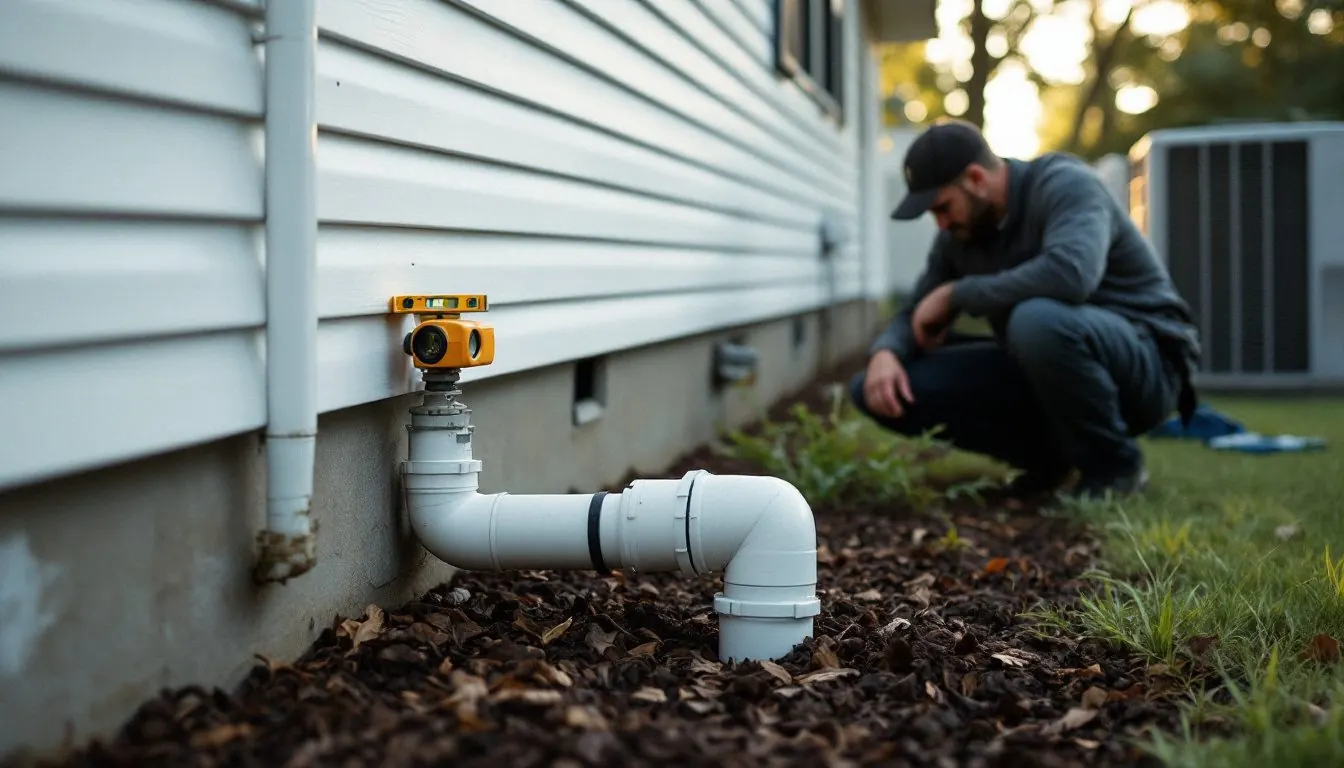
Can HVAC condensate drain outside? Yes, in most US homes. Model code asks for an approved place of disposal, 3/4 inch pipe and 1/8 inch per foot of fall, and bars streets, alleys and nuisance spots. Acidic condensing furnace and boiler drains, freezing routes and local amendments are the exceptions.
Which HVAC drains can go outside, appliance by appliance?
A cooling coil can usually drain to the yard. A condensing furnace or boiler can only where local code allows and the pipe will not freeze. DOE’s Building America guide draws that line: “Unlike condensate from air conditioners and heat pumps, condensate from condensing furnaces and boilers can be highly acidic.”
| Water source | Flows | Acidity on record | Outside? | Document says |
|---|---|---|---|---|
| AC or heat pump indoor coil | Cooling | Not classed acidic by DOE | Yes | DOE: commonplace near the foundation, with a splash pan |
| Overflow line on that coil | When the primary blocks | Same | Yes, by design | IRC M1411.3.1: ends at a “conspicuous point of disposal” |
| Mini split indoor head | Cooling | Same | Yes | Gree: 6 inches above grade. Pioneer FYB-24: 1-7/8 inches (50 mm) above ground |
| Condensing furnace | Heating | pH 3 or below (DOE); pH 3.2 to 4.5 (Bryant) | If local code allows | Bryant: “permissible if allowed by local codes.” Bosch BGH96: not “where it may freeze” |
| Condensing boiler | Heating | pH of 2 (DOE) | If local code allows | DOE: sewer, septic or outdoors, freeze protected |
| Heat pump outdoor unit | Defrost | None found | Falls at the unit | Lennox LRP16HP: raise it 3 inches minimum, away from walkways |
Compiled by The HVAC Brief from the Sources below.
The two lines on one coil work in opposite ways. The primary can end anywhere approved. M1411.3.1 requires the overflow to end where it will “alert occupants in the event of a stoppage,” so that drip is an alarm: clear the blocked primary rather than rerouting it. Without an overflow or float switch, the first sign can be water at a ceiling vent.
What does the code text say about draining condensate outside?
The model rule never says “outside.” IRC M1411.3 says condensate goes “to an approved place of disposal” at 1-percent slope and “shall not discharge into a street, alley or other area where it would cause a nuisance.” M1411.3.2 sets the 3/4-inch minimum. “Approved” hands the call to the local code official, so the answer shifts:
| Rule | Outside discharge | What it bars or limits |
|---|---|---|
| UPC 814 (chapter copy) | “Approved plumbing fixture or disposal area” | “Shall not drain over a public way”; drainage system only through an air gap or air break |
| Seattle mechanical code 307.2.1.1 | Names “discharging to grade outdoors” | No direct drain, waste or vent connection; lavatory wye and tub overflow do not count as fixtures |
| Minnesota 4714.0814 | Only a place “approved by the Minnesota Pollution Control Agency” | Public way, nuisance areas |
| North Carolina ruling, August 1, 2024 | “To the exterior independent of any foundation drains” | Lavatory tailpiece in homes (P2706.2) |
| 40 CFR 122.26(d)(2)(iv)(B)(1) | No permission; a storm sewer rule for city programs | Air conditioning condensation is addressed where a city identifies it as a pollutant source; furnace condensate is not listed |
Compiled by The HVAC Brief. UPC section numbers shift between editions and state adoptions.
Can the drain run onto a sidewalk, driveway or the neighbor’s side?
A public sidewalk is the riskiest spot, though no code we read uses the word sidewalk. The UPC says “public way,” and in many jurisdictions the inspector decides whether a sidewalk counts. Water crossing a property line can count as an IRC nuisance.
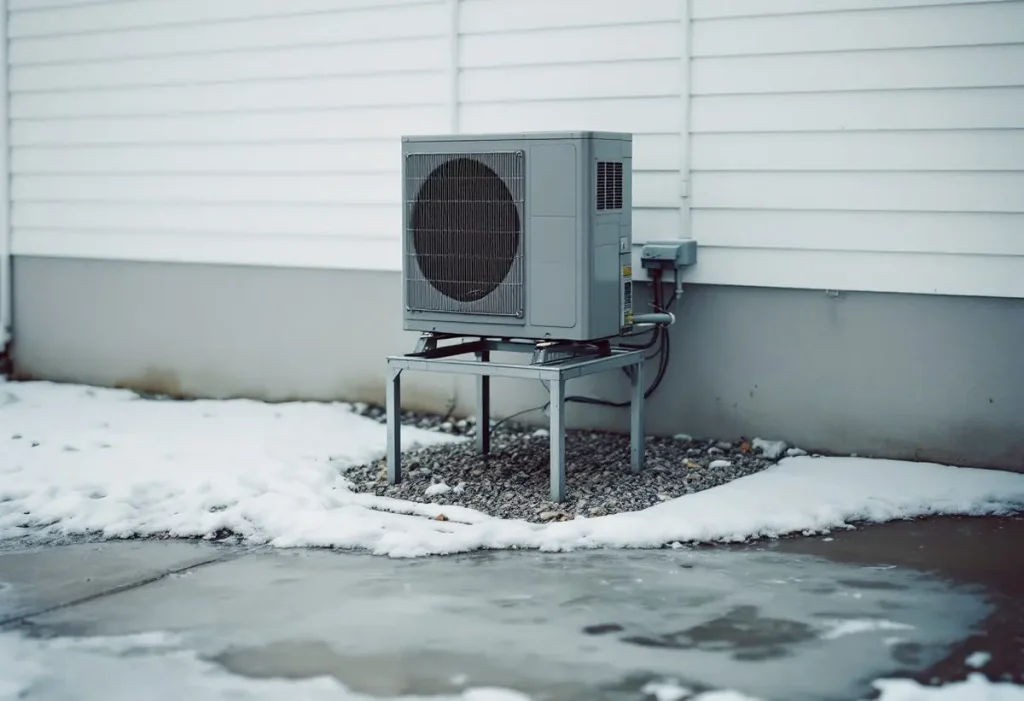
On your own lot the limit is safety. Bryant’s 352MAV manual warns against “draining where slippery conditions may cause personal injuries,” and Lennox says its LRP16HP “should not be located near walkways, to prevent possible icing of surface from defrost condensate.” That meltwater comes from the heat pump defrost cycle.
How many gallons will an outside drain put on the ground?
About 1 gallon per hour for a 3-ton AC at a sensible heat ratio (SHR) of 0.75. Only latent cooling condenses water, so volume follows from capacity and SHR:
| AC at full output | SHR 0.80 | SHR 0.75 | SHR 0.70 |
|---|---|---|---|
| 2 tons | 0.54 gal/h | 0.67 gal/h | 0.81 gal/h |
| 3 tons | 0.81 gal/h | 1.01 gal/h | 1.21 gal/h |
| 4 tons | 1.08 gal/h | 1.35 gal/h | 1.62 gal/h |
| 5 tons | 1.35 gal/h | 1.69 gal/h | 2.02 gal/h |
HVAC Brief calculation: gal/h = tons x 12,000 x (1 minus SHR) / 1,065.7 Btu/lb / 8.342 lb/gal, using NIST water values at 50 F. SHR columns are scenarios, not measurements of any model.
In a 1,600 square foot lab home, the Florida Solar Energy Center recorded “105 pounds (12.6 gallons) of condensate” on a very hot, humid day, close to the table’s 3 tons at SHR 0.75 over 12 run hours (12.1 gallons), though that lab ran a different system. Bryant warns that excessive draining “may cause saturated soil conditions which may result in damage to plants.”
Carrier says a 60,000 Btu/h furnace at full input can produce “roughly 0.7 gallons of water vapor per hour” before accounting for how much condenses. What does not condense leaves through the vent pipe, which is why white smoke from furnace exhaust on a cold morning is usually just water vapor. Scaled by input, that is at most 1.17 gal/h at 100,000 Btu/h.
Will a condensing furnace’s outside drain freeze in winter?
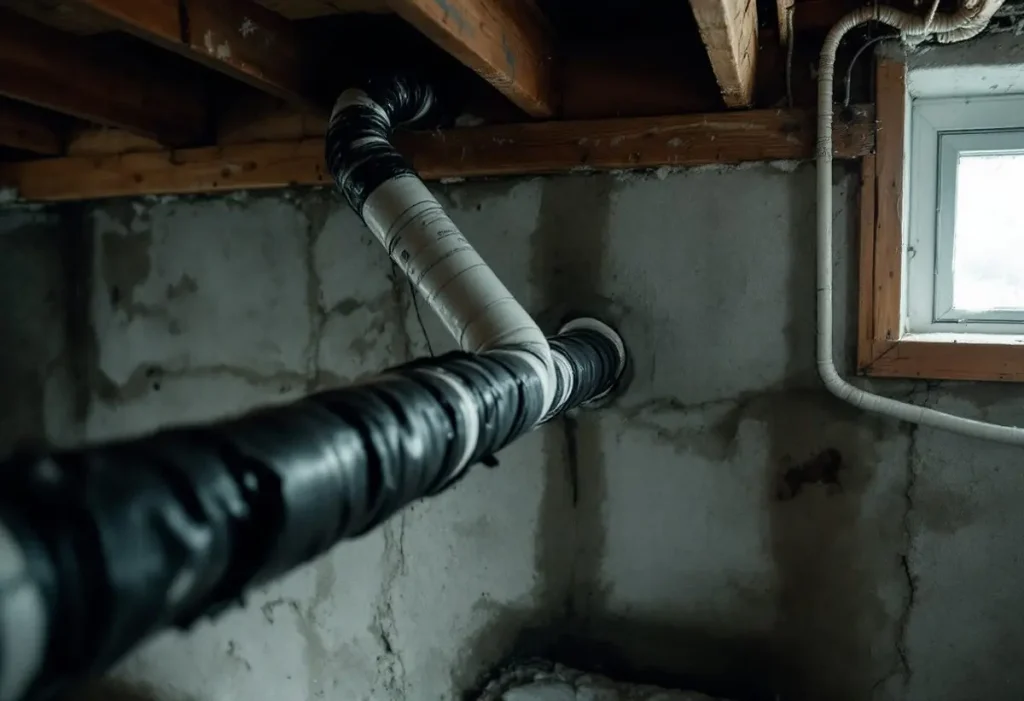
It can, and the documents disagree on whether to try. Bosch’s BGH96 manual says: “Do not route the drain line outside where it may freeze.” DOE’s furnace guide says that in cold climates condensate lines “should be directed to an indoor drain,” yet also says an outdoor line should be insulated or wrapped with heat tape. Bryant allows outdoor draining where local code does, with 3 to 6 watt per foot, 120 V, 40 F self-regulating heat tape, and warns against leaving a unit off in an unoccupied structure at 32 F and below without freeze protection.
Watch the shared line. Bryant permits furnace, AC and humidifier drains to be combined, so tying a new furnace into an AC line that exits a wall turns a summer pipe into a winter one. Backups from a frozen run show up as water around the furnace, not outside. Ice in that run also stops a condensing furnace before it lights, and when the furnace condensate line is frozen the fix starts with thawing the trap gently.
Stop line: leave the furnace trap to a technician. Carrier’s KGAET0101ETK instructions warn that a badly built or unprimed trap “may allow positive pressure vent gases to enter the structure through drain tube,” and those gases contain carbon monoxide. Ask the technician to prime the trap, measure Bosch’s 1/4 inch per foot of fall, and show where the run could freeze.
Does furnace condensate need a neutralizer before it goes outside?
Seattle requires it; most other documents leave it to local authorities. Section 307.1 of Seattle’s mechanical code, marked [S] in the reprint, says by-products “shall be collected, pH neutralized and discharged to an approved plumbing fixture or disposal area,” with no target pH. Bryant says a neutralizing filter “may be desired.” DOE’s boiler guide says calcium carbonate pretreatment “is recommended whether required by code or not,” though mostly about the sewer. We found no published yard-discharge limit.
Can a condensate line tie into a gutter, French drain or dry well?
Only where the local official approves it; none of the code text we read names gutters, downspouts or French drains. The UPC copy lists “dry wells, leach pits” as receptors, and North Carolina’s ruling keeps exterior discharge away from foundation drains. The federal storm sewer list names only AC condensation, so it gives an acidic furnace line no support.
Should your line go outside or to an indoor drain?
Choose by what makes the water, then by whether the route freezes. Where gravity cannot work, a condensate pump moves the outlet, and M1411.4 requires a pump in an attic or crawl space to shut the equipment off when it fails; air handler installation covers the pans.
Then check the pipe:
- The end is open and above grade. Pioneer warns that if it “touches the ground, the unit may become blocked.”
- A level shows 1/8 inch per foot or better; Gree and Bosch ask for 1/4 inch per foot.
- Blockages clear without cutting the line (M1411.3.3), and the pipe never narrows below 3/4 inch (Seattle 307.2.2).
A wall stain under an indoor head points back to the fall set during mini split installation. Water indoors on a ducted system points to an AC leaking water.
Frequently asked questions
Can AC condensate just drain onto the ground?
Usually yes. DOE’s Building America guide says it is commonplace to discharge condensate at the exterior of the house, generally near the foundation, with a splash pan to direct the water away. IRC M1411.3 still requires an approved place of disposal, so the local official has the last word.
Can condensate drain into a sink or plumbing drain instead of outside?
Often, but only indirectly. The UPC chapter we read requires an air gap or air break into a trapped and vented receptor. North Carolina accepts a washing machine standpipe in homes and rejects a lavatory tailpiece, while that UPC text lists fixture tailpieces. Ask the local inspector before cutting into a drain.
Why is no water coming out of my outside condensate drain?
In heating season a cooling coil makes no water, so a dry AC line is normal. In summer, FSEC measured 12.6 gallons on one very hot, humid day and found condensate tracked outdoor temperature. A dry outlet on a day like that suggests checking the pan and float switch for a blockage.
How we researched this
In November 2026 we read Seattle’s 2021 reprints of IRC M1411 and mechanical code Section 307, a copy of UPC Chapter 8, the state and federal rule text, and the DOE and maker documents listed. We did not read paywalled ICC or IAPMO originals. Contractor blogs were excluded as number sources.
Sources
- City of Seattle. “2021 Seattle Residential Code, Chapter 14.” https://seattle.gov/documents/Departments/SDCI/Codes/SeattleResidentialCode/2021SRCChapter14.pdf. Accessed November 2026.
- City of Seattle. “2021 Seattle Mechanical Code, Chapter 3.” https://www.seattle.gov/documents/Departments/SDCI/Codes/MechanicalCode/2021SMCChapter3.pdf. Accessed November 2026.
- IAPMO, InspectAPedia copy. “Uniform Plumbing Code, Chapter 8.” https://inspectapedia.com/plumbing/UPC-Chapter-8-IAPMO.pdf. Accessed November 2026.
- Cornell LII. “Minn. R. 4714.0814.” https://www.law.cornell.edu/regulations/minnesota/Minn-R-4714-0814. Accessed November 2026.
- NC State Fire Marshal. “Condensate Waste Discharge to Receptor or Exterior.” https://ncosfm.gov/plumbing/08022-condensate-waste-receptor-or-exterior/open. Accessed November 2026.
- eCFR. “40 CFR 122.26.” https://www.ecfr.gov/current/title-40/chapter-I/subchapter-D/part-122/subpart-B/section-122.26. Accessed November 2026.
- DOE Building America. “Corrosion-Resistant Condensate Drain Pan.” https://basc.pnnl.gov/resource-guides/hvac-has-corrosion-resistant-condensate-drain-pan. Accessed November 2026.
- DOE Building America. “Combustion Furnaces.” https://basc.pnnl.gov/resource-guides/combustion-furnaces. Accessed November 2026.
- DOE Building America. “Condensing Boilers.” https://basc.pnnl.gov/resource-guides/condensing-boilers. Accessed November 2026.
- Bryant. “352MAV instructions, II 352M-60-2.” https://www.shareddocs.com/hvac/docs/1009/Public/06/II352M.60.2.pdf. Accessed November 2026.
- Carrier. “KGAET0101ETK trap kit instructions.” https://www.shareddocs.com/hvac/docs/1009/Public/09/AG-GAET-02.pdf. Accessed November 2026.
- Bosch. “BGH96 installation manual.” https://www.bosch-homecomfort.com/ca/media/country_pool/documents/installation-manuals/bgh96_furnace_revc_iom_09.2024.pdf. Accessed November 2026.
- Lennox. “LRP16HP installation instructions.” https://lennox.com/dA/a0933b3275/Lennox_LRP16HP_IOM.pdf. Accessed November 2026.
- Gree Comfort. “How to Run a Drain Pipe for a Mini Split.” https://www.greecomfort.com/news-and-events/how-to-run-drain-pipe-for-a-mini-split-system/. Accessed November 2026.
- Pioneer. “FYB-24 Condensate Drain Hose.” https://help.pioneerminisplit.com/en-US/install-fyb-drainline-6107344. Accessed November 2026.
- FSEC for DOE. “DOE/EE-1702, February 2018.” https://www1.eere.energy.gov/buildings/publications/pdfs/building_america/1421385.pdf. Accessed November 2026.
- Carrier. “Furnace Leaking Water.” https://www.carrier.com/us/en/residential/hvac-resources/furnaces/furnace-leaking-water/. Accessed November 2026.
- NIST WebBook. “Saturation properties of water.” https://webbook.nist.gov/cgi/fluid.cgi?Action=Data&Wide=on&ID=C7732185&Type=SatP&Digits=5&THigh=60&TLow=40&TInc=10&RefState=DEF&TUnit=F&PUnit=psia&DUnit=lbm%2Fft3&HUnit=Btu%2Flbm&WUnit=m%2Fs&VisUnit=uPa*s&STUnit=N%2Fm. Accessed November 2026.
Leave a Reply