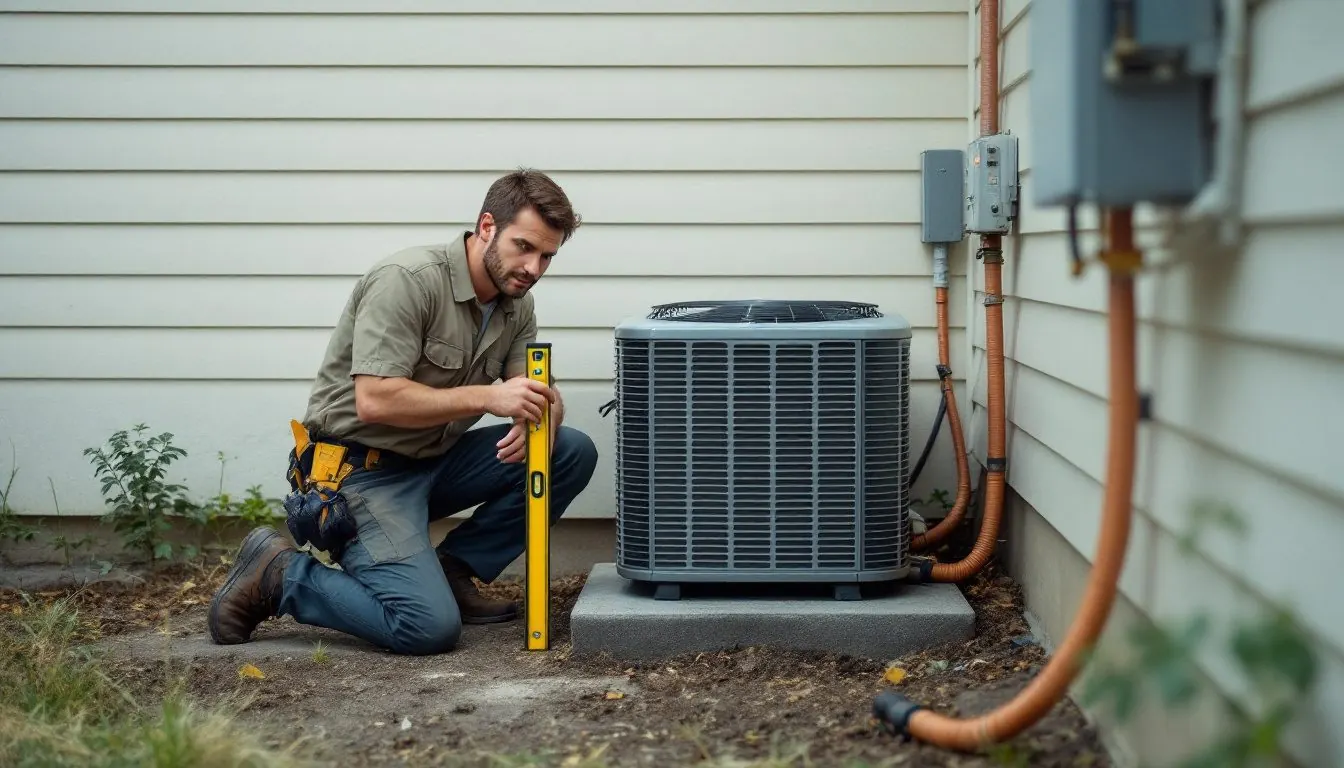
Does outside AC unit need to be level? Yes, close to it, but not perfectly. Carrier’s manual allows ±2° (±3/8 in./ft), Lennox allows a 2 degree slope away from the house and Ducane allows ±1/4 in./ft. Across a 30 in. pad, that is 5/8 to 1 in. of drop.
What tolerance does each maker’s manual actually print?
Five of the eight outdoor-unit brands below print a number, running from ±1/4 in./ft to about 2°. The other three just say “level”. No outdoor-unit manual we opened allows more than 2° for the cabinet that holds the compressor, coil and fan.
| Brand and document | Exact wording | Limit, in./ft | Drop across 30 in. | Reason printed |
|---|---|---|---|---|
| Carrier 25TPA7 (2022); same limit in 38EYA (2001) | “Unit must be level to within ±2°(±3/8 in./ft,±9.5 mm/m.) per compressor manufacturer specifications.” | 3/8 | 15/16 in. | Compressor spec |
| ICP C4A3, H4A3, T4A3 (2017) | “Unit must be level ± 2 degrees [a 3/8 inch rise or fall per foot of run…] or compressor may not function properly.” | 3/8 | 15/16 in. | Compressor function |
| Lennox XP25 (2018) | “Install unit level or, if on a slope, maintain slope tolerance of 2 degrees (or 2 inches per 5 feet…) away from building structure.” | 0.4 | 1 in. | Slope direction only |
| Allied 4SHP16LS (506860-03) | “Slab should have a slope tolerance away from the building of 2° or 2” per 5’.” | 0.4 | 1 in. | Ice during defrost |
| Ducane 4HP14/15 (Issue 1946) | “unit must be level to within ± 1/4 in./ft. per compressor manufacturer specifications” | 1/4 | 5/8 in. | Compressor spec |
| Goodman IOG-4002A (2017) | “the unit must be on a solid, level foundation that will not shift or settle” | None | n/a | Settling, sound |
| Trane TTR, 18-AC41D16-5 | “The unit should be set on a level support pad at least as large as the unit base pan.” | None | n/a | None given |
| Rheem archive 708367 (2004) | “The slab should be level and anchored (if necessary) prior to placing the equipment on the slab.” | None | n/a | Stable foundation |
| Copeland ZR24KRE to ZR190KRE (a compressor, not an outdoor unit) | “the compressor tilt angle during operation should not exceed 15° to allow adequate lubrication” | 3.2 | 8 in. | Lubrication |
Mitsubishi and Daikin have no row: we could not open a US outdoor-unit manual for either, and we will not guess across brands. Your model’s manual outranks this table: ICP’s 2004 Premium Line manual prints the 2 degree limit, while other ICP condenser manuals say only “must be level”.
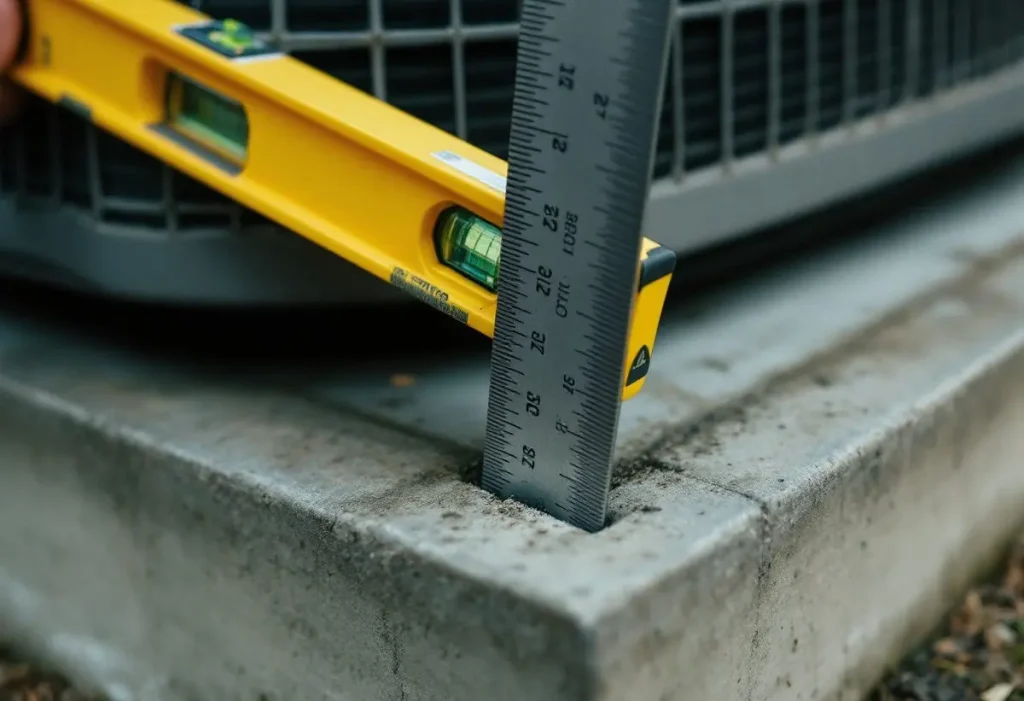
What does 2 degrees look like across a 30 in. pad?
Just over 1 in. of drop: 30 in. x tan 2° = 1.05 in. A true 2° is 0.42 in./ft, so the rounded 3/8 in./ft in the manuals is slightly tighter; measure against it.
Two figures in current search results appear in no maker document we read. One ranking page calls 10 degrees acceptable: 5 5/16 in. across a 30 in. pad, five times Carrier’s limit. Another sets 1/4 in. over 3 ft, 3 times stricter than Ducane.
Does outside AC unit need to be perfectly level?
No, and three heat pump manuals describe a deliberate slope. Lennox and Allied allow 2 degrees away from the building, and Ducane says the “Mounting slab must slope slightly away from building, not to exceed 1/4” per foot.” Allied’s stated purpose: the slope “will prevent ice from building up under the unit during a defrost cycle”.
Direction matters. Carrier’s and ICP’s ±2° run both ways, but the Lennox, Allied and Ducane slope language only runs away from the house, so a pad tipping 1 degree toward your foundation falls outside those allowances.
What actually goes wrong past the limit: oil, ice, lines or noise?
Makers name four failure paths, and only oil concerns the compressor. A unit at 3° is out of spec, but it is not proof of a dying compressor: Copeland’s 15° is nearly 8 times the cabinet limit, though it covers only that ZR*KRE range. ICP’s 2004 manual adds that improper installation “can void the warranty”. Our compressor replacement guide covers confirming real damage.
Oil. ICP warns the “compressor may not function properly” outside ±2 degrees. One top result says settling traps compressor oil, but in the ICP and Ducane manuals “oil return” belongs to line sizing: ICP says “If velocities drop below 1500 fpm (feet per minute), oil return will be decreased.” No outdoor-unit manual we read ties oil return to cabinet tilt.
Ice, heat pumps only. Goodman says heat pump bases “have cutouts under the outdoor coil” and asks for “free unobstructed drainage of the defrost water and ice”. The defrost cycle makes that water. A cooling-only unit makes none; winter ice on one is a question about what the manuals say on covers.
Line stress. ICP’s caution reads: “Inadequate unit support may cause excessive vibration, noise, and/or stress on the refrigerant lines, leading to refrigerant line failure.” Unitary Products warns of “strain on the refrigerant lines and possible leaks”. A sinking pad loads the refrigerant line set where it meets the cabinet.
Noise. Goodman keeps the slab off the house “To reduce the possibility of sound transmission”. A new rattle after a pad shifts belongs on our list of HVAC noises.
How do you check a condenser with a torpedo level?
Set the level on the pad edge or base pan rail, not the top grille, and read two directions at right angles. If the bubble is off center, lift the low end of the level until it centers, then measure the gap with a ruler. No panel comes off.
| Measured over | Ducane, 1/4 in./ft | Carrier, ICP, 3/8 in./ft | Lennox, Allied, 2 in. per 5 ft |
|---|---|---|---|
| 9 in. torpedo level | 3/16 in. | 9/32 in. | 0.3 in. |
| 30 in. pad edge | 5/8 in. | 15/16 in. | 1 in. |
No manual we read says whether its limit is per axis. Both axes at 3/8 in./ft make a true slope of 2.53° by our calculation, so treat that reading as out of tolerance.
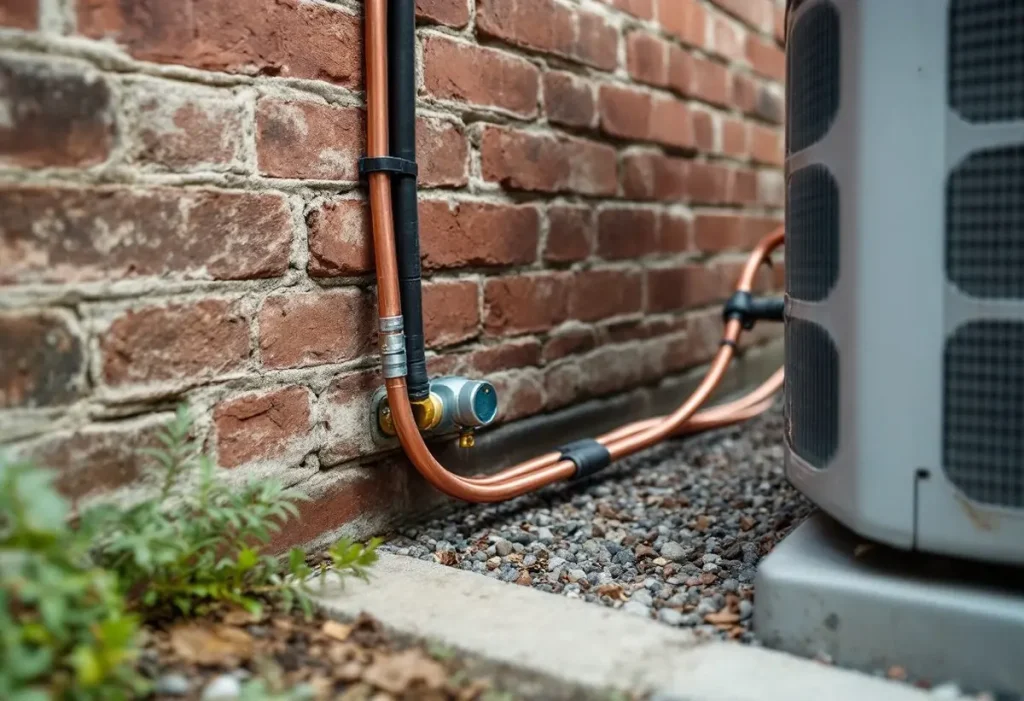
When is a sunk pad worth fixing, and how is it lifted without stressing the line set?
Fix it when the gap exceeds your manual’s limit, a heat pump’s pad tips toward the house, or refrigerant lines look taut. No manual we read prints a pad-lifting procedure, so these limits come from their siting and support text.
- Power off. Goodman: “Disconnect ALL power before servicing.” Pull the AC disconnect and turn off the breaker, because the disconnect’s line side stays live until then.
- Protect the lines. Carrier says “Leave some slack between structure and unit to absorb vibration.” If lifting uses up that slack or bends a tube, stop.
- Use support your maker allows. Manuals conflict: ICP accepts “concrete, bricks, blocks, steel, or pressure-treated timbers”, while Ducane says do not locate the unit “On brick, concrete blocks or unstable surfaces”. Lennox shows threaded 2 in. Schedule 40 feet extenders for adjusting level.
- Keep drains and height. A frame “must not block drain holes in unit base” (Ducane). In severe-weather locations, Goodman suggests 2 1/2 in. of height at +15° design temperature and above, 8 in. from -5° to +14°, and 12 in. below -5°.
Stop and call a technician if a line is kinked, oily at a joint or pulled tight. The technician re-levels, then checks for leaks: Lennox’s procedure pressurizes to 150 psig with nitrogen and uses a leak detector. Carrier’s final check confirms tubes are not “rubbing against each other or any sheet metal”.
Does code require a level pad under an outdoor unit?
In many jurisdictions, yes, without a number. 2021 IMC section 304.10, as adopted in Texas, says equipment at grade “shall be supported on a level concrete slab or other approved material extending not less than 3 inches (76 mm) above adjoining grade”, and that the support “shall be in accordance with the manufacturer’s installation instructions”. That second clause can make a maker’s number enforceable. The IRC’s “level and firmly supported” wording, M1305.1.3.1, sits under underfloor appliances, so the local inspector decides how it applies outdoors. The separate working space rule is in our AC cage article.
Frequently asked questions
Do outside AC units need to be level?
Yes, within a printed tolerance. Carrier’s 25TPA7 manual requires ±2° (±3/8 in./ft), ICP’s 2017 manual uses the same figure, and Ducane’s 4HP14/15 manual requires ± 1/4 in./ft. Goodman, Trane and Rheem manuals require a level pad or foundation but print no number.
Should outside AC unit be level or slope away from the house?
Either, if your manual allows it. Lennox’s XP25 manual says to install the unit level or keep a slope of 2 degrees, or 2 inches per 5 feet, away from the building. Ducane allows slab slope up to 1/4 in. per foot away from the building. Neither describes a slope toward the house.
Do mini split outdoor units need to be level?
Yes, though the ductless documents we read print no tolerance. Hessaire’s H Series manual says “It is important that pad is level and is on a solid surface that won’t sink.” A Department of Energy job aid calls for a non-wicking pad or stand, with the unit “level, plumb, stable”.
How we researched this
In November 2026 we read the documents listed below. We read the top articles for this query but used none as evidence. The Trane guide’s distributor host stopped resolving, so its wording comes from a copy saved on 31 October 2026.
Sources
- Carrier. “25TPA7 Heat Pump Installation Instructions, 25TPA7-1SI, 03/22.” https://www.shareddocs.com/hvac/docs/1009/Public/02/25TPA7-1SI.pdf. Accessed November 2026.
- Carrier. “38EYA Installation Instructions, 38EYA-3SI, 2001 (archived copy).” https://archive.org/download/manualsonline-id-6371e5dc-7d07-46bd-9e20-9d37c2b8b668/6371e5dc-7d07-46bd-9e20-9d37c2b8b668.pdf. Accessed November 2026.
- International Comfort Products. “R-410A Split System Air Conditioner, 421 01 5103 05, 2017.” https://c.searspartsdirect.com/doc/1710213L. Accessed November 2026.
- International Comfort Products. “Premium Line AC Condensers, 421 01 3204 03, 2004.” https://c.searspartsdirect.com/doc/L0522745. Accessed November 2026.
- Lennox Industries. “XP25 Installation Instructions, 507005-01F, 2018.” https://www.lennox.com/dA/3afe37cae1/507005-01f.pdf. Accessed November 2026.
- Allied. “4SHP16LS Series Heat Pump Installation Instructions, 506860-03.” https://inspectapedia.com/heat/Alliued-Air-HEAT-PUMP-Manual-4SHP-Series.pdf. Accessed November 2026.
- Ducane. “4HP14/15 Heat Pump Installation Instructions, Issue 1946.” https://inspectapedia.com/heat/Ducane-4HP14-4HP15-Heat-Pump-Manual.pdf. Accessed November 2026.
- Goodman. “Installation and Service Reference, IOG-4002A, 2017.” https://cdn.shopify.com/s/files/1/0253/0852/8730/files/Goodman_GSZ16_Installation_Manual__1.pdf. Accessed November 2026.
- Trane. “Installer’s Guide, TTR Condensing Units, 18-AC41D16-5.” https://wizard.youngsupply.com/files/51-10747.pdf (host unreachable in November 2026; saved copy read). Accessed October 2026.
- Rheem literature archive. “Outdoor Heat Pump Installation Instructions, 708367, 2004 (document carries no brand name).” https://files.rheem.com/LiteratureArchive/7083670.pdf. Accessed November 2026.
- Unitary Products Group. “Outdoor Split-System Heat Pump, ERHQ Series.” https://c.searspartsdirect.com/mmh/lis_pdf/INSTL/L0612125.pdf. Accessed November 2026.
- Hessaire. “Ductless Mini-Split AC, H Series Installation Instructions.” https://pdf.lowes.com/productdocuments/f3de197b-3177-480c-ae39-235a7f8faf60/73685847.pdf. Accessed November 2026.
- Copeland. “Scroll Compressors for Comfort Applications, ZR24KRE to ZR190KRE, Application Guidelines.” https://media.copeland.com/0cfb235b-7155-4885-b009-b16b0107a750/AGL_AC_ST_ZRKRE_E_Rev02_FULL.pdf. Accessed November 2026.
- U.S. Department of Energy. “Island Grantee Job Aid: Install AC Mini-Split, 2024.” https://www.energy.gov/sites/default/files/2024-10/island-grantee-job-aid-install-ac-mini-split.pdf. Accessed November 2026.
- UpCodes. “2021 IMC (Texas adoption), Chapter 3.” https://up.codes/viewer/texas/imc-2021/chapter/3/general-regulations. Accessed November 2026.
- UpCodes. “2024 IRC (Texas adoption), Chapter 13.” https://up.codes/viewer/texas/irc-2024/chapter/13/general-mechanical-system-requirements. Accessed November 2026.
Leave a Reply