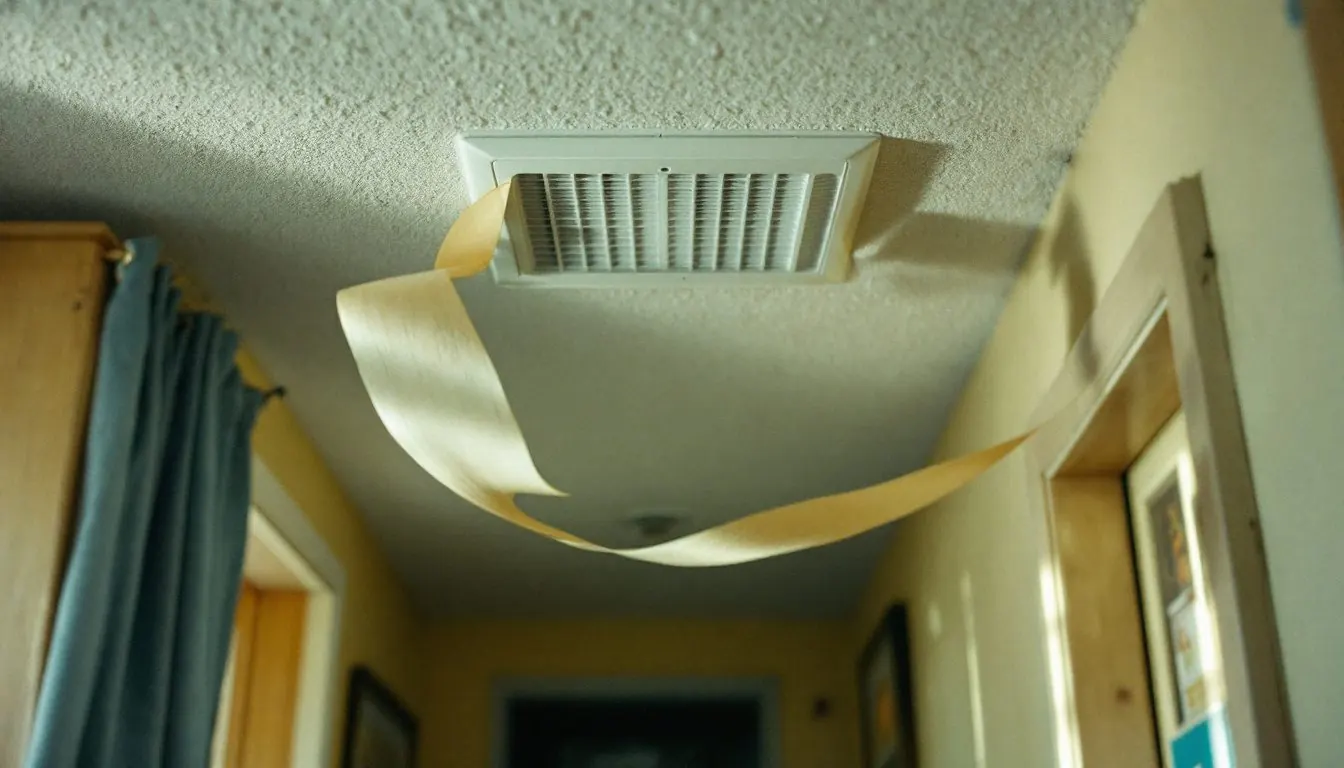
AC won’t turn off? Set the thermostat to OFF with the fan on AUTO and see what keeps running. Indoor fan only: a fan setting or stuck relay. Outside unit still running: a stuck contactor or shorted wire, so open the outdoor disconnect. Nothing at all: the thermostat was calling and never reached its setpoint.
Thermostat on OFF, fan on AUTO: what is still running after 2 minutes?
Only one branch is urgent. Wait 2 minutes first, because Goodman and ICP equipment keep the indoor blower running 45 to 90 seconds after the compressor stops. Then listen at the furnace or air handler and at the outdoor unit.
| What still runs | Thermostat state | Most likely cause | Test that settles it | Document |
|---|---|---|---|---|
| Indoor fan, steady | OFF, fan ON | Fan set to On | Set fan to AUTO | Resideo RTH6360 |
| Indoor fan, stops within 90 seconds | Fan AUTO | Designed cool off delay | None needed | Goodman RS6610004; ICP |
| Indoor fan, never stops | OFF, fan AUTO | Time delay relay, fan relay, or G held on | 24 VAC on G at OFF | ICP |
| Outdoor fan, about 1 minute | Just satisfied, 100°F+ outside | Designed fan run-on | Wait | ICP *SA5, *SA6 |
| Compressor and outdoor fan, blower off | OFF | Contactor stuck closed, or R shorted to Y | Open the disconnect; coil voltage | Trane; ICP code 73 |
| Everything, app shows off | Nest, heat pump | Reverse valve set to seasonal | Set Cyclical | Google Nest |
| Everything, but it stops at OFF | COOL, setpoint not reached | 95°F+ day, low setpoint or lost capacity | Temperature split | 10 CFR 430 App. M; DOE |
Compiled by The HVAC Brief from the documents in the last column, November 2026. ICP rows apply to the series named.
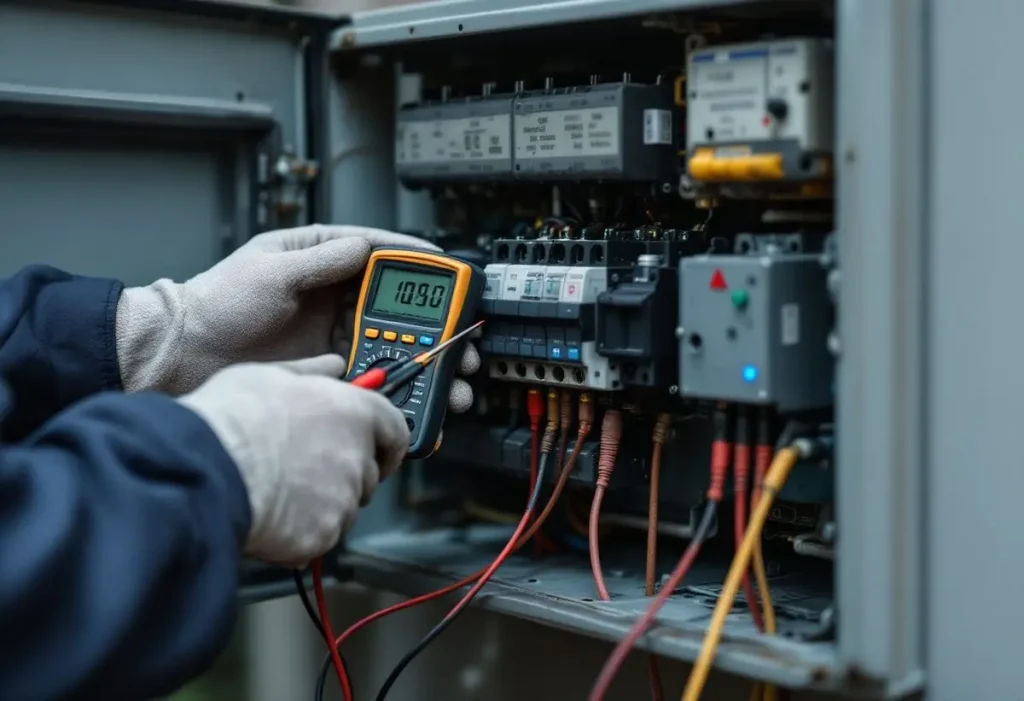
Outside unit still running with the thermostat off: is the contactor stuck closed?
Usually, unless a shorted wire is still sending the cooling call. Trane puts it plainly: “If the compressor contactor becomes welded closed, the AC unit will continue running with constant power.” Arcing is how a contactor pits and welds shut.
Open the outdoor disconnect or AC breaker now. At OFF the blower has no call, so the compressor keeps chilling an indoor coil with no air across it, the same risk as an outside unit running while the inside fan is not. The handle cuts power to the unit, not to the incoming terminals, which is why the live side of an AC disconnect stays off limits.
In the 2017 International Comfort Products service manual, the control on the single stage *SA5 and *SA6 and two stage *CA7 and *CA9 air conditioners flashes amber code 73, Contactor Shorted, for “Compressor voltage sensed when no demand for compressor operation exists,” adding: “Contactor may be stuck closed or there is a wiring error.” If the unit has a status light, count the flashes, then cut power.
Do not tap or brush the contacts, a fix one top-ranking article offers. Goodman’s S-8 contact test in service manual RS6200006 is done with power on and a voltmeter across L2 and T1, under the warning “Line Voltage now present.”
Could a shorted thermostat wire be holding the cooling call on at OFF?
Yes. In Goodman’s RS6200006, cooling is the thermostat closing R to Y1 and G; when satisfied “it opens its contacts, breaking the low voltage circuit, causing the compressor contactor and indoor fan relay to open, shutting down the system.” A nicked or crushed cable that bridges R to Y keeps the contactor pulled in at OFF.
Goodman’s S-3A test in furnace service instructions RS6610004 runs that logic forward: wires off the board, R jumpered to Y and G, and “If the furnace blower motor starts and the condensing unit runs, then the trouble is in the thermostat or wiring.” Reversed (our inference, not a Goodman step): wires off and the outdoor unit still running leaves the contactor or outdoor cable; if it stops, the thermostat or its cable was the cause. Terminal letters are in our thermostat wiring chart.
On a Nest with a heat pump, Google says: “If your system continues to run, even if the Google Home app says the system is off, your reverse valve activation is likely set to seasonal instead of cyclical.” And a Nest set to Off can still start cooling to hold its Safety Temperatures.
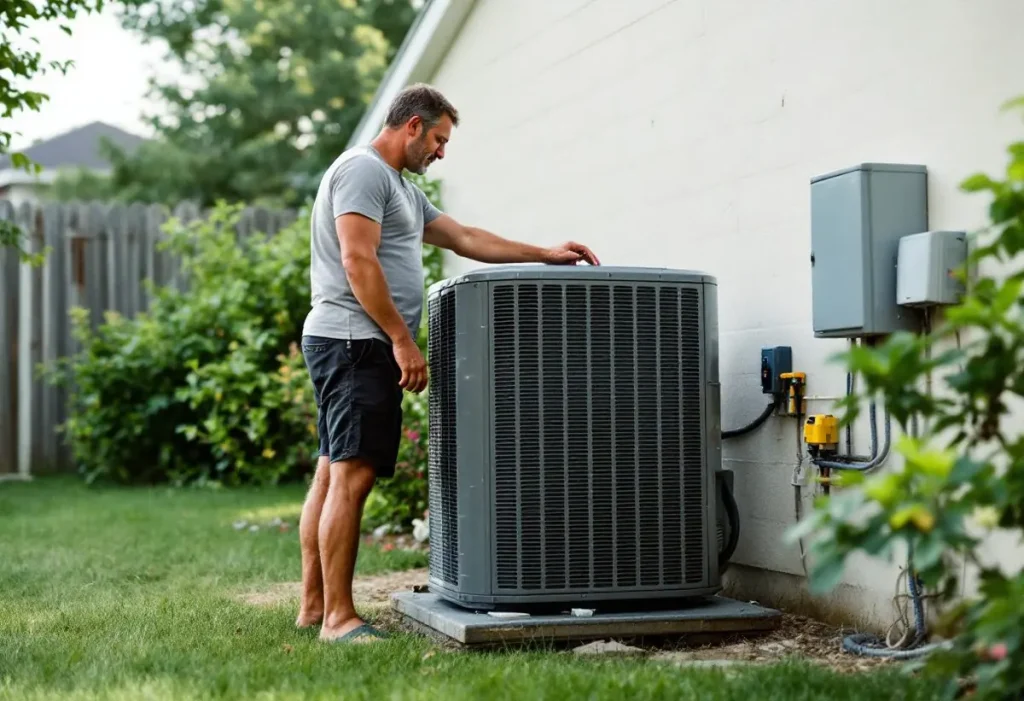
Indoor fan won’t turn off: is it fan ON, a 45 to 90 second delay, or a stuck relay?
Check the fan setting first. Resideo’s RTH6360 guide defines Off as “Heating and cooling system is off. Fan will still operate if fan is set to On,” and Goodman’s RS6200006 says that with the fan selector on, the blower would run continuously rather than cycling with the compressor. The running cost is worked out in fan ON vs AUTO.
On AUTO, a short run-on is designed in. Goodman’s RS6610004 lists “a fixed forty five second cool off delay” on its single stage and two stage 80% and 90% furnaces, while its variable speed models take the delay from a ramping profile. ICP’s time delay relay keeps the blower running for 90 sec after the thermostat is satisfied, and ICP adds: “If the blower runs continuously instead of cycling off when the fan switch is set to AUTO, the TDR is probably defective and must be replaced.” On a furnace board, 24 VAC from G to C at OFF blames the thermostat or cable, not the relay.
Running nonstop in COOL but stops at OFF: is the AC broken or outmatched by a 95°F day?
If everything stops at OFF, nothing is stuck. DOE’s full-load cooling A test in 10 CFR 430 Appendix M, Table 5, runs with 80°F air entering the indoor unit and 95°F entering the outdoor unit, so near that temperature long runs are normal. City design numbers and a one-evening test are in why a house won’t cool below 75.
Two things stretch runs without a fault. DOE’s Energy Saver (archived copy) says a colder than normal setting “will not cool your home any faster.” And Carrier writes of variable speed systems: “Because they are operating for longer periods of time, they can remove more moisture from the air.” Trane’s yardstick is a cycle of “approximately 20 to 30 minutes” and “two to three cycles each hour,” figures that only fit together at the short end.
| Cycles per hour (Trane) | Minutes per cycle (Trane) | Run minutes per hour | Share of the hour | What it leaves |
|---|---|---|---|---|
| 2 | 20 | 40 | 67% | 20 minutes off per hour |
| 2 | 30 | 60 | 100% | no off time at all |
| 3 | 20 | 60 | 100% | no off time at all |
| 3 | 30 | 90 | 150% | does not fit in an hour |
HVAC Brief calculation: cycles per hour × minutes per cycle, both from Trane’s AC won’t turn off page, November 2026.
So 40 run minutes an hour is a rough mild-day picture, not a test. A single speed AC that runs far longer in mild weather while the house creeps warmer needs a temperature split reading; Trane names dirty filters, dirty evaporator coils and an undersized unit.
AC keeps turning on and off instead: is a 5 minute timer behind it?
Sometimes. ICP’s *SA5 and *SA6 controls apply a “Five minute time delay to start cooling operation” on each call, and Resideo notes that Cool On may flash for 5 minutes for compressor protection, so a pause before each start is normal. Starts that end within minutes are short cycling, covered in AC short cycling.
Where should a homeowner stop, and which readings should the technician report?
Stop at the thermostat, the AC breaker and the disconnect handle; past them is line voltage. Ask for these readings, which separate a contactor swap from a thermostat or cable repair:
- Contactor coil voltage at OFF: should be 0 VAC.
- With the coil dead, are the contacts still closed? Then the contactor is replaced.
- Does the outdoor unit stop with the thermostat wires off the indoor board?
- Any outdoor flash code, such as ICP code 73.
The proof of a repair is a clean shutdown at OFF within the 45 to 90 second delays. If the outdoor unit ran for hours with the blower stopped, have the coil checked for ice first, as in the inside fan guide.
Frequently asked questions
Why does my AC condenser fan turn on then off?
Often by design. ICP’s single stage *SA5 and *SA6 controls run the outdoor fan for one minute after the compressor stops when it is 100°F or hotter outside, and keep it energized for 15 minutes if a pressure switch or the compressor thermal protector opens.
Why does my AC turn on and then shut off right away?
On ICP two stage *CA7 and *CA9 units, compressor voltage that disappears for 10 consecutive seconds during a call is logged as a thermal cutout; the control keeps the fan running and retries after 15 minutes, and three trips in a row lock the unit out for 4 hours.
Is it bad if the AC unit keeps running all day?
Not on its own. DOE’s full-load cooling test for central air conditioners uses 95°F air entering the outdoor unit, so long runs on afternoons near that temperature are expected. It is a problem when the unit keeps running after you select OFF, or runs all day in mild weather while the house drifts warmer.
Can a Nest thermostat turn the AC on when it is set to Off?
Yes. Google says Off mode disables regular schedules, but the thermostat will still use its Safety Temperatures during extreme heat or cold and start cooling automatically in those cases. Check that setting before suspecting the wiring.
How we researched this
Researched 6 November 2026. We read Trane’s troubleshooting page, Goodman manuals RS6200006r85 (condensing units, 2017) and RS6610004 Rev. 9 (gas furnaces), the 2017 ICP split system service manual, Resideo 33-00201EF, Google Nest help, Carrier’s variable speed page, 10 CFR 430 Appendix M and DOE Energy Saver. Timings and codes are given only for the series each document covers. We excluded Goodman’s analysis chart (its text extraction loses the dot columns) and took no numbers from contractor, lead-gen or affiliate pages.
Sources
- Trane. “AC Won’t Turn Off? Find Out Why and What to Do.” https://www.trane.com/residential/en/resources/troubleshooting/air-conditioners/ac-wont-turn-off/. Accessed November 2026.
- International Comfort Products. “Application Guideline & Service Manual, R-410A & R-22 Split System AC & HP (2017).” https://resource.gemaire.com/is/content/Watscocom/Gemaire/icp_nxa6_sm.pdf?fmt=pdf. Accessed November 2026.
- Goodman Manufacturing. “Service Instructions, ANX, SSX, ASX, GSX, DSX Condensing Units and Split System Heat Pumps with R-410A, RS6200006r85.” https://daikincomfort.com/docs/default-source/aspt/130000.pdf. Accessed November 2026.
- Goodman Manufacturing. “Service Instructions, 80%, 90%, 95% Gas Furnaces, RS6610004 Rev. 9.” https://s3.amazonaws.com/s3.supplyhouse.com/product_files/Goodman-GMS951155DXA-Install-Instructions.pdf. Accessed November 2026.
- Resideo. “RTH6360 Series Programmable Thermostat guide, 33-00201EF.” https://digitalassets.resideo.com/damroot/Original/10015/33-00201EF.pdf. Accessed November 2026.
- Google. “Nest thermostat Off mode.” https://support.google.com/googlenest/answer/9251570?hl=en. Accessed November 2026.
- Google. “Troubleshoot when heating and cooling won’t turn off.” https://support.google.com/googlehome/answer/15834911?hl=en. Accessed November 2026.
- Carrier. “Four benefits of variable speed technology.” https://www.carrier.com/residential/en/ca/homeowner-resources/hvac-basics/four_benefits_of_variable_speed_technology.html. Accessed November 2026.
- eCFR. “10 CFR Part 430, Subpart B, Appendix M, Table 5.” https://www.ecfr.gov/current/title-10/chapter-II/subchapter-D/part-430/subpart-B/appendix-Appendix%20M%20to%20Subpart%20B%20of%20Part%20430. Accessed November 2026.
- U.S. Department of Energy. “Energy Saver: Thermostats (archived copy).” https://web.archive.org/web/2025id_/https://www.energy.gov/energysaver/thermostats. Accessed November 2026.
Leave a Reply